
Category Archives: Radio history

1940 Pointers on Learning Morse Code

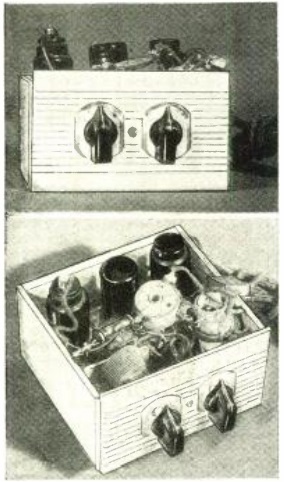
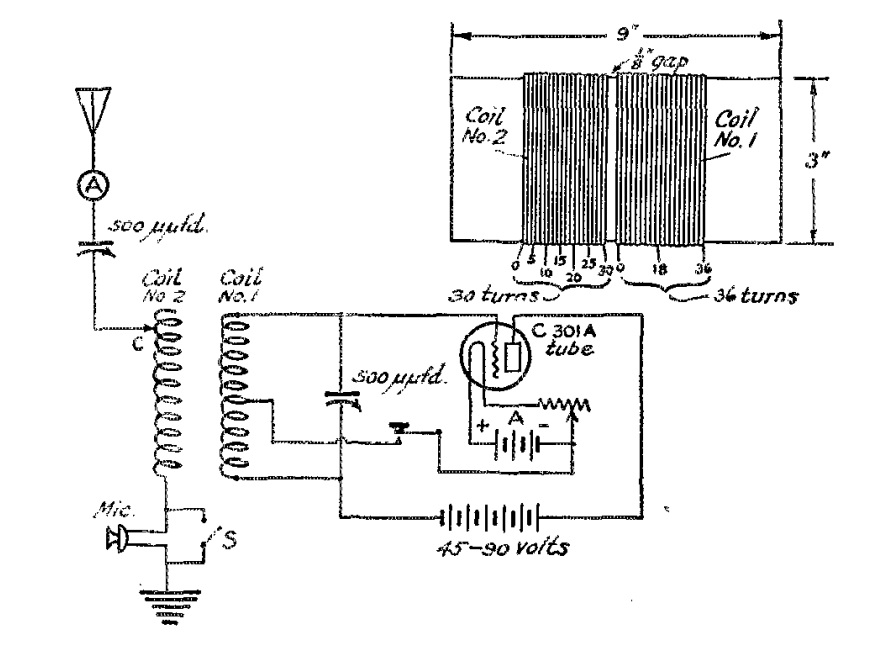
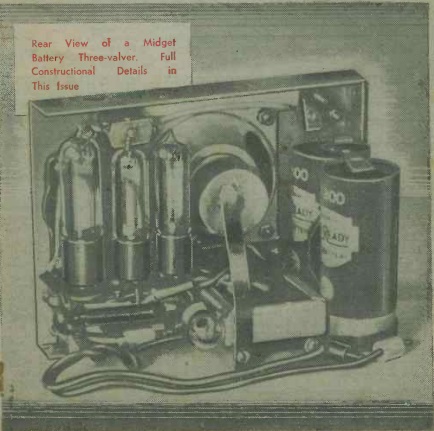
Eighty-five years ago this month, the British magazine Practical Mechanics offered some pointers on how to master the Morse Code, including the simple code oscillator shown here. The article included one idea that I’ve never seen before. It mentioned that code records, in addition to providing receiving practice, could be a source of sending practice as well. This was accomplished by having the text being sent, and then sending it in unison with the record.


1940 RCA Radio Lineup

Eighty-five years ago, this ad in the October 21, 1940, issue of Life magazine reminded readers that every member of the family deserved to be able to listen to their own radio programs. That meant getting an extra radio, but one with extra quality from RCA Victor.

The least expensive model was the five-tube model 45X1 “Little Nipper” for only $9.95.


1945: Hams Coming Back in Droves

This illustration appeared 80 years ago this month, in the ad from Hytron Radio and Electronics Corp., in the October 1945 issue of Radio Service Dealer.

The ad pointed out that the 2-1/2 meter band had just reopened to hams, and dealers were probably already seeing the impact of hams coming in to buy. They pointed out that demand was sure to grow. Before the war there were 60,000 hams, but QST estimated that would grow to 250,000 within five years.

That meant that dealers should stock Hytron tubes, which had been advertised in QST. And as new tubes were announced, especially for VHF and UHF, dealers should add them to their stock.


Panasonic RF-8800 Portable, 1975

Fifty years ago, this discerning radio listener is showing off her new portable, the Panasonic RF-8000. The set hand a handle, meaning that it was portable, but it weighed in at 46 pounds, so the portability was somewhat limited. But it tuned 24 bands, including longwave, most of the shortwave spectrum, and continuous tuning from 30-230 MHz. It included a BFO for tuning CW and SSB transmissions. And, of course, it covered the standard AM and FM bands. It had three antennas, a clock, and a motorized tuning dial.

According to the October 1975 issue of Popular Mechanics, where this picture appeared, it retailed for a mere $2500.


1925: Making Faces for Beauty and Wiring Hospital for Radio

OneTubeRadio.com is a full-service blog. While we endeavor to bring radio history to life, we’re also on the lookout for other helpful information, and today, we offer a beauty tip that’s in danger of being lost to the ages.

One hundred years ago today, the October 15, 1925, issue of the San Antonio Light newspaper carried this helpful hint for young women to stay beautiful. According to unnamed beauty experts, “making faces will keep girls young and sweet.” The technique is demonstrated by Kathrin Hatch.

But Miss Hatch probably kept beautiful by also listening to the radio, and this same issue of the paper showed that one could regain health with the radio. According to Major John W. Sherwood of Fort Sam Houston, the base hospital was to be wired for radio. 800 headphones were to be placed in hospital rooms, and loudspeakers would be placed in recreation rooms. More than five miles of wire would be used, and the installation would take about two weeks.


1925 Wearable Crystal Set

The gentleman shown at left, pictured in the October 1925 issue of the magazine The Experimenter, is, according to the article, what the well-dressed radio man would be wearing in the near future. He is equipped with a self-contained receiver, capable of pulling in stations within 10 miles.

It’s a crystal set, and the loop antenna means that you don’t have to worry about an antenna or ground connection. You can move about freely listening to your favorite program.


1945 One Tube Portable

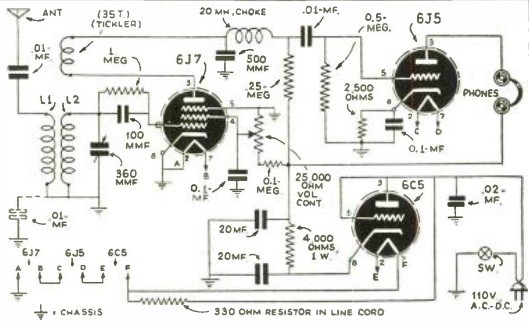
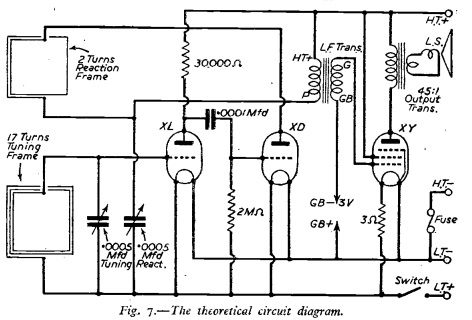
Eighty years ago, the October 1945 issue of Radio Craft showed this circuit for a simple one-tube portable receiver. Almost any tube could be used, including the 1S5, 1A5-G and 1N5-G. It had been sent in to the magazine by one Harold J. Shaffer of San Francisco, who noted that the regenerative circuit, while unconventional, proved to be unusually stable. For that reason, the set could be carried around and provided pleasant headphone reception for local stations.

L1 was a spiderweb loop, and Shaffer intentionally made the set large so that it could have a large loop. The other two coils were wound on a one-inch tube. The A battery was a flashlight cell, and while this circuit used 45 volts, the B battery could be as low as 15 volts.


Eveready 412 “Mini-Max” 22.5 Volt Battery

Eighty years ago, Eveready introduced the “Mini-Max” B battery, model number 412. The 22-1/2 volt battery measured only 2 x 1-1/32 x 5/8 inches, and weighed only 1-1/2 ounces. It was about the same size as the still-in-production 9 volt battery, although rather than having both terminals on one end, the 412 had positive on one end and negative on the other.

It was originally intended for use as the B battery in tube portable radios, but it was also used in instruments, and even in some early transistor radios, such as the Regency TR-1. The carbon-zinc battery remained in production through at least the 1980s.

If you’re looking for a modern replacement, a replacement using alkaline cells is available on Amazon.  The ad above appeared in the October 1945 issue of Radio Service Dealer.


1945 Postwar Radios

Eighty years ago, the war had been won, and a lot of people were happy about it. And that included these two on the cover of Radio Retailing, October 1945. The woman on the right was happy because she was able to buy a new radio, for the first time since 1942. And the gentleman on the left was even happier, because he was a radio dealer, and was able to once again make it a Radio Christmas.


1940 Three-Tube Loudspeaker Set

Eighty-five years ago, this gentleman is pulling in a program with a receiver he built for only $4.06, following the plans in the October 1940 issue of Popular Science.

The three-tube circuit was simplicity itself. It was an AC-DC set that used a 25Z5 rectifier, 6C6 regenerative detector, and 43 AF amplifier. It could provide loudspeaker volume on the broadcast band.

The chassis was an aluminum cake pan, which had the added advantage of being easy to work with. If no drill or punch were available, it could be cut with an ordinary pair of scissors. It was housed in a metal cabinet found in the home scrap pile.  The coils were honeycomb-style and were easy to wind. A 25 foot antenna was called for.