Category Archives: Radio history

1919 Portable Crystal Set

1919SeptRadioAmateurNews1919SeptRadioAmateurNews2A hundred years ago this month, the September 1919 issue of Radio Amateur News carried this “pocket size” (for large pockets, presumably) crystal set. According to the author, the set was, from Illinois with a 140 foot antenna, able to pull in NAA Arlington, NAR Key West, as well as a large number of ships off the Atlantic coast. Tuning was accomplished through taps on both the primary and secondary coils, and could tune to a maximum wavelength of 3500 meters (86 kHz).

The radio was mounted in a leather-covered carrying case for a No. 2 Folding Brownie Camera.  It was set so that one side could be opened completely, allowing access to controls. The detector was a galena crystal, and the set contained a test buzzer for use in finding the “sweet spot” on the crystal. A fixed capacitor was made of two 2×6 inch sheets of tinfoil, separated by wax paper and folded.


Science Fair Project: Hot Wire Ammeter

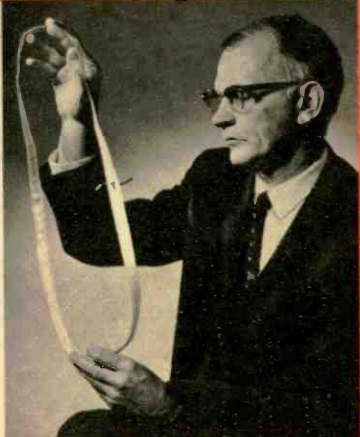
1969AugSepRadioTVExpThe young scientist looking for an award-winning science fair project can’t go wrong with this ammeter from the August-September 1969 issue of Radio-TV Experimenter.

The instrument can be constructed with materials from the hardware store, but will do accurate measurements of current, whether it is DC, AC, or even RF. It is a hot-wire ammeter, and was frequently used in the early days of radio for measuring RF current in order to calculate power. As the name implies, the current is measured by the expansion and contraction of a steel wire. As the current flows, the wire heats up. It is attached to a spring-loaded second wire, and that wire moves a pointer. A standard ammeter can be used to calibrate the device once constructed. In the photo here, the meter is shown measuring current from a dry cell battery (and a modern alkaline D cell will work just as well as the old-fashioned battery, especially when used with a battery holder). However, the instrument can also be used to measure AC current, and can be used as part of an experiment measuring current consumption of various kinds of light bulbs.


1969 Greeting Card Radio

1969SeptEICoverFifty years ago, the September 1969 issue of Electronics Illustrated showed how to put together this greeting card radio. The chasis was a 6×9 inch greeting card. On the left side is a homemade circuit board consisting of aluminum foil attached to cardboard with rubber cement. The top half of the circuit board is also the stator of the variable capacitor, with the rotor being another piece of foil cemented to cardboard. The crystal earphone was permanently attached, presumably meaning that extra postage was required.

If the idea looks familiar, it’s because we’ve featured similar ideas in the past, such as this 1947 one-tube set or this 1940 postcard radio.  If you’re looking for parts, see our crystal set parts page.

1969SepEI2


160 Meters in 1949

1949SepRadioElecThe 160 Meter band was reopened to use by Amateur Radio Operators in 1949, but the band was also used for the LORAN radio navigation system. That system allowed ships to plot their location quite accurately. It relied on shore stations that transmitted synchronized signals. The time difference between the two signals placed the ship on a given line, and by noting the intersection of two such lines, the location could be determined.

Because the band was shared, hams were limited in both frequency and power to protect the LORAN signals. The map shown above showed the initial restrictions in 1949, and appeared in the September 1949 issue of Radio Electronics.

Essentially, each state and territory was assigned two 25 kHz segments with specified day and night power levels. The Gulf Coast states were allowed 200 watts power during the day, but this segment of the country was not allowed on the air at all after local sunset.

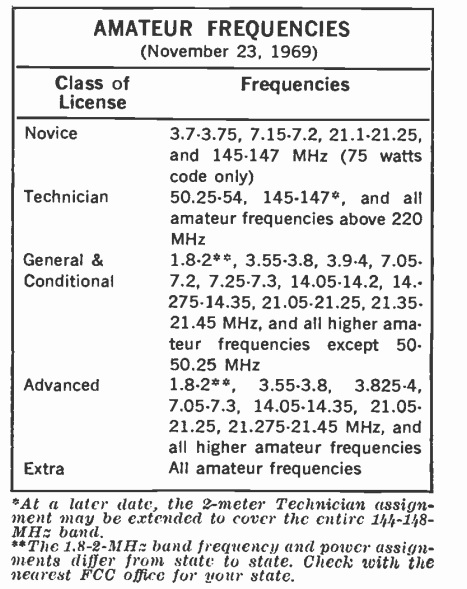
By the mid-1970s when I got on the air, the restrictions had been relaxed considerably, and the band was quite good for regional contacts at night. While ‘phone operation was allowed, almost all of the activity I remember was CW. The restrictions as of 1975 are shown here, from the 1975 edition of the ARRL License Manual:

1975LicenseManual


1939 Philco Radios

1939Sep13MilJour

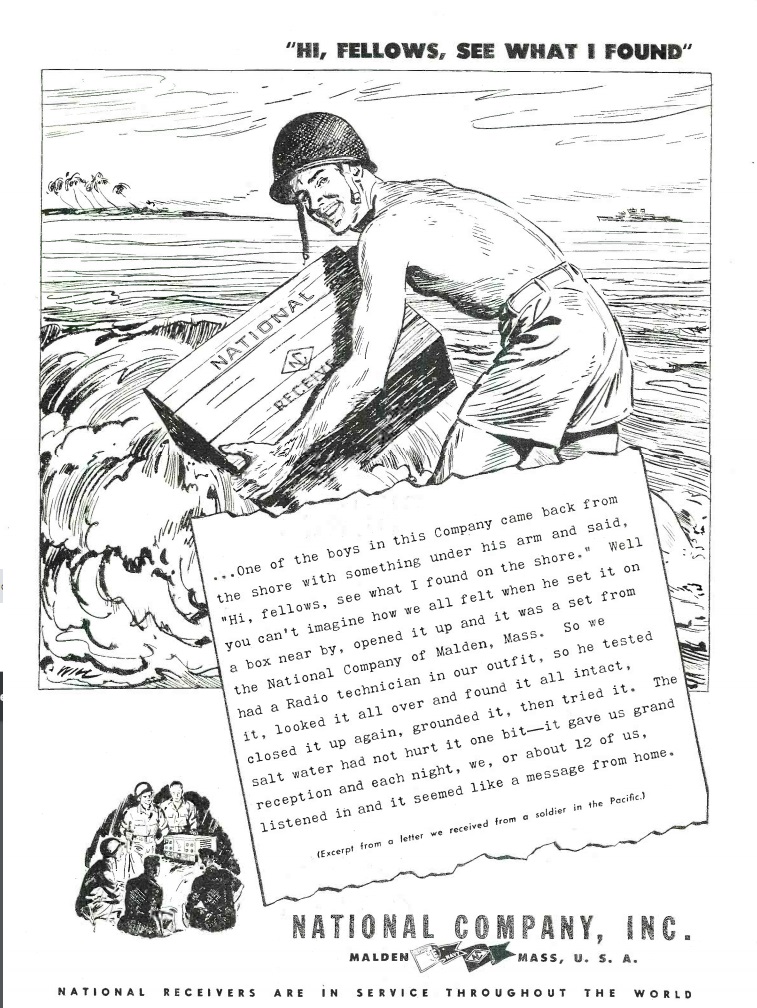
This ad showing Philco’s line of radios appeared 80 years ago today in the September 13, 1939, issue of the Milwaukee Journal. From most browsers, you can view a full size copy by clicking twice on the image.


Women’s Royal Canadian Naval Service

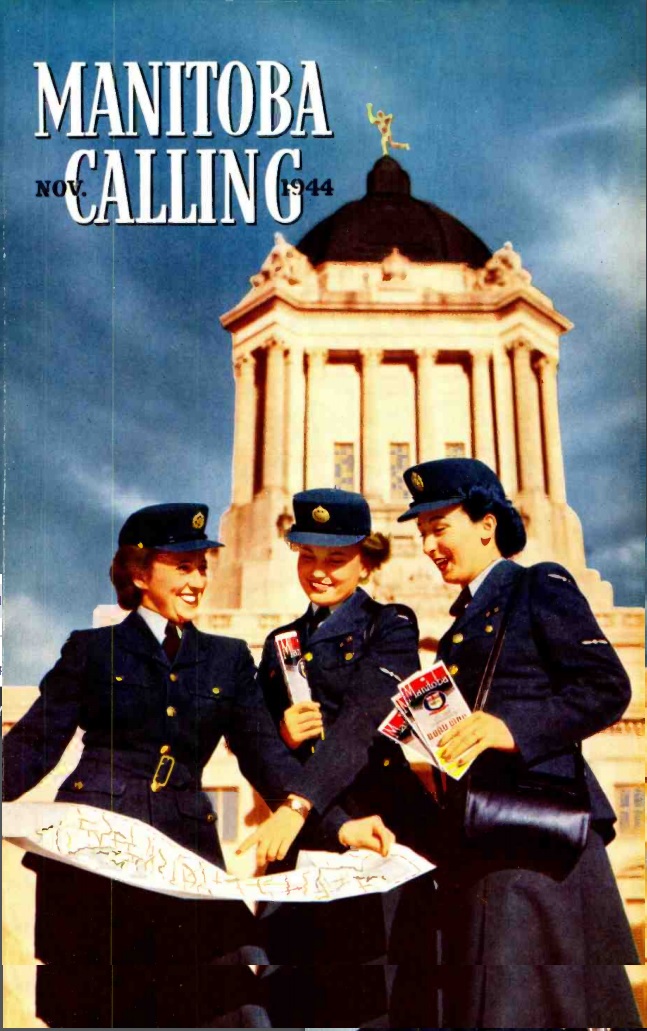
1944SepManitobaCallingShown here, in the September 1944 issue of Manitoba Calling, the program guide of CKY Winnipeg, are two “Wrens” of the Women’s Royal Canadian Naval Service. Stationed atop the signal tower over Halifax harbor, these women did the job of Naval signalmen in visual signal work. They flashed and received messages to and from ships and relayed them to the Navy shore offices. The magazine noted that the tools of their trade were projection lamps, signal flags, binoculars, telescopes, telephone, and radio telephones.

The magazine noted that while nothing could compensate for the horror and destruction of war, there were some good results. One of those was the fact that women had been given the opportunity to serve Canada in a variety of jobs with few openings in peace time.

For another look at visual signalling methods, see our earlier post.


1934 HCJB QSL

1934HCJBqsl

Clarence Jones. Call of the Andes blog.

Clarence Jones. Call of the Andes blog.

We’ve previously shared the history of HCJB,

the missionary radio station in Quito, Ecuador. We noted that the station had its real start as a force on the shortwave bands in 1940, when it signed on with its new 10 kW transmitter. But as we noted, the staton really started in 1931 by American missionary Clarence W. Jones with a 200 watt transmitter in his own residence to a wire antenna.


1934JBLHindsThis early QSL card from the station confirms reception of a program on February 7, 1934. The card notes that the station was then on 73 meters running 150 watts. The card bears Jones’ signature, and the illustration suggests that the station was still in his residence and using a wire antenna. The card was addressed to J.B.L. Hinds of New York, shown in the illustration at left. He presumably pulled in the 150 watt signal with the set shown here. Hinds was the editor of the “Foreign Station Department” of Short Wave Radio magazine, and the card and this illustration appeared in the magazine’s September 1934 issue.

The listing of shortwave stations in the same magazine lists HCJB at 73.0 meters, 4.11 MHz.


1944 Meterless VTVM

1944SepServiceDuring the war, meter movements were extremely hard to come by, but a radio serviceman in need of an accurate measuring device could probably scrounge up a magic eye tube. This circuit on the cover of the September 1944 issue of Service magazine showed how to construct a very accurate vacuum tube voltmeter (VTVM) that didn’t actually require a meter. The switch was used to set the range, which could vary from 0-0.5 volts to 0-500 volts. Then, the 770 ohm potentiometer was adjusted to the point where the magic eye tube closed. The potentiometer was calibrated with the voltage, and the reading was obtained from that scale.

The magazine noted that the instrument was particularly good for tracking down transient or intermittent voltages that might not be seen because of the inertia of a standard meter movement. It noted that the instrument’s function was similar in many respects to an oscilloscope.


1919 Florida Keys Hurricane

This week marks the 100th anniversary of the 1919 Florida Keys Hurricane, which also had a major impact in Louisiana and Texas, in addition to the Caribbean. On September 7, 1919, the storm strengthened to hurricane intensity over the Bahamas, and continued to grow as it zeroed in on Key West. It ultimately strengthened to category 4 before making landfall at Dry Tortugas. The storm was the second strongest since 1851, and the ninth deadliest in U.S. history, with 772 fatalities.

Outside of the Keys, the state of Florida was relatively unscathed, although communications south of Miami was cut off. After the storm crossed into the Gulf, there was a false rumor that it had turned toward Louisiana. This caused warnings to be taken down for Corpus Christi, Texas, the day before landfall. Although the warning was re-instituted, the city was unprepared for the storm surge as high as 16 feet.

Among the dead were 310 in Texas, as well as 488 persons aboard a steamer found sunk between Key West and the Dry Tortugas. One of the survivors of the storm was a six year old Robert Simpson, who did have one family member perish in the storm. He went on to become a meteorologist and along with Herbert Saffir devised the Saffir-Simpson Hurricane Scale.

1919DecQSTAmateur Radio was still off the air, since restrictions on transmitting were not removed until October 1, 1919. Receiving, however, had been allowed since April 15, and Houston amateur radio operator Clifford W. Vick became a bit of a celebrity in his hometown by copying radio traffic related to the storm and passing these dispatches on to the local newspapers. The clipping at left appeared in QST in December 19, and notes that Vick made the point to the Houston papers that he could have done more good if the transmitting restrictions had been lifted.

Corpus Christi after the storm. Wikipedia photo.


The Holy Grail: Loudspeaker Volume with No External Antenna

1959Sep59

Sixty years ago this month, the September 1959 issue of Popular Electronics carried the plans for this three-transistor pocket transistor receiver with built-in antenna and speaker. It also pointed out the Holy Grail for the experimenter, and there’s more than a little bit of truth:

It is every hobbyist’s ambition one day to achieve loudspeaker operation using a single transistor and no external antenna.

The article noted that such a day was not here yet, but this three-transistor model was getting close. The internal loopstick antenna went to one stage of regenerative RF amplification, a diode served as detector, and two transistors provided loudspeaker volume.