Category Archives: Radio history

1949 Admiral 30F15

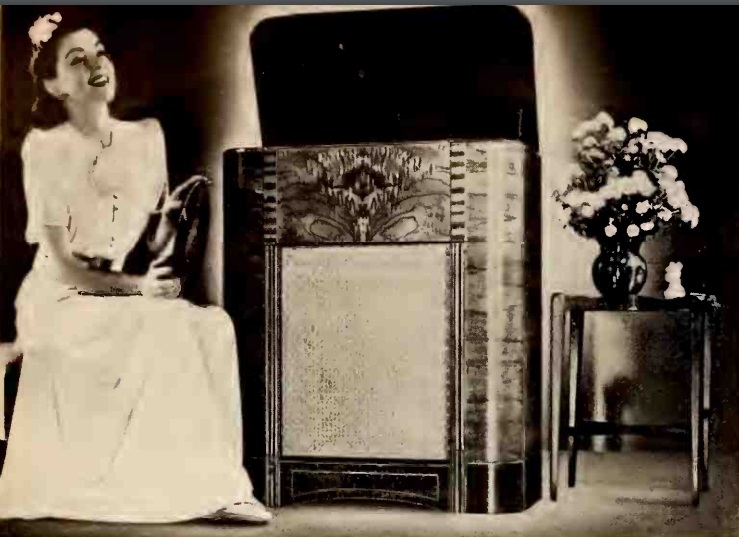
1949OctRadioRetailSeventy years ago this month, the October 1949 issue of Radio & Television Retailing carried this ad for a top of the line Admiral console, the model 30F15.  The ad noted that Admiral had a 50% market share when it came to television combinations.  This one combined an AM-FM receiver, record player, and 12-1/2 inch TV.

You can see a specimen of the set at this link, although at some point someone decided that it needed a coat of blue paint.


Wiring the Iowa State Capitol For Sound: 1939

1939OctRadioNews2For the first 93 years of statehood, the Iowa Legislature managed to carry on the people’s business without resort to electronic sound amplification. Back then, politicians presumably understood that to be successful, they needed to learn how to project their voice. But in 1939, they decided to solicit bids for an audio amplifier for the House chambers. The low bidder was Lloyd Moore of Moore’s Radio Shop, Chariton, Iowa, and he recounted his experiences with the project in the October 1939 issue of Radio News.

The first step in successfully completing the project was the preparation of a viable bid. To do this, Moore met with members of the legislative committee tasked with overseeing the project. The committee was made of of non-technical men, none of whom had any experience with sound work. A few had used a studio mike, but they were unfamiliar with the problems of having the speakers and microphone in the same room. After Moore’s patient explanation, they readily understood the feedback problem. It was explained that they would need to talk within about eight inches of the mike and use a good voice.

The sealed bid was submitted, with an adequate cushion to allow for the best equipment and a reasonable amount for the labor involved. Moore’s bid was chosen, and he set to work.

Act appropriating payment. Google books.

Act appropriating payment. Google books.

1939OctRadioNewsThe amplifier was over engineered. The power transformer was three times as large as necessary. Four stages of amplification were used. Gain was not excessive, so as to avoid any problems with microphonics. Five inputs were used, each switchable from the main console. One mike was mounted at the Speaker’s desk and one at the clerk’s. Three additional microphones were located in front of the floor, with cords long enough to extend to any speaker’s desk. Future plans called for additional microphones throughout the chamber, with a switch box used in place of the three existing mikes.

The amplifier was placed near the clerk’s desk, giving the Clerk the ability to turn microphones on and off and set the levels. They were particularly lucky that one of the clerk’s staff was “a girl, who had been an operator in a broadcasting station,” and her skill proved invaluable.

The author was honored to address the body in the use of the new system, particularly with regard to what to do in the case of feedback, and noted that this was probably the only time he would address such a distinguished body.

The legislator shown above at the microphone is Leo Hoegh, who was elected in 1936. He resigned in 1942 when called up for duty in the National Guard. He rose to the rank of Lieutenant Colonel and served in Europe. After the war, he returned to Iowa where he served as Attorney General from 1953-55 and Governor from 1955-57.

In 1957, President Eisenhower named him the head of U.S. Civil Defense and a member of the National Security Council. He was in the backyard bomb-shelter business for a time, before returning to the practice of law. He retired in 1985 and died in 2000.


Polish One Transistor Receiver, 1979

1979PolishCrystalSet1This unusual design for a one-transistor receiver came from Poland 40 years ago. Perhaps it was used to pull in reports from Radio Free Europe in anticipation of the rise of Solidarity.

It appears in the October 1979 issue of the Polish magazine Horyzonty Techniki dla Dzieci (Horizons of technology for children), which was published in the Soviet Union with the Russian title Горизонты техники для детей.  No schematic is given, but the general idea is clear from the pictorial diagram shown above.  (The mice are presumably optional.)  The small red component is a solid-state diode, the output of which is amplified by the transistor.  The blue component underneath appears to be the battery.  One side of the battery goes to a terminal of the transistor (probably the emitter), and the other battery terminal connects to the headphone, which is also connected to another terminal of the battery (probably the collector).  The polarity of the battery would depend on whether it’s an NPN or a PNP transistor.

The most unusual feature of this set is the tuning.  Two honeycomb coils are wound on flat forms.  They are then connected similarly to a variometer.  More detail can be seen in the illustration below.  The coil forms appear to be cardboard and popsicle sticks.  The set is tuned by adjusting the mutual inductance by varying the angle.

1979PolishCrystalSet2

One interesting feature of this magazine was a listing of addresses of children in Poland who desired Soviet penpals.  A copy of that page is shown below.  The names are shown in Cyrillic, followed by the full name and address in the Roman alphabet.  This is followed by a few lines in Russian with the child’s age and a short description.

1979PolishCrystalSet3


Hitchhiking with a Portable Radio, 1939

Screen Shot 2019-10-10 at 11.39.09 AMEighty years ago today, the October 1939 issue of Life magazine detailed the adventures of 21 year old hitchhiker Will Parker of San Francisco, who thumbed his way to New York thanks to the 29 motorists who stopped to give him a lift. He was accompanied by his friend and amateur photographer Hart Preston who got the pictures of the trip for Life.

As you can see from the photo above (and from several other photos where it was visible), Parker brought with him a portable radio, which the magazine attributed as being one of the secrets of his success. In addition to the radio, Parker brought an electric razor which he used daily. He also bathed almost every day, resulting in a clean-cut appearance.

According to the magazine, the radio was the inspired touch. Drivers would ask Parker about it, made conversation about it, and found themselves persuaded to take him along.

Drivers were eager to talk about themselves and give their opinions about politics. By the time he reached New York, all drivers thought that Roosevelt should run again, but only a third said they would vote for him. Most were in favor of staying out of the war, and almost all of them thought it had been a shame to change the date of Thanksgiving.


1919 Wireless Receiver

1919OctRadioAmateurNewsA hundred years ago this month, the October 1919 issue of Radio Amateur News showed how to make this receiver (that is, a replacement for a headphone) for wireless use. It was said to provide a bit more volume than a standard headphone, allowing its use on the table, rather than strapped to the ear.

It consists of a phonograph reproducer attached to a steel piano wire held taut above a coil. The tightness of the wire, the number of turns of the coil, and the distance from the coil to the wire were subject to experimentation.

The cone was optional, but would produce more volume.

For more ideas on homemade speakers and headphones, visit our posts on
piezoelectric speakersa homemade magnetic speaker, and homemade microphones.


Scout Signaling: 1939

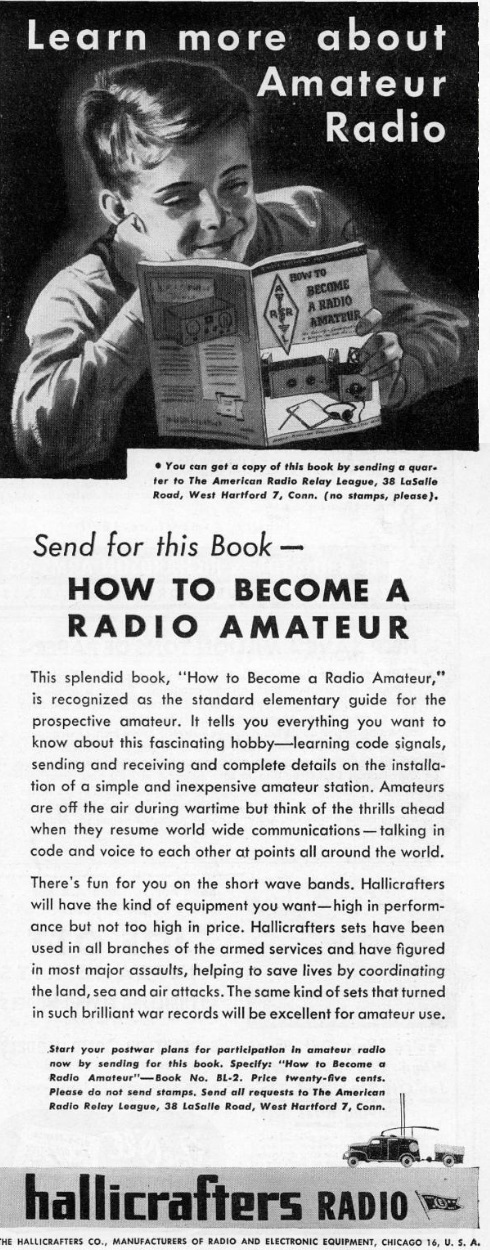
1939OctBL2Eighty years ago this month, Chief Scout Executive James E. West penned this editorial in the October, 1939, issue of Boys’ Life, stressing to Scouts the importance of the skill of signaling.

He noted that signaling was included in the Scout requirements because it was “part of the equipment of an outdoorsman” and helped a boy to be “accurate, painstaking, and thorough.”

He began by recounting an episode that took place in Sequoia National Park during a raging forest fire. One crew was at work on a hill when they found themselves trapped by flames on all sides. Frantically, they began signaling with their signal flags for water and more men.

But everyone else in the region was busy fighting the fire and initially nobody noticed their frantic plea. Fortunately, however, another fire fighter had been a Scout, and the signals caught his attention. Out of a crew of sixty men, he was the only one who could read the message, but rounded up a crew to rescue his trapped colleagues, who were saved in the nick of time.

Also, during a flood in Zanesville, Ohio, the flood waters divided the town, and all telephone and telegraph lines were down. The first messages to get through were from Scout troops on the opposite banks of the river.

Another Scout saw a plane circling over his town, and noticed that it was flashing a light. Thanks to his knowledge of Morse Code, he made out the siganl “N-A-M-E.” The quick-witted Scout figured out that the pilot had lost his way. He got a large mirror, turned on the lights of an automobile, and flashed the beam of light upward, sending the name of the town. The pilot answered, “T-H-A-N-X.”

The tradition of Scouts learning signaling continues with the Signs, Signals, and Codes Merit Badge, which I counsel in the BSA Northern Star Council.  I have more information about the Merit Badge at this post and this one.  I also have links to advice from William “Green Bar Bill” Hillcourt.

If you know any Scouts who are interested in earning the Signs, Signals, and Codes merit badge, I will be counseling it at the North Star Scouting Museum in North St. Paul, MN, on Saturday, October 19, 2019.  For more information or to sign up, visit the museum’s website.


1944 Combat Recording

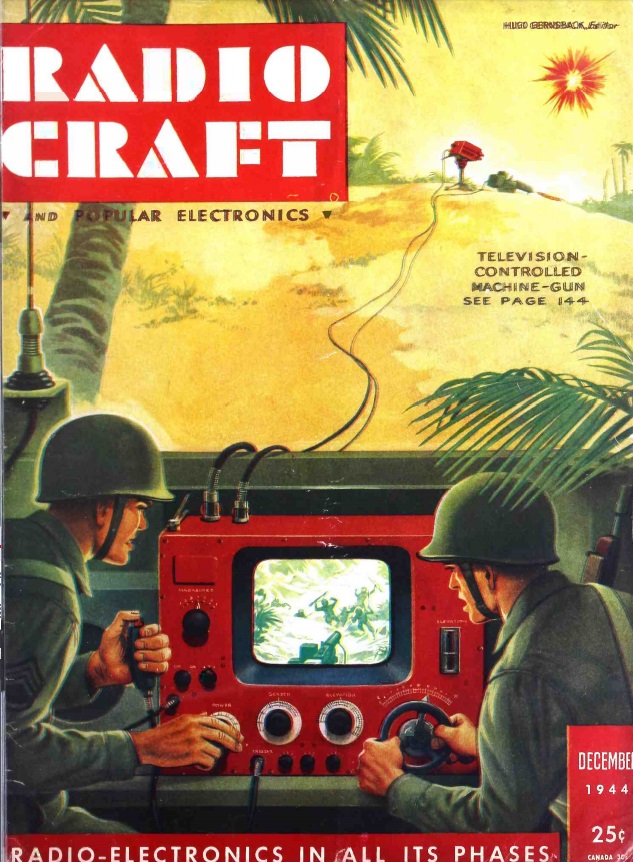
1944OctRadioCraftThe cover of Radio Craft magazine 75 years ago this month, October 1944, showed an artist’s conception of the apparatus used for on-the-spot recordings of the D-Day invasion. Those broadcasts were made by Blue Network correspondent George Hix, whose reports were part of the pool coverage and heard on the other networks. You can listen to the reports at the video below.

The equipment being used was a Recordgraph manufactured by Amertype. We previously described that equipment.  It was a technology that was short lived, since it was soon replaced by magnetic recording. It recorded grooves on a 50 foot roll of film, with a total of 12,000 feet of sound track (in other words, 240 tracks on a strip of 35 mm film). The process is identical to a phonograph recording, but with a strip instead of a disc. The system allowed five hours of speech per roll. As you can hear from the recording below, the sound quality was quite good.

The magazine noted that the Navy considered that the device’s primary use would be production of a real-time log of a battle, although the ability to record a reporter’s voice was an important secondary use.


Europe Is Talking: The Shortwaves in 1939

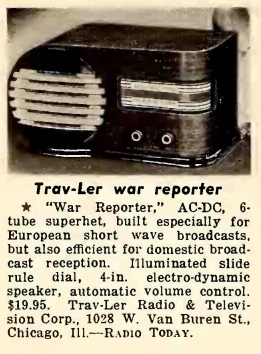
1939Oct6RadioguideMany radio receivers sold in the U.S. in the late 1930s contained a shortwave band, but it took war in Europe for many Americans to show interest in tuning in. Eighty years ago today, the October 6, 1939, issue of Radio Guide provided some pointers in how to get the latest news directly from the European capitals.

During the day, London could be heard on the 16 meter band.  Starting mid afernoon, you could tune to 19 meters and also pull in Berlin and Moscow.  Later at night, France and Italy could be tuned in on the 25 and 31 meter bands.


1959 Tesla Coil

1959OctEIThe young woman shown here is startling and impressing her friends by demonstrating the Tesla coil she constructed according to plans published 60 years ago this month in the October, 1959, issue of Electronics Illustrated. She is shown lighting up a neon tube and fluorescent tube thanks to the high voltage produced by the coil.

The article noted that most Tesla coils presented a problem for storage and transport, since the coil is so large. However, this one solved that problem by making both of the coils removable thanks to color-coded banana plugs. The smaller primary coil had color coded connections, and the larger secondary coil plugged right into the base. After dazzling her friends, she could unplug the coils and easily transport the set to the next location.