Category Archives: Radio history

Electric Hot Dog Cooker

1960JulyEE4I suspect many of our readers have independently invented the idea shown here for an easy way to cook a hot dog. You simply run 120 volts through the hot dog, and the hot dog serves as a resistor and cooks itself. This incarnation of the idea was designed by prolific electronics writer Len Buckwalter and appeared in the July 1960 issue of Electronics Illustrated.

This design is a bit safer than what I remember doing. While cooking, the hot dogs are safely concealed inside a bakelite box. They don’t start cooking until the lid is inserted, since the cord is part of the lid, and there’s a TV-style safety interlock.

The young scientist wishing to come up with an interesting science fair project won’t go wrong with this idea. It give a great demonstration of Ohm’s law and the power law. And sharing the hot dogs with the judges certainly won’t hurt in earning that coveted blue ribbon.

Of course, you don’t want to be disqualified by electrocuting one of the judges, so it’s best to come up with some form of interlock.

The venerable Presto Hot Dogger used the same principle to cook hot dogs. It unfortunately seems to be out of production, but they show up on eBay.  But making your own is easy, and a lot more fun.


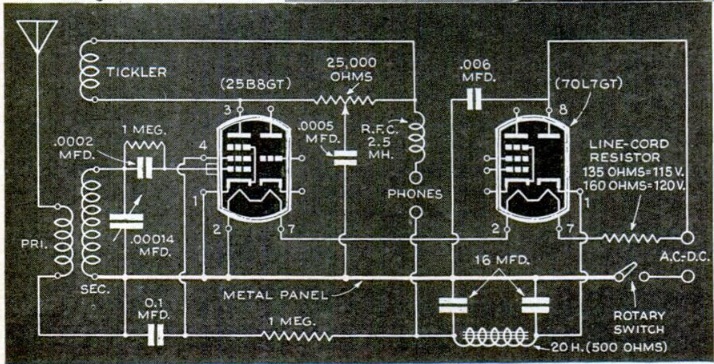
1940 Three Tube Superhet

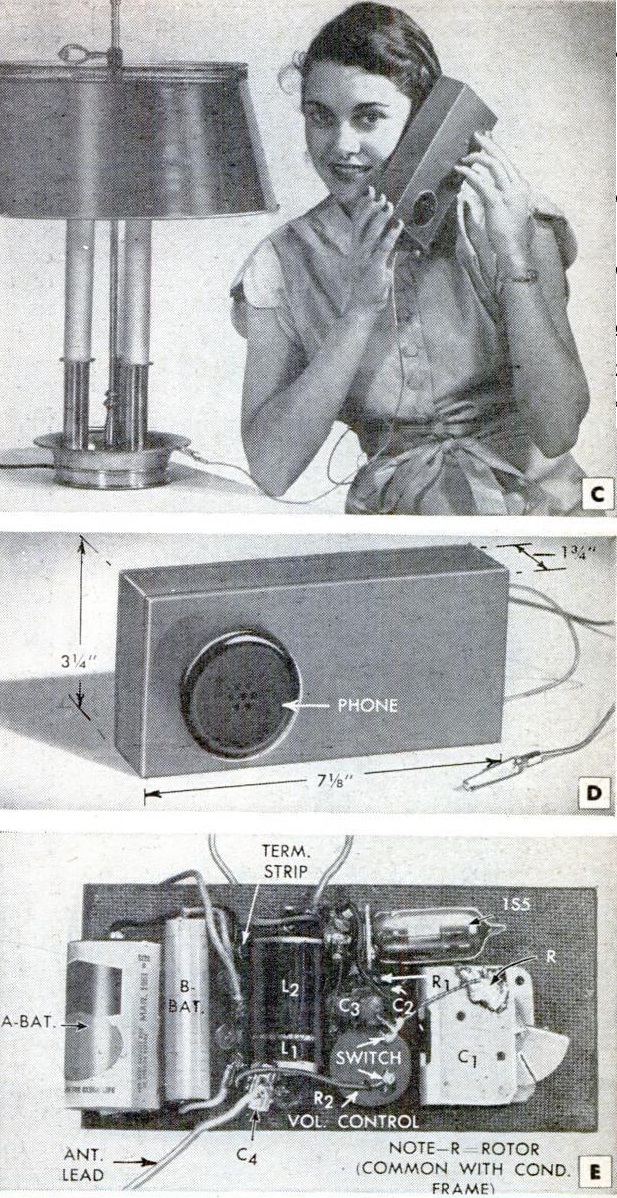
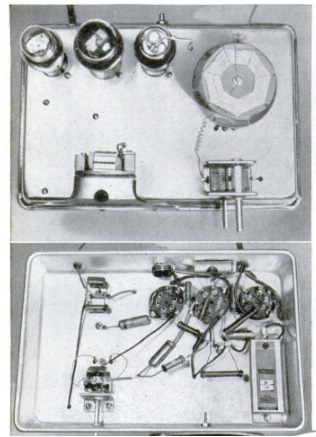
1940JulyPS4This young woman and her faithful canine companion are pulling in a program from a distant station thanks to the very sensitive and selective three-tube superheterodyne receiver described in the July 1940 issue of Popular Science,

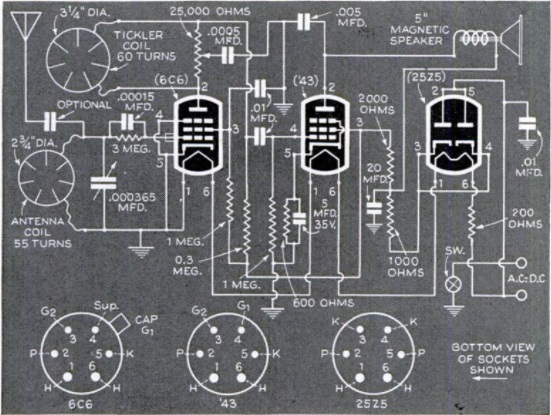
For added sensitivity, the detector is regenerative. Only one IF coil is used, meaning that the set can easily be aligned for peak performance. If a strong station is present in the area, then the article showed how to add a volume control in addition to the regeneration control shown in the circuit.

1940JulyPS5


1960 Two Tube AM-FM Stereo

1960JulyEEThis listener was undoubtedly the first on her block to tune in a stereophonic broadcast, thanks to the two-tube AM-FM stereo receiver shown in the July 1960 issue of Electronics Illustrated.

That’s right,  With only two tubes, this radio pulls in AM-FM stereo broadcasts.  If you wondering how that’s even possible, read carefully.  It doesn’t receive FM stereo broadcasts.  In fact, the FCC didn’t even adopt a standard for FM stereo until 1961.  Just like I said, it receives AM-FM stereo broadcasts:  An AM station is transmitting the left channel, the right channel of the program is being transmitted on FM.  The set is actually two separate two-tube receivers.  It uses a dual triode 12AT7, one half as a regenerative AM detector, and the other half as a superregenerative FM detector.  The set contains two audio amplifiers, each using half of a 12AX7.  A DPDT switch on the stereo headphones allows the listener to select AM, FM, or AM-FM stereo.

The author concedes that the set is basically experimental, and not high fidelity.  But he added that the set gave remarkable qualities of depth and direction to the sound.  By tweaking the coils a bit, the FM side could also be used to listen to TV audio when stereo broadcasts weren’t on the air.  The magazine noted that stereo broadcasts would be listed in the newspaper, and were available in many cities.

1960JulyEE3In addition to being the first on her block to have a stereo receiver, this woman could very well have been one of the few on her block to have an FM receiver of any kind.  They were starting to show up by 1960, especially in higher-end console radios for the home.  AM-FM portables were available, but as this issue of the magazine also shows, they were very expensive.  This Zenith AM-FM portable, the Royal 2000, gives every indication of being a top performer.  But it also sold for the princely sum of $189.95.

A minimum wage worker earning a dollar an hour would have to work for more than a month to afford this radio, and still wouldn’t have enough money to buy the eight D cells.  Putting together your own AM-FM stereo doesn’t sound like that bad a deal.

1960JulyEE2


Kathi’s CB Carousel Turns 50

1970JulyEEWe’ve previously written about (here and here) Elementary Electronics CB editor Kathi Martin, KGK3916. She got her big break fifty years ago this month, July 1970, when her column, Kathi’s CB Carousel, first appeared in the magazine.

We read her column every month, but we always wondered what a nice girl like Kathi was doing in a place like 11 meters.  In any event, we congratulate Kathi on this important anniversary and wish her all the best.

One of our readers made a strong circumstantial case that Kathi, along with her husband, is the author of this interesting looking book on how live a retirement lifestyle yet keep money rolling in with continuing education seminars.  It’s not a bad idea, as I also try to make a living with  such seminars (although mine tend to be in places like Iowa, and she seems to recommend more popular tourist destinations).


1960 CB Converter

1960JulyElecWorldSixty years ago this month, the July 1960 issue of Electronics World carried the plans for this CB converter. The magazine noted that inexpensive transceivers were available with superregenerative receivers, and that those worked well at first to get people on the air at a low price. But as the band became more and more popular, the lack of selectivity posed a problem, and a superheterodyne was becoming necessary.

This circuit used a single 6EZ8 triple triode, and would use a standard AM radio tuned to 1500 kHz as the IF stage. It circuit could also be tuned to cover any 400 KHz segment of the 10 meter band.


1920 Radio Ad

YoungMcCombsAd1920We’ve previously featured ads from Young McCombs department store in Rock Island, Illinois and its well-stocked radio department.  This ad appeared a hundred years ago today in the July 15, 1920, issue of the Rock Island Argus and Daily Union.


First FM Car Radio, 1960

1960JulyPMSixty years ago this month, the July 1960 issue of Popular Mechanics showed this car radio from Motorola, which, according to the magazine, was the first mass-produced transitorized FM car radio. The set installed under the dash, and despite its compact size, it was completely self-contained, with its own speaker.

The radio was in response to the demands of discriminating motorists who enjoyed a more specialized programming, and the set was capable of reproducing the full range of FM audio.


1950 Four Tube Pocket Portable

1950JulyPSThe gentleman shown here is listening to one of the first pocket-sized radios, the plans for which were shown in the July 1950 issue of Popular Science.

The magazine notes that you don’t have to carry your portable radio–you can wear it. The receiver is so small that it will slip into your pocket, and you’ll hardly know you have it with you. The set was a four-tube superheterodyne that would pick up everything on the dial, thanks to four subminiature tubes.

The article did state that one needed to have “a little practice in radio building” in order to put it together. Indeed, the mechanical construction looks very challenging, trying to squeeze all of the parts into a small makeup box.

Unfortunately, the project is challenging partly because it’s unclear which tube is which. The set calls for four tubes: 2G22, 2E32, 2E42, and 2E36. Unfortunately, they’re not labeled on the schematic, and the text gives only a few hints. The 2E36 is the audio output, the tube on the far right. I think the other three, from left to right, are 2G22, 2E32, and 2E42, but I’m not positive. In any event, the tubes are taped to the sides of the IF transformers to squeeze everything into place. Of course, it probably doesn’t matter, since these tubes are probably all unobtainium.

1950JulyPSschematic


Update:  A reader sent us a copy of the page below, which shows the missing tube numbers.  Apparently, the top of the page was cut off, but is visible in the scan below.  Thank you!!

1951 pocket radio circuit


Answer to Yesterday’s Quiz

1940JulyRadioCraftYesterday, we posted this quiz from the July 1940 issue of Radio Craft magazine. Based upon the symptoms shown, what was wrong with the radio?  As promised, here’s the answer:  R1 is open.  Here’s a more complete explanation:

1940JulyRadioCraft2

We’ll give you 24 hours to think about it, and then post the correct answer tomorrow.


1940 Quiz

1940JulyRadioCraftWould you have made the grade as a radio technician 80 years ago? You can find out from this quiz in an ad in the July 1940 issue of Radio Craft magazine. Based upon these symptoms, can you figure out what’s wrong? If you graduated from National Radio Institute’s home study course, you would undoubtedly identify the problem right away.

For a larger version of the image, click on it.  Then, in most browsers, click on it again to enlarge.

We’ll give you 24 hours to think about it, and then post the correct answer tomorrow.