Category Archives: Minnesota History

1921 Transatlantic Tests

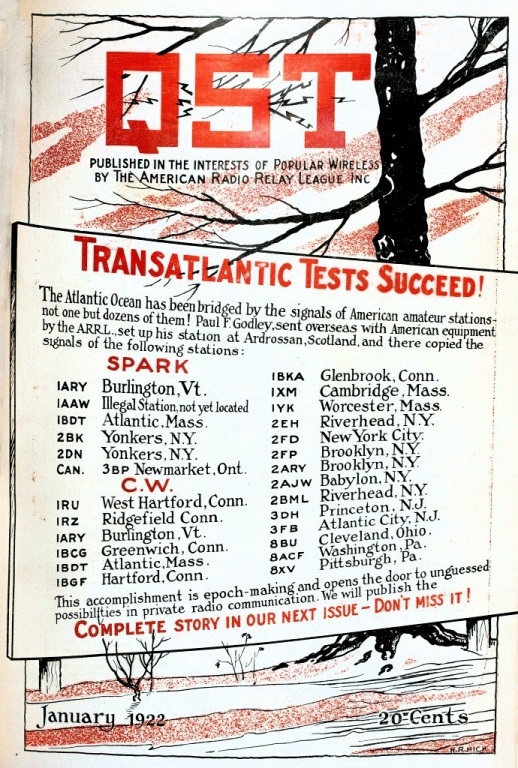
1922JanQSTx
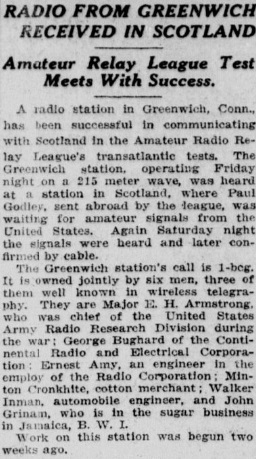
1921Dec12NYHeraldAmateur Radio signals first crossed the Atlantic 100 years ago the night of December 11/12, as documented here in the December 12, 1921, issue of the New York Herald.

An attempt the year before had been unsuccessful, and in 1921, the American Radio Relay League pulled out all the stops to ensure success. In addition to European operators who would be listening in, American Paul Forman Godley, 2ZE, was sent to England with the latest in American receiving equipment. He set up in a field at Ardrossan, Scotland, with only a tent to house himself and the receiver.

Transmissions from North America followed a pattern. Between 7:00 and 9:30 PM Eastern Time, all stations were invited to send, with a 15 minute period designated for each call area. These stations simply called TEST and their call sign. Starting at 9:30 until 1:00 AM, about two dozen pre-selected stations took turns calling. Each of these stations sent a five-letter cipher which had been given to them in a sealed envelope.

My personal connection to the tests is the fact that one of these stations, 9XI at the University of Minnesota is one I personally operated many times, and of which I served as trustee for several years. In those early years, there was a fuzzy line between amateur stations and broadcast stations. At some point there was a split, and the broadcast side of 9XI became licensed as WLB, and later as KUOM, under which call it still operates.
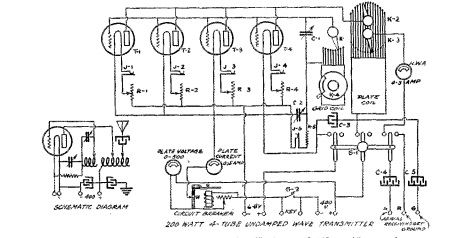
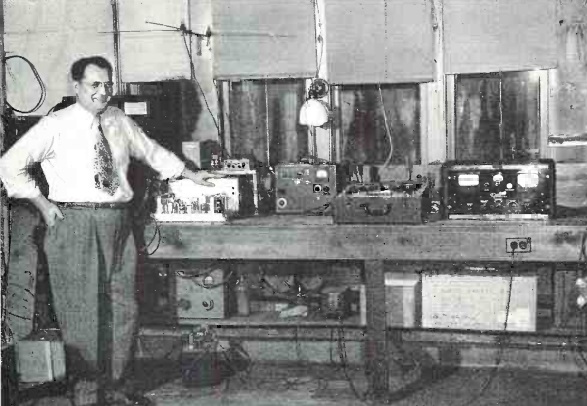
1921DecQST1Amateur station 9XI became 9YC, later W9YC, and after the war, W0YC, the call it held when I was a member and later the licensee. With the exception of 6XH at Stanford University in California, 9XI was the furthest west station participating. It was not heard in Europe, but the station sent the cipher SFLJT on 300 meters (1000 kHz) using CW. The transmitter was undoubtedly the one shown at left, described by Prof. Cyril M. Jansky, Jr., in the December 1921 issue of QST.

Numerous stations were heard the night of December 11, the most notable being 1BCG, as reported in the news clipping above. The signals from Connecticut were heard not only in Britain, but also on the Continent. A full message was picked up by Godley from the station at 3:00 AM GMT, or 10:00 PM in America.

Through special arrangements with the Marconi Company, word was sent back to America on the high powered commercial station MUU. Even though Marconi used automated high-speed code, it allowed this message to be sent by hand so that it could be copied by Amateurs in America directly. The message was acknowledged by Marconi’s American station, WII, also hand keyed for the occasion, to make sure that the word was heard throughout North America that the tests had been successful

Back in Hartford, ARRL officials were gathered around the longwave set tuned to MUU. According to the account in the February 1922 issue of QST, the air was so thick with tobacco smoke that it was hard to see how a signal could get into the room.

Today, communicating across the Atlantic is a pretty routine occurrence. We’ve learned over the years that even higher frequencies work even better than the ones used in 1921–most of which were in what we today consider part of the AM broadcast band. When I operate portable from a park using 5 watts, I made numerous contacts with Europe. It’s pretty easy now, and it’s something that’s been going on for a century now.

Various events will be taking place this weekend to commemorate the event.  Most of these are listed at the ARRL website.  In particular, I want to do my best to listen to a recreation of 1BCG’s transmitter, and you can read details of that event at this link.
1921 Montgomery Ward Radio Equipment

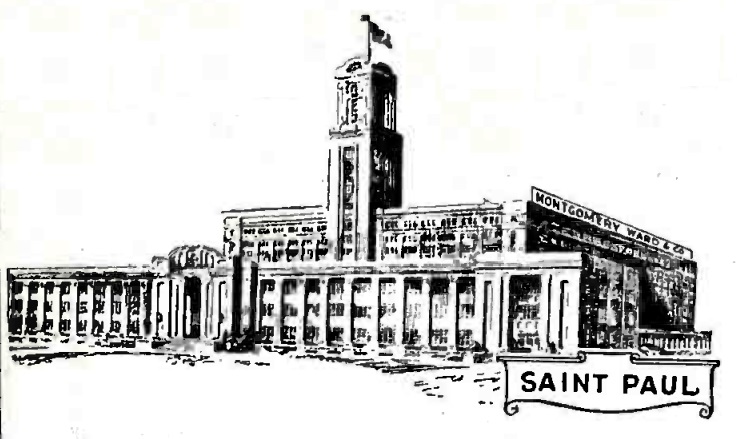
MWStPaulA hundred years ago, Montgomery Ward was a supplier of just about everything the radio experimenter might need.  This ad appeared a hundred years ago this month in the November, 1921, issue of Radio News.

The St. Paul, MN, store with its iconic tower shown in the ad was a familiar landmark for me.  It was torn down in 1996, but for decades, it served as the distribution center in our area.  We lived in Minneapolis, and usually shopped at our local store.  But when we needed something more exotic, we knew that everything in their thick catalog would be available at that store.  Frequently, it was tires or auto parts.  We would drive to the big store, my dad would use the catalog to fill out the order form, he would hand it to the guy behind the counter, and a few minutes later, they would return with our order.  It was like having Amazon, but with immediate delivery.


ATR Karadio, 1961

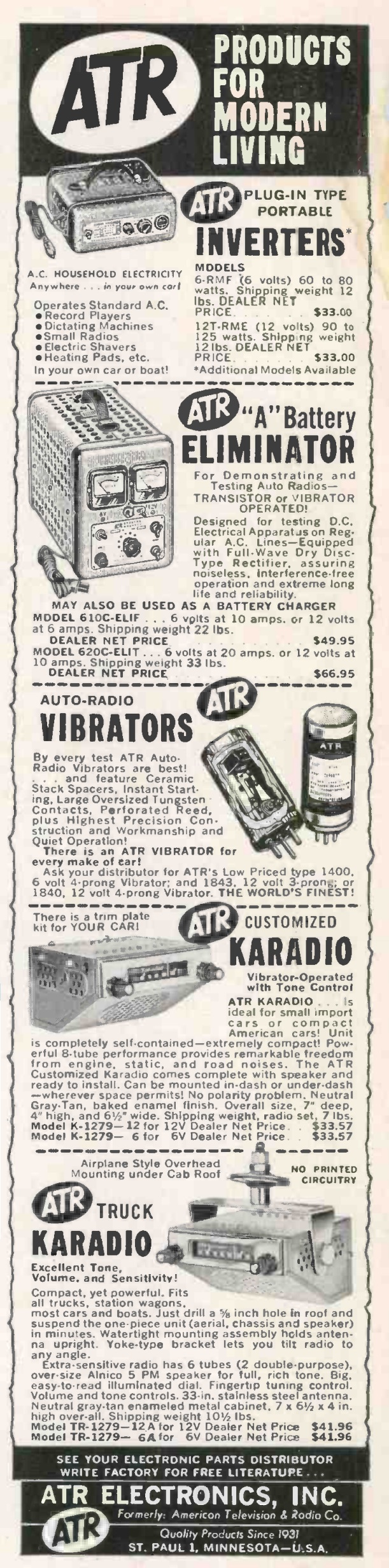
1961AugElectronicsTechnicianSixty years ago this month, the August 1961 issue of Electronics Technician carried this ad for ATR Electronics, formerly known as American Television & Radio Co., of St. Paul, MN.  The street address for the business isn’t listed, but the postal zone is 1, meaning it was in the downtown area.

The company’s specialty was vibrators, but as shown here, its product line included inverters (which undoubtedly contained those vibrators), “A” battery eliminators, and car radios.  The two radios appear to be identical, but the “truck” version of it mounts “airplane” style in the roof of the cab.  The installation took only minutes, consisting of cutting a hole in the roof, and bolting in the combination antenna/mounting bracket.

I’ve been able to find little information about the company, other than that they were involved in a labor dispute which made its way to the Minnesota Supreme Court in 1960.


Terado Co. Trav-Electric Model 6-1160 Inverter, 1946

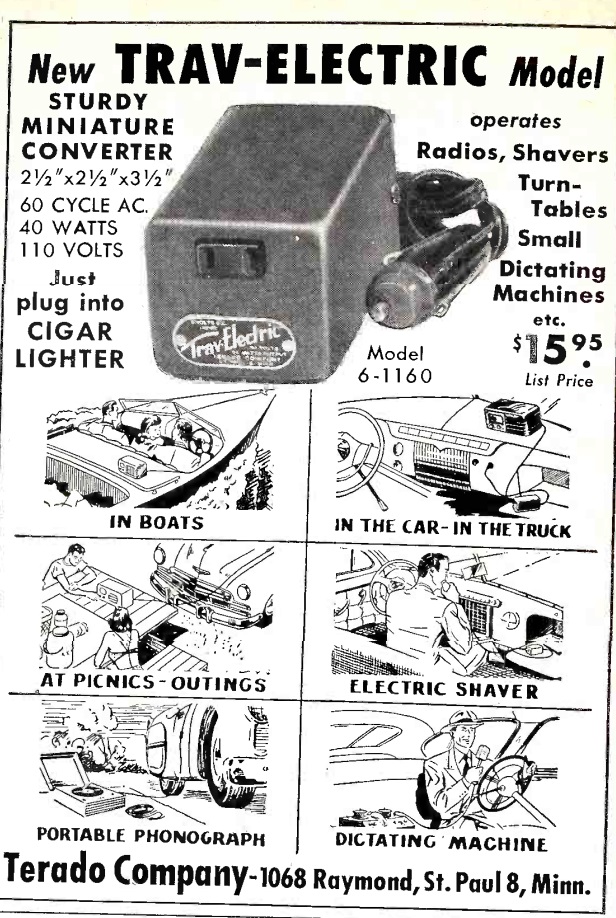
1946JunRadioRetailing2I found this ad from 75 years ago to be intriguing. It’s an inverter for running 120 volt appliances from a car’s electrical system, presumably six volts. The ad appeared in the June 1946 issue of Radio Retailing.

I haven’t found much information about this unit, model 6-1160,  But it’s almost certainly vibrator driven.  The electromechanical vibrator changes the DC to a square wave, which is stepped up by a transformer.  It’s billed as providing up to 40 watts.

It’s priced at $15.95.  According to this inflation calculator, that works out to about $330 in 2021 dollars.  By comparison, a modern one such as the one shown here outperforms it and sells for just a few dollars.
The manufacturer, the Terado Company, appears to be defunct, but their street address jumped out at me.  I drive past it, 1068 Raymond Avenue, St. Paul, MN, almost every day.  There is currently an apartment building at that address, which I believe was built in the 1980s.

Some links on this site are affiliate links, meaning this site earns a small commission if you make a purchase after clicking on the link.

Quonset Huts for Postwar Housing

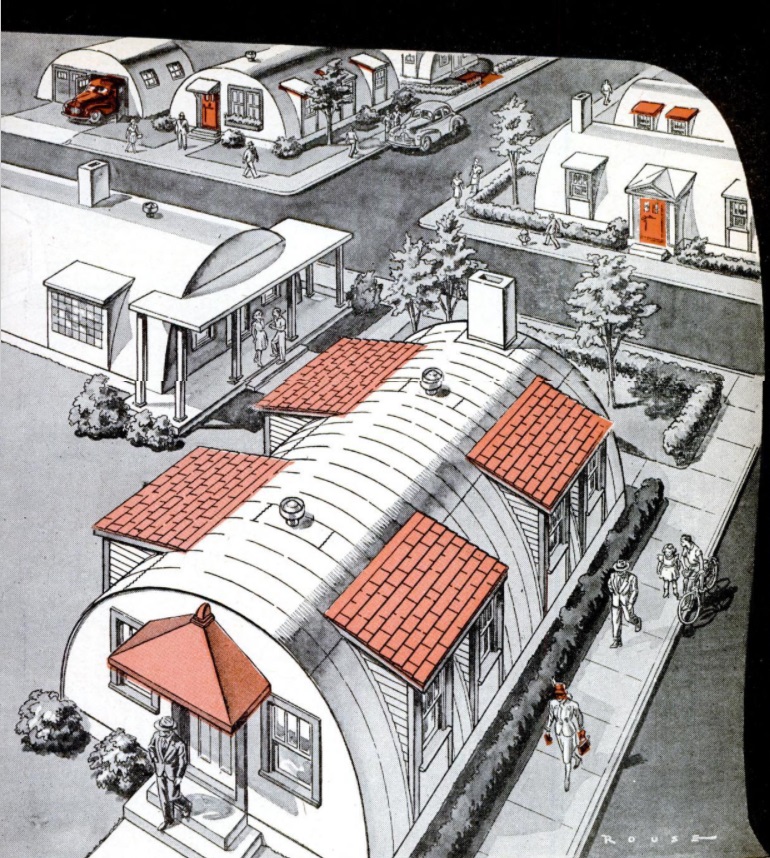
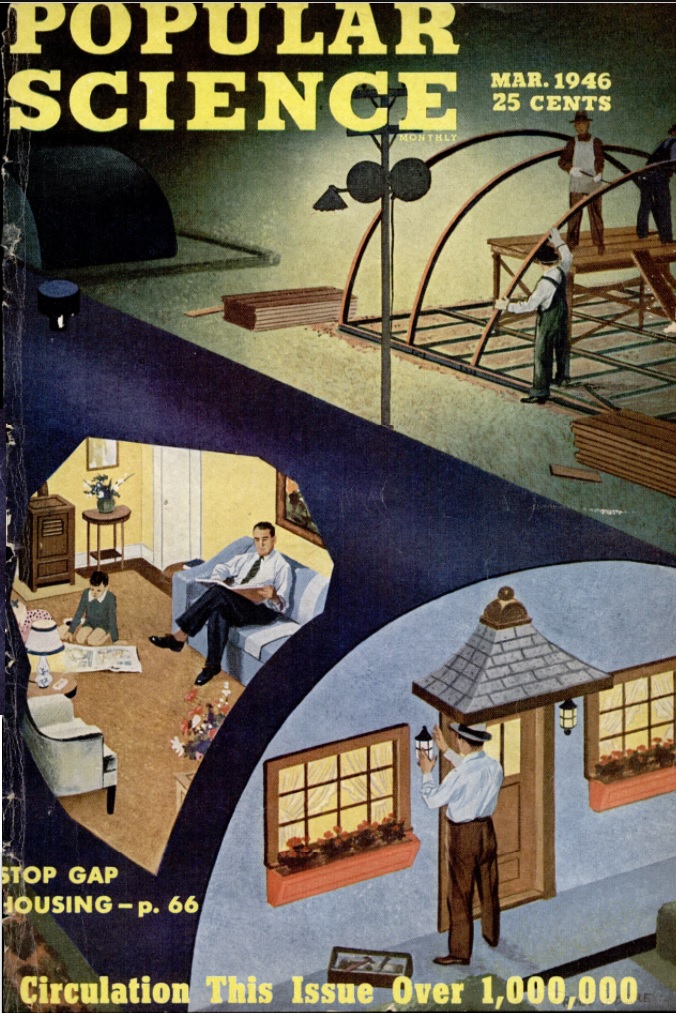
1946MarPSOne of the hallmarks of the early postwar years was the lack of housing. There had been a depression followed by a war, which meant that there hadn’t been much new housing construction for a long time. And suddenly, millions of servicemen were returning home from winning a war, getting married, having children, and needing a place to live.

As this March 1946 issue of Popular Science points out, for many, “home” meant a bedroom in someone else’s house. In fact, the number of families doubling up exceeded the entire populations of New York, Chicago, and Philadelphia combined.  Some kind of stopgap housing had to be built, and decommissioned military structures were put into service.  The federal government made Quonset huts available to cities, universities, and non-profit agencies for use as housing.  Those entities were responsible for providing the real estate and building streets and other infrastructure.  The also agreed to rent the units on a non-profit basis and dismantle them when the crisis was over.

Photos and stories about one such neighborhood near where I grew up in Minneapolis can be found at this site and this site.

1946MarPS2


1971 EBS False Alarm

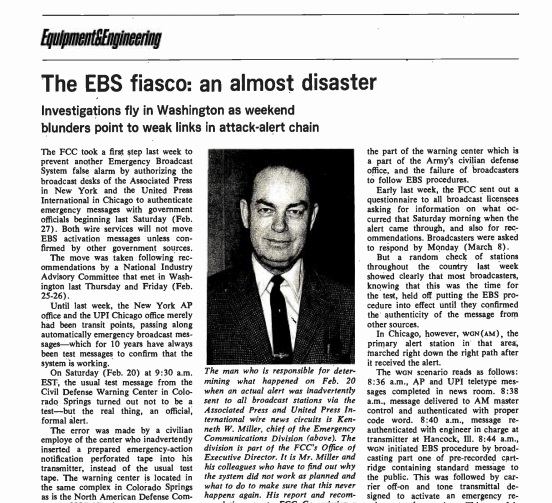
MushroomCloudFifty years ago today, the Emergency Broadcast System (EBS) sent out a warning that the nation was under attack. Thankfully, it turns out it wasn’t. A test was scheduled for that Saturday morning, but an operator at the Cheyenne Mountain complex put in the wrong tape. Instead of the tape announcing that it was only a test, he ran the tape for a real attack. It contained the code word “hatefulness” to authenticate the message.

At radio stations around the country, DJ’s ripped open the envelope next to the teletype machine containing the authenticating code. And sure enough, that was the correct code word for that day. Stations were supposed to cease normal operations and begin broadcasting information about the attack. But that information was never forthcoming.

Since a test had been scheduled, many stations suspected that there was an error, but it wasn’t confirmed officially for 40 minutes. The most famous recording from that day comes from WOWO in Ft. Wayne, Indiana, which you can hear in this video, where announcer Bob Sievers interrupted the Partridge Family with the news:

You can also listen to the event from WCCO Minneapolis at RadioTapes.com.


1941 Minnesota Radio Stations

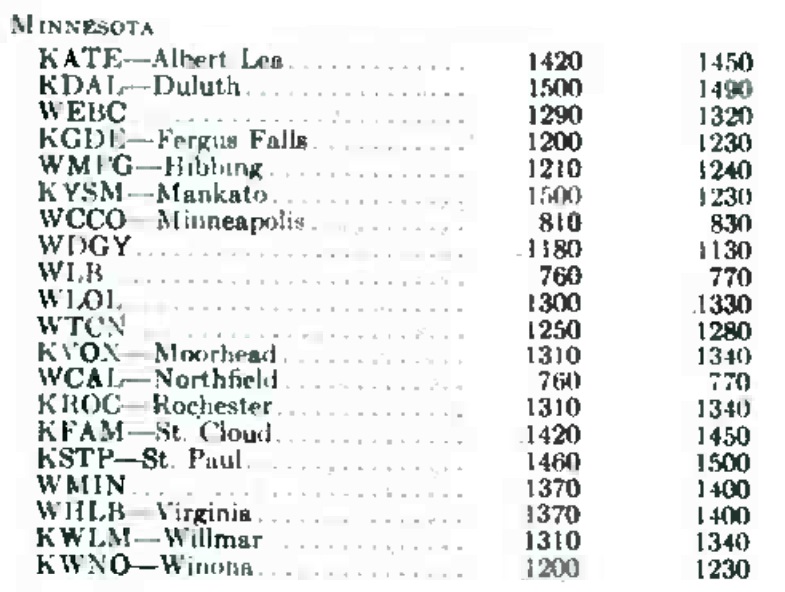
1941FebServiceAs we’ve previously written, on March 29, 1941, most broadcasting stations in the United States changed frequency, as the top of the dial moved from 1500 kHz to 1600.  This listing shows all stations in Minnesota at that time.  The first column shows their old frequency, and the last column shows the new frequency, many of which still look familiar today.

The listing appeared in the February 1941 issue of Service magazine.


St. Paul, MN, City Radio System, 1951

1951FebFMTV

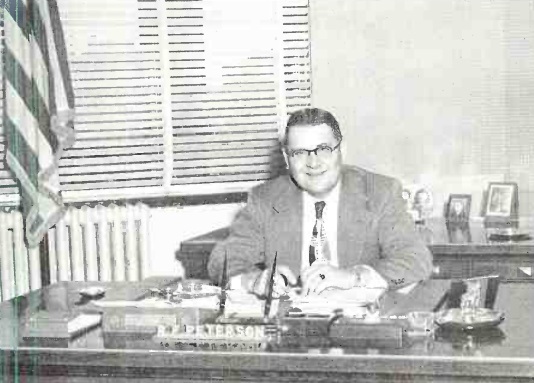
St. Paul Police Sgt. Hans Peterson.

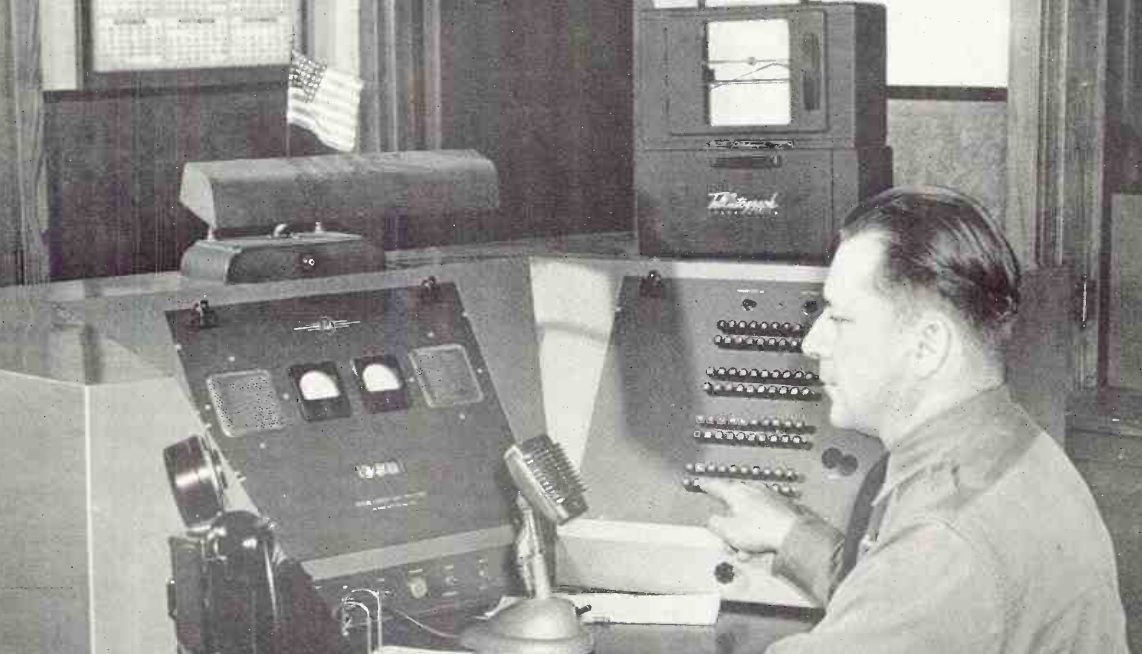
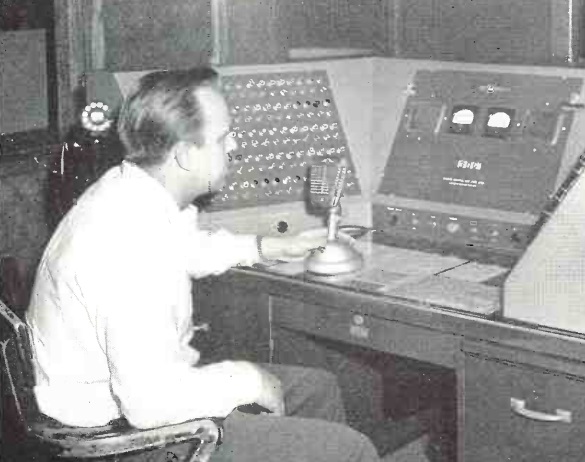
Shown above, 70 years ago, is Sgt. Hans Peterson of the St. Paul, MN, Police Department, at the console of the city’s mobile radio system. The system was described in detail in a two-part series appearing in the February and March, 1951, issues of FM-TV-Radio Communications magazine, authored by the city’s Commissioner of Public Safety, Robert F. Peterson.

Peterson notes that, as in most other cities, greatly increased demands had been placed upon the police department since the war, due to added services, as well as additional crime and juvenile delinquency. And with the development of long-range aircraft, the city found itself closer to Russia than the cities on the east coast, making civil defense a concern. “Obviously, more manpower is indicated, but in St. Paul our 40-hour week and limited budget make any substantial increase in personnel out of the question.” Therefore, the city turned to technology, in the form of a modern radio system, to increase efficiency of officers. The system also handled traffic for the city of West St. Paul and the Ramsey County Sheriff’s Department.

Morrison caption.

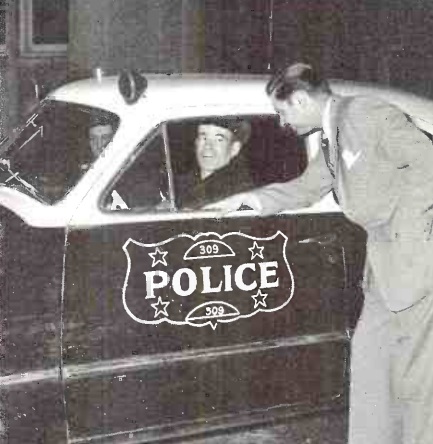
Engineer Bob Morrison standing beside police cruiser. Selective call light is visible above center of windshield.

The system consisted of equipping 53 police vehicles, as well as fire stations and vehicles, with dual-frequency radios with selective calling capability. All outgoing calls were handled on 159.09 MHz from a console at the Public Safety Building. A leased telephone line led to the transmitter and receiver atop the First National Bank Building. The transmitter room was, understandably, kept locked at all times, and also had a CO2 fire suppression system installed. The door and fire system had monitors that were linked back to the main control point, so that the dispatcher would be aware of any intrusion or fire.

Normally, all units operated on 159.09 MHz. But the mobile units were all equipped to transmit on a secondary frequency of 158.97 MHz, which was continually monitored by the dispatcher. This allowed mobile units to make emergency calls even during longer broadcasts from the dispatcher.

A key element of the system was the selective calling ability. The console shown above was equipped with dozens of switches, one for each mobile unit. One of these could be switched on to selectively call any car. Normally, officers in the squad would be listening to the radio at all times. But previously, if they had to get out of the car to perform their duties, they were out of service for further calls. For example, if an officer were out of his squad car investigating a traffic accident and a robbery occurred just around the corner, there would be no way to alert the officer.

Selective calling provided a solution. When an officer was out of his car, he could still be alerted by a light mounted above the windshield, or perhaps a horn. These were connected the the selective calling system. If the officer was needed, the dispatcher would flip the switch, the light would come on, and the officer would know there was a priority call.

A duplicate console was connected. Shown below, radio operator Art Tweet is shown at this console. The radio operator was responsible for system operation, but in rush hours, he could assist the dispatcher.

Radio Operator Art Tweet

Radio Operator Art Tweet

Tierney caption.

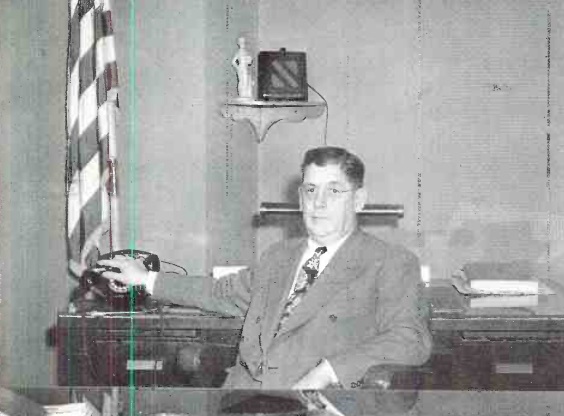
Police Chief Charles J. Tierney.

Mattocks Caption.

Fire Chief William H. Mattocks.

Peterson Caption.

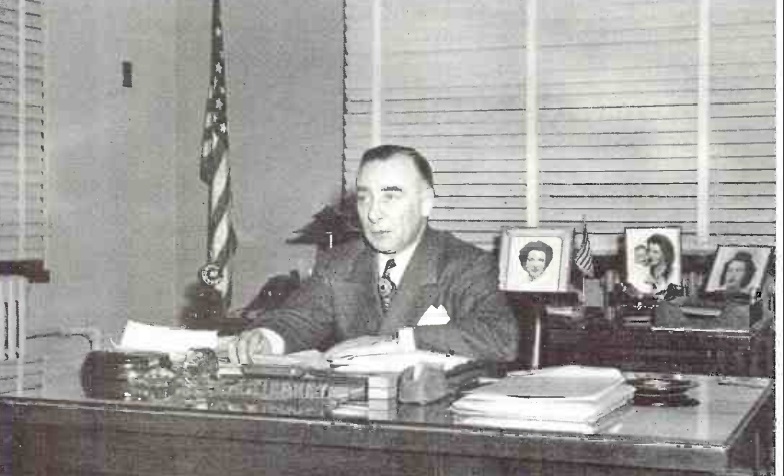
Commissioner of Public Safety Robert F. Peterson.

Ginther Caption.

Superintendent of Radio L.A. Ginther.


1921 Alarm Clock Extension

1921JanPMclock

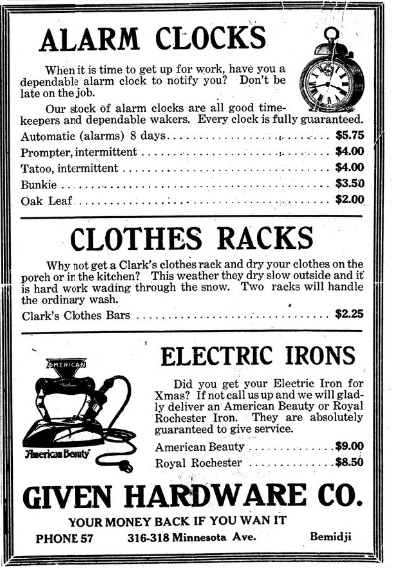
1921Jan4BdjiPioneerAs you can see from the ad at the left, an alarm clock was a non-trivial expense a hundred years ago. This store, the the Given Hardware Company, 316-318 Minnesota Avenue, Bemidji, Minnesota, had models ranging in price from $2.00 to $5.75. That doesn’t sound like a lot of money, but according to this inflation calculator, that works out to a range of $28.92 to $83.14 in today’s money. If you had a clock in one room and wanted to hear the alarm in another room, going out and buying a new one would constitute an unnecessary expense.

You can compare that price to some of the perfectly functional, extremely accurate clocks below, all of which are probably orders of magnitude better than the 1921 model:

In fact, you can probably get a perfectly suitable alarm clock at the closest dollar store. So if you need an alarm clock in another room, or need a louder alarm clock, it’s a simple matter of going to the store or going to Amazon and just buying one.

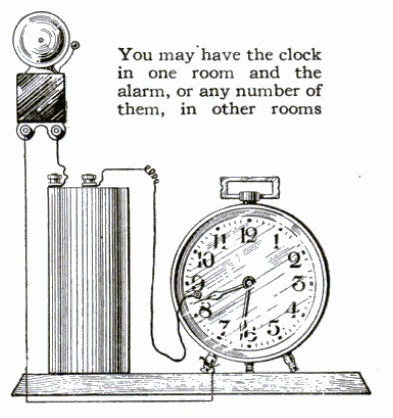
But a hundred years ago, it was a problem best solved by ingenuity, as shown by the self-explanatory idea shown above. This relied on the fact that the glass of most alarm clocks could be rotated, but would still hold its position. Therefore, a small hole was drilled in the glass and a machine screw was carefully inserted so that it would contact the hour hand, but not interfere with the minute hand. A small piece of spring brass wire was soldered to the hour hand to serve as a brush and make contact. The alarm could be set to any desired time simply by revolving the glass.

In case you’re wondering how much the doorbell cost, this 1918 Western Electric catalog showed them starting for about $1.30, and the dry cell battery was about 60 cents.

This idea appeared in the January, 1928, issue of Popular Science, and had been sent in to the magazine by one G.H. Rouse. The ad appeared in the Bemidji Daily Pioneer, January 4, 1921.


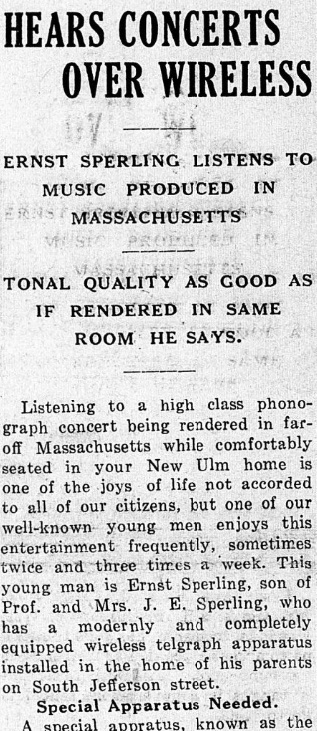
Ernest Sperling, 9BBF, W9BKX

1921Jan26NewUlmThis article appeared a hundred years ago today, in the January 26, 1921 issue of the New Ulm (MN) Review.

HEARS CONCERTS OVER WIRELESS

ERNST SPERLING LISTENS TO MUSIC PRODUCED IN MASSACHUSSETS

TONAL QUALITY AS GOOD AS IF RENDERED IN SAME ROOM HE SAYS

Listening to a high class phonograph concert being rendered in far off Massachusetts while comfortably seated your New Ulm home is one of the joys of life not accorded to all of our citizens, but one of our well-known young men enjoys this entertainment frequently, sometimes twice and three times a week. This young man is Ernst Sperling, son of Prof. and Mrs. J. E. Sperling, who has a modernly a completely equipped wireless telegraph apparatus installed the home of his parents on [21] South Jefferson street.

Special Apparatus Needed.

A special apparatus, known as the audion receiving set, is necessary to receive music by wireless. This apparatus is more sensitive and of a better grade than the regular wireless receiving instrument. There is very little electrical energy used in transmitting music waves by wireless, so that the detector must be unusually sensitive, or the other tones will not be clear. Another important factor in the transmission of music via wireless is the prevailing weather conditions. If the air is clear and quiet, with no perceptible wind, the music is much more audible and there is no rising or falling of the tone During a wind that is strong enough to sway the antenna the music sounds as if it were being played on a phonograph, the modultor of which is being changed constantly.

News Every Night.

Mr. Sperling spends a considerable part of his spare time evenings at his wireless instrument and receives many messages containing accounts of important happenings not only in this country but abroad also. One of the principal sources of this in formation is the big wireless station on Arlington Heights, near Washington, D. C., from which such messages are sent out every evening. He also receives messages from commercial stations every section of the United States, the most distant one being located in Alaska.

“Connect” With Europe.

Mr Sperling is at present working on a large receiving set, which, when completed, will enable him to get wireless messages direct from Europe, thus enlarging the scope of his wire less work. Quite a number of interested New Ulmites have visited the Sperling home to view the young man’s wireless apparatus and have him explain its workings.

Later in the year, the newspaper’s June 1, 1921, edition reported that young Mr. Sperling had agreed to supply farm market reports to the telephone company, which made them available to local farmers.

Sperling is listed in the 1922 callbook as being licensed as 9BBF (with his name spelled Ernest). His father, Prof. J.E. Sperling of Dr. Martin Luther College is listed in this yearbook as a Pastor Emeritus of the Joint Wisconsin Synod of the Lutheran Church.

In the 1937 callbook, Ernest is listed as one of two licensees, along with one Victor H. Schleuder, as licensee of W9BKX of 313 S. State St., New Ulm. He is listed in the 1940 census as living at 21 South Franklin.