Category Archives: Emergency Preparedness

Family Emergency Preparedness Tips from 1951

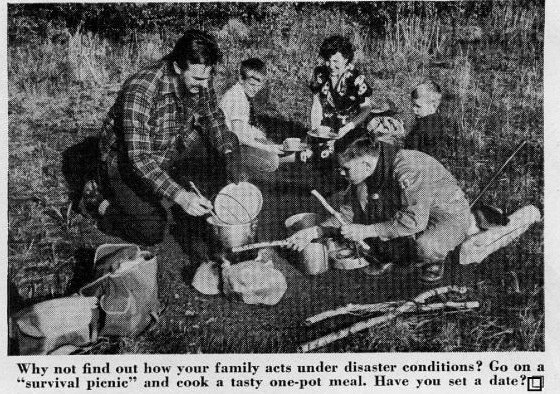
1951JulBL1The July 1951 issue of Boys’ Life carried some pointers for Scouts to help prepare their families for disasters, such as storm, flood, fire, or even enemy attack.  One of the ideas is shown above:  The family can schedule a “survival picnic” where they will grab their survival rations and head out to the countryside where they turn it into a tasty meal.

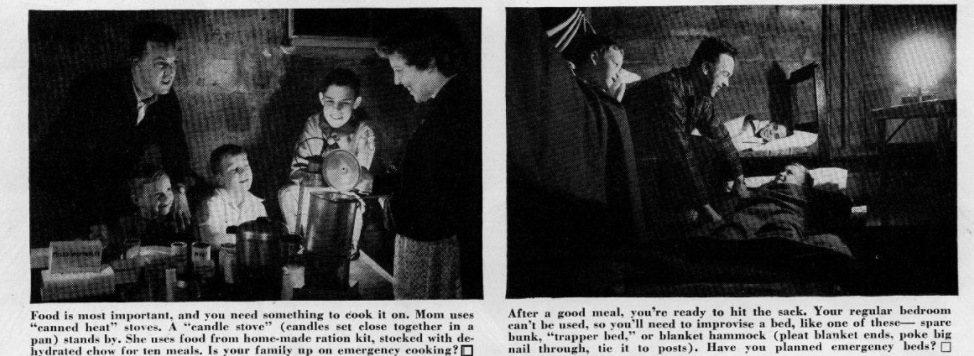
Other pointers are shown below.  The family should be prepared for emergency cooking, and emergency beds “if your regular bedroom can’t be used.”  The beds were simplicity themselves:  Pleated blankets were simply affixed to posts with big nails.

The survival picnic doesn’t sound like a bad idea.  Maybe we’ll need to break out the car survival kit and make an expedient meal with it using the emergency stove.

1951JulBL2


Review of Accumed BNX N95 Masks: Made in the USA

Mask1

Bottom Line:  The AccuMed BNX N95 mask is a high quality protective mask, meets USA N95 standards, and is made in the USA.  Even if this pandemic is over, it’s worth keeping some on hand for the next public health emergency.  Update 12/26/21:  When this review was written, Amazon carried the 10 pack shown above.  At this time, only the 50 pack is available in white.   The other masks reviewed on this page are available in smaller quantities.  Update 12/29/21:  The 10 pack is available again in black at this link.

Quick Link

Preparing for Emergencies

I like to believe that I’m reasonably well prepared for emergencies, and the COVID-19 pandemic generally proved that I was prepared.  We never ran out of toilet paper, although early on, we did have to be careful with our limited supply, and at one point we were rationing coffee.  Curiously enough, the first thing we ran out of was lightbulbs, although we could have gotten by quite a bit longer by scrounging them from other rooms in the house.  Even when riots hit the area, we were fully stocked with all the necessities of life, other than having to use powdered milk for a few days.

In a few cases, we had to make substitutions.  We didn’t have very much hand sanitizer, but we solved that problem by washing our hands.  And even though sanitizing wipes were unavailable, bleach was readily available and we were able to use it for sanitizing items.

But there was one shortage that made me angry at myself:  In 2019, I could have walked into any hardware store to buy an N95 mask that was made in the USA.  And unlike most people, I actually knew that an N95 mask would be a useful thing to have around in a public health emergency.  But at the start of the pandemic, they were totally unavailable.  And early on in the pandemic, we were told that it was practically unpatriotic to wear a mask, especially an N95 mask, because the limited supply was earmarked for healthcare workers.

A few weeks later, the official advice flip flopped, and we were told that it was unpatriotic not to wear a mask.  But the N95 masks (in other words, the ones that were actually effective in preventing the spread of disease) were still off limits, since they were still reserved for healthcare workers.

During those early days of the pandemic, I rarely wore a mask, because I was rarely in a situation where I needed one.  I didn’t go into other buildings, period.  And I believed (and still do believe) that the risk outdoors was extremely small.  I did all of my shopping with curbside pickup or home delivery.  So I didn’t need a mask, because I wasn’t going into stores or other buildings.

The Need for a Good Mask

But eventually, there were unavoidable situations where I did need to go into buildings.  So after about three months, despite the official guidance to the contrary, I decided it was time for me to be selfish and buy an N95 mask.  Unfortunately, there were none to be had.  The best I could find at that time was a KN95 mask, and even those were hard to find.

“N95” means that a mask meets the U.S. Government’s NIOSH standards.  “KN95” means that the mask meets the standards of the Communist Chinese Government, and almost all of those masks were made in Communist China.  The irony wasn’t lost on me:  I was buying a Chinese Communist mask to protect myself against the Chinese Communist virus.  I wasn’t happy about it, but I only had myself to blame.  After all, in 2019, I could have walked into the hardware store and bought an American-made mask with the U.S. seal of approval.  I didn’t do so, and I was stuck having to rely on the Communist Chinese Seal of Approval.

The mask I bought was the one shown at the left, and it served me very well.  It was made in China, but it was imported by a reputable American company, AccuMed.  At the time, there were a lot of dubious products on the market.  I researched AccuMed and found that they were a medical supply company with an excellent reputation.  Frankly, their name on the product meant more to me than the certification from some Chinese lab.  The company was also in the process of gearing up to produce masks in the USA.  (The same mask, made in the USA, is now available.  Even though it is now made in the USA, it has the KN95 designation, probably because it uses ear loops instead of bands that go behind the head.)  Those masks served me very well for a couple of months.  On the occasions when I had to be inside the same building as other people, I was protected.

True to its promise, a few months later, AccuMed came out with a mask that was made in the USA, and I previously reviewed that mask, the duckbill-style A96 mask, similar to the one shown at left.  This mask was made in the USA, but it was sold as meeting the Chinese KN95 standard, because the American N95 certification was still pending.  It’s odd to have an American product that’s advertised as meeting the Chinese standard.  But the virus doesn’t care about the paperwork.  It was made in the USA by a reputable company, it seemed to form a tight seal, and I have no doubt that it provided protection.  And after I purchased it, the mask was approved, and now has the U.S. N95 seal of approval.

Edited to add (11/16/21):  The AccuMed A96 no longer appears to be available on Amazon, but this Kimberly Clark N95 mask, shown at left, appears to be identical.

This mask, like most N95 masks, was a bit more difficult to put on than the KN95 mask, because the elastic goes around the back of the head, and not just over the ears.  But even though it’s slightly harder to put on, it’s much more comfortable to wear, since it’s not constantly pulling on your ears.  If I had to wear a mask all day, this would be a huge advantage.


The New Made in USA N95 Mask

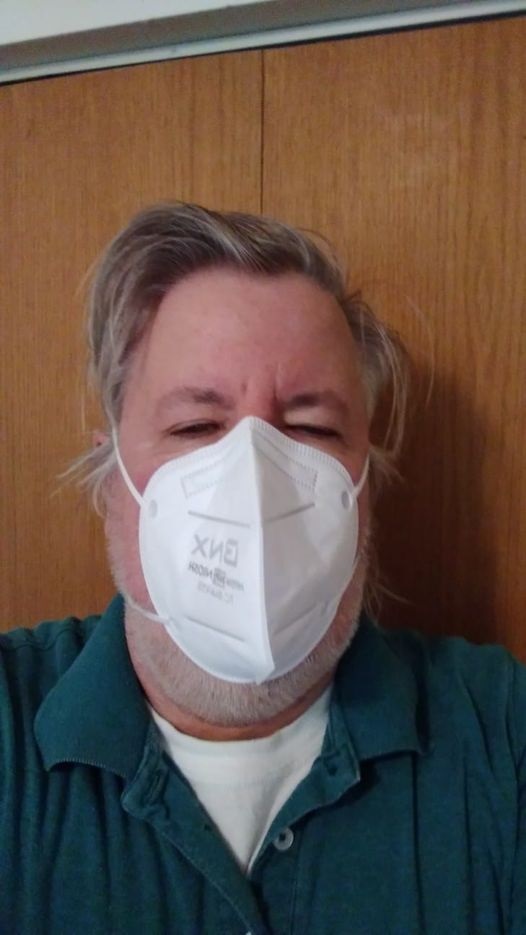
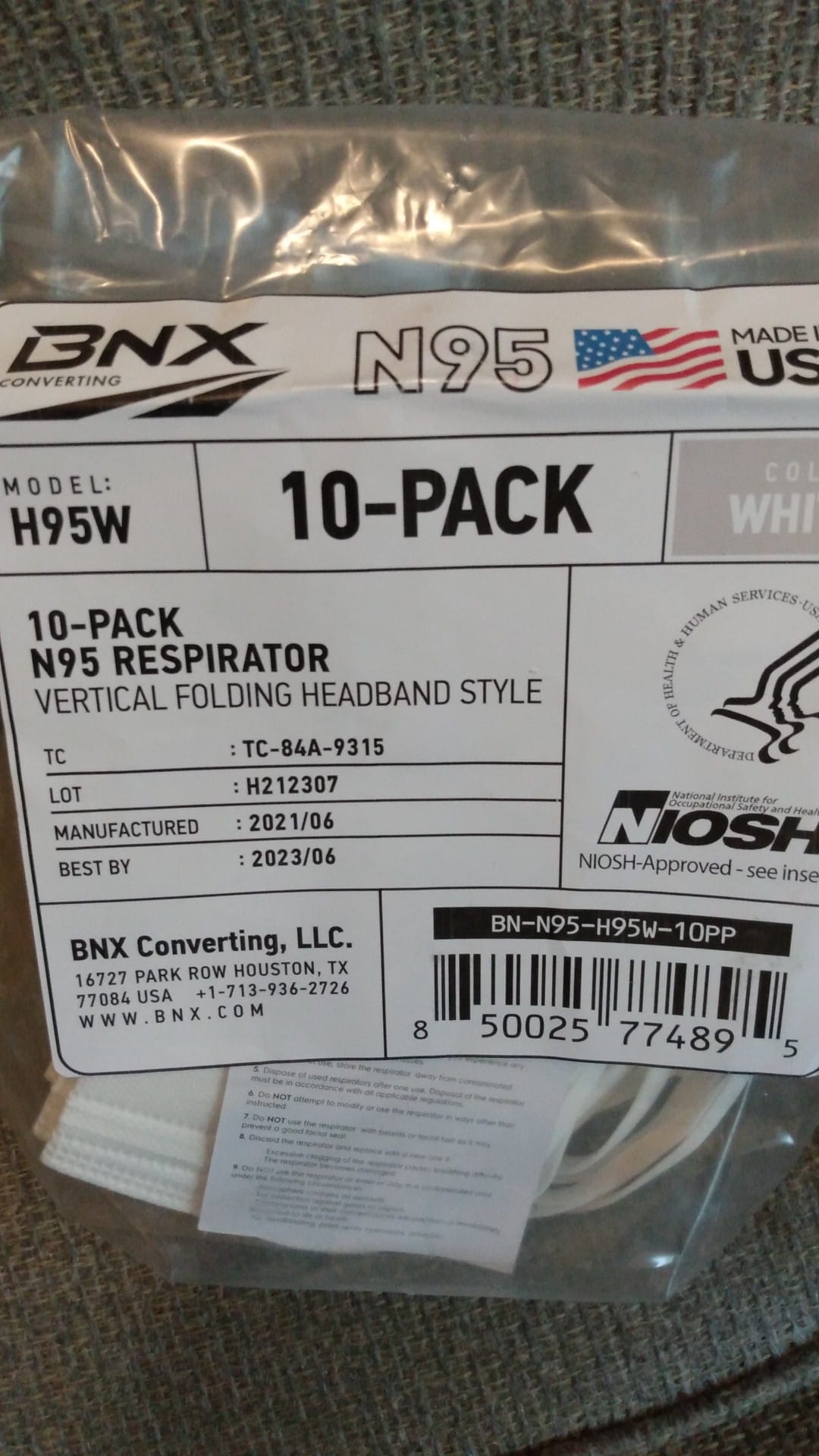
Fortunately, the time has now come when it’s once again possible to buy the thing that I should have bought in 2019:  An N95 mask made in the USA, the BNX N95 Mask NIOSH Certified MADE IN USA Particulate Respirator Protective Face Mask.  I recently received mine, and I’m glad to have it.Mask2

Like most other N95 masks, the straps go around the head, which makes it slightly more difficult to put on.  But the advantage is that it’s much more comfortable once you have it on.  It seems to form a good seal.  If I had to work for hours with this mask on, it would cause very little if any discomfort.

Both of the AccuMed N95 masks, the white one and the blue duckbill style one, are comfortable to wear, and both make a good seal.  For me, the white one is a little easier to put on, although the blue one seems to be easier to ensure a good seal once it’s on my face.  Either one, though, takes only seconds to put on.  One thing to keep in mind, though, is that the blue one seems to fit better on a smaller head.  My daughter had a hard time getting a good seal with the white mask, but it was much easier with the blue mask.  So if you are buying for a family, I would recommend getting both.

On the other hand, I now rarely have to wear a mask for more than a few minutes.  Therefore, I will probably continue to use  the AccuMed KN95 mask in those situations.  It seems to have a good seal, and if I’m just going into the store for a few minutes, it’s somewhat more convenient to put on.

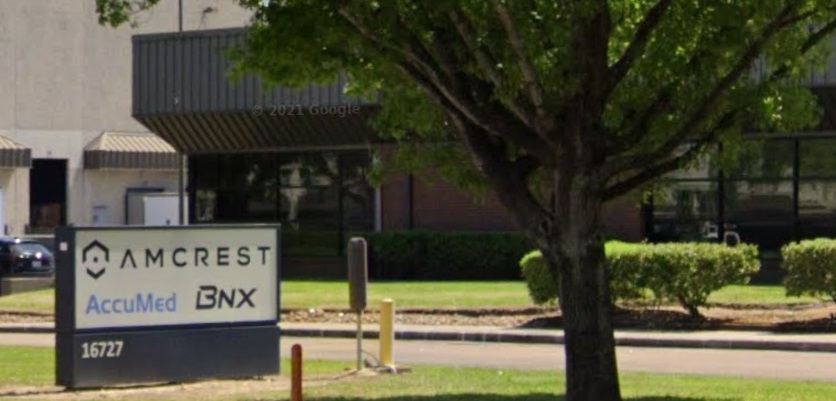
accumed1Especially at the beginning of the pandemic, and probably still now, there were a lot of fake masks hitting the market, and it’s important to buy from a reputable source.  Fortunately, AccuMed/BNX is a real company, selling a real product, from a real bricks and mortar location in Houston, Texas, shown here.  You can probably find something cheaper at the dollar store, but it’s more important to buy something that will really protect you, rather than trying to save a few pennies.

Ongoing need for a mask

From my personal point of view, the pandemic ended on March 15, 2021.  On that date, the immunity from my second dose of the Moderna vaccine officially kicked in.  There’s still a possibility that I’ll be infected, but the risk of serious illness or death are practically nil.  The day after my immunity kicked in, I went from never going inside buildings unless absolutely necessary, to taking teaching jobs which put me in close contact with hundreds of kids.   (I secured an early dose of the vaccine as a teacher, and I felt it was my duty to resume teaching at the earliest possible moment.)  In my opinion, the need for a mask is now mostly gone.  Chances are, I will rarely wear the new N95 mask.  Because it was required this school year, I wore a mostly symbolic cloth mask while teaching.  With my vaccination, I didn’t feel the need to wear the N95 mask all day.  But if I had to work close to other people and was not yet vaccinated, I would certainly wear one of the N95 masks.

Even though I don’t believe it’s is necessary because of the vaccine, I have noticed that I didn’t get any colds or flu during the pandemic lockdown, because I wasn’t in a position to be infected.  On my first few trips back to Walmart after a long absence, I realized something:  There was a certain amount of truth to all of those “People of Walmart” memes.  Many of my fellow shoppers don’t look particularly healthy.  They might not be infections with COVID-19, but it’s likely that they’re infectious with something.  Wearing a mask for my own protection probably isn’t a bad idea, and since I have some of them, I’ll probably slip on the KN95 mask before going in there or similar environments.

Even though all of my masks are disposable, there’s no reason why they can’t be used many times.  I store mine in a paper bag labeled with the date.  I have links to official guidance on reuse of masks at my earlier review.  So when you order your masks, don’t forget to order a supply of brown paper bags.

At this point, I no longer have an immediate need for an N95 mask.  From my point of view, the pandemic is over, because I am vaccinated.  However, I didn’t need an N95 mask in 2019, and I’m still kicking myself for not going to the hardware store and buying one then.  It would have made the early months of the pandemic less stressful knowing that I had this supply if needed.

And the next pandemic might be worse, and during that pandemic, I might need to come into contact with other persons.  Even though it proved deadly to many, coronavirus was not as lethal as many anticipated.  But the next plague might be worse.  Having an N95 mask on hand for such an emergency is a low-cost way to make sure I’m prepared.  I hope I never have to use them, just like I hope I never have to use my potassium iodide.  But I feel a lot better knowing I have them.

During this pandemic, I never ran out of toilet paper.  And in the next pandemic, I won’t run out of N95 masks, because I bought some when they were still available.  I’m not making the same mistake I made in 2019.

I recommend all three of these masks.  The duckbill style mask in the middle seems to be slightly easier to get a good seal, although it’s slightly more difficult to put on in the first place.  If necessary, it would be comfortable enough to wear all day.  Of the three, it probably is the best choice for children.

The white mask on the left is slightly easier to put on, and would also be a good mask if needed for all day use.

The white mask on the right seems to be very good quality, although it does not have the U.S. N95 approval.  It is made in the USA, but has the Chinese KN95 approval.  The reason is probably the fact that it uses ear loops rather than head bands.  It is the easiest to put on, but the ear bands would be uncomfortable for all day use.  It’s the easiest to use if you have to go into a store for a few minutes.

Since they all have slightly different uses, I’m glad I have a supply of all three for the next pandemic.


The product was supplied at no charge by the manufacturer in exchange for an honest review. Some links on this page are affiliate links, meaning that this site earns a small commission if you make a purchase after clicking on the link.


Hurricane Preparedness Links

time of arrival graphic

Tropical Storm Elsa forecast as of 7/3. National Weather Service.

For those in hurricane country, here are links to earlier posts on hurricane preparedness.


Field Day 1946

WFD1This weekend is ARRL Field Day, an amateur radio operating event in which hams set up their stations in remote locations and attempt to make as many contacts as possible.  It’s a hotly debated question of whether it’s an emergency preparedness exercise, a contest, or just a fun weekend.  The truth is that it’s all three.

Even if all infrastructure were to be destroyed immediately, it would still be quite possible for hams to communicate worldwide using simple equipment, relying on nothing other than the laws of physics.  Short of a zombie apocalypse, the need for such ability might be rare, but it’s a point of pride with hams what they can do.

1946 Field Day. QST for Feb. 1947.

1946 Field Day. QST for Feb. 1947.

Amateur radio was off the air for the duration of World War II, so Field Day 1946, 75 years ago, was the first postwar opportunity for hams to show that they could still communicate off-grid.

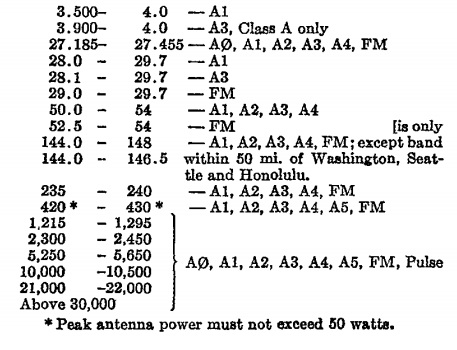
When the results were published, it was pointed out that comparisons with earlier Field Days were not appropriate.  Hams had only recently come back on the air, and they were not yet allowed on all bands.  In particular, they did not yet have privileges on the 160, 40, and 20 meter bands, all workhorses of earlier Field Days.  Instead, their HF was limited to 80, 11 and 10 meters.  The top portion of the 80 meter band had just been re-opened, and here were the allocations, as shown in the June 1946 issue of QST:

1946JunQST

The top score in the 1946 event was W2FC/2, the Jersey Shore Amateur Radio Association, which netted 9621 points from a total of 809 contacts.  The 27 participants had eight transmitters on the air simultaneously.

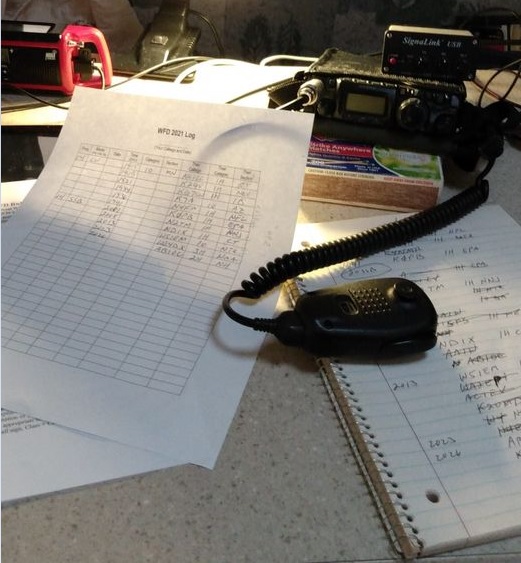
Shown above is my most recent field operation.  It wasn’t ARRL Field Day, but instead Winter Field Day 2021.


Ration Challenge: Implications for Emergency Preparedness

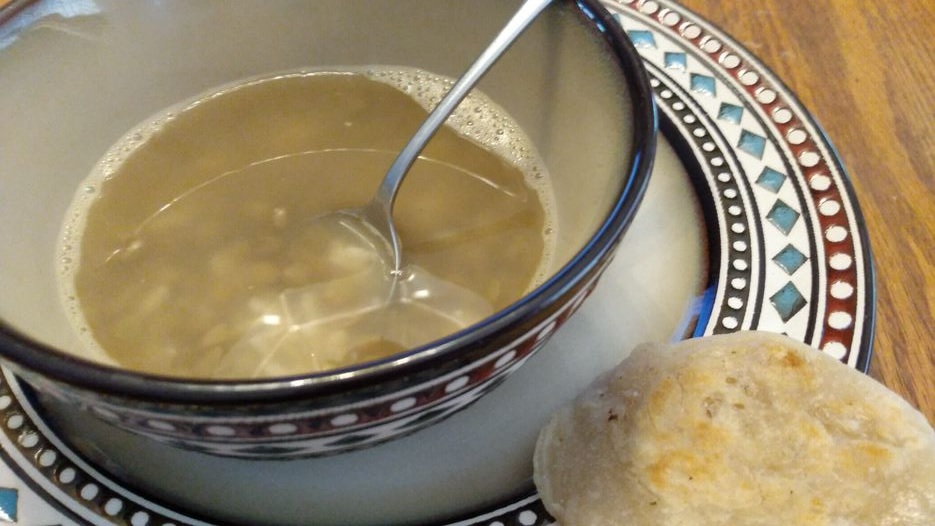
The rice and lentil soup that I enjoyed most of this week.

The rice and lentil soup that I enjoyed most of this week.

Today, I complete the Ration Challenge. For the past seven days, my diet consisted of the same rations provided to Syrian Refugees in Jordan. This is a fundraiser for Church World Service. You can make your donation at this link:

I did get a bit of variety, such as a can of sardines, a couple of eggs, and a potato.  But for the most part, my “staff of life” was  ricechickpeas (garbanzo beans), and  lentils.  For the week, I had about three pounds of rice, 3 ounces of dried chickpeas, and 6 ounces of lentils.  Each day, at least one of my meals consisted of a soup with these ingredients, flavored with chicken bouillon.  I also had three cups of flour (which I turned into the flatbread shown above), but most of my carbohydrate needs came from the rice.

My soup was satisfactory, but many other participants were able to come up with much more creative recipes for the ingredients.  You can see many of them in their Facebook group.

One of the focuses of this website is emergency preparedness, and it didn’t escape my notice that these ingredients would form an inexpensive base for emergency food storage.  They do require cooking, but they are inexpensive and have a practically indefinite storage life.  These ingredients fed me relatively well for seven days.  For one year, I would need the following quantities:

At today’s normal supermarket prices, these ingredients would cost about $125.  And chances are, by shopping around and buying larger packages, the cost would be even lower.  (Even though I didn’t add it to my soup recipes, one of my major sources of calories this week was the 12 ounces of cooking oil.  That works out to about five gallons per year, which would add approximately $30 at typical supermarket prices.)    One would not eat well if these were the only things you had to eat, but this relatively small expense would guarantee that one person would have minimal nutrition for a full year.  It seems like a cheap insurance policy.

For those of us in places like North America and Europe, it seems inconceivable that we might become “refugees” and have to worry about finding enough food to eat.  But I suspect that most of the Syrian refugees in camps in Jordan didn’t think so either.  Most of them were probably living middle-class lifestyles at some point.  They weren’t always refugees, just as you and I are not refugees today.

If we take a little bit of time to plan ahead for emergencies, we can help ourselves at the time of some future disaster.  But more importantly, we can be in a position to help our friends and neighbors.

And if you are able, please make a donation to help today’s refugees through Church World Service at this link:


Some links on this site are affiliate links, meaning this site earns a small commission if you make a purchase after clicking on the link.

1951: Building the Family Foxhole

1951MarPS1951MarPS4Seventy years ago this month, the cover of the March 1951 issue of Popular Science featured this artwork by artist Denver Gillen (who made the first drawings of Rudolph the Red Nosed Reindeer, and later, numerous covers for Outdoor Life) showing “what an A-Bomb blast may do to your home,” but with an inset of a family safely hunkered down in their family foxhole.

The cover entreats the buyer to save the issue, since it contains a special section on emergency preparedness written by Michael Amrine, formerly of the Atomic Energy Commission.

The magazine’s editors noted that much of the literature regarding civil defense was “tragic nonsense–aspirin for cancer. Even the official booklets say mainly, ‘Keep calm, keep covered, and follow directions.” But it goes on to say that official directions might not be forthcoming, since there did not exist civil defense organizations comparable with the problem. Instead, the magazine advocated “planning and plain hard work” by individual homeowners, and the magazine contained advice on how to do that. “The hard truth is that the most you can expect from civil defense will be control and rescue work after a bombing. The most effective preparation for atomic attack will be family by family, house by house.”

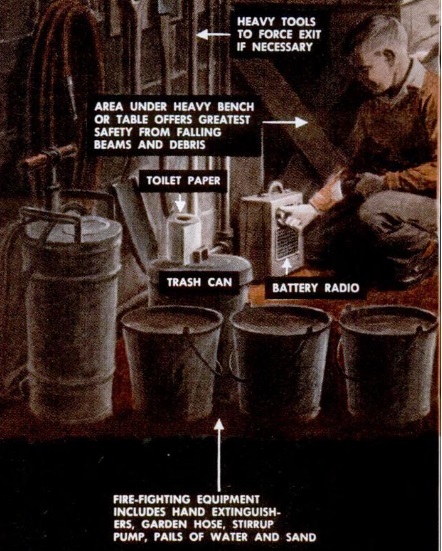
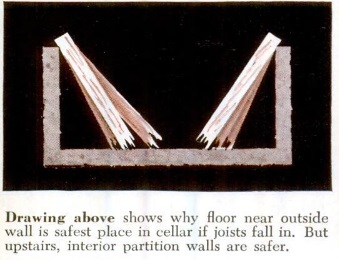
1951MarPS2The article first noted what not to do, and pointed out that steps such as blacking out the house, taping windows, or even buying a Geiger counter were of very minimal utility. It noted that, as in Hiroshima and Nagasaki, radiation was not going to be the big killer. Instead, it would be the familiar forces of heat and blast, and the article gave pointers on preparing a refuge room to protect against them. The author asked readers to “imagine that your house is in a cyclone or hurricane belt, and next door to a gas tank” and plan accordingly. The most important principles in planning a refuge room were making sure there were at least two exits, keeping out from under heavy furniture or appliances, and preferably being in a corner of the cellar with the least windows or exposure. The importance of using a corner is illustrated by the drawing at left.

After a spot was located, ideas such as shuttering windows and making use of a heavy table or workbench were outlined.

The article included a number of frequently asked questions, including “what should I tell the children?” The answer was simple: the truth. They should be instructed where to go in a raid and how to hit the deck. You shouldn’t scare them, but don’t make it a game, either.

1951MarPS3For homes without a basement, the author suggested placing earth or logs against an outside wall, with a sturdy table inside.

The list of recommended supplies included the usual suspects such as canned food and battery operated lights. Under the category of “valuables,” the recommendation included an extra pair of glasses and a lockbox for valuable papers. Rounding out that category was money (in small bills), on the assumption that, as in the last war, the economy would be in full operation.

The list included a wind-up clock and maps of the city and county. The battery operated radio made its usual appearance on the list. The article noted that utilities would probably be out, although some, especially the gas lines, might continue to function for a time. Since battery operated radios were still quite rare (but not unheard of) in 1951, the article noted that a car radio would also work.

The article did note that it was dealing with just the Hiroshima-style A-bomb, and not the H-bomb. It notes that the H-bomb was then still just a theoretical possibility, but that if perfected, it would wreak the same level of damage over a still larger area.

1951MarPS5


Winter Field Day 2021

WFD1This previous weekend was Winter Field Day.  While this event is billed as an emergency preparedness exercise, it’s also simply a fun opportunity to get on the air from a portable location, and make the most of limited resources.

As happened with ARRL Field Day this past June, the event was affected by COVID-19.  Since the pandemic generally prevents operation as a group, many who would have otherwise participated stayed home.  But in my opinion, being part of a group is not what defines this event.  The event is not called “Group Day,” it is called “Field Day.”  The focus is operating from out in the field somewhere.  And while groups of people can be dangerous because of COVID, there is absolutely nothing that is unsafe about a field.  I was completely socially distanced during the entire event.  I saw a few other campers and said hello to some of them from 50 feet away.  As I’ve previously written, camping is an excellent safe way to travel during the pandemic.

As an emergency preparedness exercise, it seems to me that it was best to adapt to the actual emergency conditions.  Because of COVID, it wasn’t possible to do it as a group.  But in many emergency situations, a group of helpers might not be available to set up a station and get it on the air.  It seems to me that the ability to get a station on the air, even a minimalist station, without outside assistance, is a valuable skill in an emergency.

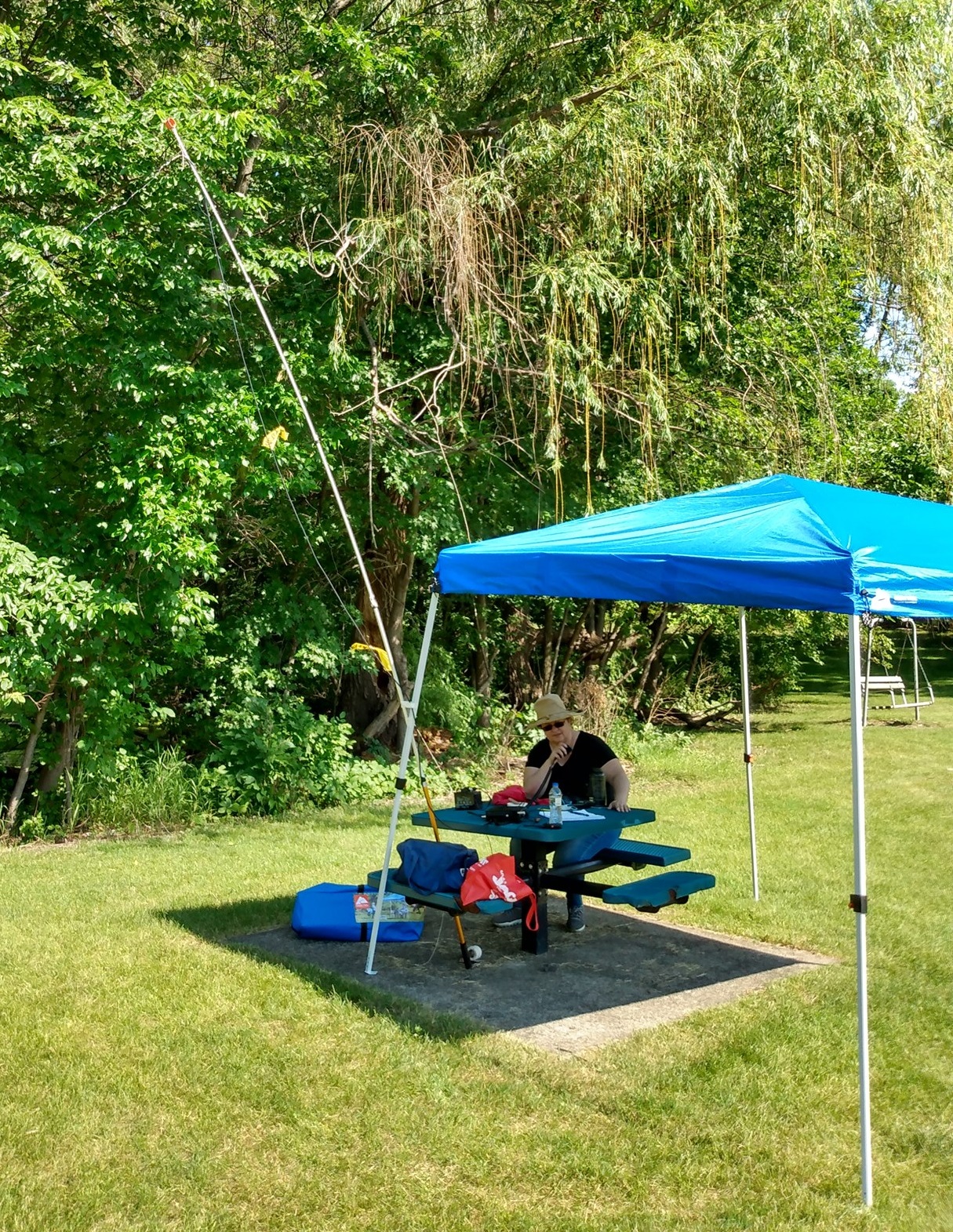
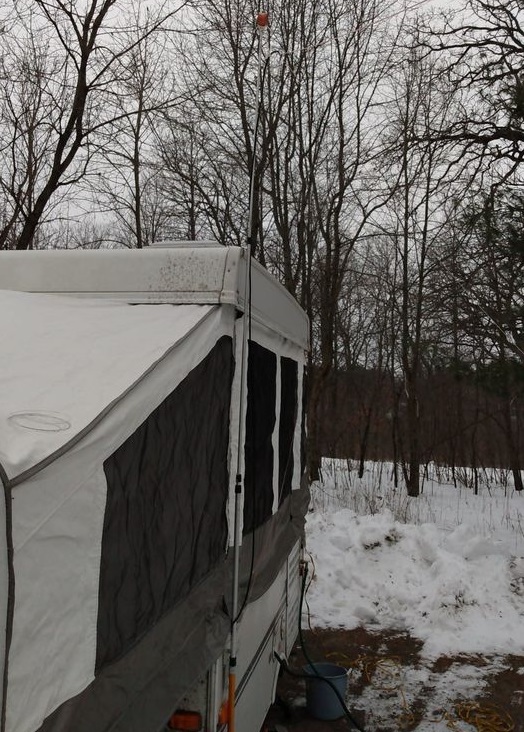
FD1For summer Field Day, my wife and I operated for an hour or two from a city park, shown here.  If it weren’t for all of the naysayers lamenting that they had to stay home for Winter Field Day, I probably would have done something similar and just operated for a while from the back yard, or maybe again from a city park.  But since so many people were lamenting that it was impossible to truly go out and operate away from home, I decided to do a winter camping trip in our popup camper.

I made reservations for William O’Brien State Park, which is only a 45 minute drive from home.  The temperature never got below 20 degrees, and it was actually a very nice weekend for camping.  There were several other campers in the campground.  I spotted three RV’s, as well as three family groups camping in tents.  Also, I believe at least one of the park’s cabins was occupied.  So at least a few non-hams were undaunted by being in the field in the middle of winter, in the middle of a pandemic.

Even though it’s not insulated, the popup camper stays quite warm inside with electric heaters and/or the furnace running.  Since I was paying for the electricity anyway, I used two electric space heaters.  One was plugged into the outlet in the camper, which was hooked up to the campground’s 30 amp circuit.  The other heater was plugged into a separate extension cord going to the campground’s 20 amp circuit.  Therefore, if needed, I could run both heaters full blast.  When I needed the electricity for cooking, I temporarily unplugged one of the heaters.  There was a light dusting of snow Sunday morning, but the camper’s canvas was bone dry by the time I folded it up.

WFD2I didn’t set out to make hundreds of contacts.  In fact, after making the first one, which happened to be with Rhode Island, I felt like I had proved the concept.  But I was on the air for a total of about three hours out of the 24 hours of the contest, and made 27 contacts with 14 states.

Only eight of those contacts were with other portable stations.  Six were outdoors, and two were indoors but at temporary locations.  I’m grateful for the other 19, who were operating at their home stations, since they gave me someone to make contacts with.  But I feel a little sorry for them that they didn’t figure out some way to operate in an actual field for Field Day, even though they couldn’t do it as part of a group.  Also, I was a little bit mystified to hear home stations working other home stations, while calling it Field Day.  For previous Field Days when I’ve stayed home, I’ve often made some contacts, but since it’s Field Day, I’ve made a point to seek out stations who were actually in a field.  There are contests almost every weekend that are geared up for home stations to work other home stations.  I guess I don’t see the point of ignoring those opportunities, and then getting on only for a weekend called Field Day.  Again, I was grateful that I had stations to work, but I really didn’t get the point of home stations spending the whole weekend working other home stations.

My original plan was to use dipoles for 20 and 40 meters, along with a quarter wave wire for 80 meters.  The 80 meter wire was a bust, and didn’t really get out, due undoubtedly to its very low height and lack of much of a ground system.  But the dipole for 20 meters did a great job, and I made all of my contacts on that band.  You can see (just barely) that antenna at left.  It’s held up at the center, inverted-vee style, with my telescoping golf ball retriever, and the ends are tied loosely to some bushes that happened to be at about the right spot.  I was running low on wire before the contest, so I ordered a roll of speaker wire that did the job.  I cut it to the proper length of about 16-1/2 feet, and then unzipped it when it was in place.  I thought I had forgotten to bring a tape measure (it turns out there was one in the toolbox), but I used a six-inch ruler to measure the table, and then used the table to measure the wire.

My original plan was to put up a 40 meter antenna as well, but when 20 meters closed in the early evening, I decided to simply call it a night, and made a few more contacts Sunday morning.  As with most of my NPOTA activations, I operated mostly CW, but also made a few SSB contacts.  I also made one PSK-31 contact using my tablet computer and the DroidPSK app.

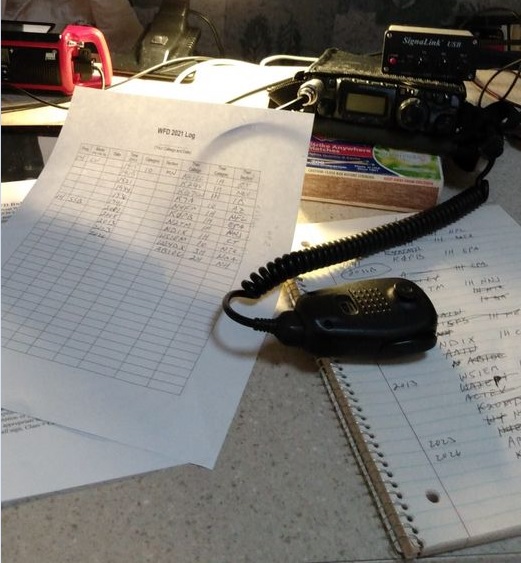
My station consisted of my Yaesu FT-817 powered by a fish-finder battery, which still had plenty of charge left at the end of the contest.  The one digital contact was made possible with the Signalink USB interface, which performed flawlessly with the inexpensive RCA tablet computer.  For some reason, the tablet’s keyboard didn’t work very well with the DroidPSK software, so I had to use the touchscreen, which seemed like a rather laborious process to me.  I probably could have made the process much easier by setting up some macros in advance.  But for the first time using it, I was glad that I was able to make my first ever portable digital contact.

As you can see in the picture above, I needed something to prop up the radio on the table, and a box of matches did a perfect job with this important task.

Am I going to save any lives with my ability to operate a portable station?  Almost certainly not.  On the other hand, if there is ever an emergency, large or small, that makes other forms of communication impossible, I know that I am able to send messages to friends and relatives in other states.  I can do it formally by checking in to a National Traffic System net, or I can do it informally simply by working someone and asking them to make a phone call or send an e-mail for me.  I can also do that for neighbors who want to let their friends in other states know that they’re safe.  I’m also well equipped to receive information from the outside world simply by knowing that I can power up a broadcast receiver to listen to either local or distant stations.  It’s unlikely that I’ll ever have a need, but it’s good to know that I have the ability.

The point of exercises like Field Day is to show that hams can adapt to emergency situations and still be able to communicate.  COVID has shown us that there are some emergencies where you are cut off from the group that normally helps you establish communications.  Can you adapt and still communicate if you are cut off from both this group and your normal station setup?  Field Day and Winter Field Day during COVID gave me the opportunity to show that I can.

Here’s a short video tour of my setup:


Some links on this page are affiliate links, meaning that this site earns a small commission if you make a purchase after clicking on the link.



Product Review: Opinel Pocket Knife

OpinelKnife

Bottom Line:  The Opinel is a very inexpensive and unpretentious high quality knife for your everyday carry needs.

Pre-pandemic, I very rarely carried a pocket knife. When I needed a cutting tool, I looked around the garage or kitchen and found something suitable. In the car, I would find a cheap utility knife in the toolbox which would usually serve the purpose.


But with the pandemic, it seemed that I needed a knife multiple times per day. More often than not, it was to open a box from Amazon or Walmart. I like to do this outside, so that I can immediately discard the outer packaging into the recycling bin. Thus, it became convenient to keep a knife in my pocket. I had several around the house, many of which had been given to me as gifts over the years. The first one I stumbled upon was the Opinel No. 6 Stainless Steel folding knife.

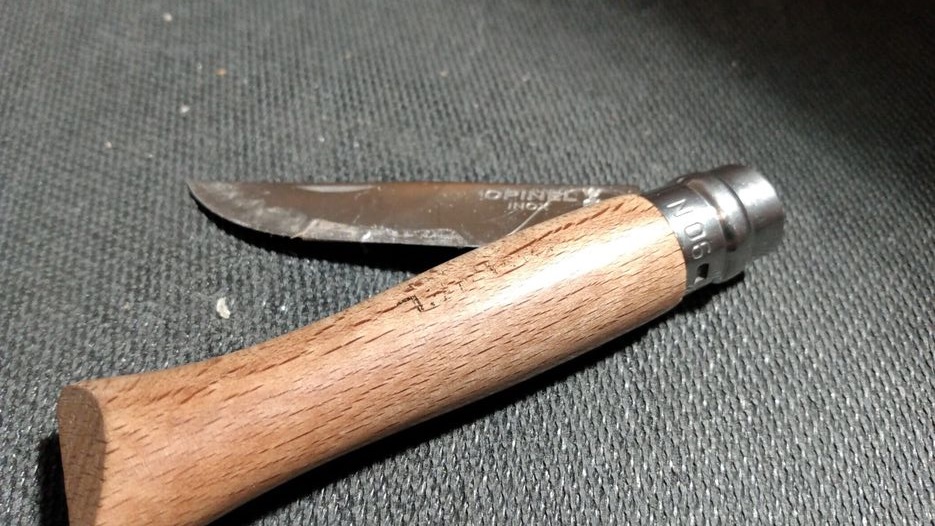
As you can see from the picture, the Opinel is a nondescript knife with a wooden handle. It looks like a tool, which, of course, is exactly what it is. It doesn’t have a camouflage handle. It doesn’t have a built-in screwdriver or can opener. It’s benign looking, and designed for cutting things, a goal which it accomplishes remarkably well. It’s well made, and it seems to keep a cutting edge well. I’ve sharpened it a couple of times with a whetstone, and the edge seems to last.

My version came in stainless steel, and the knife is also available in carbon steel. Apparently, the carbon steel blade holds an edge a bit better, but is more prone to rust. The stainless steel (marked on the blade in French, Inox, short for inoxidable) seems the more practical choice.

The Number 6 in the product name indicates the length of the blade, the number 6 being 2.87 inches. The sizes range from a tiny Number 2, up to a Number 12 with a 4.84 inch blade. The number 6 seems to be the perfect size for the occasional jobs I use it for. In addition to opening boxes, I’ve used it to cut food while camping, strip wire, cut cords, and do the normal variety of tasks for which one would use a pocket knife. It’s big enough to do the jobs I need it for, but as it weighs only about an ounce, I hardly notice it in my pocket.  The blade meets the “under three inches” standard which is important for some regulatory purposes.  (On the other hand, at such time as it becomes safe to fly commercially, I’ll have to remember to leave it at home or in my checked baggage.)

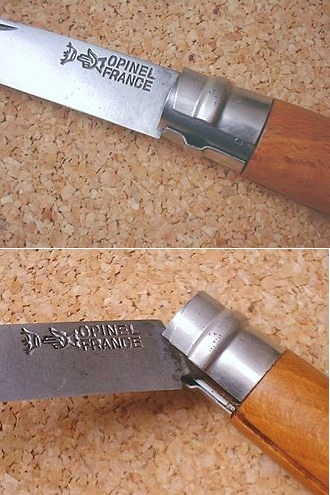
Locking mechanism. Wikipedia photos.

Locking mechanism. Wikipedia photos.

The knife has a simple locking mechanism, which allows the blade to be locked open or closed. It’s simplicity itself–namely, a notched ring which can be twisted to hold the blade in place. In my opinion, most locking mechanisms are annoying and dangerous. If you’re using a knife in such a way that the blade might inadvertently close, then in my opinion, you are using it wrong. And most locking mechanisms I’ve seen require some contortion to disable them, such as holding down a button while moving the blade toward your finger.  In most cases, in my opinion, the “safety” feature of a locking blade makes the knife less safe.   In the case of the Opinel, however, the locking mechanism needn’t be used at all.  In fact, I carried the knife around for quite some time before even realizing that the blade could be locked.

On the rare occasions when I might want to lock the blade on the Opinel, the mechanism and easy and safe to use. You merely rotate the ring to lock or unlock the blade.

Joseph Opinel began making knives in 1890 in Savoie, France, and the knife has always been the quintessential working man’s knife. Picasso reportedly used one as a sculpting tool. Today, about 15 million knives per year roll off the company’s assembly lines.

The Opinel knife is quite inexpensive, but high quality and useful. It’s unpretentious and looks like a tool, so it won’t draw the ire of those who are squeamish about knives. It’s the perfect knife to keep in your pocket. You’ll find you wind up using it several times per day.

Some links are affiliate links, meaning this site receives a small commission if you make a purchase after clicking on the link.



More Sourdough by U.S. Mail

A few months ago, as an experiment, we sent some sourdough starter through the U.S. Mail.  We previously posted the results from one recipient.  The other sample went to Keith at the Successfully Living Simpler blog, and he posted the results.  He claims that he made a “mistake” with the recipe, but I would say that he actually made an “invention” by inadvertently mixing two recipes to make these biscuits.

Early in the pandemic, many people simultaneously decided to take up baking, and yeast became almost impossible to find.  But a single package of store-bought yeast has now been used to make bread in three different states.  And in my refrigerator, I still have the means to continue making it indefinitely.

Home AM Broadcasting: 1960 and 2020

1960AugPECoverSixty years ago this month, the August 1960 issue of Popular Electronics was a particularly good one. In an upcoming post, we’ll feature one of its construction articles, the elusive loudspeaker crystal set.  There’s also a primer on soldering, and a guide to restoring shortwave receivers from the 30s and 40s and turning them into state-of-the-art communications receivers.  There’s even the obligatory one-tube radio, namely a one-tube superregenerative receiver for the FM broadcast band.

The issue also  showed the ambitious cover project, a portable oscilloscope. These days, of course, you can get a much better one at a much lower price, such as the one shown at left, conveniently available on Amazon.

And one particularly intriguing teaser on the cover promises to tell you all about unlicensed two way radio. The magazine was pointing to FCC rules that are still in effect today in more or less the same form, namely Part 15. Among other things, they allow license-free broadcasting on the AM broadcast band, as long as the transmitter input power is less than 100 milliwatts and the antenna is less than 10 feet long (today, strictly speaking, the allowable antenna is now two inches shorter, because the limit is now 3 meters).  Of course, you also need to avoid interference with licensed stations.  The magazine explained how you could use two transmitters, along with two broadcast receivers, for a two-way operation.  It gave other ideas on how to use such a transmitter, such as mounting it in a car, to stay in touch with another car that’s driving with you, or even to talk to the house while driving by.

Back in the day, as the source of your transmitter, the magazine recommended a wireless phono oscillator.  We’ve discussed these before, and they were readily available, either assembled or in kit form, to listen to a phonograph on a nearby radio.  These units usually had a range of 50-100 feet.  But with the full-size (10 foot) antenna carefully placed, the range could be much greater.  According to the magazine, the signal could be picked up by a good car radio a half mile away.

Due to COVID-19, home broadcasting is making a comeback.  In particular, there are many applications where you might want to broadcast to nearby car radios.  A church, for example, can have its service in the parking lot, with churchgoers listening on the car radio.  They can see the altar, but they’re safely distanced in their car.  Along with an inexpensive video projector, neighbors can come together for an impromptu drive-in movie.


Review of the Talking House AM Transmitter

talkinghouseOf course, there’s no such thing as a phono oscillator any more, so where do you get a good transmitter?  The answer is the transmitter shown at the left, the reasonably priced InfOspot Talking House transmitter.  I recently bought one, and I am absolutely amazed at how well it works.

The name derives from the fact that it was originally marketed to real estate agents.  The agent would record a short sales pitch for the house, put a sign outside inviting passers by to tune in to a particular spot on the dial, and the house would literally start selling itself.

Because this is the intended use, the Talking House has a built-in digital recorder.  You can record a continuous loop of up to about five minutes.  Earlier models of the Talking House were capable of only the continuous loop–you couldn’t broadcast live with them.  Before I bought the model shown above, I bought one of the older models on eBay.  It had an excellent transmitter, but wouldn’t work for live programming without some modification.  I was tempted to break out the soldering iron and tap into the audio line, but with the low price of the newer model, I decided to just get it.  The transmitter has two inputs in the back, one for a microphone, and the other for a line-level input, such as from a PA system.  These inputs can be used to record a loop on the built-in digital recorder, or for live audio.  I tested the unit by recording a program on my MP3 player consisting of music and voice.  I set it up in my ground floor home office, stretched out the 3 meter antenna, plugged it in, and went on the air.

You can select any frequency from 530-1700 kHz.  When you plug the transmitter, you can hear a small electric motor running the built-in antenna tuner.  The assures the best possible antenna match, and the best possible signal.  After starting it up, I walked around the house with a portable radio admiring the audio quality.  Then, of course, I hopped in the car to see how far I was getting out.

Given the short antenna inside the house, I was absolutely blown away at how well it got out.  It easily covered the city block.  There were a couple of spots where the signal dropped out slightly, but it was broadcast quality within the block.  I kept driving and driving.  The signal got weaker, but it was still very listenable several blocks away in most directions.  There were spots where it dropped out, but I had almost 100% coverage (with a good car radio) out about a half mile.  When I explored further out, I found many “sweet spots” where I had an excellent signal more than a mile away.  My best DX was over 2 miles, since there were a few places where I could positively identify my signal at that distance.

I’m astonished at how well this transmitter works.  And it is FCC certified as complying with part 15, so there is no question as to its legality.  You only have to ensure that you’re using a vacant spot on the dial so as not to interfere with licensed stations.  In my case, I use 1610 kHz.  In the U.S., that frequency is used only for Traveler Information Service (TIS) stations, and there are none close by.

One might be tempted to purchase an FM transmitter, rather than one for the AM band.  There’s a knee-jerk reaction by some that the audio quality is better on FM.  That’s not necessarily true, since it depends on the quality of the transmitter.  An AM signal can have an excellent frequency response, and the Talking House has excellent audio, probably better than a cheap FM transmitter.

The main problem with buying an FM transmitter is that it’s probably not legal.  The requirements for license-free FM transmitters are such that the signal must be extremely weak to be legal.  A good receiver 100 feet away probably wouldn’t be able to pick it up.  If a transmitter performs better than that, then it’s probably not legal.  If you use it for a few minutes per week, you probably won’t get caught.  But fines are typically in the range of $10,000 per day, and in my opinion, it’s just not worth the risk, particularly since the Talking House AM transmitter works so well.

There are many uses for this transmitter, and it seems like a very useful item to keep on hand.  In addition to drive-in church services and impromptu drive-in movies, it could be very useful to broadcast information in the neighborhood in case of emergency.  It comes with a “wall wart” power supply for the 18 volts needed to power the unit.  It could be run on batteries, but since the wall wart’s ground lead is an integral part of the unit’s antenna system, it seems best to run it on a small inverter power supply in an emergency, even the smallest of which would be adequate.

One accessory that is necessary if using an external audio source is an audio isolation transformer, to prevent ground loops.  When I plug in my MP3 player, it sounds great.  But if hook up to an AC adapter, the hum overwhelms the signal.  The isolation transformer prevents this.  It’s necessary if feeding the audio from any device, such as a computer, that is plugged in to the AC power.

If, for whatever reason, you want to legally broadcast, and have people be able to listen to you up to a mile away, sixty years ago, I would have told you to go to Lafayette or Allied and get a good phono oscillator.  And today, it’s even easier.  All you need is a Talking House transmitter, and you’ll be on the air the same day your Amazon order arrives.