Category Archives: Emergency Preparedness

Product Review: Great Value Pulled Pork in BBQ Sauce

PulledPork3CarSurvivalKit

Bottom Line:  Relatively expensive, but good way to add some variety to your survival kit.

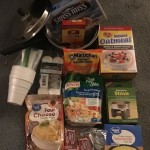
We’ve previously reported about the importance of a car winter survival kit, to make sure you have enough food in the car to keep yourself reasonably comfortable if stranded. Recently, for example, a winter storm stranded motorists on Interstate 95 in Virginia for over 24 hours. As we showed previously, the kit in our car contains mostly dry food, and we have water and a means of cooking in the car.

One item that was lacking from the original kit was meat, or any type of protein for that matter. I corrected that after Christmas by buying a Hickory Farms meat and cheese gift package at a steep after-Christmas closeout discount, similar to the one shown at right.

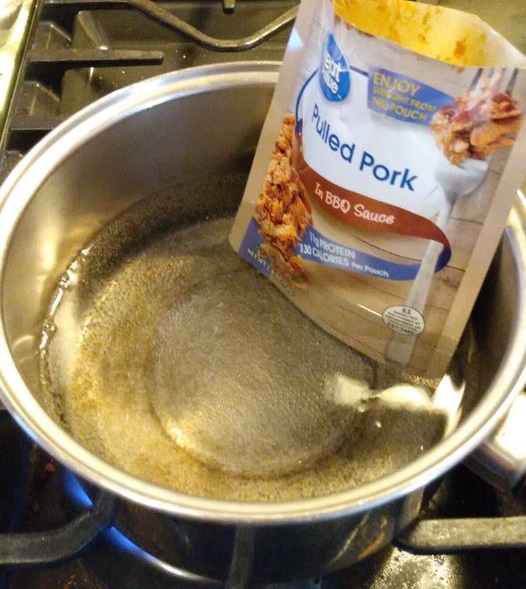
PulledPork2Another item recently caught my eye, and that was the pouch of Great Value Pulled Pork in BBQ Sauce from Walmart. Its already cooked, so it only needs to be warmed up. Of course, in an emergency, it could be eaten cold. It’s best on a bun, but any kind of bread or crackers would work fine.  You could also eat it right out of the pouch, or together with one of the other dishes in the survival kit, such as the rice or mashed potatoes.

To test it at home, I was originally going to heat it up in the microwave, but I realized that I should just warm it up as I would in the car. Since I have in the survival kit an emergency stove and a pan, I decided to duplicate this at home. To keep from getting the pan dirty, I heated up water and simply placed the pouch in the water. Of course, in an emergency, if water is short, you can still use the water for drinking or cooking. More likely than not, if I had to heat it up in the car while stranded, I would be using melted snow.

The finished product was better than I expected. It made a reasonably filling lunch, and in an emergency, a hot sandwich (or even just hot meat out of the pouch) would seem luxurious.

This product wouldn’t be viable for a large portion of your emergency food storage. The 2.8 ounce pouch cost $1.28. It provides 11 grams of protein, and only 130 calories. By contrast, a jar of peanut butter, for only a little bit more money, provides 2520 calories and 98 grams of protein. According to Harvard University, the recommended daily protein intake is 0.36 grams per pound. So a person weighing 150 pounds should get about 54 grams per day. This means that for long-term storage, the peanut butter is a much better value. But for a day or two, the pulled pork would add a few calories to your diet, provide a welcome hot meal, albeit a small one, and provide you with some protein. And it’s quite possible that the contents of the car witner survival kit will be frozen when you need them. Thawing a pouch of meat is probably a lot easier than figuring out how to thaw a jar of peanut butter.

The package I bought had a “best by” date of November 2024, almost three years in the future. So I’ll definitely be tossing some in the car survival kit. I hope I don’t have to use them until a future family survival picnic.

Incidentally, if the package looks familiar, that’s because this type of packaging is also used for tuna, another possible choice for the survival kit.


Some links on this site are affiliate links, meaning this site earns a small commission if you make a purchase after clicking the link. However, the Walmart link above is not an affiliate link.

Yacht as Fallout Shelter, 1962

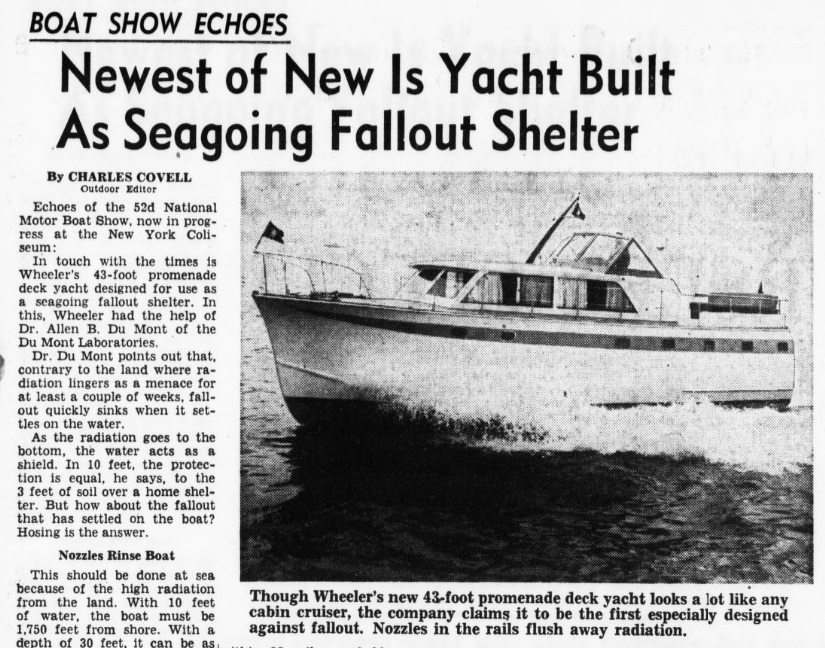
1962Jan16WashEveningStarSixty years ago today, the January 16, 1962, issue of the Washington Evening Star carried this feature by its outdoor editor about one of the stars of the New York Motor Boat Show. This craft was touted as a seagoing fallout shelter. The craft was from the Wheeler Yacht Company, which had teamed up with a name familiar to students of television history, namely Dr. Allen B. Du Mont, one of the pioneers of television.

The principle behind using a boat is sound, as described by Du Mont. Fallout is almost invariably heavier than water, and sinks to the bottom. If the water is 10 feet deep, this means that there is 10 feet of water between the fallout and the boat, which is equivalent to 3 feet of earth, giving excellent protection. Of course, fallout might have settled on the boat, so it was equipped with nozzles for cleaning the deck. Fallout on shore was dealt with through distance, by keeping the boat a minimum of 750 feet from shore. Of course, the ship did nothing to protect against blast and fire, and noted that it would need to be at least 35 miles from ground zero at the time of blast.

For a more detailed look at the concept of using boats for fallout protection, see the 1963 report from the U.S. Naval Radiological Defense Laboratory, Civil Defense Utilization of Ships and Boats.


Lady Bird Johnson Tours Fallout Shelter, 1961

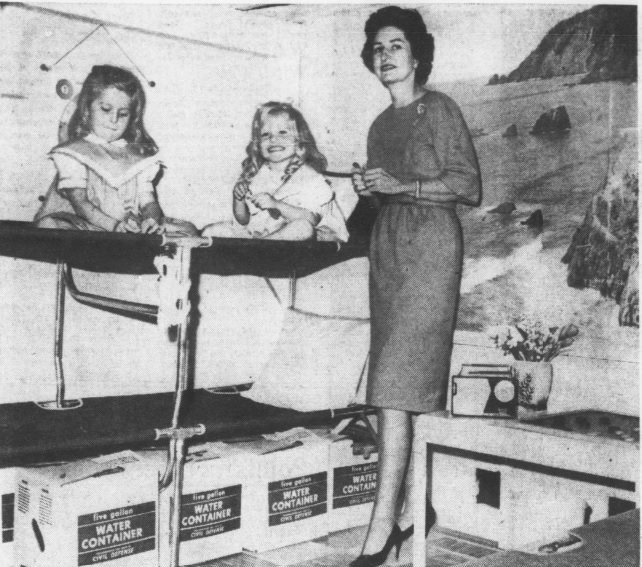
DamascusMdFalloutShelterShown here is second lady Lady Bird Johnson touring a fallout shelter at the home of John R. Bryan, Jr., 25014 Woodfield Drive, Damascus, Maryland.

Because of his official duties as Training and Education Officer with the Office of Civil Defense, Mr. Bryan would be on duty at such time as the shelter was occupied, but he built it, at an expense of about $300 for the benefit of his wife, daughters, and mother in law.

According to the Washington Evening Star, the shelter was surprisingly cheerful looking, with yellow walls. It measured 10 by 11, with a height of six feet. Concrete blocks eight feet thick surrounded it. About 40 gallons of water were stored in the shelter, with an additional 160 gallons in tanks in the basement connected to the shelter by a hose. Food consisted largely of canned goods, with crackers and other items. A canned heat stove was on hand to heat meals, but when Bryan participated in a shelter occupancy experiment, it was discovered that this type of stove was very slow to heat the food. They also had a ratemeter and dosimeter, and as shown above, a portable radio. Little money was spent on furnishings, since most were hand-me-downs or camping gear.

The children slept on the double-decker cots, and one cot was left out during the day for seating. Another cot was unfolded at night for sleeping. A folding table rounded out the furnishings. Toilet facilities consisted of a portable toilet using plastic bags, which would be sealed in food cannisters after they had been emptied.


Re-use of N95 Masks

Most N95 respirators are intended to be disposed of after a single use. However, during the first months of the COVID-19 pandemic, there were insufficient numbers of respirators for healthcare workers, and strategies for preserving the supplies were necessary. Therefore, the Centers for Disease Control published strategies for reusing masks, rather than disposing of them after each use. Those strategies were published online.
As of May 2021, that agency reported that the supply of approved respirators has increased significantly, and most healthcare facilities should resume conventional practices, namely, disposing of masks after one use.

However, with the increased availability of N95 masks, many consumers are using them for protection outside of the healthcare context. We have previously published a review of some of the available N95 and KN95 masks.

While they are now readily available, the cost might be prohibitive if a whole family wears them all day and then has to dispose of them. Therefore, many consumers may want to employ the same strategies to be able to use a single mask for more than a single use.

I rarely wear an N95 mask for more than a few minutes at a time, and it’s usually in relatively low-risk situations, such as a supermarket. Therefore, it would be extremely expensive to discard it each time. Therefore, I store the mask and re-use it at a later time. I use a procedure similar to these instructions from the North Dakota Department of Health, which show the approved procedure for re-use.  Basically, I carefully remove the mask in a brown paper bag until the next use.  This video from the University of Nebraska is a good overview of the procedure:

If you are looking for particular masks, I have used and recommend all of the following, all of which are made in the USA. You can view my full review of these masks at this link. (Note that availability varies, but all of these are usually available at Amazon. You may need to search for different colors or different size packages.


Some links on this page are affiliate links, meaning that this site earns a small commission if you make a purchase after clicking on the link.

Plain Facts About Fallout Shelters: 1961

1961DecPS1Yesterday, we featured some fallout shelter designs from the December 1961 issue of Popular Mechanics. The public relations department at the Office of Civil Defense must have been working overtime, because that month’s issue of Popular Science also carried a feature entitled “Plain Facts About Fallout Shelters.” The Popular Science article was written mostly in Question and Answer format. It started by noting that those who build fallout shelters in the past kept it secret for fear they would be considered crazy. But according to the magazine, “safety precautions against the ravages of atomic war no longer reveal old-maidish nervousness but admirable prudence.”

Unfortunately, the magazine lamented that many buyers, as well as builders, of shelters didn’t know what they were doing. So the article is devoted to dispelling some misconceptions and providing good information.

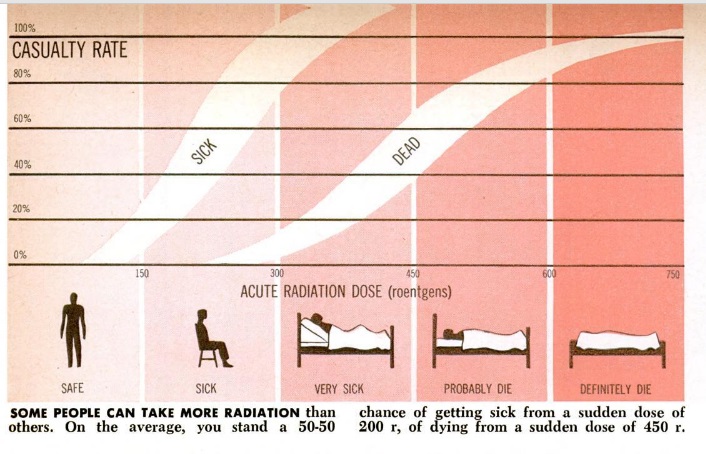
The chart above illustrates that radiation is not necessarily fatal, but the dose is the key factor. The stress on fallout shelters was because much of the country would be free from the immediate effects of the blast, but would be subject to deadly fallout. The general idea was that if you were in the “probably die” category, you would want to move yourself up to “sick,” or even better yet, to “safe.” And a fallout shelter would do that for millions of Americans.

After explaining the basics, the magazine urged readers to write to the Office of Civil Defense for further information. It also made the reminder to check local building codes before starting work.


1961 Fallout Shelter Designs

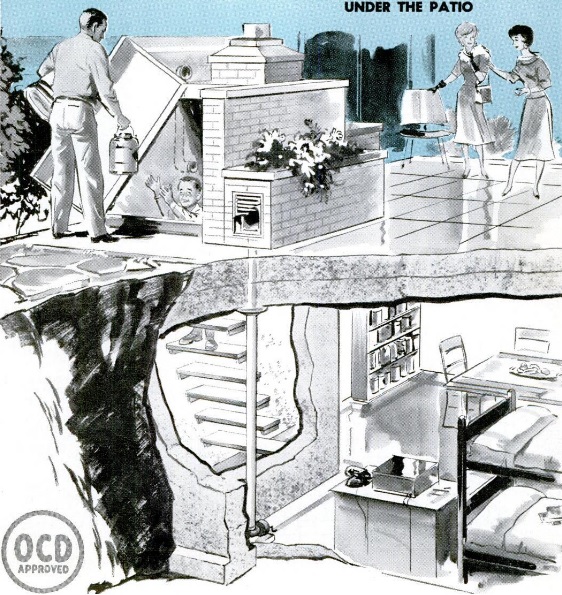
1961DecPM1Sixty years ago this month, the Cuban Missile Crisis was still almost a year off, but protection from nuclear weapons was already on the minds of many Americans, and the December 1961 issue of Popular Mechanics carried construction details for four fallout shelters. The deluxe model shown above, with an estimated cost of $1841 (about $17,000 in 2021 dollars) was typical of that offered by commercial builders. It was an underground room that could be used in peacetime for some other use, with an attractive patio on top, complete with a built-in grill.

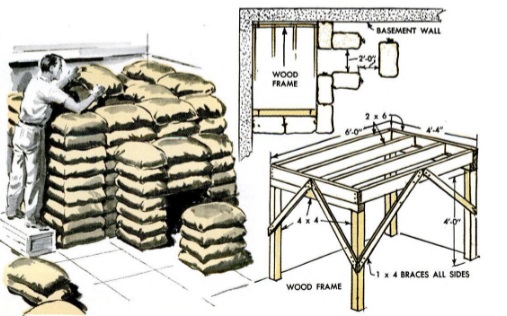
1961DecPM2The other end of the cost spectrum was represented by the design shown at left courtesy of Prof. R.M. Stephenson of the University of Connecticut’s nuclear engineering program. He estimated that the design would reduce radiation levels by a factor of 200-1000, meaning that it would save lives even in areas of high fallout. The material consisted of 100 sandbags, 10,000 pounds of dry sand, and some miscellaneous lumber, with a cost of only $30 ($279 in 2021 dollars).

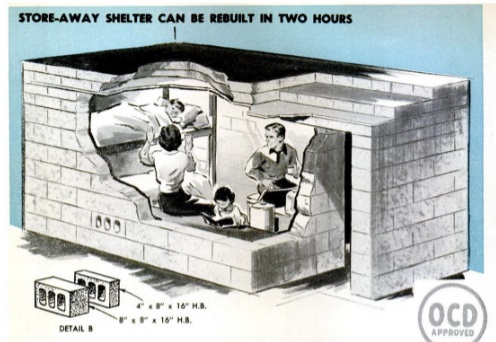
1961DecPM3The next least expensive was the design shown at right, with an estimated cost of $97 (about $900 in 2021). The initial construction of this design was done prior to the emergency, requiring about 33 hours of labor. A wooden frame was mounted to the wall with a hinge for the ceiling, with the concrete blocks stored nearby. In time of emergency, the construction could be completed in about two hours, assuming you were in a hurry, which you probably would be. To save space in this shelter, food and water was to be stored outside, with the occupants brining in a one or two day supply.

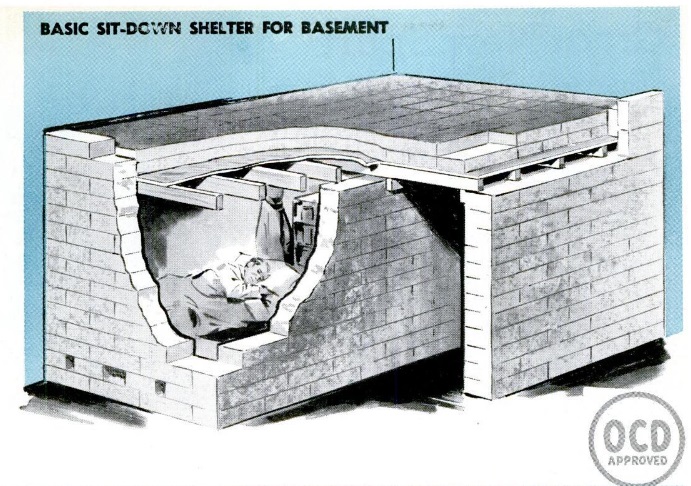
The final design, shown below, could shelter four persons at a cost of $280 ($2600 in 2021 dollars). This design was made mostly of concrete block. Some lumber was used, and the designers recommended that any lumber in contact with existing basement floor or walls be coated with tar or white lead paste to prevent rot.

The magazine offered a booklet with more details about the designs, and also directed readers to the Office of Civil Defense for more free information.1961DecPM4


1946 Compass/Match Case/Fire Starter

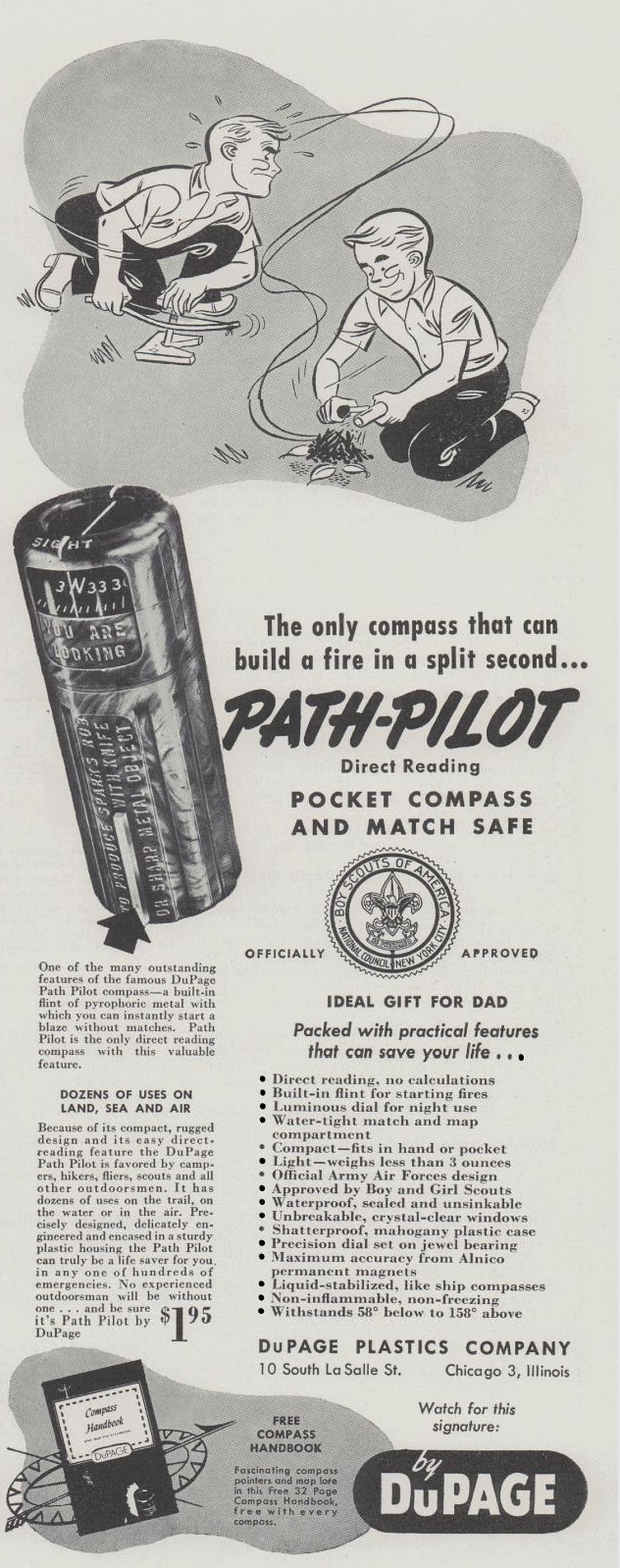
1946OctBLSeventy-five years ago this month, the well equipped Scout might have in his pack this combination compass, match safe, and fire starter. A compass was at the top, with a window to view the direction. To avoid confusion, the window was labeled “YOU ARE LOOKING” to make clear that if you saw an N, then you were looking north, rather than having the N printed on the north side of the dial.

Matches were stored in a watertight container, but just in case you ran out, the side had a “flint of pyrophoric metal” that could be struck by a knife. The ad declared that it was the only compass “that can build a fire in a split second,” and I’m guessing that would be done with one of the matches inside. With practice, the flint would probably work, but it would take some practice, and probably wouldn’t happen in a split second.

The product was manufactured by the DuPage Plastics Company, 10 South LaSalle Street, Chicago. It was officially approved by the BSA, and is advertised here in the October 1946 issue of Boys’ Life.


While this particular model is no longer available, there is a modern replacement, shown at left. I have one of these, and while I’m not sure it’s from the same manufacturer, it looks identical. There’s a compartment for storing matches, and as far as I can tell, it is waterproof. Strike anywhere matches are still available, but they’re often hard to find. I simply use regular strike on box matches and include one of the strikers from the box inside with the matches. If all else fails, it does include on the side what is now called a ferro rod.

The modern version also includes a whistle, which is quite loud, as well as a tiny mirror inside the cap, which presumably could be used for signaling.

I’m guessing that the compass on the 75 year old version was better than the modern one, but the modern one does, indeed, work. You have to be careful, however, because if you don’t hold it perfectly level, it will bind up and not move. The best way to use it is to check it once, and then check a second time to make sure that north hasn’t moved.

Especially if you buy the three pack, the modern version is very inexpensive.  Like this Scout 75 years ago, it’s not a bad idea to have one of this in your pack.


Some links on this page are affiliate links, meaning that this site earns a small commission if you make a purchase after clicking on the link.

Expedient Tent Frame

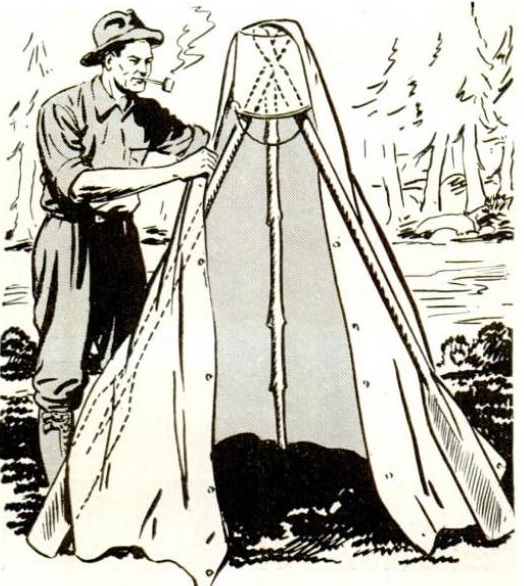
1941OctPMEighty years ago this month, the October 1941 issue of Popular Mechanics carried this self-explanatory idea to quickly make an emergency tent with materials that might be at hand. Any poles of similar length could be used, but in this case, it’s two oars and another stick of the same size. To quickly turn them into a tripod, a bucket is placed over the ends as shown. The frame is then covered with a piece of canvas or other available material.

If the idea looks familiar, it’s probably because we previously showed how to make a similar tripod for cooking using an empty can.


1921 San Antonio Flood

Today marks the 100th anniversary of floods in San Antonio, Texas, that killed 215 and caused $19 million in damage.

On September 7, a hurricane made landfall near Tampico, Mexico. It lost cyclonic characteristics the same day, but the storm remnants were forced northward. It stalled over central Texas, causing the devastating flooding in San Antonio and other areas. Some stations reported as much as 40 inches of rain in a 24 hour period.


How to Use USPS General Delivery

generaldeliveryOccasionally, we need to write about very simple concepts, because we have discovered that those simple concepts are at risk of being lost to the ages. For example, you can find on our website instructions on how to make coffee without electricity.

Another simple concept that many people apparently don’t know about is the concept of General Delivery.  Did you know that you can receive a letter or package by snail mail, even if you don’t have your own address?  You can, and you can do it at almost any Post Office in the United States, or indeed, in the world?

I mailed the letter shown above to myself, but it didn’t come to my home or business.  I picked it up at the Post Office in another state where I don’t live, and have no connection.  I did this by mailing it to myself at “General Delivery.”  I waited a few days, and then picked it up at the Post Office in the town to which I sent it.

Why You Might Need General Delivery

MovingImageHHSdotGOVThere are many reasons why someone may need to take advantage of the General Delivery service.  When I asked the postal clerk, she said that the most common reason was people who were temporarily between addresses and had to receive mail.  For example, someone might move out of one apartment but can’t move into their new home for a few days.  In the meantime, they might stay in a hotel or stay with friends.  If they don’t know exactly where they are going to be staying, but need to receive mail during this time, they can receive mail by General Delivery.

NPSRVphotoGeneral Delivery is also useful for people who are traveling.  For example, many full-time RV’ers take advantage of General Delivery.  If you live in an RV, you probably have a permanent address set up somewhere.  But if you decide to order something on Amazon, you will want it sent to you on the road.  If you know exactly where you will be staying, sometimes you can have it sent to the campground or motel.  But if you don’t know exactly where you will be staying, you can take advantage of General Delivery.

NPSApTrphotoGeneral Delivery can also be part of an outdoor experience.  For example, hikers hiking a long distance, such as thru-hikers on the Appalachian Trail can arrange to have supplies such as food and clothing mailed to them at towns along the trail.

One way to send money to a stranded traveler is to send them a Postal Money Order via General Delivery.  They can usually cash the money order right at the Post Office.  (For more information on money orders, see my Money Order Basics page.)

If you are ever relocated due to a natural disaster or emergency, General Delivery could be an important way to stay in touch.  If you are displaced, you can ask friends to send you needed items or even money by General Delivery to the closest Post Office.  After a disaster, the Post Office is often one of the first services to re-emerge.  And in outlying areas away from the disaster, it will probably continue to operate without interruption.  If you are forced to relocate, then General Delivery can provide you with a needed mailing address.

There might be situations where someone needs to receive mail without the knowledge of their roommates or nosy neighbors.  If so, they can arrange to have the item sent by General Delivery.  Or, there might be situations where a service is provided only to persons with an address in a certain ZIP code.  A General Delivery address might provide that ZIP code.  Finally, General Delivery provides a method for homeless persons to receive mail.

In short, any time you need to receive mail but don’t have an address, you can use a General Delivery address.

How and When To Send General Delivery

Practically anything that can be sent by mail can be sent to General Delivery.  It can be a letter or a package.  To make sure you get it, you’ll need to make sure that the sender follows these instructions carefully.

First of all, they need to figure out when to mail it.  There might be exceptions, but you can generally plan on the Post Office holding the item for about two weeks.  If they send the item too late, then it won’t arrive in time.  But if they send it too early, then it might be returned to the sender before you pick it up.

In my example above, I mailed the letter from Minneapolis, MN, on a Monday.  I went to the Post Office to pick it up on Thursday, but it hadn’t arrived.  I went back a week later (a total of 10 days after mailing) and it was there.  I would recommend planning on it taking about one week, so have them mail it one week before you plan to pick it up.

If the timing is more critical, then it might be best to send the item by Priority Mail or Express Mail.  If you mail early enough in the day, then Express Mail is almost always delivered the next day, almost anywhere in the country.

Finding a Post Office

Next, you need to decide on the Post Office at which you will get the letter.  Most Post Offices offer General Delivery, but not all of them do.  There are exceptions, but in large cities and their suburbs, General Delivery is available only at the main downtown Post Office.  For example, I live in the Minneapolis-St. Paul area.  In Minneapolis and suburbs, the ZIP codes begin with 554.  In St. Paul and suburbs, the ZIP codes start with 551.  In those suburbs with 551 and 554 ZIP codes, General Delivery is available only at the downtown Post Office.  You can’t get general delivery at the neighborhood Post Office.  This is true in other cities as well.  For example, in Chicago, in any area with a 606 ZIP code, the only place to get General Delivery is the main downtown Post Office.

If you live or work downtown, this is great.  But going downtown isn’t particularly convenient for many people these days, so if you are in an urban area, the most convenient place to get General Delivery might be an outlying suburb.  In general, if the first three digits of the ZIP code are not the same as the main city Post Office, then that Post Office will have General Delivery service.  So in the Minneapolis-St. Paul area, most of these outlying suburbs have a ZIP code starting with 550.  In general, all of these post offices offer general delivery.  Since I had to drive a few miles anyway, I decided to send my experimental General Delivery letter to another state, to Hudson, Wisconsin, ZIP code 54016.

In general, small town Post Offices will have General Delivery available.  If you are sending something to a larger city, then you will need to check more carefully on which post office to use.

There are exceptions to all of these rules, so before deciding on a Post Office to use, you should look it up on the USPS website.  From the main page, select “Find USPS Locations” from the menu.  Then, click on the Post Office you are interested in.  The hours will be listed.  For larger towns, it will be open about 9:00-5:00 Monday through Friday, and Saturday mornings.  Almost all Post Offices will be closed on Sunday.  In small towns, the hours might be much more limited, such as just a couple of hours in the morning.  So before selecting a Post Office, be sure to check that you will be in that town at a time when the Post Office is open.

generaldelivery2Then, scroll down to “Services at this Location.”  If General Delivery is offered, it will be shown on this list.  If it’s not listed, you’ll need to pick another Post Office.

After confirming that the Post Office offers General Delivery service, scroll to the top of the page, where you will see thegeneraldelivery3 address of the Post Office.  The street address is shown.  You’ll obviously need this information later, so that you can find the Post Office to get your letter.  The person sending the letter, however, will not need the street address.  Instead, they will need the City, State, and first five digits of the ZIP code (but not the last four).  So in this example, they will need:  HUDSON, WI 54016

Addressing the Letter

Once you have found a Post Office where you can get your item, the sender can address the letter or package.  The letter should be addressed with your full name.   You will need to show identification when you pick up the letter, so make sure the letter is addressed to your real name, and not a nickname.  The second line of the address should be:  GENERAL DELIVERY.  The third line of the address should be the City, State, and ZIP code.  The nine-digit zip code for General Delivery always ends in -9999.  So they should include this after the five digit ZIP.  So in the example above, the ZIP code is 54016-9999.

Here’s an example of the address.  You are sending a letter to John Q. Public, and he will pick it up at the main Post Office in New York City at 421 8th Avenue:

John Q. Public
General Delivery
New York, NY  10001-9999

Make sure the sender includes their return address.  If something goes wrong, the letter will be returned to them.  Of course, they should make sure to include enough postage, which they can calculate online.  If it’s a small item they’re sending, the postage for a letter of up to one ounce is 63 cents (as of April 2023), or one “Forever” stamp.  (For information on how to buy stamps, see our Buying Stamps During Quarantine page.)

Picking Up Your Item

After you have given enough time for your letter or package to arrive, you simply go to the Post Office to which it was sent.  Just tell the clerk that you are expecting a General Delivery letter or package.  They’ll go to the back room, and if it’s arrived, they will bring it out.  You will need to show identification.  When I picked up my letter, my out-of-state driver’s license was all I needed for ID.

General Delivery in Other Countries

The instructions on this page are specific to the United States, but most other countries offer the same service.  So if you are traveling in another country and need to receive mail, you can probably take advantage of this service there.  In most other countries, the service is called “Poste Restante

Other Alternatives

The USPS is not the only way to send items if you don’t have a permanent address.  Private delivery services such as UPS and FedEx allow you to pick up packages at fixed locations.  However, USPS is still the least expensive.  You can send a letter anywhere in the United States for only 55 cents.

And keep in mind that if you are buying an item from Amazon, another alternative is to have it sent to one of their lockers  located all over the country.

The USPS official information about General Delivery can be found on their website.


Some links on this website are affiliate links, meaning that this site earns a small commission if you make a purchase after using the link.