Due to the cornavirus pandemic, schools around the country and around the world are grappling with the issue of how to provide instruction to students by distance learning. It isn’t a new phenomenon, however, as shown by this article from the October 15, 1937, issue of Broadcasting magazinei
During a Chicago polio epidemic, schools were closed, and the city’s radio stations banded together to broadcast classes for students at home. The program was so successful that it was to continue even after school was back in session. Broadcasts would not duplicate material from school, but would supplement it, with a cultural value directed at both adults and children. The city’s stations would each donate 15 minutes per day of airtime to the programs.
Other schools facing quarantine were looking to Chicago’s successful venture as inspiration for their own. The Chicago schools had been contacted by educators and broadcasters in the U.S. and Canada for pointers.
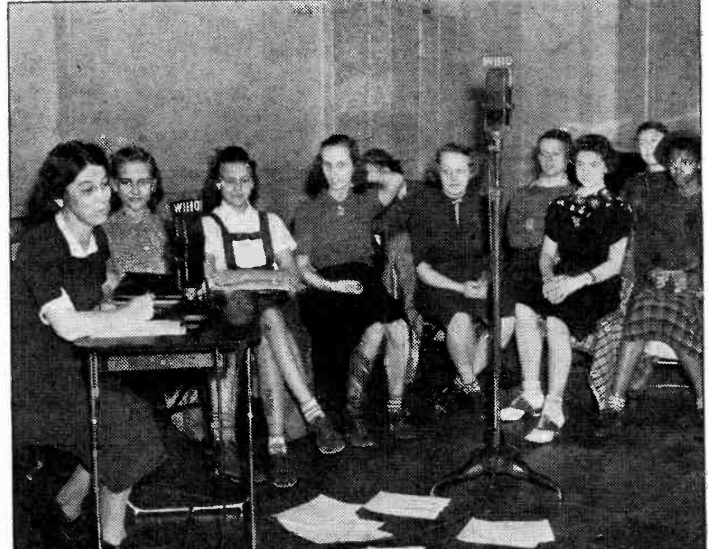
The photo above is another example from 1938. This one isn’t because of an epidemic, but because of a fiscal emergency in Dayton, Ohio, as recounted in an earlier post.
Crowds descending on Virginia to view 1970 eclipse. NASA photo.
Today marks the 50th anniversary of the total solar eclipse of Saturday, March 7, 1970. As I previously recounted, this was the first eclipse I witnessed. That eclipse began in the Pacific and had a path of totality that crossed southern Mexico before entering the Gulf of Mexico.
Then, the shadow hit the United States , first in Florida, then Georgia, then the Carolinas and Virginia, then grazing Maryland before heading back out to sea, saying goodbye to the United States at Nantucket.
For those with Learjets, it then crossed Nova Scotia, Newfoundland, and the French island of Miquelon, before heading out to sea again into the North Atlantic.
Where I was in Minnesota, it only covered 47% of the sun at high noon. If nobody had told me about it, I probably wouldn’t have noticed. It didn’t get dark outside, and no animals were confused by sudden darkness. But that day, it was the biggest deal in the world. The moon contained fresh footprints of Americans who had walked on its surface less than a year earlier. Now that same moon was casting its shadow over me.
To me and my fellow third graders, it was presented as a big deal. And it was a big deal. If there had ever been any doubt about it, yes, the moon went around the earth, the earth went around the sun, and sometimes they got in the way of each other. Any third grader could see tangible proof.
In school, we had learned all about umbras and penumbras, and by the time the big day came, I was an expert on all things eclipse. With a shoebox, some foil, and a note card, I constructed myself a pinhole viewer. I figured that if a pinhole was good, then a giant hole would be even better. Fortunately, my mom corrected my error and got the viewer in good working order.
I pointed the box at the sun coming in the window, and sure enough, there was a little crescent shape of sunlight coming in through the round hole, plainly visible on the note card.
Perhaps I was a little disappointed at the tiny size of the image, but it didn’t matter. Right there in my shoebox was proof positive that the moon orbits the earth. I didn’t have to take anyone else’s word for it. The proof was right before my eyes.
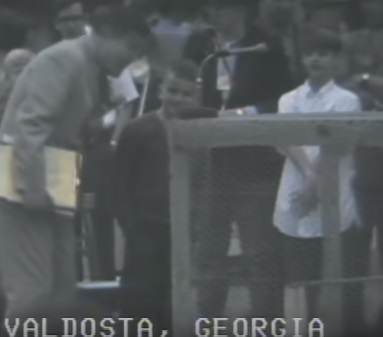
The home movie here shows some of my contemporaries in North Carolina who had the fortune of being in the path of totality:
From our location, we had to turn on the TV to see the full effect, and we witnessed the darkened skies and the amazed reactions of those who went outside to see it. I don’t remember too many details about the TV coverage. Mostly, I remember some poor confused rooster in Georgia crowing in the middle of the day.
I believe it was the CBS coverage that I watched on TV fifty years ago today, and that broadcast is available on YouTube. (You can hear the rooster at 22:23.)
Here is another reminiscence of another kid who was older than I was and who lived closer to the path of totality. As he recounts, he was able to talk his dad into driving him the 200 miles to totality where he was able to set up his telescope and take some photos.
When my friends and I got back to school the next Monday, the eclipse was the topic of conversation. We knew how the universe worked, because we had seen it with our own eyes. It was a big deal, and the kids remembered it.
In 1970, we were over a thousand miles away from the path of totality, and going to see it wasn’t really an option. But I envied those people and roosters on TV who got to see it in person.
The next total solar eclipse in North America will take place on Monday, April 8, 2024, just over four years from now. The path of totality will be a narrow strip passing through Mexico and Canada, and the states of Texas, Oklahoma, Arkansas, Missouri, Illinois, Kentucky, Indiana, Michigan, Ohio, Pennsylvania, New York, Vermont, New Hampshire, and Maine. The path of totality includes a number of large cities, including, San Antonio, Austin, Fort Worth, Dallas, Little Rock, Indianapolis, Cleveland, Buffalo, and Rochester. That path through Canada will include Windsor, ON, and Montreal.
My family went to see the 2017 eclipse, and the 2024 eclipse will be within a days’ drive of most of the population of the United States. It’s an unforgettable experience, and you should plan on seeing it, just over four years from now. It will be a school day, and if 2017 is any guide, most schools will fail to do anything meaningful. I rarely encourage truancy, but kids should skip school that day, and instead travel to the zone of totality. When I’m substitute teaching, I tell kids to ask their science teacher on the first day of the 2023-24 school year if there will be a field trip to see the eclipse. If the teacher balks, then I tell them they should plan on skipping school. From where I live in Minnesota, it’s a day’s drive to Illinois or Indiana to view it. Kids who are currently sixth grade and older will probably have their driver’s licenses by then. And all of the kids probably have parents who can take them.
You should also pencil in the 2024 eclipse on your calendar. Keep following OneTubeRadio.com, and we’ll certainly remind you. My experience from 2016 is that if you make your travel plans about one year in advance, there will be plenty of inexpensive accommodations available. If you are a student or parent, then you should plan on bugging the science teacher in September 2023 about organizing a trip. Just as I tell the kids here, if he or she doesn’t seem enthused, then you should take matters into your own hands.
When I’m teaching a class, there are often one or two kids in the class whose parents took them to see the 2017 eclipse. I ask them if it was the coolest thing they had ever seen, and they invariably say that it was. If you had asked me fifty years ago, I would have said that it was pretty cool, even though I was stuck mostly watching it on TV. It took 47 years to actually go see a total eclipse in person, and I can vouch for the fact that it was indeed the coolest thing ever.
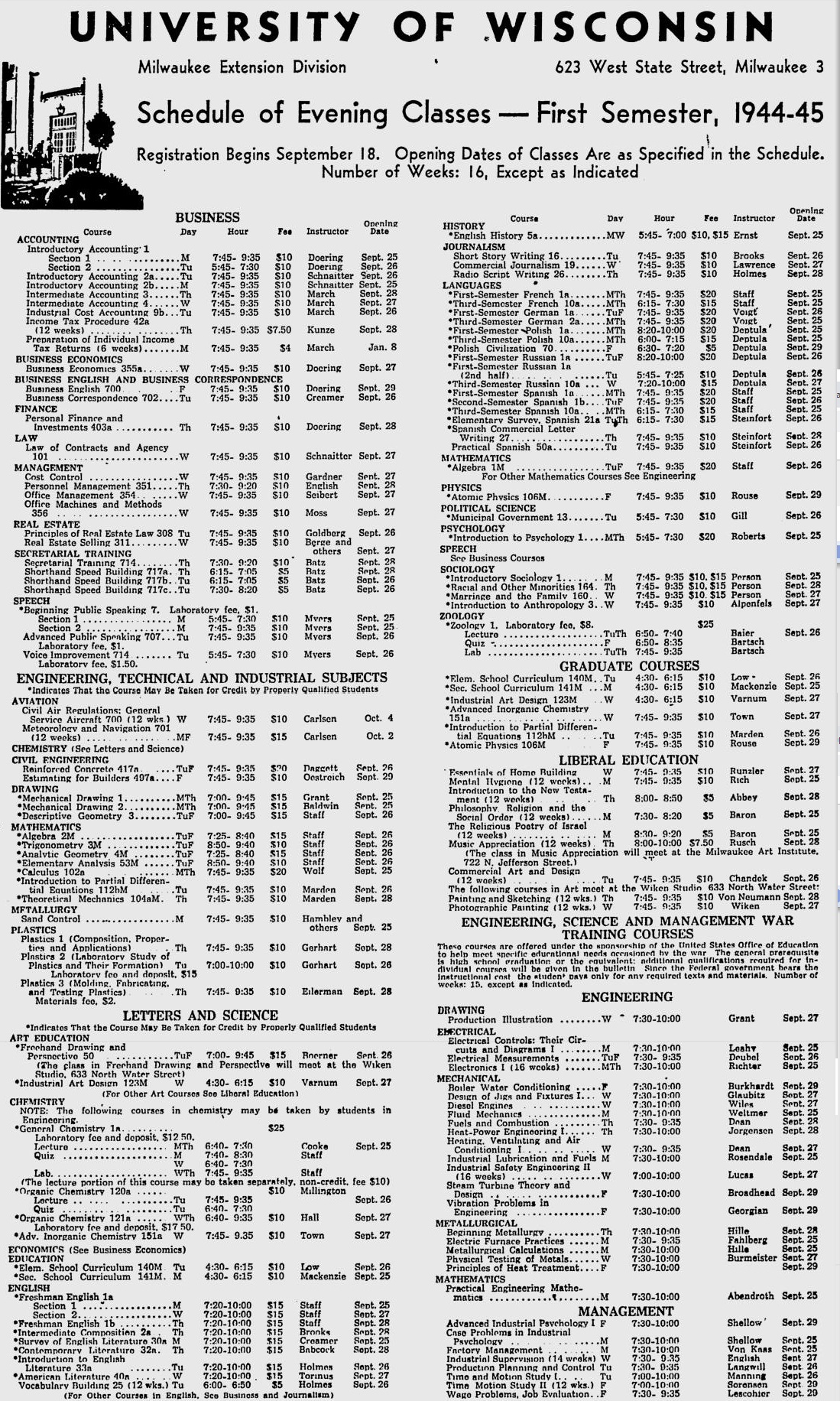
The engineering and management courses were offered under sponsorship of the U.S. Office of Education to meet war needs. Accordingly, no tuition was charged for those courses, other than the cost of texts and materials. Tuition for other courses ranged from $4 to $25.
For a larger version of the image, from most browsers, click twice to enlarge.
My son’s high school freshman year didn’t include stellar grades. In fact, it included failing his geography class. There were two causes of this. The major cause was the traditional reason, namely, a failure to apply himself. He might have squeaked by with a passing grade, but when he finally handed in quality work, the teacher was already convinced that he was incapable of quality work. So she accused him of cheating, even though she admitted that she couldn’t prove it. Since she couldn’t prove it, she instead gave him poor grades, meaning that the average score for the course was still a failing grade. As a result, he had to make up the course over the summer.
One option, of course, was to send him to summer school. Logistically, this wasn’t a convenient option for us. And there was still a chance that subjective grading would keep him from passing the course. Therefore, after some research, we settled upon The Keystone School, which offers a number of “credit recovery” courses. The school, even though it is apparently accredited in Pennsylvania, does not actually offer the credit itself. Instead, before enrollment, an official from his home school, in his case, the counselor, has to sign the application. Keystone School then reports the scores to the home school, and the home school changes the grade from an F to a grade of P, a passing grade. The school agreed that this was a suitable option, and signed the application.
We were a bit hesitant, since many of the online reviews I saw were rather poor. Many of the criticisms in these reviews were justified, but for our purposes, the course actually served us quite well. For families in different situations, those shortcomings could prove to be very frustrating, so please use caution before registering.
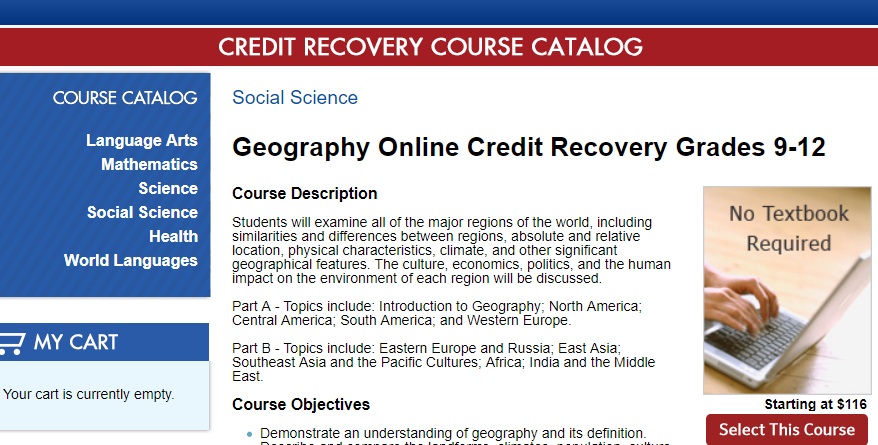
The school’s course catalog can be found at this link. The course my son took was entitled “Geography Online Credit Recovery Grades 9-12,” and the tuition was $155 for two semester credits. It was also possible to take one semester credit for $116. The course goes quite fast, so I’m glad I paid for both credits at the same time.
There were many technical glitches with the course. In fact, he was never able to view some portions of it. I suspect we would have eventually figured out how to view all of the material, as we probably needed to update some of the software on our computer. For example, most of the lessons included at least a few videos and Flash presentations that we never were able to open.
The bulk of the lessons consisted of slides similar to the one shown at the left. These are interspersed with videos, links to other websites, and the various Flash plugins that we weren’t able to view. Fortunately, most, but not all, of the missing elements had a PDF transcript that he could open, which contained the same information. These actually proved to be more convenient, since the text could be searched when taking the open-book quizzes.
For some students, the missing elements might have caused a major problem. It’s likely that problem could have been solved by updating our software, but in my son’s case, having the missing items wasn’t a major problem.
This is because the course is set up so that the student takes a quiz for each unit before reviewing that unit. Each quiz can be taken up to three times, and the student is instructed to take it the first time as a pre-test for the unit. If the student passes the quiz (it appears that 70% is the passing score), then the student simply moves on to the next unit.
With one exception, my son passed all of the quizzes (usually with a score of 90% or 100%) on the first try. Therefore, he was never required to actually review the lessons. However, for many of the chapters, he did open the lessons and quickly review them. (The method for doing this was somewhat counter-intuitive. From the course main page, he had to click on “Start Here,” and then on “Table of Contents.” From the table of contents, he had to right click on the unit he wanted to view, and then open that unit in a new tab. For some reason, it didn’t work to open the lessons by left clicking.) He usually had one or more tabs open with the course materials, with the open book quiz in another tab. He was able to answer most of the questions from his prior knowledge (much of it presumably learned in the class he failed). Other questions required him to regurgitate material from the lessons, so he would search for the material in the other tab.
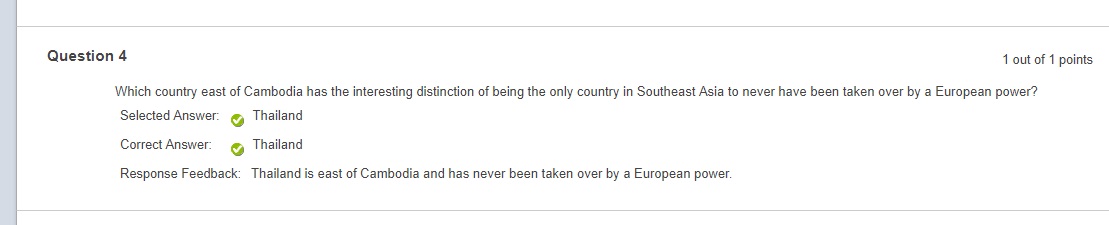
Most questions were relevant, but quite a few were somewhat confusing. A few of the answers were simply wrong, such as the one below. But he picked the least wrong answer, which turned out to be the right answer. (Thailand is not east of Cambodia):
Over the course of about a month, my son passed the course (with a score in the high 90’s). He probably learned a few things (such as the true location of Thailand in relation to Cambodia), but more importantly, the school will accept the credits and change his grade from failing to passing. The technical glitches weren’t a problem, because he used the Keystone course essentially only to “test out” of the subject. If he needed to actually learn something from the course, it wouldn’t have worked very well. But despite the shortcomings, it was vastly superior to bringing him to summer school, and the $155 was well spent.
Seventy-five years ago, the over 170,000 students in the Philadelphia schools were getting a good dose of the fourth “R.” In addition to reading, ‘riting, and ‘rithmatic, the schools were taking full advantage of Radio. Thanks to the community spirit of the city’s commercial radio stations, regular lessons were scheduled. For example, for the elementary grades, WFIL carried “Studio Schoolhouse,” an educational program three days a week. The Monday program allowed the students, left, to participate in dramatized scripts about how they could help the war effort.
The pictures and accompanying article appeared in the June 1944 issue of Tune In magazine.
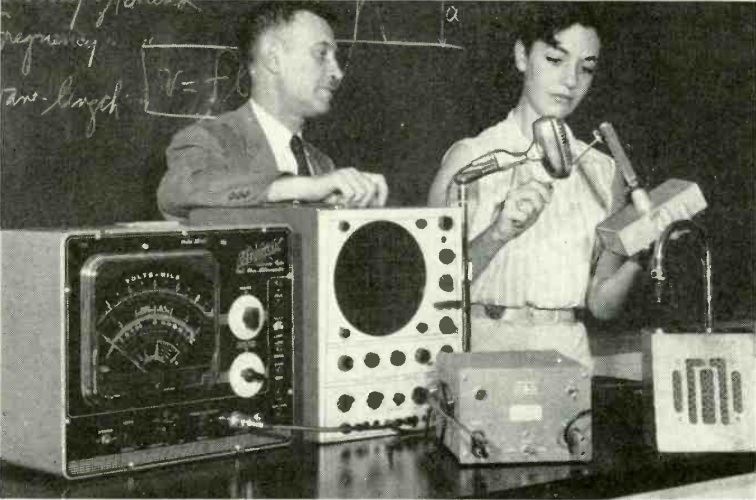
The student and instructor shown here are demonstrating properties of sound, thanks in part to $300 million in federal funds made available to high schools by the Science Education Bill. The February 1959 issue of Radio Electronics gives some ideas of how electronic equipment can be worked into the curriculum. The article suggested that many phenomenon, such as sound, can be converted into electrical energy by appropriate transducers. Here, a scope, audio amplifier, and giant VTVM are used to demonstrate properties of sound.
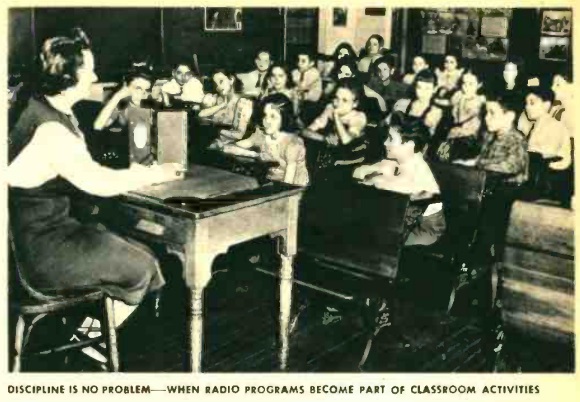
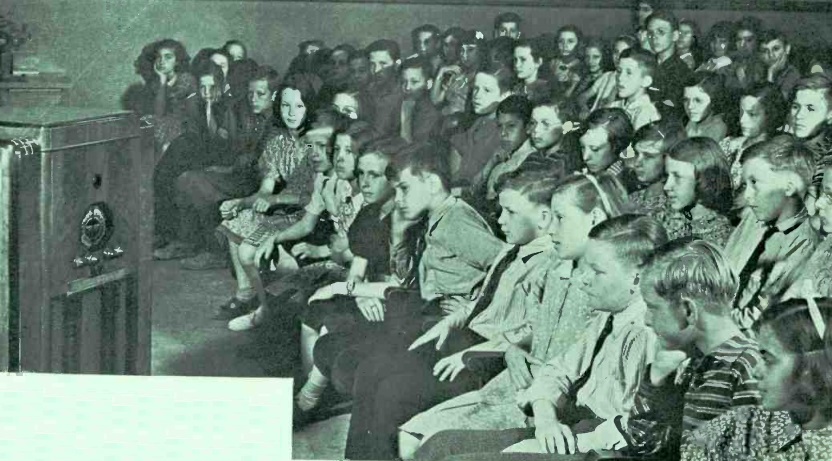
Eighty years ago this month, the January 1939 issue of Radio Retailing devoted most of its pages to the use of radio in education. Of course, the focus was on how the dealer could tap this market. The most basic use of radio, of course, is shown above. A set is brought into the classroom for these Midwestern students to listen to a program of educational value.
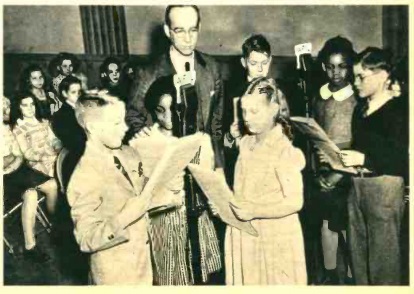
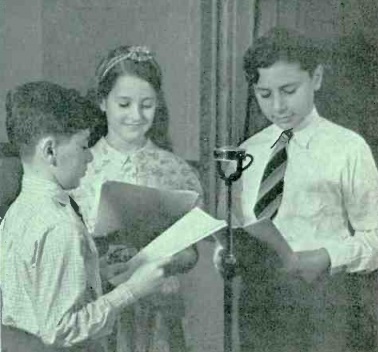
Wiring the school with a public address system would be, of course, a lucrative sale. In addition to being able to make announcements immediately, the magazine suggested educational uses for the equipment. Below, for example, students who handed in the best writing are allowed to broadcast their work over the PA.
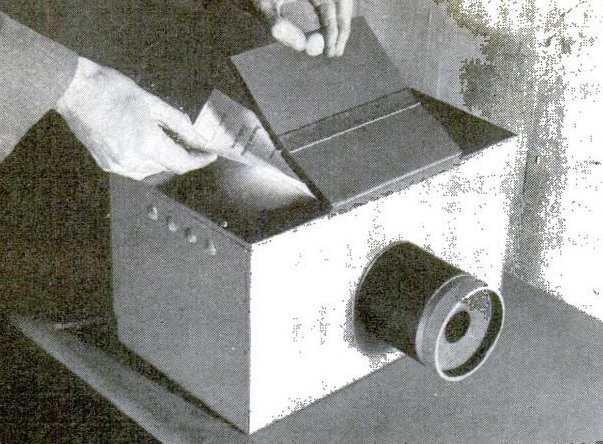
During my school days in the 1960s and 1970s, the teacher would occasionally wheel out a monstrosity known as the opaque projector. It would project the image of an opaque object, such as the page of a book, onto a screen. Apparently, the models of that era had about a 1000 watt lamp inside, and their size was due in part to the fact that they required a big fan to keep it cool. The process also required a lens that was quite large.
The projector was rarely used. Instead, it was much more common to copy the desired image onto a transparency, which was projected with the much more common overhead projector.
75 years ago this month, the September 1943 issue of Popular Science showed how to make an opaque projector. The article doesn’t seem to specify the wattage of the bulbs, but since ordinary household bulbs are shown, I assume that they would be 100 watts. The lens is made from one, or preferably two, magnifying glasses mounted in a tube.
The opaque projector has been more or less replaced by the document camera, such as the one shown here on Amazon, which can be viewed through the video projector that is now found in almost all American classrooms.
It’s almost that time of year again to shop for back-to-school supplies. Back in my day, that was a relatively straightforward proposition. Parents went to the store to purchase supplies such as crayons, pens, pencils, and notebooks. Especially as kids got older, the family’s shopping list was sometimes supplemented by a list from the teacher. That list often included the more esoteric items such as protractors, compasses, and other specialty items. It was clearly understood, however, that the supplies that each child brought to school were intended for that child. In fact, it was frequently requested that the items be marked with the child’s name.
At some point, an enterprising teacher came up with the idea of requesting a few communal supplies. This probably started innocently enough, when some teacher noticed that stores were selling certain items as loss leaders. For example, a discount store might advertise that it was selling glue sticks for 5 cents, a price well below cost, and much less expensive than the school’s normal supplier.
So if a teacher needed a supply of glue sticks to last the year, asking the parents to buy a few made perfect economic sense: Each parent spent only a few pennies to buy a few extra glue sticks. This saved the school a larger amount of money by not having to buy at the higher price. It was a win-win situation for all involved, except perhaps the store. But the store went in with its eyes wide open, fully realizing that they were going to lose money on the glue sticks.
Unfortunately, however, this whole system eventually got out of hand. The technique worked so well that the size of the lists kept getting larger and larger. And unfortunately, the list was no longer limited to loss leaders. Eventually, teachers began demanding specific brand name products, without regard to cost or availability. In fact, since the lists were public knowledge, retailers could be careful not to sell any of the listed items at a loss.
As a result, procuring all of the items on the list became a financial burden, to the point where some parents could no longer afford to purchase the full list. As a result, the children became either the “haves” or the “have nots.” Some children came from families that could afford the expensive designer label glue sticks. But other families could not. Chances are, all or most of the children would have been able to afford the cheap loss leaders. But some could not afford the expensive versions that were now demanded by the lists.
Perhaps correctly, someone noticed that this wasn’t fair: Some children came to school with all of the supplies. But some came with no supplies. At this point, a decision was made to make all supplies communal. Gone were the days when teachers recommended placing the child’s name on supplies. With the advent of communal school supplies, parents were now prohibited from labeling them with the child’s name. Children no longer had their own pencils. Instead, they brought the requested brand-name pencils to school, in accordance with their abilities. Then, the children helped themselves to the now free pencils in accordance with their perceived need.
Since some parents could no longer afford to buy the expensive designer brand names, the remaining parents were required to provide them in larger and larger quantities. This, in turn, resulted in a greater economic burden, meaning that the number of “have not” children kept increasing.
Of course, the communal supplies generally aren’t as well cared for as personal property, further increasing the expense. And since parents are buying communal supplies anyway, the teacher naturally adds a few other needed communal items, such as Kleenex, cleaning supplies, and dry erase markers. For many of these items, the children (whose parents bought them) are not allowed to use them.
As with most forms of communism, this is not sustainable, and it will soon enter a death spiral as fewer and fewer parents can afford to purchase all of the required supplies. But in the meantime, the few remaining “have” parents are expected to purchase the items on the growing lists.
Eventually, there will be a rebellion. But in the meantime, you can ease some of the pain by taking advantage of the school lists at Walmart.com. You can search for your school by zip code and view the lists. In some cases, the expensive brand names won’t be available at Walmart. But if they are, you can purchase online, or at least do price comparison online. Since the prices are the same nationally, there’s less chance of a particular item’s price being manipulated because a local retailer knows it’s required by a local list. If you do purchase online, in most cases, you have the option of picking up your order at the store. I’ve used this service a number of times, and it works quite well. You simply go to the counter, show your ID, and your entire order is brought to you, without have to fight the crowds in the back to school aisles.
Links in this post are affiliate links, meaning that this website receives a commission if you order after viewing the link.
This teacher and students are holding class in 1938 in the studios of WHIO, Dayton, Ohio, as shown in the December 3, 1938 issue of Radio Guide.
The teacher was apparently working without pay, but most of her colleagues weren’t quite so generous. The Dayton Board of Education “ran out of funds,” and the city’s 1300 teachers refused to continue without pay, leaving the 34,000 students without the possibility of public education. The station’s owner stepped in and volunteered the station’s facilities to cope with the emergency.
In cooperation with the superintendent, the station quickly revamped the station’s schedule to broadcast emergency lessons. Four periods of instruction were organized, supplemented by educational programs from the networks. As a result, students were able to spend a couple of hours per day receiving expert instruction. The Emergency School of the Air included classes in English, Biology, Chemistry, General Science, Physics, Vocational Guidance, Latin, French, Spanish, German, Bookkeeping, Geography, American History, Mathematics, Civics, Art, and Music.

 Due to the cornavirus pandemic, schools around the country and around the world are grappling with the issue of how to provide instruction to students by distance learning. It isn’t a new phenomenon, however, as shown by this article from the October 15, 1937, issue of Broadcasting magazinei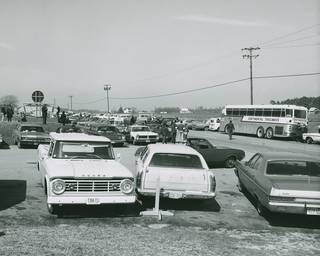





 The opaque projector has been more or less replaced by the document camera, such as the one shown here on Amazon, which can be viewed through the video projector that is now found in almost all American classrooms.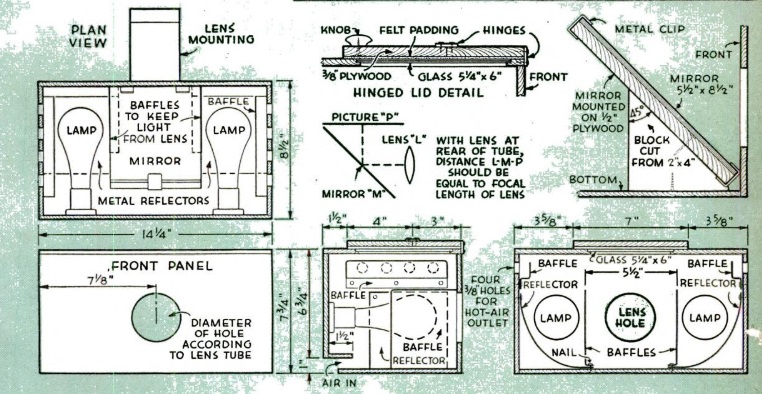

 It’s almost that time of year again to shop for back-to-school supplies. Back in my day, that was a relatively straightforward proposition. Parents went to the store to purchase supplies such as crayons, pens, pencils, and notebooks. Especially as kids got older, the family’s shopping list was sometimes supplemented by a list from the teacher. That list often included the more esoteric items such as protractors,
 compasses, and other specialty items. It was clearly understood, however, that the supplies that each child brought to school were intended for that child. In fact, it was frequently requested that the items be marked with the child’s name.
 At some point, an enterprising teacher came up with the idea of requesting a few communal supplies. This probably started innocently enough, when some teacher noticed that stores were selling certain items as loss leaders. For example, a discount store might advertise that it was selling glue sticks for 5 cents, a price well below cost, and much less expensive than the school’s normal supplier.
 Of course, the communal supplies generally aren’t as well cared for as personal property, further increasing the expense. And since parents are buying communal supplies anyway, the teacher naturally adds a few other needed communal items, such as Kleenex, cleaning supplies, and
  . You can search for your school by zip code and view the lists. In some cases, the expensive brand names won’t be available at Walmart. But if they are, you can purchase online, or at least do price comparison online. Since the prices are the same nationally, there’s less chance of a particular item’s price being manipulated because a local retailer knows it’s required by a local list. If you do purchase online, in most cases, you have the option of picking up your order at the store. I’ve used this service a number of times, and it works quite well. You simply go to the counter, show your ID, and your entire order is brought to you, without have to fight the crowds in the back to school aisles.