Author Archives: clem.law@usa.net

1942 Home Master-Slave Clock System

1942OctPracMechEighty years ago this month, the October 1942 issue of the British Practical Mechanics
noted that battery clocks were in great demand because of the war. In the event of a cut-off of the electric mains, householders would be without a means of keeping track of time, and the battery clock was a solution. As shown above, you could build a system of clocks for your house. The master clock could be anywhere in the house, and it could be wired to any number of “slave” clocks. Plans for the master clock had appeared in an earlier edition of the magazine, and complete blueprints were available for two shillings. Once the time was set on the master clock, all other clocks in the house would keep accurate time.

1942OctPracMech2To build the slave clocks, “the first thing to obtain is an old clock.” Most of the innards were removed, leaving only the two cogs behind the face, controlling the minute and hour hands (or “fingers,” as the author called them). At that point comes the task of making a cog wheel with 60 teeth, which “requires some care, but it may be easily made” by cutting a sheet of steel or brass, and then filing out 60 teeth.

Once a minute, the mater clock would send a pulse, which would advance the long hand–er, finger–by one minute. The author reported that he powered his system by a battery tucked away, floating on a trickle charger, and that his had been in operation for a few years with no problems.

1942OctPracMech3The 1942 clock is quite elegant. But of course, today it would be of little practical value, since the cost of an extremely accurate battery operated clock is close to zero, as shown below. But for the person who constructed the 1942 version, I’m sure there was a sense of pride that the modern version can’t deliver.


Some links on this site are affiliate links, meaning this site earns a small commission if you make a purchase after using the link.

1922 Skywriting

1922OctSciInvThis artist’s conception of skywriting appeared a hundred years ago this month, in the October 1922 issue of Science and Invention.

While this advertisement never appeared in the skies of New York, the magazine did report that London residents, startled by the sound of an airplane, found the words “Daily Mail” written in the sky.

The magazine reported that the plane’s exhaust was routed through a tank containing oils and chemicals to produce the writing, described as dense black smoke.

The term “skywriting” had apparently not yet been coined, and the magazine’s title for the article was simply “Airplane Writes Words in Smoke.”


1952 Transatlantic Television Ideas

1952OctWirelessWorldSeventy years ago this month, the October 1952 issue of the British Wireless World carried this illustration showing possible methods of linking American and European television. The diagram had actually first appeared two months earlier in the August 1952 issue of Tele-Tech as part of an open letter to the President of the United States (which would have been Harry S Truman) imploring action on TV networking with Europe and South America.  According to the magazine, American homes would be able to view the great events of Europe, live, but “the underprivileged of Europe can be shown the wonderful richness of life in America.”

The diagram showed the potential methods, the first of which being an “airplane-relay between a dozen or more express planes continuously flying a regular route across the ocean,” presumably carrying 16-mm film.

The next idea was Stratovision, the use of a string of aircraft aloft, each relaying the signal to the next plane. As we previously showed, this system was tested, and even used to a certain extent, in the United States. But doing it over the Atlantic would require a set of aircraft carriers on which the planes could land, which would likely make the idea much less feasible.

The next idea was a string of VHF relay stations through Labrador, Baffin Island, Greenland, Iceland, the Faeroe Islands, and the Shetland Islands. The longest link would be 290 miles, meaning that the idea might be feasible. If this idea sounds familiar, it’s because it’s similar to one we talked about earlier, one proposed by David Sarnoff in 1951, although his plan envisioned the link going the other way, over the Bering Strait. Other ideas included a submarine coaxial cable, or scatter transmission, essentially the use of brute force to propagate VHF signals over the horizon. It also mentioned “miscellaneous marginal proposals,” such as use of moon reflections, which of course depended on the moon being visible over both continents, which would happen for about five hours per day.

One of the first transatlantic broadcasts was the coronation of Queen Elizabeth the following year. It was first seen on American television courtesy of 16-mm film flown by the RAF to Gander, Newfoundland, to the CBC, which was then picked up by American networks. The first live transatlantic broadcast didn’t take place until 1962, and it relied upon a method not anticipated by the 1952 article, namely, the use of the Telstar 1 satellite.  While Telstar was the first transatlantic use of satellite, it should be pointed out that it wasn’t the first television transmission by satellite. Those honors go to Echo 1, which successfully relayed signals via a passive reflector between the east and west coasts of the U.S.


1937 Precision Sundial

1937OctPSaIf Junior decides to make a sundial for the Science Fair project, he or she could just order a kit from Amazon, slap it together, and hope for the best, undoubtedly a participation ribbon.

But if they have some basic mechanical aptitude, they can’t go wrong by putting together the advanced model shown here, from the October 1937 issue of Popular Science. This sundial will be able to read the correct time to within about a minute. It’s a bit more complicated to operate, but it’s quite easy once you get the hang of it.

The dial is fixed in place, with the axis pointed at the North Star. This means that the dial is mounted at an angle the same as your latitude, pointing due north. To read the time, you move the upper part of the dial so that the pointer P is casting a shadow on the figure-8 (known as the analemma.)

Once that shadow is positioned, then the time is read directly from the pointer T, which is pointing at the time. The article explains how to calibrate the dial, which has markings every five minutes. With these, you should be able to interpolate the time to within one minute. As an added bonus, the shadow on the analemma shows the approximate date.

Parts are all readily available.  The dial itself is a cake pan.


Some links on this site are affiliate links, meaning that this site earns a small commission if you make a purchase after following the link.

BBC 100th Anniversary

Portion of 2LO's original transmitter. Wikipedia photo.

Portion of 2LO’s original transmitter. Wikipedia photo.

This year marks the 100th anniversary of the BBC, the British Broadcasting Corporation. It was incorporated as a private enterprise, as the British Broadcasting Company, on October 18, 1922, and first hit the airwaves on 350 meters (857 kHz) on November 14, 1922, as station 2LO.  2LO had actually come on the air earlier, for an hour a day starting on May 11, 1922.

You can read more of the BBC’s history at their website.  Most of our readers on the American side of the Pond will undoubtedly be most familiar with the  signature tunes and interval signals of the World Service in the video below.  (And the familiar tune does indeed have a name, namely, Lilliburlero.)


British 1952 One-Tube Broadcast Set

1952OctPracWirSeventy years ago this month, the October 1952 issue of the British journal Practical Wireless showed how to put together this handsome little one-tube receiver for mediumwave and longwave. With even a short indoor antenna, it would pull in a large number of stations, both from Britain and the continent.

The magazine pointed out that the set was obviously much more sensitive than a crystal set, but as the beginner gained more experience, it would serve as the basis for a loudspeaker set, with the addition of an amplifier.

The tube (or “valve” as it’s known on the other side of the Pond), could be a 1N5, 1N5GT,  Mullard DF33, or Marconi/Osram Z14.

1952OctPracWir2


Partial Solar Eclipse of 25 October 2022

On 25 October 2022, there will be a partial solar eclipse over most of Europe, northern Africa, the Middle East, and western Asia. While not nearly as spectacular as a total solar eclipse, if you are in the area where the eclipse will be visible, it is certainly worth observing.

Since the sun is never completely obscured, it is dangerous to look directly at the sun. However, you can view it indirectly by projecting it, as shown in this picture. You can use a pair of binoculars or telescope to do this. You do not look through the binoculars or telescope. Instead, you point the binoculars at the sun, and point the other end at the ground or other flat surface. You will then see a projected image.

While this picture shows a relatively expensive telescope, this is not necessary.  A good image can be projected with even a pair of toy binoculars.  See the NASA website for more ideas on viewing the eclipse.  You can also view our page from the 2017 U.S. eclipse.

The eclipse will be visible first over Greenland at 08:58 UTC, and will end over India at 13:02 UTC. The peak eclipse will be visible over Siberia at 11:00 UTC. To find the exact times for your location, use this interactive map.

Those with an interest in radio will want  to experience how the partial eclipse affects radio propagation.  During the 2017 eclipse, I found that there was a very noticeable effect on propagation on 40 meters.  Those with just a mediumwave or longwave receiver will probably discover that stations normally heard only at night can be picked up during the day, due to the eclipse.

Solar eclipses and lunar eclipses come in pairs, about two weeks apart.  The corresponding lunar eclipse will be visible in North America on November 7-8.


First Flight From Aircraft Carrier, 1922

USS Langley. Wikipedia photo.

USS Langley. Wikipedia photo.

A hundred years ago today, October 17, 1922, marked the first time that an aircraft took off from a U.S. aircraft carrier, the USS Langley (CV-1).  While aircraft had previously taken off from ships, this was the first time that a ship specifically designed for that purpose had been used.  The ship had previously been a collier in World War 1, and had been newly converted.  That first plane was piloted by Lt. Virgil C. Griffin.

The ship had served as a collier in World War I, and was converted to a seaplane tender prior to World War II, in which she also served.  The ship was damaged in 1942 and scuttled.


Signal Corps Recruiting Ad, 1942

Eighty years ago this month, the October 1942 issue of Radio News carried this ad announcing that the U.S. Army Signal Corps was open for direct enlistment.  As long as they had not received notice of induction, young men ages 18 and 19 could sign up, as long as they were physically fit.  And up through ages 45, men with some experience in the communications industry could enlist as long as they passed the physical exam.

The ad appears to be paid for by Hallicrafters, probably as a way of keeping their name before the public, despite not being able to sell their wares for the duration.


1942 2-1/2 Meter WERS Transceiver

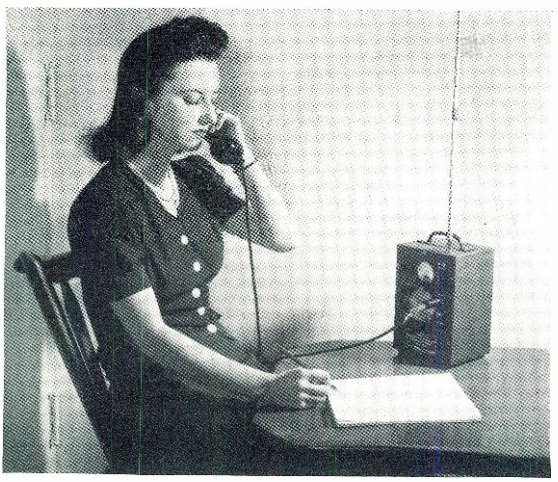
1942OctQSTEighty years ago this month, the October 1942 issue of QST featured on its cover this transceiver for the 2-1/2 meter WERS band.

The set was designed by George Grammer, W1DF, and the operator shown here is John Huntoon, W1LVQ, later W1RW, who was then communications manager of the ARRL. Huntoon went on to become ARRL Secretary and General Manager.

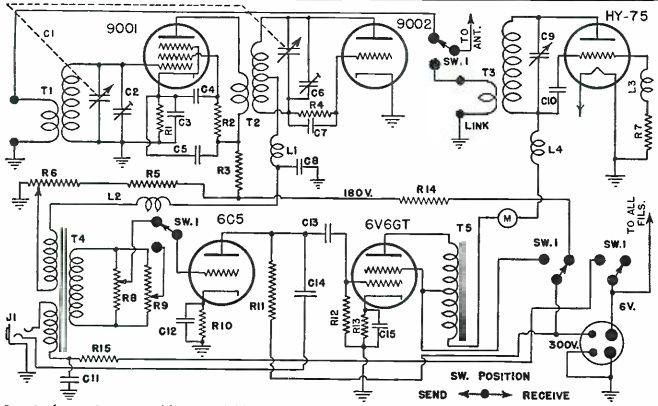
The three-tube transceiver was typical of designs of that era, with a superregenerative receiver that could be put into service as a transmitter at the flip of a switch.

1942OctQST1