Author Archives: clem.law@usa.net

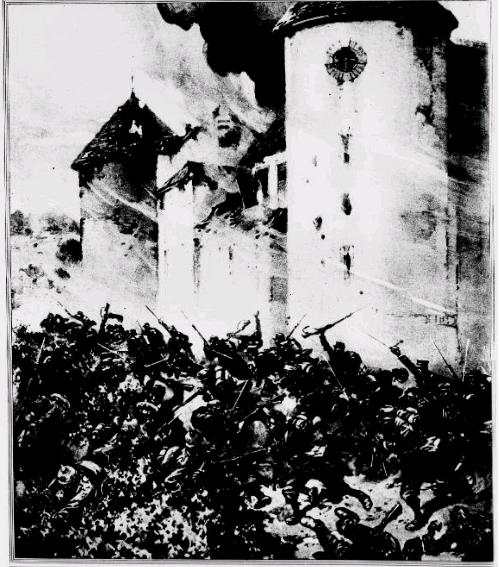
Chateau de Mondement, 1914

Mondement1914

This illustration appeared in the New York Sun a hundred years ago today, on October 18, 1914.  It depicts the chateau at Mondement. During the last day of the First Battle of the Marne, September 12, 1914, the chateau changed hands four times before the final German retreat. The sketch was made by British war artist Frederic Villiers, who noted that “every shell hole and bullet mark has been faithfully portrayed.” The final drawing was the work of Dutch artist H.W. Koekkoek, also known as Hermanus Kokkoek the younger.

References

Association Mondement 1914 (French)

Monument national de la Victoire de la Marne at French Wikipedia

Read More at Amazon


Bing Crosby Entertains Troops, 1944

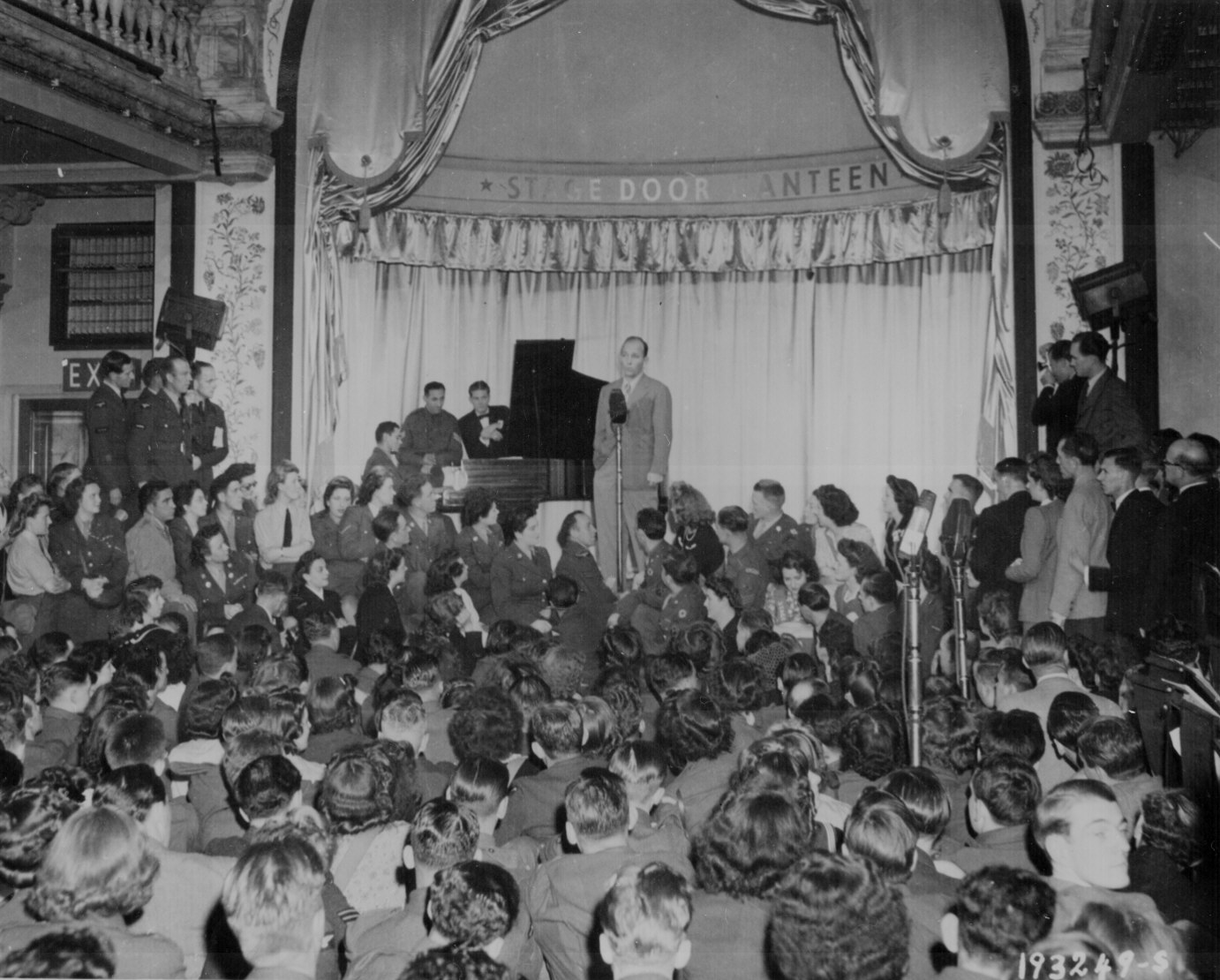
Bing Crosby entertains troops in London, 1944.  US Archives photo.

Bing Crosby entertains troops in London, 1944. US Archives photo.

Seventy years ago today, the radio section of the Milwaukee Journal (October 17, 1944) reported on Bing Crosby’s four weeks in France, where he performed for the troops “under any and all conditions, during bombings and artillery barrages, and in any kind of weather.”

The singer reported that the handiest things for stages were often captured German trucks and trailers, and that some of the performances took advantage of captured German mikes and sound equipment.

The paper notes that the Vichy radio station was now in Allied hands and was being used for Allied broadcasts. There were, however, still some Germans holding out in the basement. “Rather than destroy the equipment by bombing, the Allies went right on broadcasting and were trying to starve the Germans into surrender.”

Radio Vichy’s leading voice wasn’t in the basement.  Philippe Henriot, the “French Goebels,” was the leading propaganda voice coming from the Vichy station.  He had been assassinated by the French resistance on 28 June 1944.


U.S. Orders Closing of Honolulu Marconi Station, 1914

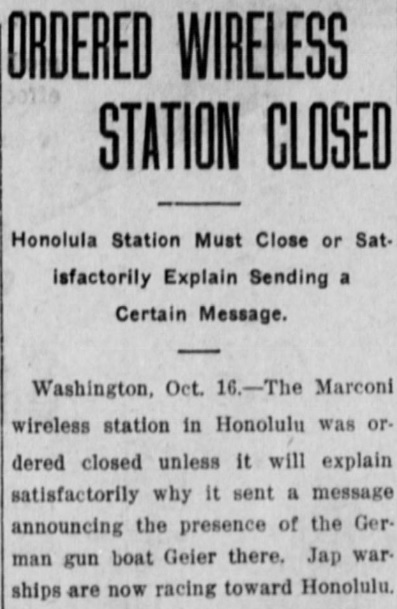
MarconiHonoluluIn the early days of the Great War, the U.S. Government was struggling with how to deal with wireless stations in relation to U.S. neutrality. We’ve seen other examples of how they were dealing with communications in the Atlantic.

But the Pacific was also a theater of war, with Japan at war with Germany. In this news clipping from a hundred years ago today in the Bryan (Texas) Daily Eagle and Pilot (October 16, 1914), the U.S. Government had ordered the closing of the Marconi Company station in the Hawaiian Islands.

In violation of U.S. neutrality, the station had sent a message reporting the presence in Honolulu of the German gunship Geier. The U.S. had ordered the station closed unless the company could come up with a satisfactory explanation. Japanese warships were reportedly speeding toward Hawaii.  The next day’s issue of the paper reported that the order to close the station was rescinded, the company having apologized for the breach of neutrality.

The ship was subsequently interned by the neutral United States.  When the U.S. entered the war, the ship was seized by the U.S. Navy and became the USS Schurz.  In 1918, the ship was rammed by a freighter, killing one crewman and injuring twelve.  The ship was then abandoned and sank three hours later.

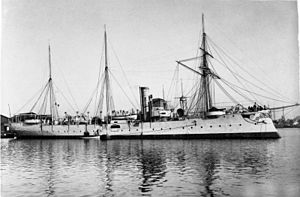
SMS Geier in 1894. German Federal Archive photo, via Wikipedia.

SMS Geier in 1894. German Federal Archive photo, via Wikipedia.


Debt Collection Firm Messerli & Kramer Gives $1000 to Rep. Alice Hausman

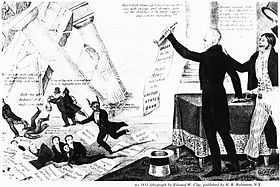
This 1833 Democratic cartoon shows Democrat Andrew Jackson destroying the Devil's Bank.  Times have changed.  Wikipedia Illustration.

This 1833 Democratic cartoon shows Democrat Andrew Jackson destroying the Devil’s Bank. Times have changed. Wikipedia Illustration.

Even though I’ve always been a Republican, I always believed that most Democrats want to “stand up for the little guy.”  Their policies actually hurt the little guy, but at least their heart is in the right place, and their motives are pure. Or so I used to believe.

Maybe that’s still true of some Democrats, but it’s becoming less and less common. I first realized this when I started to see how many ties there were between big business and the Democrats. At first, I dismissed this as “country club liberalism.” So the argument goes, the wealthy feel guilty about their ill-gotten lucre, and to atone for their sins, they support liberal causes. But then, I started to notice that it’s generally the biggest of the big that benefit from Democratic policies. If you’re a large bank or a large insurance company, or even a large polluter, you’re well capitalized, and you can bear the regulatory burdens as a cost of doing business, and then simply pass those costs on to your customers.

But if you’re a small bank, or a small insurance company, or even a small polluter, you don’t have sufficient capital to bear those regulatory burdens. As a result, you go out of business. Or, if you’re lucky, one of your well capitalized competitors buys you out. To your former competitors, the regulatory burdens are a non-issue. They simply pass those costs along to their customers. And now, as an added bonus, they don’t have to worry about competition.

This point was driven home to me when I recently happened to look at the Campaign Finance reports filed this year by my legislator, Rep. Alice Hausman. I happened to be looking at those reports because of an address mix-up, as I previously reported on this blog.

According to Rep. Hausman’s campaign website, the legislator believes in “investing in hard-working families and middle-class Minnesotans.” She believes in a livable wage, affordable housing, and, ironically enough, relieving the burden of debt on college students.  Her legislative website contains a press release about fighting financial scams.

In short, she has concern for the little person, she recognizes the burden of debt, and she’s worried about financial scams.  But one incongruous name kept showing up on her campaign finance reports, that of law firm Messerli & Kramer. In 2014, she received a contribution of $250 from Messerli & Kramer lobbyist John Apitz. During 2013, Apitz had also contributed another $250, and Messerli & Kramer lobbyist Ross E. Kramer contributed $250. In addition, the Messerli & Kramer Political Action Committee had donated  $250 to her campaign coffers. So in just over 18 months, the law firm was responsible for a thousand dollars in the legislator’s war chest.

A lot of little people probably recognize the name Messerli & Kramer.  They’re very likely to recognize that name if they are worried about financial scams or the burden of debt, because Messerli & Kramer is one of the state’s largest debt collectors.  And they’ve been called on the carpet many times for their practices in collecting those debts.

Like any other business, Messerli & Kramer  has a right to give money to politicians. The Citizens United case makes clear that they have that right.  But the name stands out like a sore thumb in support of someone who supposedly supports the little guy.

Messerli & Kramer is a prestigious law firm with offices in Minneapolis, St. Paul, and Milwaukee.  Most little people don’t know the names of prestigious law firms, but anyone in Minnesota who has gotten behind on a car payment or a credit card bill probably knows the name Messerli & Kramer, since the firm’s Plymouth office operates a high-volume debt collection practice. In fact, because the firm does such a high volume of business, it has resorted to outsourcing to a company in Birmingham, Alabama, simply to mail out the huge volume of correspondence.  They send out so many collection letters that their own office can’t handle the volume.

My personal involvement with Messerli & Kramer dates back to 2002 when I was hired by a woman who needed to sort out a mess involving her Discover Credit Card. She was being sued in Anoka County, and Discover was represented by that friend of the little guy, Messerli & Kramer. I was appalled by the tactics employed by Messerli & Kramer. Messerli and Kramer attorneys made false statements in an affidavit in order to obtain a default judgment. I had to go to court and get the default judgment set aside. Then, Messerli & Kramer failed to properly respond to discovery.  The judge in the case, District Judge Sharon Hall, found that the plaintiff offered an affidavit containing false statements, failed to comply with court rules, and failed to cooperate in the discovery process.

Judge Hall set aside the default judgment, and held that the firm’s misconduct was so egregious as to warrant simply tossing out the plaintiff’s case. She also awarded my attorney fees.

Dissatisfied with this turn of events, Messerli & Kramer took the case to the Minnesota Court of Appeals. In 2004, the Court of Appeals affirmed, and awarded my attorney fees on appeal.

In 2007, the Minnesota Attorney General filed a lawsuit against Messerli and Kramer. The state’s 38-page complaint referred to my earlier case, as well as numerous other cases of misconduct by the law firm in its collection activities. That complaint noted that Messerli & Kramer is involved in the collection of student loan debt, the very burden that Rep. Hausman’s website professes concern.

Banks, credit card companies, and student loan lenders are entitled to legal representation. But Messerli & Kramer has a documented history of abuses in carrying out those representations.

Many middle-class Minnesotans instantly recognize the name of Messerli & Kramer. And if they live in Roseville, Falcon Heights, Lauderdale, and St. Paul, they’re probably represented in the legislature by Rep. Alice Hausman. Can they turn to their legislator for support when abuses occur? Can they turn to the legislator who accepted a thousand dollars in campaign contributions from the very firm that is hounding them?

Unfortunately, voters in other districts encounter the same problem, and it doesn’t matter whether your representative is a Republican or a Democrat.  The Messerli and Kramer cash flows freely, and they’re happy to give money to Republicans as well as Democrats.  Messerli and Kramer’s political contributions can be found at FollowTheMoney.org,  That site reveals that over the last 18 years, they gave over a quarter of a million dollars to politicians, with little regard for the politician’s views.  Democrats seem to have received a slim majority of their cash, but Republicans are well represented as well.  In 2002, they gave to Republican Tim Pawlenty.  In 2014, they once again had the checkbook out, this time giving to Democrat incumbent Mark Dayton.

Not too surprisingly, back in 2002 (about the same time they were filing false affidavits in Anoka County), they also donated to Democrat Roger Moe, who was running against Pawlenty.  That same year, they donated to Rep. Rich Stanek, a Republican, who currently serves as the Hennepin County Sheriff, the guy who needs to execute the writs against the people that Messerli and Kramer is suing.

In 2006, they gave to ultra-conservative Republican Jim Abeler.  But political ideology didn’t stop them from giving.  The same year, they also donated to ultra-liberal Democrat Ellen Anderson.

Nobody has done anything illegal.  The Citizens United case gives them the right to give money to Representative Hausman, or to another politician with opposing views.  It even gives them the right to donate to both sides, which appears to be exactly what they are doing.  But the voters ought to know about it and decide in the polling place whether this is just plain wrong.

This post expresses the opinions of the author, Richard P. Clem, who prepared and paid for it.  This post is not authorized by any candidate or candidate’s committee.



Sinking of the Metapan

15Oct1914NYWorld

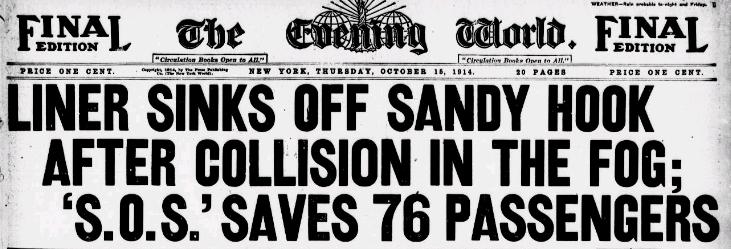
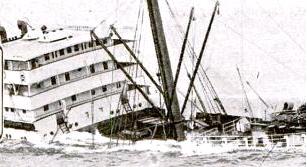
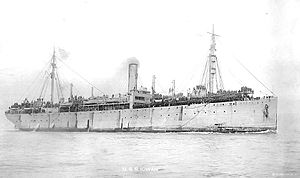
A hundred years ago today, October 15, 1914, the United Fruit Company passenger steamer Metapan, bound for New York from Colon, and the  American-Hawaiian line steamer Iowan, crashed near the entrance of New York Harbor. The Iowan suffered only slight damage, but The Metapan, with 76 passengers aboard, sank rapidly after the crash. Thanks largely to the ship being equipped with wireless, everyone got safely ashore. The Metapan was raised six days later and taken to Brooklyn for repairs.

Until a few weeks prior to the crash, the Metapan had flown the British flag.  With the war, she was hastily registered as an American ship and flew the neutral U.S. flag.

The first ship to respond to the SOS was the British cruiser Lancaster. The dredge Atlantic quickly sent two steam launches, and a number of other small boats gathered quickly. According to press reports, a group of English passengers were singing “It’s a long way to Tipperary” as they boarded the lifeboats.

According to the report in the New York Evening World, the Metapan’s wireless operator, realizing the ship’s predicament, switched over to a storage battery to send the SOS.

The Iowan had entered service only months earlier, and resumed inter-coastal service via the Panama Canal after repairs.  In 1916, the Iowan came under Navy control and served as a troop carrier.   The ship resumed civilian service after the war and in 1942, was transferred to the Soviet Union under lend lease, and was renamed the SS Tashkent.  After World War 2, the ship remained a Soviet merchant vessel until 1966, when she was transferred to North Korea for use as a fish processing ship.  She was finally scrapped in 1969.

References

SS Iowan at Wikipedia

Popular Mechanics, January 1915

Master, Mate & Pilot, Nov. 1914

New York Evening World, Oct. 15, 1914.


Rep. Hausman Responds

I received a phone call from Rep. Alice Hausman in response to my earlier blog post about her failure to reply to my invitation to a “meet the candidates” event.  It’s apparently partially explained by an address mix-up at the Campaign Finance Board.  But it also raises the troubling question of why her former campaign treasurer isn’t forwarding the mail.  You can read my update to the original post.

A Hundred Years of Progress

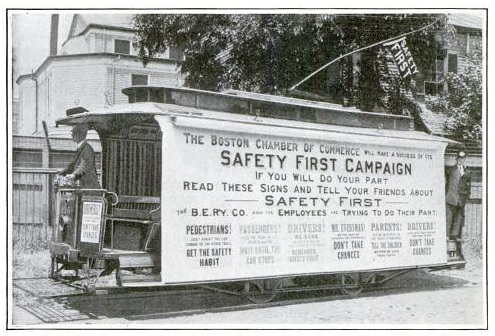
A hundred years ago, there were rail vehicles running down the middle of the street, and they discovered that people were getting run over. (It turns out they didn’t have a steering wheel.) The solution was the “Safety First Campaign” with inspiring slogans such as “Pedestrians: Get The Safety Habit,” “Don’t Take Chances,” and “Employees Trying To Do Their Part.”

Now that we’re once again running billion dollar rail vehicles without steering wheels down the middle of the street, it’s probably time to dust off that old safety campaign.


Bomb at St. Patrick’s Cathedral, 1914

World101314

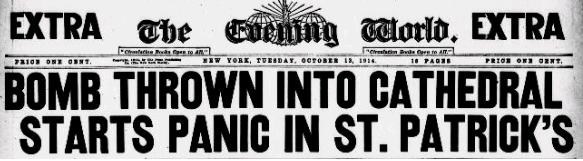
A hundred years ago this evening, a bomb exploded in St. Patrick’s Cathedral in New York. One person was injured, and the New York Evening World had an extra edition with this banner headline on the street the same evening.

Despite the size of the headline, I had never heard of this incident, and it’s barely mentioned in the historical record.

The rector of the Cathedral, Msgr. Michael Lavelle, (1856-1939) is quoted as describing it as “a small bomb. It did little actual damage outside of splintering some of the pews and tearing a hold in the floor about two feet square. It filled the interior of the church with smoke and caused a lot of excitement among the worshipers. I have no idea who did it. I have received no threatening letters of any kind in a long time and am at peace with the world.”

The October 15 issue of the New York Tribune reported that the Reds were rejoicing over this and other church bombings, and that the police were seeking an I.W.W. plot that “menaced many.”

There was very little actual damage and the indicent has been forgotten. But there were banner headlines, people to blame, and general excitement. Very little has changed in a hundred years.


A Look at 1939 Prices

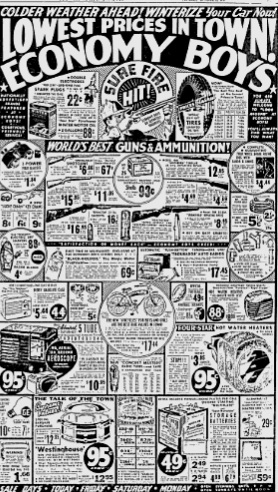
EconomyBoys1939Here’s a sampling of what your money would buy 75 years ago today, on October 12, 1939. This ad for a store named “Economy Boys” appeared in the Milwaukee Journal.

Two radios for the home were shown. The least expensive was a four-tube Tiny Teletone for $5.44. An Admiral five-tube superhet “with television connection” was available for $10.95. Both of these radios had bakelite cases. For the car, a Troubado auto radio was available for $17.45. It had six pushbutton presets, and could also be manually tuned. A better image of this car radio can be found at RadioMuseum.org.

Radios were but a small part of what Economy Boys had for sale. Tires for your car started at $4.33, batteries started at $2.49, and spark plugs were 22 cents. Two gallons of motor oil were 88 cents. A bicycle cost $17.44. GE light bulbs were a dime. If you were willing to settle for “Elram” bulbs, they could be had for 7-1/2 cents each.

Economy Boys also seemed to have everything for the hunter. Rifles started at $4.69, and shotguns started at $6.66. Shotgun shells were 67 cents for a box of 25, and .22 cartridges were 16-2/3 cents for a box of 50.


An Idea That Never Quite Caught On

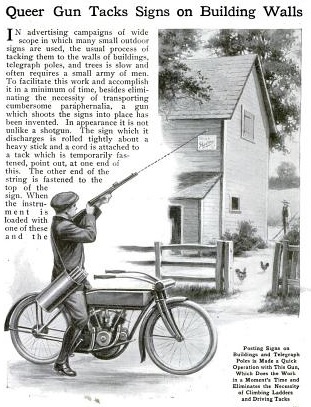
SignGunA hundred years ago this month, October 1914, Popular Mechanics magazine leads with one of those ideas that seemed like a good idea at the time, but for some reason never quite caught on. Someone had finally tackled the problem of what to do for advertising campaigns of wide scope which used many small outdoor signs. It required a small army of men who tediously had to climb ladders and tack up the signs.

Those days were over, or so they thought. This new invention was a gun which shot the signs, which were wrapped around a heavy stick. This stick had a tack at the end which would affix itself to the building or utility pole. The sign was attached to the tack by a string, and when it struck the wall, it would unravel and display itself. Posters could reportedly be mounted at heights of 30 feet from a distance of 50 feet.

The article was silent as to how to get the sign down.