Author Archives: clem.law@usa.net

Moon Mission Update

According to the LuxSpace blog, the 4M-LXS spacecraft is not about one light-second away from Earth, meaning that it takes one second for the signals to reach earth.  The blog also reports that the messages being sent from the spacecraft are about to cycle, meaning that all messages have been sent once, and will now repeat.

This means that the W0IS.COM URL has been transmitted from space once.  Since the earth stations seem to be collectively copying 100%, it is likely that the signal has been received.  We have not yet received any reception report.   Since LuxSpace is running a contest for stations to report the number of messages received, this information is not yet being published.  We are confident, however, that the message has been transmitted from the spacecraft to Earth, and continue to seek verification.

Nazi Conscription Comes to America, But Without Much Luck

GermanDraft

This AP article appeared in a number of American newspapers on June 28, 1939. It is shown here as it appeared in the Borger (Texas) Daily Herald.  It can also be found in the Milwaukee Journal along with some additional detail.

The German consulate in Cleveland (and probably other consulates) had issued a  proclamation” ordering 19-year-old “Reich citizens” in the United States to register with the consulate for compulsory military and labor service under the Reich on or before July 15, 1939.

Apparently, a copy of the proclamation had been forwarded to the German-American Turner Society in Detroit in order to communicate  it to the men required to register. The society objected, and stated that it resented “the assumption on the part of Reich officials that we will take any part in helping them carry on their work.”

It is unlikely that very many “Reich citizens” residing in the United States complied with the proclamation.


Herbert Hoover and the Belgian Humanitarian Crisis

Today marks the 100th Anniversary of Herbert Hoover’s great humanitarian work in the First World War. His great granddaughter, Margaret Hoover, shared this poster today on her facebook page.

Starting a hundred years ago, President Hoover spent the last half century of his life serving his country, as Commerce Secretary, President, and Humanitarian. Fifty years ago today, the State of Iowa was preparing for the late President’s State Funeral. You can read more at the Cedar Rapids Gazette. You can also read more posts about President Hoover on my blog.

References

Herbert Hoover at Wikipedia 

Herbert Hoover National Historic Site

Herbert Hoover Presidential Library and Museum

Hoover Institution at Stanford University

Read More at Amazon:



Seizure of the S.S. City of Flint, 1939

SSCityOfFlint

The United States didn’t join the war until attacked by Japan in 1941. After Pearl Harbor, Germany quickly declared war on the United States. Even though public opinion ovrwhelmingly favored a declaration of war against both Germany and Japan after Pearl Harbor, President Roosevelt didn’t ask Congress for war against Germany. A few days later, Germany obliged by declaring war.

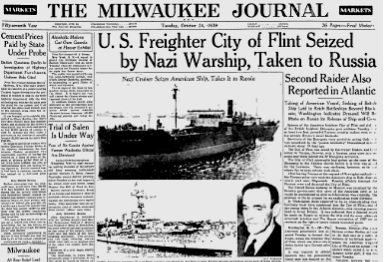
But there was little doubt that the U.S. would be at war with Germany. The Germans had been menacing American shipping, and there soon would have been cause for war with Germany. The first incident in this de facto war took place 75 years ago, as reported here in the October 24, 1939, edition of the Milwaukee Journal.

The SS City of Flint became the first U.S. vessel to be seized by the Germans. It was en route to Britain with a cargo of tractors, grain, and fruit. The Germans declared the cargo to be contraband and seized the vessel. The German crew set sail for neutral Norway, but was refused entry. It then sailed for the Soviet Union, then a German ally, which eventually sent it away. The ship eventually wound up in Norway a second time, where it was eventually boarded by the Norwegians and returned to the Americans. The ship unloaded its cargo in Norway and returned to the U.S. The ship remained in service until 1943, when it was sunk by a German U-boat.


Update on Lunar Mission: Successful Launch

The 4M-LXS Spacecraft was successfully launched from China today, at or near the scheduled launch time of Thursday, October 23, at 12:59 PM U.S. Central Time.

The spacecraft was successfully activated, and it signals have been received in Brazil.  The official announcement can be found at the LuxSpace blog.

An article about the mission, the first ever privately funded Lunar mission, can be found at the Air & Space magazine website.  During its Lunar orbit, the spacecraft will transmit the URL of our parent website, w0is.com.  More information can be found in my earlier posts.

WW2 Prisoner of War Broadcasts

PrisonerBroadcasts

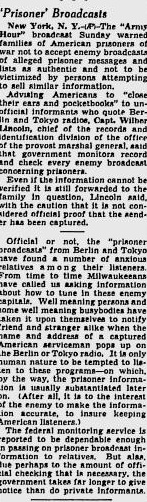
Seventy years ago today, October 23, 1944, the Milwaukee Journal carried this item regarding the prisoner broadcasts that were being carried by the German and Japanese shortwave stations. The stations broadcast the names of, and sometimes personal messages from, Allied prisoners of war. Often, these broadcasts preceded any official notification.

The paper cautioned American families “not to accept” such messages, and certainly not to pay for them. The paper did note that the government monitored these broadcasts and would make official notification if warranted. But the paper did concede that these broadcasts were generally accurate, and that “well meaning persons and some well meaning busybodies have taken it upon themselves to notify friend and stranger alike when the name and address of a captured American serviceman pops up on the Berlin or Tokyo radio.”

This phemomenon was discussed in more detail in the book World War II Radio Heroes: Letters of Compassion by Lisa Spahr. As the title suggests, letters from listeners to the families were generally well received, and often represented the family’s first notification that the serviceman was captured and still alive.  The author of that book wrote it after discovering 70 letters written to her great grandmother from shortwave listeners around the United States reporting that her son had been captured but was in good health.  She was able to track down some of them, forming personal friendships with some of these “busybodies.”

Even though the article cautions families “not to be victimized by persons attempting to sell similar information,” I have never found reference to even a single case of anyone attempting to profit from notifying families, although one apparently asked for a postage stamp so that he could continue providing the service.  The government did all it could to discourage the practice, even accusing one listener in Nebraska of being a Gerrman spy.

References

Book Review of Letters of Compassion

Book Website

Author’s Blog

Facebook Group


Radio Detector for a Dime

10centdetector

Radio and Boy Scouting share a long history, and in the early days of Scouting, radio played an important role. The October 1914 issue of Boys’ Life magazine shows this detector, guaranteed to bring in stations from 100 to 500 miles away, for only a dime.  All that was needed was a telephone receiver and a wire on the roof.  Even though this seemingly arcane piece of technology (consisting mostly of a lump of galena) would set the aspiring young wireless enthusiast back only a dime, he would probably find that the more familiar telephone receiver would be harder to come by.  But that too was available, for fifty cents.  But for sixty cents, the scout would have a radio that would pull in a strong signal.


Edison Day: October 21, 1914

A hundred years ago today, October 21, 1914, by Act of Congress, it was Edison Day in America, marking the 35th Anniversary of the perfection of the incandescent light bulb.  Street cars paused in his honor, light bulbs were lit during the day, and many “Edison concerts” of music being played on phonographs took place.

WireHouse

It was also a time for some commercial promotion.  Even though electric lighting had been almost completely adopted by 1914, especially in cities, it was not yet universal.  The utility shown here encourages readers to wire their houses before Edison Day.  And many retailers of phonographs encouraged readers to buy a phonograph in honor of the day.

I graduated from Minneapolis Edison High School, which opened in 1922, a full nine years before Edison’s death.  In fact, the school’s early yearbooks contain a dedication signed by Edison himself.  It always struck me as odd that a living person was so glorified during his lifetime.  And the modern-day cynic will undoubtedly point to Edison’s faults.

But the fact that the country was no completely electrified only 35 years after Edison’s invention of the light bulb is remarkable.  The world of 1914 was very different from the world of 1879.  The world of 1914 is recognizable.  The world of 1879 was a very different place.


Death of Herbert Hoover, 1964

HerbertHooverAbout1920

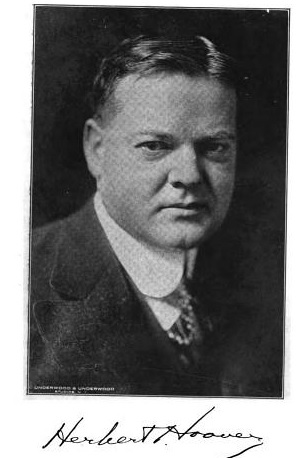
Herbert Hoover, 1874-1964.

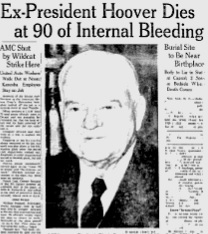
On this day fifty years ago, President Herbert Clark Hoover died in New York.   A native of Iowa and a graduate of Stanford University, he was a successful mining engineer.  During and after both world wars, he was first and foremost a humanitarian.  During the 1920’s as Secretary of Commerce, he was largely responsible for the regulatory scheme that allowed radio to flourish.

Hoover was involved in public life for half a century.  Fifty years before his death, almost to the day, he was named chairman of the commission charged with the relief of Belgium.  The Richmond (Virginia) Times Dispatch  for October 22, 1914, carries the following report:

At last real action has been taken for the relief of the Belgians, upon whom has fallen the great burden of suffering from the war. An American commission, headed by Herbert C. Hoover, of California, and composed of Americans resident in London and Brussels, as the result of an agreement reached between Belgium, Great Britain and Germany, will take under its charge the care of hundreds of thousands of Belgians threatened with starvation in their own country.

And President Hoover continued to serve the country long after he left the Oval Office.  Here’s what stated on his 85th Birthday, on Meet The Press, August 9, 1959:

 Mr. Hoover: My feeling is that we have involved ourselves in too many crises and that our major job today is to clean up our own household, that we are in more imminent dangers from internal causes than we are from the cold war.

Mr. Wilson: Which are you referring to, sir?

Mr. Hoover: We’re fast drifting into inflation, unbalanced budgets, overspending by Congress, the huge growth of crime. There are half a dozen different things that infest the public mind with worry, anxiety, that need to be cleaned up at home.

Mr. Wilson: Have these things weakened us so much that we can’t stand out strong against Russia?

Mr. Hoover: No, I wouldn’t want anybody to think for a moment that the American people are not capable of solving any crisis. As a matter of fact, this nation is now in its 183rd year, and it has lasted longer than any representative government.

It has gone through seven wars, has gone through three great depressions. It has had some bad administrations in Washington; it has fallen on evil days in every one of the wars which we’ve fought, which produced a series of crises, and yet, after all that, we still have of the original heritage of the American people a very large part of what the forefathers established. We still have a freedom of religion, freedom of press, freedom of assembly, freedom of enterprise within the limits of some socialistic tack, freedom of speech within the limits of very mild laws on the subject. Generally, we possess today the same vitality, the genius, the initiative and the ability to solve these crises that we have in the past. We need to be more diligent on the job.

References

Herbert Hoover at Wikipedia 

Herbert Hoover National Historic Site

Herbert Hoover Presidential Library and Museum

Hoover Institution at Stanford University


Read More at Amazon:



Taking the Radio for a Swim, 1924

RadioInWater

We’ve seen previously that the idea of taking the radio to the beach was a popular one in the 1920’s. We’ve seen people listening to the radio at the beach, dancing to the radio at the beach, and even taking the radio out in the canoe.

The young women shown here in the October 1924 issue of Radio News have taken it a step further by taking the radio out into the water. The caption notes that the bathers may listen in with complete comfort and sip cool drinks at the same time. The lifeguard in the background is presumably there to make sure the radio doesn’t fall in the water.