Fifty years ago, from March 9-27, 1965, the first two-way amateur satellite, OSCAR III, was in operation. The 16.3 kg spacecraft was launched on March 9 from Vandenberg Air Force Base, piggybacking with seven Air Force satellites. Over 1000 amateurs in 22 countries made contact through the satellite’s linear transponder, with both the uplink and downlink taking place on the 2 meter amateur band. Signals were received by the satellite on 144.1 MHz, and were retransmitted on 145.9 MHz. The downlink had a power of one watt, which was divided over the whatever stations were in the passband of the uplink frequency.
A beacon transmitter sending voltage and temperature readings was audible for several months. The orbit was nearly circular, with an altitude of 570 statute miles and an orbital period of 103.5 minutes.
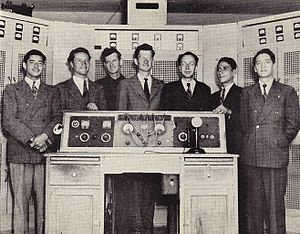
The photo here shows Ed Hilton, W6VKP, and Don Norgaard, W6VMH, working on the satellite’s electronic package in Hilton’s garage. This photo is taken from the March, 1965, issue of Popular Electronics. A summary of the mission and complete list of contacts made and calls heard during the spacecraft’s 250 orbits is also available online.
40 years ago, careful observers were probably anticipated that something like the Internet would sometime come to pass. For those early adopters, Radio-Electronics magazine carried plans for a terminal, which the magazine called the TV Typewriter II, since an earlier version had appeared in the magazine in 1973. Some of the chips used in the 1973 design, however, turned out to be unobtainium, and the 1974 model featured use of commercially available 74-series TTL chips. The plans included a keyboard (hence “typewriter”), and called for connection to a black and white TV for the display (hence “TV-typewriter”). The plans for the 1974 model, shown here, are found in the February, March, and April, 1975, issues of the magazine.
The terminal had an RS-232 interface, and could communicate at 110, 220, 440, or 880 baud, or if a different crystal was used, 150, 300, 600, or 1200 baud. The terminal had two potential applications. First, the article noted, would be “data communications with computers. Combined with a keyboard, we have one of the fastest and most efficient means for an individual to communicate with a machine.” One example of a computer with which it could communicate would be the fledgling home computer described in the magazine’s July, 1974, issue.
Another, possibly more common, use for the TV-typewriter was also given: “Of course, if you don’t have or don’t want your own machine, you can always tie into a full size time-shared system, assuming you have access to one.”
This statement shows how the TV-typewriter foreshadowed the Internet. My first experience with computing involved one of those time-shared systems. In my case, I accessed the Minneapolis Public Schools’ timesharing system with the use of a 110-baud teletype machine, like the one shown here. To use this terminal, we dialed the phone number of the timeshare system computer, placed the telephone receiver into the acoustic coupler modem, and after logging in we were able to do things such as write short basic programs. Later on, other systems such as the Minnesota Educational Computing Consortium‘s MECC-MERITTS system, which also included a rudimentary chat function.
Of course, accessing such a system required having physical access to a terminal, which nobody other than the school owned in those days. Something like the TV-Typewriter would have been an incredible luxury for those of us interested in the proto-internet offered by the timesharing systems.
Many of us back in those days figured out that it was just a matter of time before something like the Internet came into being. However, most of us were wrong in one regard. We believed that online computing would follow the model of those timeshare systems: There would be a big computer somewhere doing all of the computing, and users would access it using a dumb terminal like a teletype machine or the TV-Typewriter.
In some respects, our predictions were borne out a few years later when CompuServe came along in the late 1970’s and early 1980’s. It was way out of my price range, at about $5 per hour (a rate at which it would cost about $20 to download the entire contents of a daily newspaper). But since I worked for Radio Shack, which was one of its primary sellers, I did have limited access and was able to use it to read the handful of newspapers online, get aviation weather, and even access the early chat server. There was even something called “Email,” a registered trademark of CompuServe. It was still out of my price range, and I never even sold a single subscription, but I realized that it was the future of computing.
Except I was still wrong on one detail. I still assumed that online content would be delivered the way that CompuServe was doing it: Individual users would use a dumb terminal to call a big computer somewhere that delivered the content. The 1981 video below is a newscast about the early days of CompuServe. It also makes clear that this is the model: Once a day, the newspaper in San Francisco programs into a computer in Columbus, Ohio, the contents of the daily paper.
Most of us believed that was how it would work, and we were wrong. We probably could have figured this out, because to access that computer in Columbus Ohio, we weren’t exactly using a dumb terminal. We were using a computer (at that point, the TRS-80 Model 100). By today’s standards, the computer didn’t have much computing power. It had 8 kB memory and ran at 2.4 MHz. But that computing power was doing only one thing: Emulating a dumb terminal. The computing power wasn’t being used, other than to duplicate the functions of the 1975 TV-Typewriter.
By the early 1980’s, the first computer bulletin board systems (BBS’s) were starting to appear. They esentailly followed the same model as the early timesharing systems and CompuServe. The only difference was that they were much smaller systems, generally run by hobbyists. But the end user still called up the “big computer” with a dumb terminal. The real origin of the internet is best seen in a development that took place a few years later, when BBS systems began to be linked up as FidoNet. FidoNet was developed starting in 1984. Users would still call in to a single local BBS. But at night, when the phone rates were low, those BBS’s would communicate with one another and transfer mail, discussion posts, and files. While the end user would still interface only with one local “big” computer, the information he or she was reading actually originated on some other computer. In other words, the information was no longer centralized in Columbus, Ohio. The absence of one computer from the larger network would hardly be noticed. For home users, the Internet really began in 1984 when FidoNet allowed them to access information globally from a dumb terminal. Most users of these BBS systems were using computers with some computing ability. I doubt if too many TV-Typewriters were being used in 1984. But the TV-Typewriter, assuming that someone got one working in 1975, would have been perfectly adequate to the task.
The TV-Typewriter by itself was still missing one important component. It did not include the modem. To use it with a timesharing system (or a few years later, with CompuServe or FidoNet), the builder would also need to construct a modem to get those 110 baud signals into the phone line.
For those who built the TV-Typewriter, they probably had some inkling that there would be an Internet someday. They had the details wrong. They probably thought that there would be a big computer in Columbus Ohio to which they would connect. But they probably had some of the basic ideas.
Ninety years ago, the March 1925 issue of Radio Broadcast shows how resistors were made. This worker, at the Chicago radio show, is running a precision machine capable of producing resistors ranging from 3 to 700 ohms. The wire was wound automatically, very accurately and quickly.
A hundred years ago, the young lady shown here, 6SO, was burning up the ether of the West Coast.
Shown here in the August 1916 issue of The Wireless Age is Miss Kathleen Parkin of San Rafael California. which the article identifies as one of the youngest girl wireless operators in the world. She was fifteen years old and held a first grade commercial license, having gained her knowledge of radio in her brother’s station where, as she said, “I spent every minute of my spare time, and often helped him make his instruments.” She constructed, without assistance the 1/4 kilowatt transmitter shown here, and was in the process of making a rotary spark gap and a receiver with vacuum tube detectors. At the time, she was using a galena detector, but successfully receiving up to 1000 miles.
According to Wikipedia, her full name was Gladys Kathleen Parkin, and she was born in San Francisco in 1901, and moved to San Rafael after the 1906 earthquake. She received her amateur license at the age of 9 (in about 1910), and she died in 1990.
In the 1923 call book, she is listed as holding the call 6BP. However, in the 1938 call book,
there’s no listing for W6BP. I was unable to find any later history about Miss Parkin. If you know more about this wireless pioneer, please add a comment or contact me.
Eighty years ago this month, March 1935, Radio Craft magazine featured this one-tube broadcast radio that could be built for a dollar. The only manufactured radio part was the type 30 tube, which ate up 75 cents of the budget. Everything else was scrounged from household goods. The author reported receiving a station in Dallas, 1500 miles away from his location, the first night.
The two fixed condensers were made of tinfoil and waxed paper. The filament condenser consisted of 36 feet of 36 gauge wire wound on a spool. The grid leak condenser, which would probably be about 1 megohm, consisted of a pencil mark on a piece of wood. The tuning condenser consisted of two metal plates separated by celophane. The tuning coil was home wound on a cardboard form, and the tube socket was four paper clips.
The diagram of the completed receiver is shown below.
One hundred years ago today, March 11, 1915, the Chicago Tribune reported the completion of the third largest radio tower in the world, one of the two 400 foot towers at the naval training station at Great Lakes, Illinois. The paper reported that the station would be able to establish communications between both coasts, Alaska, and the Canal Zone.
The Chicago antenna’s height was bested only by the Eiffel Tower and the navy station at Arlington, Virginia. To mark the completion, the flag flown by the U.S.S. Chester at the Battle of Vera Cruz was unfurled from the structure. The commandant of the naval station had previously commanded the Chester at Vera Cruz.
Seventy years ago, the U.S. conducted its most destructive air raid of the Second World War. On the night of March 9-10, 279 American B-29s operating from Guam, Tinian, and Saipan dropped 1,665 tons of bombs on Tokyo. Fourteen of the planes were lost, but the incendiary bombs created a general conflagration that overwhelmed the city’s fire defenses and destoyed 16 square miles of the city. Over 100,000 were killed in the raid, and over a million Tokyo residents lost their homes.
One of the shortcomings of the fallout shelter program of the 1950’s- 1970’s was the lack of communications from shelters to the outside world. The 1962 Fallout Shelter Plan for St. Paul, MN, for example, stated that “many designated shelters will be in places with access to existing telephones. When telephones are available and operable they will serve as basic communications.” The plan also stated, but apparently with no thought as to who would be responsible, “plans should be made to insure that at least one battery operated AM radio receiver plus extra batteries will be made available in the shelter for reception of emergency broadcasting information.”
When I was a student in elementary school, I noticed these gaps. One year, during a tornado drill (that had been scheduled well in advance), I was quite pleased to see that one of the teachers had with him down in the basement a battery-operated radio. It was rather reassuring to see it, since I knew we wouldn’t be cut off totally from the outside world in the event of an emergency, since we would still be able to receive whatever emergency instructions might be forthcoming from the radio.
My reassurnce was dashed that afternoon, however, when I saw that same teacher walking home, carrying his portable radio. It was apparently his personal radio, which he brought to school in preparation for the scheduled drill. In other words, it wouldn’t be around in the event of an actual emergency. If the power were out, we would, indeed, be cut off from the rest of the world.
On another occasion, the school administration was going to have an additional twist on the drill. Instead of heading to the designated shelter when the school’s own bells sounded the warning, each class was instead going to act when the sirens outside went off. When we heard the siren, we were to head for the basement.
Unfortunately, the closest siren was miles away, and wasn’t very loud where we were. Undaunted, my classroom teacher had a solution to the problem. Shortly before the scheduled test, she opened a window at the back of the room, and a designated student sitting near that window was tasked with listening for the siren. The plan went off without a hitch. He heard the siren and warned the class, and we all headed for the shelter. Of course, it occurred to me that the window wasn’t normally left open. In an actual emergency, nobody would have heard the siren.
The 1962 St. Paul shelter plan realized many of these shortcomings, and stated that “two-way radio is being considered as back-up to telephone communication.” It also considered the possibility of using amateur radio. Under the heading of “other desirable equipment” was “portable transmitting-receiving equipment belonging to members of units of RACES (Radio Amateur Civil Emergency Service). Plans will be made to have designated ‘hams’ take their portable equipment to shelters upon receipt of warning.”
I’m not aware of any specific plans worked out to use RACES in fallout shelters. However, on the national level, there was indeed some planning taking place for two-way radio equipment in shelters. Even though some planning was done, as far as I’m aware, this was never put into place.
In a 1962 report entitled “Fallout Shelter Communications Study,” the engineers conducting this study used Montgomery County, Maryland, as an example, and determined what kinds of communication would be appropriate between the fallout shelters and Emergency Operating Center (EOC) in what the study considered to be a fairly typical county. The report concluded that the telephone system should serve as the primary communications network for these needs, but also recognized the desirability of two-way radio, and came up with a budget of $391,000 for the county. Each shelter’s radio was budgeted at a minimum of $250, with another $50 set aside for the antenna.
Specifications for equipment were contained in a 1964 report prepared for the Office of Civil Defense by the same engineering firm. The sketch here of a prototype transceiver for shelter use is from that report. This report provided specifications for the equipment in each shelter. The radio for use in the shelters is shown here, and could be either VHF or UHF, in the 150, 460, or 950 MHz band.
A key concern in the design specifications was the fact that the radios would be left unattended for long periods of time. Therefore, non-corrosive properties were important, and ferrous metals were to be avoided to the extent possible.
Power supply could be either 120 volts AC, or 12 volts DC. The problems of storing batteries for long periods of time was a challenge, and consideration was given to storing dry batteries. In addition, batteries from vehicles could be used. Presumably, they would be brought into the shelter in an emergency. If the battery needed replacing, presumably a short excursion out to the parking lot could be made when radiation levels decreased.
Ease of operation by untrained personnel was also a concern. The unit did not have an external microphone. Instead, both the microphone and speaker were built in, with a push-to-talk switch on the panel. The only other control on the panel would be the volume control and power switch. The unit was to have a squelch control, which would be accessible from the front panel. However, it would be preset, requiring a screwdriver to make any adjustments. It did include a headphone jack for private listening.
The cost for equipment was estimated at between $250 and $420 per shelter, with an additional $10 to $100 for the antenna, which would be installed prior to the emergency.
It was recommended that the radios be licensed as local government service, perhaps on the same frequencies as other municipal services. It was anticipated that any necessary drills might be conducted on weekends, causing minimal interference to the other governmental users.
Fifty years ago today, it was anything but a slow news day, as shown by the front page of the Milwaukee Journal, March 8, 1965.
In the left column, almost lost in the clutter, is an article with the headline, “US Marines Land at Base in S. Vietnam,” which reported that 3500 U.S. Marines from the Third Marine Division at Okinawa had landed at Da Nang, or were in the process of arriving. This marked a major escalation in U.S. involvement in the war. In 1964, there were about 16,500 American servicemen in Vietnam. The March 2 attack on the U.S. Marine barracks at Pleiku marked the initiation of a three year bombing campaign, and a rapid escalation of U.S. forces on the ground. These 3500 Marines arrived on March 8, marking the beginning of the ground war. At the time, U.S. public opinion overwhelmingly supported their deployment. By the end of 1965, there were 200,000 U.S. servicemen in Vietnam.
“Bloody Sunday” in Selma, AL, March 7, 1965. Wikipedia photo.
But the escalation of the war was dwarfed by other news. The photo shows not fighting in Vietnam, but on the streets of Selma, Alabama. According to the caption of the UPI photo, it shows “charging Alabama state troopers passing fallen Negroes on the median strip after the troopers, acting on orders of Gov. George Wallace, broke up a march with clubs and tear gas. The Negroes had planned to march to the state capitol.” The article notes that the march consisted of “600 praying Negroes” and had been “broken up by Alabama state troopers and deputies who used clubs, whips, ropes and tear gas. Sixty-seven Negroes were injured.” An FBI agent filming the troopers was also injured after being attacked by a group of white civilians.
The paper reported that the National Council of Churches had called upon Christians throughout the nation to join the demonstrators in another march scheduled for the following day. Catholic authorities were conferring on a plea from Rev. Martin Luther King and promised a statement as well. Rabbi Richard G. Hirsch of the Union of American Hebrew Congregations also announced that he planned to attend the march.
A number of race-related decisions from the U.S. Supreme Court were announced in the paper. The banner headline went to announcing the decision in Louisiana v. United States, 380 U.S. 145 (1965). Louisiana had vested in its election registrars virtually unbridled discretion in administering an “interpretation test” to prospective voters. Under the state law, in order to register, a voter was required to read, “be able to understand” and “give a reasonable interpretation” of any section of the state of federal constitution. According to the Court, there was ample evidence that the provision was used as a ruse to deprive otherwise eligible African-American voters of the right to vote. The court noted that “colored people, even some with the most advanced education and scholarship, were declared by voting registrars with less education to have an unsatisfactory understanding of the Constitution of Louisiana or of the United States. This is not a test but a trap, sufficient to stop even the most brilliant man on his way to the voting booth.”
The Supreme Court unanimously affirmed the district court’s striking down of this provision.
The front page also contained an editorial stressing the importance of voting in a school board primary to be held the following day. To drive home the importance, the front page cartoon shows a stereotypical southern politician addressing a group of African-Americans protesting for voting rights. He’s telling them: “What you all fussin’ for? Lots of white folks up north don’t think voting’s important.” And he was probably right. The paper notes that only 11% of registered voters bothered going to the polls in the 1963 primary.
Finally, the paper reported that President Johnson had asked congress for help in the “War on Crime.” He asked for a ban on mail-order firearms, tighter control over drugs, and for provisions to “strengthen safety in the streets” with “development and testing of experimental methods of crime control.”
Ninety years ago today, the March 7, 1925, issue of Radio Digest carried this photo of an airplane used by WCCO radio in Minneapolis to carry “the only successful airplane broadcast of the recent solar eclipse.”
The plane was equipped with the 5-watt transmitter shown here.
The eclipse, which took place on January 24, 1925, had been visible in Northern Minnesota, and then moved over the Northeastern United States and then the North Atlantic. Its shadow had passed over Manhattan, where the path of totality was above 96th Street. Those below 96th street experience only a partial eclipse.
The film below shows film of the eclipse as seen from a Navy dirigible.
https://www.youtube.com/watch?v=l7XPjfCaltw
As I reported in an earlier post, the station had recently adopted the WCCO call sign, having previously been known as WLAG. Another photo of the event can be found in WCCO’s 40th Anniversary album.