Author Archives: clem.law@usa.net

Minnesota Wireless Association in 1915

MNWirelessAssn1915

MplsCityHall

Minneapolis City Hall 2012 cropped” by Jason Riedy from East Point, GA, USA. Licensed under CC BY 2.0 via Wikimedia Commons.

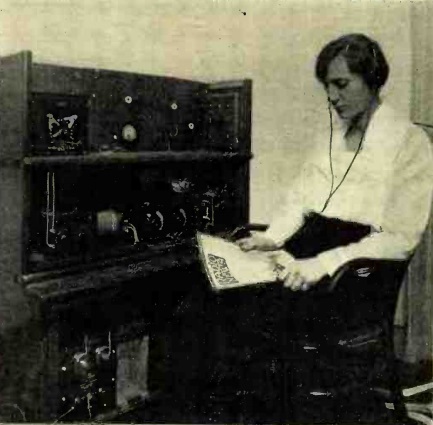
The Minnesota Wireless Association (MWA), according to its QRZ.com listing, has been in existence since 1914, and that fact is borne out by the photograph above, which appeared a hundred years ago, in the March 1915 issue of Popular Mechanics.  The article describes the station installed in the Minneapolis City Hall, a structure which is still in existence and easily recognizable, as seen in the modern photo here.

The magazine reported that the station had just been installed by the Minnesota Wireless Association, and was “probably the largest private wireless station” at the time. It noted that the instruments in the station were “arranged with particular reference to experimental work, which will include tests and comparisons of new apparatus, studies of stray electrical disturbances, and the development of new apparatus.” The antenna consisted of eleven wires between the two towers, 400 feet above ground at the clock tower.

The article reported a receiving range of 4000 miles and a “sending range limited only by the power used.” The station had a license to operate on any wavelength and with any power, but the article noted that “every precaution will be taken not to interfere with other stations.” The station apparently used only radiotelegraph at the time, but the article noted that a wireless telephone set was under construction.

According to a 1914 Wireless Age account, the station’s best DX was Colon, Panama, as member Claud Sweeny had copied that signal.  The club also reported that the station had excellent reception of time signals, presumably from NAA in Arlington, Virginia, and it was likely that those signals would be utilized for controlling the city clock, “thus giving Minneapolis the first radio municipal time.”

The MWA currently holds the call sign W0AA, although I’m not sure when they received this call.  According to the Club’s QRZ.com listing, they’ve held it since 1967, in memory of one of its members, Art Andersen, who had held the call prior to his death.  However, W0AA is shown in the 1952 call book as belonging to the club, with Andersen listed as the trustee.  The 1938 call book shows W9AA as belonging to a ham in Chicago, so it appears that the club got the ‘AA call sometime between 1938 and 1952.

According to the September 1914 issue of Wireless Age, the station bore the call sign 9ZE.  That call is listed in the 1914 call book as being held by Philip E. Edelman, who is identified in the Wireless Age article as being the Association’s president.   The club is listed in the 1920 call book as holding the license for special land station 9ZT, with an address of 402 Courthouse Bldg.  In the 1926 call book, the licensee for that call sign is a familiar name in Amateur Radio history, D.C. Wallace, later W6AM.  A QST search for 9ZT reveals that the call was Wallace’s personal call sign until he moved to California in the 1920’s.  It’s unclear, therefore, whether MWA has continously held a license for the last hundred years.  But as the photo above proves, they have been a force in Amateur Radio for a century, as 9ZE, 9ZT, W0AA, and possibly other call signs.

Read More At Amazon

Don C. Wallace: W6AM, Amateur Radio’s Pioneer


Click Here For Today’s Ripley’s Believe It Or Not Cartoon


Morse Code Secret Message in Colombian Song

FARC Guerillas. Wikipedia photo.

FARC Guerillas. Wikipedia photo.

Morse Code was used in 2010 to get a secret message to hostages being held in the Colombian jungle by FARC guerrillas.  Some of the hostages had been held for years, and the Colombian army wanted to deliver a message that they hadn’t been forgotten, that some hostages had already been rescued, and that they were next.

Since it was known that some of the prisoners knew Morse Code, and the captors probably didn’t, the Army decided to insert a Morse message into a popular song and get it broadcast on the air.  The result was the song heard on this YouTube video, Mejores Dias (Better Days), recorded by Colombian studio musicians Natalia Gutierrez Y Angelo.

I knew there was Morse Code coming, and I heard it the first time.  If I hadn’t been expecting it, I suspect it might have taken a couple of plays for me to notice.  And once I knew it was there, it took me several times to get the entire message, since it is well hidden in the music.  But if I had a lot of time on my hands, I would eventually decode the entire message.  It’s in the chorus, starting at about 1:30, 2:30, and 3:40 in the video, following the words, “escuchas esta mensaje, hermano” (listen to this message, brother).

To make sure that the song was heard, the Colombian army arranged to have it inserted into the play lists of the government-owned stations serving the jungle areas where the hostages were being held.  The guerrillas listened to the radio, and the hostages later reported that they even liked the song.  The message was heard, as rescued hostages later reported.

The message reads:   “19 LIBERADOS. SIGUEN USTEDES. ANIMO.”  (19 PEOPLE RESCUED. YOU’RE NEXT. DON’T LOSE HOPE.)  Even if you have only a passing knowledge of Morse Code, you will hear it, and you’ll eventually be able to decode it.

More information is available at TheVerge.com, at the article linked below.

References


Heathkit GR-64, 1965

HeathGR64We recently looked at the Knight-Kit Star Roamer Receiver from 1964. It was a beginner’s general coverage receiver and was quite popular. The February 1965 issue of Popular Electronics announces another popular general coverage receiver for beginning SWL’s and hams, the Heathkit GR-64 shown here. It covered 550 kHz through 30 MHz in four bands, and made do with four tubes, a mixer-amplifier, IF amplifier, detector-audio amplifier, and audio output. The power rectifier consisted of two silicon diodes.

The kit retailed for $39.95.  The assembly manual is available for download at this link.


The Luxembourg Effect

LuxembourgEffect

An interesting ionospheric effect was first noticed about 80 years ago, and reported 80 years ago this month in Radio Craft magazine, February 1935.  Radio Luxembourg operated on 252 kHz, with a powerful 150 kw signal designed to provide coverage in England.

The phenomenon was discovered in 1933 by B.D.H. Tellegen, in Eindhoven, Netherlands, who was listening to a station in Beromunster, Switzerland, on 652 kHz. In the background of the Swiss signal, he could hear the audio of Radio Luxembourg. This same phenomenon was reported by other listeners. Due to the distance between the three points involved, it could not be explained by the receiver being overloaded. The Luxembourg signal could be heard only when the Swiss station was transmitting.

Tellegen noted that the three points were in a straight line: When the signal from the Swiss station made its way to the Netherlands, it passed directly over Luxembourg. He correctly theorized that the carrier of the Swiss station’s signal was being modulated in the ionosphere as it passed through the strong signal of Radio Luxembourg in the ionosphere.

The ionosphere had only recently been discovered, and was not totally understood. It was previously supposed that the ionosphere was a linear medium, through which radio waves passively reflected. But the existence of the Luxembourg Effect showed that the ionosphere could be artificially “heated,” to produce non-linear effects.

Interestingly, the carrier frequency of the signal didn’t seem to be critical.  The modulation of the interfering signal was superimposed on the other signal without regard to the carrier frequency.  Subsequent research showed that most of the effect took place in the lower range of the audio frequencies.

Much to the dismay of conspiracy theorists, this is the phenomenon that the High Frequency Active Auroral Research Program (HAARP) was working with. It’s relatively easy to generate a strong radio signal in the High Frequency (HF) region. HAARP had transmitters that could generate 3.6 MW signals from 2.8-10 MHz and radiate them toward the ionosphere. This strong signal was able to generate the same kind of “heating” effects caused by Radio Luxembourg.

It’s more difficult to generate signals in the Extremely Low Frequency (ELF) region. Among other things, ELF signals are used to communicate with submarines. The main idea of HAARP was to generate these signals not in a transmitter, but in the ionosphere itself, by mixing two strong HF signals. For example, it would be practically impossible to generate a radio wave of 0.1 Hz with a transmitter. But by beaming two signals into the ionosphere, one at 4.000000 MHz, and one at 4.0000001 MHz, the result would be a radio wave, generated in the ionosphere, with a frequency of the difference, 0.0000001 MHz, or 0.1 Hz.

The phenomenon is sometimes called the Luxembourg-Gorky effect, since the powerful longwave transmitter at Gorky, USSR, produced similar effects.

References


One-Tube Wartime Receiver, 1945

RadioCraftFeb45

Radio parts were in short supply during the War, and radio enthusiasts had to make do with what they had. “H.T.,” a resident of Bothell, Washington, apparently had in his junk box a 1D8GT tube, and a low-impedance earphone, and wanted to know what he could do with them. So he wrote to the editors of Radio Craft magazine asking for a diagram of a receiver covering the broadcast band making use of the parts he had. He wanted to mount the earphone in the cabinet for use as a small speaker.

The editors indulged him and provided this diagram in the February 1945 issue. It was reprinted from the July 1940 issue, and showed how the combination diode-triode-pentode tube could be used in this circuit. The triode section of the tube was an RF amplifier, followed by the diode detector, with the pentode serving as an audio amplifier. Unfortunately for H.T., the low impedance earphone would need to be used in conjunction with an audio transformer. This set would drive a pair of high-impedance headphones, but to use it with his low-impedance earphone, it would need to be wired as shown for the speaker. So H.T. had to find himself either a set of hi-z headphones, or the output transformer, in addition to what he already owned.

The other hard-to-obtain part would be the variable capacitor. The circuit here shows a ganged condenser, but the response pointed out that two separate condensers would provide better results.

Click Here For Today’s Ripley’s Believe It Or Not Cartoon


1940 Two-Tube Two-Band Receiver

1940FebPM75 years ago, Popular Mechanics, February 1940, carried the plans for this simple two-tube, two-band receiver, which could be run off flashlight batteries, 8 for the B+, and one for the filaments. It used two Type 49 tubes, and tuned both the broadcast band and short wave. The short wave band covered the then-police freuencies, as well as the 160 and 80 meter ham bands. It was mounted on a wooden chassis and had a wooden front panel.  It was a very simple design, with one tube serving as the regenerative detector, and the second as audio amplifier.

This particular receiver would be difficult to duplicate, since the coils are unobtanium. The article notes that the coil is a “three-circuit tuner” which did away with “tedious coil winding, often a stumbling block for beginners.” The coil came with a pre-marked terminal strip which made wiring errors next to impossible. The rotating tickler coil was included. It even had a built-in switch wired to the taps on the coil for easy switching from broadcast to short wave.

As was often the case, the Popular Mechanics project was available in kit form from Allied Radio. The 1941 catalog shows this kit as selling for $4.70, plus $1.39 for the tubes and batteries.

Click Here For Today’s Ripley’s Believe It Or Not Cartoon


Battle of Iwo Jima, Feb. 23, 1945

IwoJima

The iconic photo of U.S. Marines hoisting Old Glory on Iwo Jima was taken 70 years ago today, February 23, 1945. It appeared on the front page of the Chicago Tribune, February 28, 1945, as the drawing shown here. As the artist wrote, “Not with a rope, but with Blood and Toil is the flag raised, and Devotion only can keep it aloft.”

Click Here For Today’s Ripley’s Believe It Or Not Cartoon


The Real Reason Scouting Is Important

MeasureDistancePeople sometimes ask what is the most important thing that youth learn from Scouting. They usually expect to hear something along the lines of that it “builds character.” In some cases, it is probably true that Scouting builds character, but I honestly can’t point to too many people who would have wound up being bad characters if they hadn’t been in Scouting.

A better reason why Scouting is important is summed up in this diagram, which appeared in Boys’ Life magazine 70 years ago, February 1945.  That’s not to say that measuring the width of a river is a particularly important skill in the scheme of things. In fact, I don’t recall ever being taught this particular method. But it’s illustrative of something I did learn, without knowing that it was being taught. What I really learned was that when I’m faced with some obstacle, it is usually possible to achieve the desired result, by applying a little bit of thought. But the first step is to know that there is a solution to the problem. Once a person realizes that, then finding the actual solution (or more often, one possible solution out of many) is usually pretty simple.

In this illustration, the Scout needs to know the distance across the river. The article, written by William “Green Bar Bill” Hillcourt, explains the method being used here. He starts at point A, which is directly across the river from a given point with a convenient object, in this case, a tree. He then walks along the river a set distance, such as 100 paces, and places a stick at that point. He then keeps walking that same distance. When he reaches the point marked C, he walks at a right angle, and keeps going until he’s along the same line containing the tree and the stick. At that point, the distance he’s walked away from the river is equal to the width of the river.

There are certainly other methods to figure out the distance, another one of which is also shown. But one method, which seems to be the most commonly used these days, is to consult outside information. It’s usually possible to ask someone who knows the answer. And it’s even possible to go to Google Maps, look at the image, and get the exact width. Those are very valid methods, and in many cases, they are more convenient and better methods. But the Scout learns that they are not the only methods. Even if outside assistance is not available, it is possible to figure things like this out on your own, without outside help.

I never really realized this until a few years back, when I started hearing from RV’ers that they couldn’t possibly camp in a non-electric site. I happen to enjoy the convenience of electric power, and if it’s available, I gladly take advantage of it. But I don’t view it as a necessity. When pressed, these people invariably come up with the same rationale for needing electricity: They need it in order to plug in their electric coffee maker.

Now, I drink a lot of coffee, and I probably drink more coffee than most of those people. So I understand their need for coffee. But I also realize one thing that they don’t know: I know that there are many methods of making coffee that don’t involve the friendly local electric utility. In response to their concerns, I even created a website entitled “How To Make Coffee Without Electricity.”  That website is written in a somewhat tongue-in-cheek style. But it’s also full of information that people don’t know, even though I always assumed that it was just common sense. It’s probably common sense to me because I was in Boy Scouts. I know that I can figure out the width of a river even if Google Maps is unavailable. So it stands to reason that I can figure out how to make coffee even if the power happens to be out.

There must be a lot of people who weren’t Scouts. Whenever a hurricane is bearing down on some part of the English-speaking world, my coffee page starts to get hundreds of hits. A day or two before the storm, these are from desktop computers. The day after the storm makes landfall, the number of hits increases, but most of them are from mobile devices. In other words, the power goes out, and only then they realize that they don’t know how to make a cup of coffee. I’m glad their mobile device is still working, and I’m glad that Google is still working, and I’m happy to impart my lifesaving knowledge that it is, indeed, still possible for them to make a cup of coffee.

But I worry about these people if Google ever becomes unavailable for some reason. Maybe they should have been Boy Scouts. I’m sure these people are of fine character, and they didn’t need Scouting to build it. But learning the lesson that self-reliance is usually possible probably would have served them well.

Click Here For Today’s Ripley’s Believe It Or Not Cartoon


Heathkit CB-1 “Benton Harbor Lunchbox”

HeathCB1

Most hams who have been around a while have encountered the “Benton Harbor Lunchbox.”  This was a series of transceivers from Heathkit, and the most common were the HW-30 “Twoer,” which covered two meters, and the HW-29 “Sixer” for six meters.  Less common was the HW-19 “Tener” for, you guessed it, ten meters.

These were very popular in their day.  They were a single-band transceiver.  The transmitter put out about 5 watts of AM, and the receiver was superregenerative.  The tuning was very broad, but once they locked on to a signal, they were surprisingly sensitive.

By the time I became a ham in the 1970’s, VHF AM was virtually gone.  There was one six-meter AM net in the Twin Cities that hung on, and I was a regular check-in with my Sixer and later a Gonset Communicator.  But FM had taken over two meters by then, and Twoers were basically given away for practically nothing, even though they were often in pristine condition.  I owned many of these little rigs, and at one time I owned a complete collection.

My collection included the lesser-known cousin, the Model CB-1 CB transceiver shown here.  The CB model came out in about 1960, and is shown here in this ad in the February 1960 issue of Popular Electronics.

It sold in kit form for $42.95, and was also available wired for $60.95.  It featured one crystal-controlled channel (the crystal was included).  The receiver was the same superregenerative receiver used in the other Lunch Boxes, and was calibrated for channels 1-23.  It had a built-in power supply for 120 volts.  For mobile use, it used an external power supply, which consisted of a vibrator and transformer.  The power was supplied to an octal plug on the back (the same as the bottom of a tube).  The 120 volt power cord and the DC power supply had  octal sockets on them, along with appropriate jumpers.

Click Here For Today’s Ripley’s Believe It Or Not Cartoon