Author Archives: clem.law@usa.net

1937 Radio Refrigerator

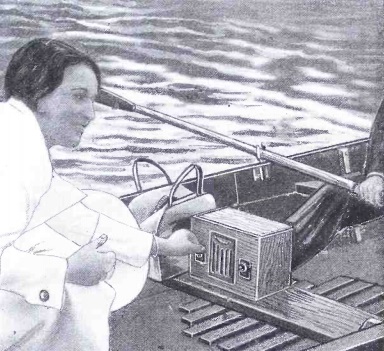
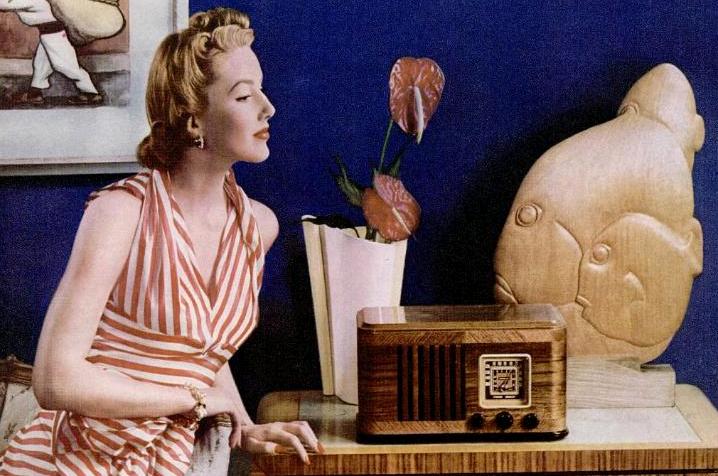
RefrigeratorRadioHere’s an idea from 1937 that for some reason never caught on. As shown in the July 1937 issue of Popular Mechanics, this single kitchen appliance combines a radio and refrigerator.  Actually, as the magazine concedes, the radio is in the removable top of the refrigerator, and tops without a radio were also available.  The article doesn’t mention the manufacturer, but a handwritten note in the margin reveals that it was Crosley, who made both radios and refrigerators.  It was billed as just the thing for the housewife who wanted to listen to a recipe on the radio, or simply listen to music while working in the kitchen.

I’ve never seen any evidence of a surviving example, or even an advertisement.  So it’s unlikely that this idea got much past the trial balloon stage.

Click Here For Today’s Ripley’s Believe It Or Not Cartoon


Trinity A-Bomb Test, 1945

Today marks the 70th anniversary of the Trinity nuclear test, the world’s first nuclear explosion, shown here 16 milliseconds after detonation.  The possibility of a fizzle led the team to construct a containment vessel dubbed “Jumbo,” a steel vessel measuring 25 by 10 feet, with steel walls 14 inches thick, capable of handling pressures of 50,000 PSI.  Brought from Ohio, it was the largest object ever transported by rail.

The blast was seen and felt in an area extending from El Paso, Silver City, Gallup, Socorro, and Albeuquerque.  One news article  quoted a blind woman 150 miles  away who asked, “what’s that brilliant light?”


The army issued a press release that a “remotely located ammunition magazine containing a considerable amount of high explosives and pyrotechnics exploded. There was no loss of life or injury to anyone, and the property damage outside of the explosives magazine was negligible. Weather conditions affecting the content of gas shells exploded by the blast may make it desirable for the Army to evacuate temporarily a few civilians from their homes.”

Other versions of the press release had been prepared noting fatalities.  The author of the press release realized that he might have been writing his obituary.


Click Here For Today’s Ripley’s Believe It Or Not Cartoon


1945 Kids Radio-Phono Combo

1945PMradiophonoThe young man shown here is presumably the son of Popular Mechanics author Arthur I. Rattray, and is shown next to the radio-phonograph assembled by his father, as described in the July 1945 issue of the magazine.

In the article, he notes that perhaps readers might have a small boy or girl who would like to play records and listen to the radio with a phono-radio combination of their very own. He notes that such units would undoubtedly be plentiful after the war, “but that does not solve the immediate problem.” Therefore, he decided to put one together himself. He did so by combining an old midget radio (probably similar to the $7.95 set featured in an earlier post) with an old table phonograph. He housed them in the legs and braces from a discarded radio console.

He ran the phono cartridge directly to the radio’s audio output tube. He noted that this hookup “does not permit full volume, which is an assset rather than a liability,” but that the volume was sufficient for both radio and phono.

I doubt if anyone is going to recreate this particular project. But one warning is in order. One side of the phono cartridge (and probably the metal tone arm) is connected directly to the radio chasis. Depending on the set, there’s a 50/50 chance that this is hooked directly to the hot side of the AC line cord.

Click Here For Today’s Ripley’s Believe It Or Not Cartoon


1950 Poolside Television

1950PoolsideTV

65 years ago, the young women shown here were enjoying the Hoffman Model 947 television poolside at the Beverly-Wilshire Hotel in Beverly Hills. The accompanying article in the July 1950 issue of Radio News notes that until recently, such activity would have been impossible, since full enjoyment of the program necessitated darkness or semi-darkness, not to mention what to do with the unwieldy line going to the antenna.

But that was all in the past, since black-faced picture tubes and improved circuit designs had resulted in greater brightness and better receiver sensitivity. A prominent motion picture star had been discussing the problem with the president of the set’s manufacturer, and had been enjoying programs poolside for quite some time. The idea soon spread, not only to the Hollywood elite, but to the area hotels.

At the Beverly-Wilshire, every warm day would find a group of swimming and sunbathing guests clustered around the set that had been wheeled out for their viewing pleasure.

And if the set ever needed servicing, the same issue advertised, for only $6.95, a high voltage probe rated at 30,000 volts, just the thing the serviceman would need if some unfortunate guest splashed a little too much water on it.

Click Here For Today’s Ripley’s Believe It Or Not Cartoon


Fire at Barnum’s American Museum, 1865


On this day 150 years ago, July 13, 1865, Barnum’s American Museum burned to the ground.  Located at Broadway and Ann Street in Lower Manhattan,

The museum had been owned by showman P.T. Barnum since 1841 and featured wholesome family entertainment, including a zoo, museum, lecture hall, theater, and freak show. Most of the animals, including the beluga whales in a second-floor tank, perished in the fire, but a few survived. The popular Ned the learned seal, was among the survivors, as was a bear that was lowered to safety by a fireman and rope.

The museum was open as much as fifteen hours a day, six days a week, and drew up to 15,000 visitors a day to pay the 25 cent admission fee.

The fire was among the most spectacular in New York history. A virtual museum supported by the National Endowment for the Humanities, recreates many of the spectacles of Barnum’s original version.

Read More at Amazon

Click Here For Today’s Ripley’s Believe It Or Not Cartoon


Sackville and Dixon Transmitters, 1945

Control room of Dixon shortwave transmitters.

Control room of Dixon shortwave transmitters.

Seventy years ago, two famous RCA transmitter installations were featured in the company’s quarterly journal, Radio Age, July 1945.

The first was Canada’s shortwave transmitter at Sackville, New Brunswick, which opened on February 25, 1945. What was then referred to as “Canada’s Loudest Voice” featured two 50,000 watt RCA transmitters. The 213-acre site had been selected due to the lack of unfavorable magnetic conditions and because the moist earth was conducive to radio transmission.

Main control console at Sackville.

Main control console at Sackville.

While Canada had a number of commercial shortwave broadcasters, the intent of the station was to provide a voice comparable to that of the United States and England, in order to communicate news and entertainment to soldiers, placing the Canadian point of view before Allied nations, and to “join their fighting allies in telling the enemy the real uncolored truth about the war’s progress.”

V-E Day eliminated the need for some types of programs, but the article notes that other features would continue to expand.

Sackville transmitter site.

Sackville transmitter site.

The station, operating with the rarely stated call letters CKCX, continued in operation until 2012. In addition to CBC programs, it served as a relay for a number of other broadcasters, including Radio Japan, China Radio International, Voice of Vietnam, BBC World Service, Deutsche Welle, and Radio Korea. In addition to international programming, it broadcast CBC Northern Service programs in English, French, and Innuit.

The other RCA transmitter featured in the issue was that of the station that later became the Voice of America relay station in Dixon, California. Under contract with the Office of War Information, both CBS and NBC were contracted to construct shortwave transmitters on the West Coast to provide a strong signal to the Far East. The CBS effort resulted in what later became the VOA relay station in Delano, California. And the NBC station with its RCA transmitters featured in the RCA publication, became the VOA station in Dixon, California. That location was on a great circle that included both Asia and Latin America. Therefore, by reversing the direction of the antenna, it could cover two target areas. By beaming North, the station could provide a signal to Asia. And by beaming South, the same booming signal would carry the American message to Latin America.

The Dixon station was operated by NBC until 1963, with call letters KNBA, KNBC, KNBI, and KNBX In 1963, the federal government assumed control until the station was shut down in 1979. The installation was mothballed, and resumed operation in 1983, at which time its primary function was to transmit Spanish programming to Central America until 1988. The site was sold by the federal government in 1993, and has been used by Globe Wireless since then as KFS, providing wireless HF e-mail service to maritime interests.

Click Here For Today’s Ripley’s Believe It Or Not Cartoon


Capt. Colin P. Kelly, Jr.

Capt. Colin P. Kelly, Jr.,  Air Power Gallery at the National Museum of the U.S. Air Force, painted by Deane Keller of Yale University. (U.S. Air Force photo, via Wikipedia).

Capt. Colin P. Kelly, Jr., Air Power Gallery at the National Museum of the U.S. Air Force, painted by Deane Keller of Yale University. (U.S. Air Force photo, via Wikipedia).

Today would have been the 100th birthday of U.S. pilot Colin Kelly, Jr., who was killed in action in the early days of World War 2. On December 10, 1941, his B-17C took off from Clark Field in the Phillipine Islands in a bombing run, in which his flight inflicted damage on the Japanese cruiser Natori. On its return flight, the plane was engaged by Japanese fighters who attacked it, followed it, and attacked again. When the plane began to burn near Clark Field, Kelly ordered the crew to bail out. After the crew was safely out of the plane, it blew up, killing Kelly.

Kelly was posthumously awarded the Distinguished Service Cross. President Roosevelt wrote a letter to “The President of the United States of America in 1956” asking for an appointment for Kelly’s infant son. In 1959, President Eisenhower honored the request and appointed Colin Kelly III to West Point.
Click Here For Today’s Ripley’s Believe It Or Not Cartoon


Armenian Genocide Memorial Eagle Projects

Memorial at St. Vartan Armenian Church, Oakland, Cal. Photo courtesty of St. Vartan Armenian Church http://stvartanoakland.org/PhotoAlbum/Genocide%20Project%202014/index.html

Memorial at St. Vartan Armenian Church, Oakland, Cal. Photo courtesty of St. Vartan Armenian Church.

As those who are involved in Scouting, and many others, know, one of the requirements for the rank of Eagle Scout is for the Scout to plan, develop, and lead a significant service project to benefit a religious institution, school, or community. Often, Life Scouts are looking for ideas of what might be a suitable project, and they can take inspiration from the projects of two recent Eagle Scouts, Noubar Armen Mannogian of Troop 869, Scottsdale, Arizona, of the BSA Grand Canyon Council, and Alex Collelo of Troop 805, Danville, California, of the BSA Mt. Diablo Silverado Council.

An item in the Winter 2015 issue of Eagles’ Call magazine, the publication of the National Eagle Scout Association, caught my eye recently. It described the Mr. Manoogian’s Eagle project. He is a second-generation Armenian-American and member of St. Apgar Armenian Apostolic Church in Scottsdale, Arizona.

Largely forgotten by most Americans, a century ago, the people of Armenia were in the midst of immense persecution, the end result of which was the wholesale genocide of the Armenian people. In the midst of World War 1, in 1915, as many as 1.5 million Armenians would die at the hands of the Ottoman Turks. It was the first genocide of the twentieth century, and it set the stage for all of the rest.  And to the extent that it is remembered, what is often overlooked is the fact that it was a case of Christian martyrdom. As I wrote previously, most of the victims died because they clung to their Christian faith despite persecution.

The survivors became the Armenian Diaspora, eventually finding their way to North America, the Soviet Union, South America, and Australia.  Among the descendants of those survivors was Mr. Manoogian, and his Eagle project was in remembrance of the genocide. At his church, he led the construction of a memorial to the genocide, one of only a handful in the United States. It contains the names of 113 towns where the victims, ancestors of the church’s members, lived.

Mr. Colello’s Eagle project was to create a similar memorial as well as new landscaping at his church, St. Vartan Armenian Church in Oakland, California. It also included the names of 48 ancestral hometowns, a plaque, and marble benches.

Click Here For Today’s Ripley’s Believe It Or Not Cartoon


Victory Eclipse of 1945

1945EclipseSeventy years ago today, July 9, 1945, a narrow strip of Idaho and Montana experienced a total eclipse of the sun.  From its sunrise beginning in the northwestern United States, the path of totality passed through Canada, Greenland, Scandinavia, and the Soviet Union. The photo here was taken near Butte, Montana, were the sun rose almost fully eclipsed, with totality a few minutes later. The photo was taken by Peter A. Leavens, and appeared in Life Magazine on July 23, 1945.

Critical frequency during eclipse.

Critical frequency during eclipse.

Ionospheric scientists at Tromsø, Norway, only two moths after liberation, took the opportunity to measure the effects of the eclipse on the ionosphere. Their results show a pronounced dip in the critical frequency during the eclipse.

Interestingly, their report also notes that the Germans had an ionospheric station at Kjeller, used to determine radio communication frequencies after the war. When the station was taken over by Allied forces, the German peronnel were ordered to continue their work, and observations were made at that station as well.

Click Here For Today’s Ripley’s Believe It Or Not Cartoon


1951 Boys’ Life One Tube Receiver

1951BLrcvrThe one-tube shortwave receiver shown here appeared in Boys’ Life magazine in October, 1951. It’s a very simple regenerative circuit using a single 3A4 tube. According to the accompanying article (which carried no byline), the circuit was designed by the ARRL. The filaments were powered by the two dry cells in series, with a 22.5 volt battery supplying the B+. The Boys’ Life editors priced the components at $17.05 in New York, and noted that most Scouts could beat that price both by shopping around and by asking a friendly local ham for components from the junk box.
1951BLrcvrSchematicThe article is a bit sketchy on details; in fact, it doesn’t mention the tuning range. But from the size of the coil and capacitor, I’m guessing that its coverage is in the vicinity of 40 meters. The Novice class license had just been created by the FCC, and the article notes that the little receiver would be good for code practice for earning that license:

For your money and time you will have a working receiver capable of picking up amateur signals, ships at sea, aircraft, and the code-practice broadcasts of the American Radio Relay League. The League broadcasts at 9:30 P.M., Monday through Friday, at Eastern Standard Time. If you’re after the Novice Class ticket, you’ll find the ARRL broadcasts tops for real practice.

The same receiver appeared in the Radio Merit Badge pamphlet, a copy of which has been scanned and placed online by AL7FS.  It appears that the receiver appeared in the merit badge book until 1962. From the text, it appears that a requirement at that time was to construct a receiver and use it to log five stations, and this one would certainly be up to the task.

Click Here For Today’s Ripley’s Believe It Or Not Cartoon