Author Archives: clem.law@usa.net

NPOTA: North Country Scenic Trail, Jay Cooke State Park, MN

JayCookeToday, I did a National Parks On the Air (NPOTA) activation of the North Country National Scenic Trail, a hiking trail that extends from eastern New York to North Dakota.  My operating location was in Jay Cooke State Park, Minnesota, about 25 miles south of Duluth.  My operating location is shown here.  The radio itself, my  Yaesu FT-817, is barely visible propped up by the bright blue canvas bag, in front of the dark blue bag.  The 12 volt battery is on top of the bright red bag, and my lunch is inside the dark red bag.  The cable going up to my antenna is visible, but the antenna, a 20 meter dipole tied to trees with string, while in the frame, is not visible.

During NPOTA, amateur radio operators set up portable stations at National Park units and make contact with other amateurs at home.  The event has been very popular, and there have been hundreds of thousands of contacts made from the parks.  Since the event includes all units of the National Park Service, the North Country Trail qualifies as a “National Park,” allowing me to operate from one of the Minnesota state parks crossed by the trail.

During today’s activation, I managed only four contacts, the furthest being Mississippi.  According to the Reverse Beacon Network, my signal was getting out.  Unfortunately, many chasers don’t bother looking for stations.  They wait until they’re spotted on the internet, and then work them.  So making that first contact can be a challenge.  Since I was only there for a brief stop over lunch, I didn’t bother persisting to make six more contacts.  But I’ll be operating from this spot again on June 5 as part of the Light Up The Trail event being done in conjunction with NPOTA.  During that event, stations will be set up at various locations along the North Country Trail.  I decided to do a trial run today, since I’m in Duluth to present a Continuing Legal Education program on Friday morning, and then serving as a delegate to the Minnesota Republican State Convention on Friday and Saturday.

The swing bridge at Jay Cooke State Park was washed away.

2012 flooding of bridge. USGS photo.

Swinging Bridge prior to 2012 flood. Wikipedia photo.

Jay Cooke State Park was originally created in 1915 by a donation of land from the St. Louis Power Company. It remained undeveloped until the 1930’s, when the Civilian Conservation Corps built many of the park’s structures, including the iconic Swinging Bridge over the St. Louis River. The bridge was destroyed by flooding in 2012 but subsequently rebuilt according to the original plans. As you can see from the picture at the top of the page, my operating location was near the bridge and near the River Inn visitor center in the picture shown below, also constructed by the CCC.  The North Country Trail passes over the Swinging Bridge, putting my operating location well within the 50 yards from the trail required by the NPOTA rules.

River Inn Jay Cooke.JPG

River Inn Visitor Center, Jay Cooke State Park. Wikipedia photo.

This stretch of the St. Louis River consists of a long rapids impossible to traverse by canoe. Therefore, both Native Americans and Europeans portaged around the rapids, and this portage remained in use until the 1870’s.

Starting in the 17th century, the portage was used heavily by fur traders, since it formed part of the route from the Great Lakes to the Mississippi River basin.  The voyageurs had to traverse the 6.5 mile portage through the area, carrying two or three packs weighing about 90 pounds each.  It took three to five days to cross the portage, and the voyageurs doing so would be covered with mud and insect bites.  My activation today was not quite so strenuous.  It required me to carry my complete station, including battery, radio, and antennas, weighing a total of about 10 pounds, a total of about 100 yards from the parking lot to the picnic area.  And even though I got mostly skunked, I bet the voyageurs who traversed the area a few centuries ago would never dream that it would someday be possible to toss a wire into a tree and talk halfway across the continent with a piece of equipment that would have made only a small dent in their 90 pound packs.

Click Here For Today’s Ripley’s Believe It Or Not Cartoon


GE Model LB-530 Portable, 1941

1941LifeGEportable

This ad for General Electric portable radios appeared in Life Magazine 75 years ago today, May 19, 1941. The main model featured, model LB-530, was a five-tube broadcast set with a tube lineup consisting of 1A7GT, 1N5GT, 1N5GT, 1H5GT, and 1Q5GT. While billed as being able to run off the internal storage battery or AC, this wasn’t entirely correct. The set always ran from the 2 volt battery, getting its 90 volt B+ from an internal vibrator power supply. The AC current would merely charge the battery, meaning that the set couldn’t really be run without a battery in place. I did have a similar model at one time, and by the time I got the radio, the lead-acid battery was long gone. The set would pull in a few strong stations without the battery in place, but the battery was an indispensable part of the circuit. The set also had provision for charging from a 6 volt car battery.

A nice example of the set can be found at this site.

The radio had a retail price of $39.95. The ad also featured other portables designed to run from dry cell B batteries, starting at $16.95.

Click Here For Today’s Ripley’s Believe It Or Not Cartoon



WW2 Wireless Code Practice Oscillator

1944JunePM

A young man drafted into the military during World War II could give himself an edge by having a useful skill, and the June 1944 issue of Popular Mechanics reported that pre-induction code practice sessions were well attended. This created a problem, since most code practice oscillators used headphones, and acquiring enough headphones presented a logistical challenge for those running the sessions.

1944JunePM2The solution was offered in the form of a three-tube wireless code oscillator which would transmit modulated CW to a nearby broadcast receiver, producing room-filling volume. In light of wartime parts shortages, the circuit called for common receiver tubes which could probably be scavenged from another set. The plans called for a 6C5 rectifier, witn 6J5’s serving as AF and RF oscillators. The 6 volt filament voltage was obtained by wiring a 40 watt lightbulb in series with the filaments. The completed circuit is shown here mounted on a circular cutting board. The output of the oscillator was run to the receiver’s antenna jack, or simply placed near the set’s antenna.

1944JunePM3

Click Here For Today’s Ripley’s Believe It Or Not Cartoon
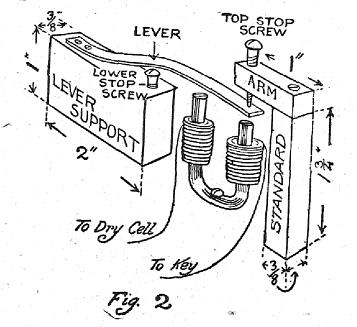


Helen Marshall, NBC Radio, 1936

HelenMarshall1935Pictured here in the May 1936 issue of Radio News is Helen Marshall, one of the three named “Miss Radio of 1936” by radio pioneer Nils T. Granlund, the other two being Dorothy Lamour and Harriet Hilliard (later known as Harriet Nelson of Ozzie & Harriet fame), also of NBC.

She was the leading soprano of Sigmund Ramberg’s Studio Party, heard Tuesday nights on NBC.

Click Here For Today’s Ripley’s Believe It Or Not Cartoon


NPOTA: Minnesota Veterans Home

VAHomeOperating

Operating at the Minnesota Veterans Home with the Mississippi in the background.

This morning, N0AIS and I set up for a couple of hours at the Minnesota Veterans Home in Minneapolis to do a demonstration of ham radio for the residents and visitors, and to “activate” RV04 (the Mississippi National River and Recreation Area) for ARRL National Parks On The Air (NPOTA) event.  This 72-mile long unit of the National Park Service passes through Minneapolis and St. Paul, and provides numerous opportunities for recreation.  I’ve operated from other locations along the river, but since the Veterans Home’s park-like campus is along the river, we obtained permission to use NPOTA as an opportunity to share Amateur Radio with some of the vets living there.

We had originally planned on operating from a courtyard, but due to the cold temperatures this morning, we were offered a spot inside in a sun room overlooking the river.

N0AIS photo.

N0AIS photo.

We were able to open one of the windows enough to get a wire through, so while I set up the radio inside, Jim put up a dipole outside. Within a few minutes, we were on the air. Since the antenna was on the east side of the building, we didn’t put out much of a signal to the west, but we made about 60 contacts with the eastern U.S., as well as contacts with Belgium and Italy.

N0AIS photo.

N0AIS photo.

One of the vets took us up on our offer to get on the air, and told one of our contacts about his service. We had one WW2 radio operator in the audience. She didn’t want to get on the air, but she did send a few letters with a code practice oscillator we had brought along.

The Minnesota Veterans Home was founded in the 1888 as the Old Soldiers Home, as a residence for indigent Civil War veterans.  It currently provides high quality care for over 300 veterans.  It’s located on a 53 acre campus near Minnehaha Falls.  The property adjoins the Lock and Dam Number 1 (the Ford Dam) on Mississippi River.  As you can see from the pictures, the room from which we were operating is directly over the lock.

I would like to especially thank Jim, N0AIS, for providing most of the equipment (and doing more than half of the work), and to the staff of the Minnesota Veterans Home for making this event possible.

Click Here For Today’s Ripley’s Believe It Or Not Cartoon


Stealth Slinky Antenna

SlinkyAntenna1Forty years ago, the May-June issue of Elementary Electronics carried an interesting idea for a stealth antenna. While the article was aimed at SWL’s, the idea is equally intriguing for hams confronted with the need for a clandestine antenna.

I’ve operated with antennas hanging down from the side of a building. They’ve generally performed well, although depending on the type of construction, they often get out better in one direction. For short-term use, I generally just let a wire out through an open window and retract it when needed. The idea shown here automates the process a bit.


As you can see, the antenna itself consists of a Slinky®, mounted in a tin can just outside the window. To extend and retract it, it’s connected to an inexpensive fishing reel inside. To keep everything neat, there’s a piece of conduit running between the reel and the can. To deploy the antenna, you simply push the button on the reel. When you’re done with it, you simply reel it in. To keep prying eyes from noticing, the article recommends painting everything black.

Exterior portion of the antenna.

Exterior portion of the antenna.


Interior view.

Interior view.


Click Here For Today’s Ripley’s Believe It Or Not Cartoon


Quist Quiz Answer

1956MayQuistQuizYesterday, we showed the mysterious circuit here, from the May 1956 issue of QST.  The two boxes are connected by only two wires.  Yet switch #1 controls lamp #1, and switch #2 controls lamp #2.

And this was 1956, so there’s not a Raspberry Pi inside each box sending control signals back and forth.  As you probably figured out, the trick involves four diodes.  If one had examined the circuit in action, they might have noticed that the bulbs weren’t burning at quite their full intensity.  But according to the solution in the June issue, the effect wasn’t great enough for most people to notice.  Here’s the complete circuit:

1956JuneQuistQuizAnswer

When one switch is turned on, it sends positive pulsating DC, which can only pass through one of the diodes.  When the other switch is turned on, it passes negative pulses, which can only pass through the other diode.  When both switches are turned on, the AC is more or less unaffected, and both lamps light.

This 1956 version used selenium rectifiers.  The modern version could use silicon diodes, and fit inside a much smaller package.

Click Here For Today’s Ripley’s Believe It Or Not Cartoon


Quist Quiz

1956MayQuistQuizIn the 1940’s and 1950’s, QST occasionally ran a feature called the “Quist Quiz.” This one appeared sixty years ago, in March 1956. It’s not quite as difficult as the last one we shared, and I promise you won’t need to use the quadratic equation to solve it.

The problem consists of two small metal boxes, shown here. The one on the left contains an AC line cord and two switches. The one on the right contains two small lamps. Running between them are two wires. (The accompanying text points out that there are no hidden conductors–only two conductors run between the boxes.)

When one switch is flipped, one lamp lights. When the other switch is flipped, the second lamp lights. When both switches are turned on, both lamps are illuminated. Can you figure out the circuits inside the two boxes? The answer will appear tomorrow.

According to QST, the two boxes were the creation of Dr. Earl Weston, W8BXO, who passed away in 2009 at the age of 97.

Click Here For Today’s Ripley’s Believe It Or Not Cartoon


Flight of Rudolf Hess, 1941

Bundesarchiv Bild 146II-849, Rudolf Heß.jpg

Rudolf Hess. Wikipedia photo.

It was this night 75 years ago that Rudolf Hess made his flight to Britain.

At 17:45 local time on May 10, 1941, the number three Nazi took off from Augsburg, Germany wearing a leather flight suit bearing the rank of Captain. He carried money, toiletries, a flashlight, a camera, maps, medicine, and dextrose tablets to ward off fatigue. After initially setting a course toward Bonn, he flew easterly from near the Frisian Islands across the North Sea. He zig zagged as he approached the British coast to make landfall after dark.

When he was nearly out of fuel over Scotland, he climbed to 9000 feet and bailed out with a parachute. He never managed to negotiate with anyone. He was captured by Scottish plowman David McLean, armed with a pitchfork. The story made the papers in America on May 13, and McLean ‘s account was carried:

I was in the house and everyone else was in bed and I heara a plane roaring overhead. I ran out to the back of the farm. I heard a crash and saw the plane burst into flames about 200 yards away.

I was amazed and a bit frightened when I saw the parachute coming slowly downward. I could see a man swinging from the harness. I concluded it was a German airman bailing out and ran back to may house for help. They were all asleep. I looked around for a weapon, but found nothing except a hay fork.

Fearing I might lose the airman I hurried ’round by myself again back of the house and in the field I saw a man lying down with his parachute nearby.

He smiled and I helped him to his feet. He thanked me but I could see he’d injured his foot some way. I helped him into the house. By this time my mother and sister were out of bed and made tea. He declined the tea and smiled when we told him we were very fond of it. He asked for a glass of water.

We sent word to the authorities and in the meantime he chatted freely to us and showed us pictures of his little boy, of whom he spoke very proudly.

He told us he had left Germany about four hours before and had landed because nightfall was approaching. I could see from the way he spoke that he was a man of culture. His English, although it had a foreign accent, was very clear and he understood every word we said to him.

He was a very striking looking man wearing a magnificent flying suit. His watch and identity bracelet were of gold.

He wouldn’t discuss his hourney. He was most gentlemanly in his attitude to my mother and sister and thanked us for what we had done for him. He was most anxious about the parachute, which he said he’d like to keep because it saved his life. He wouldn’t tell us who he was, and we thought he was just another German airman.

When the officials came he greeted them with a smile and assured them he was unarmed and stood up and allowed them to search him. Then he was taken away.

This account appeared in the Milwaukee Sentinel, May 13, 1941.

Hess remained in custody for the rest of his life, dying at Spandau Prison in 1987 at the age of 93, an apparent suicide.

Read More at Amazon

Click Here For Today’s Ripley’s Believe It Or Not Cartoon


1956 Pop Up Antenna Tower

1956PopUpTower

This is either a great idea, or a really bad idea. Whichever it was, it appeared in the 1956 Allied Radio catalog.  The idea was simplicity itself, as revealed by the diagram. One man can put up an antenna and a 73 foot tower without ever leaving the ground. “Just bolt the sections together and easily push up bottom half. Then turn the crank and up goes the second half!” The bottom half was steel, and the top half was aluminum. What could possibly go wrong?

Sixty years later, these don’t seem to be available, and even though I’m not a mechanical engineer, I think I can see a couple of reasons why. First of all, I bet the top section needs a little nudge from a second man on the ground to start cranking from that insanely acute angle, but that’s not an insurmountable problem. I would definitely want to be wearing a hardhat when the top section travels the last couple of inches, since it seems to me that it’s going to drop into place by gravity without any control from the crank. And during the time that the top half is sticking out perpendicular, I would think that it really needs to be firmly tied down on the other side, to keep the whole thing from tipping over.

The biggest problem I see is that the cable is a permanent structural part of the tower. If the cable breaks, or even if some curious passerby wonders what happens when the crank is turned, nothing is holding up the tower other than gravity and the guy wires.

The description says that it will withstand 90 MPH winds. But I wouldn’t want to be standing anywhere near it when those winds were blowing.

Of course, maybe I’m wrong about those things. If so, then this is a great idea.

Click Here For Today’s Ripley’s Believe It Or Not Cartoon