Fifty years ago, the November 1967 issue of Electronics Illustrated explained how the gentleman shown in this drawing could achieve his dream of seeing the world as a ship radio operator.
The article made clear that there were two conflicting priorities at work: The lines needed radio operators, but the unions had their own vested interest in keeping the supply tight.
Ships sailing under the American flag had to have a licensed radio officer aboard, and the lack of men sometimes meant sailing delays. One bottleneck was Vietnam. Two hundred ships had been called up from the reserve fleet. Many radio officers had been called back from retirement, and those on duty were being asked to forego vacations and leave.
Entry into the field wasn’t easy. Most American ships carried only one radio officer, but he had to hold a First Class license. But to get a First Class license, you had to have six months’ service at sea.
Because of the shortages, the Radio Officers Union recently started a limited training program. After six months, the man was ready to take an assignment on a one-man ship. After 18 months, he was entitled to full membership in the union. Base pay was $300 per month for the next six months, and then $600 per month for the next 18. After becoming a full member of the union, his pay shot up to $900-$1000 per month, with good benefits. Retirement, with about a third of the pay, was possible after just 20 years of service, regardless of age.
The magazine contained addresses of the union and companies for those interested in looking into a career at sea.
The American Radio Relay League (ARRL), the national association for Amateur Radio in the United States, announced last week a year-long operating activity for 2018. During 2018, participating hams will be trying to contact as many “grid squares” as possible. The event is called the ARRL International Grid Chase, and will run from January 1 through December 31, 2018.
The main requirement is that for the contact to count, both stations must upload the contact to Logbook Of The World (LOTW). If you’re a ham and don’t yet have one, I encourage you to set up a LOTW account. The process is relatively straightforward. There’s sometimes criticism, perhaps justified, that the process is too complicated. But if you can follow instructions, it’s quite easy to create your account. And once you have it set up, the process of actually uploading QSO’s is even simpler. You do not need to be an ARRL member to set up your LOTW account or participate in the Grid Chase.
The earth is divided up into 32,400 Maidenhead grid squares. Each of these is assigned a unique code consisting of two letters and two digits, and each measures two degrees longitude by one degree latitude. For example, I live in grid EN34. Since my house is less than a mile away from one of the boundary lines, the 45th parallel north, this means that I live right next door to grid EN35. Other neighboring grids, such as EN33, EN44, and EN24, are all within a hundred miles. In the continental united states, each square measures about 100 miles east to west, and 70 miles north to south. As you move closer the equator, the squares get slightly larger and more “square.” As you move closer to the poles, the squares get smaller and more triangular, with the 18 northernmost and 18 southernmost squares actually being triangles, with their points touching at the pole.
The easiest way to find your grid square is the website qthlocator.free.fr. You simply find your location on the Google map, click on it, and you will instantly see your own grid. You can also enter a grid and the map will center on that location.
First Thoughts About Strategy
Unless someone out there has a well-equipped boat, and someone else is prepared to operate from isolated arctic or mountainous areas, it’s impossible to work all of the grids, or even most of them. After all, most of the earth consists of water (but even some of those grids will see some activations by sea or air). It’s unlikely that any grids in North Korea will be activated, although as far as I can tell, there are no grids located entirely within the Hermit Kingdom. PN30 extends a tiny bit into China, PN31, PN41, and PN42 include larger portions of China, and PN52 staddles North Korea, Russia, and China. As far as I can tell, all of the other North Korean grids include either international (but not necessarily friendly) waters, or South Korean soil. It’s unlikely that any of those grids will see much activation, but it’s not an absolute impossibility.
But as a practical matter, it’s safe to say that nobody is going to work all 32,400 grids. In fact, it’s safe to say that even the most successful operators will only work a small percentage of that amount. But there will be some that work a few thousand. I doubt if I’ll be in that category, but I think it can be done by most hams by employing some strategy.
To be at the top of the leader boards, I think will require concentrating on three things, and I want to share my preliminary thoughts on how to accomplish them. I think the following things will be required:
Work all or most of the “easy” grids in North America
Work all or most of the “easy” grids worldwide
Work all of most of the inevitable “grid-peditions” that will take place later in the year.
Working the Easy Grids in North America
Shown here is a map of the grids I worked during 2016. The vast majority of the grids shown here were worked during the National Parks On The Air event. I wasn’t making any particular effort to chase grids, but I did make thousands of contacts, and this is how they were distributed. Some of these grids (like the ones clustered around Yellowstone National Park) were because I worked someone activating a park. But most of them were stations at home who worked me while I was at a park. They are a more or less random sampling of hams, and the ones that I worked were probably the easiest ones to work, because there are more hams there. (You can create your own map for any date range at N1KDO’s site.)
The ones I didn’t work come in two categories. First of all, there is a big gap in places like Iowa, Nebraska, and the Dakotas. This is partly because some of these areas are sparsely populated. But it also shows that I was using 20 meters for most of my activations, and stations in these areas were just too close for me to work. If I had spent some time concentrating on closer states, I probably would have worked many of these grids as well.
But some grids are rare because there are few active hams there. These will be the “rare” grids that will get more attention later in the year. But I think the first order of business will be to work the easy grids first. These will be grids like the one where I live, with thousands of resident hams. I’m sure most active chasers will have EN34 crossed off their list within the first few days.
To get a good start on the event, it will be important to take care of the easy grids as soon as possible. This is important for a few reasons. First of all, it might not be readily apparent which grids are the rare ones. Some might have few hams overall, but they might be very active. So it’s best to figure out as soon as possible what category they are in. Also, they might start out as common, but become rare later in the year. If a grid has just a few active hams, it’s possible that one of them will become inactive, or perhaps move to another part of the country during the year. If you miss them when they are still “easy,” you’ll be behind everyone else, and you’ll need to get them when they are “rare.”
This happened a few times during NPOTA. For example, in April, I worked Kalaupapa National Historical Park in Hawaii. It was a relatively easy contact. But it was also a one-time opportunity, since the park was never activated again later in the year. Another example was Touro Synagogue in Rhode Island. It was a relatively easy contact, but it was only available a couple of times, early in the year. It was easy for me, but it was impossible for someone who got a late start.
And the way to ensure that the “easy” grids get in your log early in the year is through contests. When the ARRL Triple Play Award was announced in 2008, then-ARRL CEO Dave Sumner, K1ZZ, correctly predicted that many participants would get a head start, and possibly complete the award, with three January contest weekends, ARRL RTTY Roundup and the North American QSO Party (CW and Phone).
Contesters happily handing out grid squares. Wikipedia photo by Kenneth E. Harker WM5R, 2001, and is released under the GNU Free Documentation License.
Since the mode is not as important for the International Grid Chase, it probably won’t be necessary to compete in all three contests. But it seems that starting the year with one or more of these contests is a good way to get the “easy” grids out of the way. It is important to work multiple bands. As you can see from my 2016 grid map, I’m missing many easy grids within a few hundred miles of home. I’ll need to work the lower bands to get the close-in grids, and the higher bands to get the ones further away. In fact, to ensure that I have the close-in states taken care of, it will probably be worthwhile to actively participate in the CQ 160 Meter Contest in January and February.
As Triple Play Award participants discovered in 2009, most contest stations upload their logs to LOTW promptly, and most of them include their grid square. So by participating in a few contests and working the major stations, the bulk of your stateside grids will be taken care of easily.
Working the Easy Grids Worldwide
I’m not a big “DX” operator–in other words, I don’t concentrate exclusively on getting rare countries confirmed on every possible band and mode. But I also recognize that only 488 of the 32,400 grid squares are located in the Continental United States. Even if I work every last one of those 488 (which might be a personal goal), I won’t be even close to the top of the leader board. To do well in this event, it will be necessary to work some DX.
But just like with the United States, there are plenty of “easy” grids to work. There are thousands of hams in places like Japan, Europe, and Latin America, and it will be easy to color in those parts of the world. And once again, the easiest way to do this is with contests. And probably the best way to get off to a good start will be to include the ARRL International DX contest, which runs two weekends in February (CW) and March (Phone).
Chasing and Activating the Rare Grids
After these “easy” grids are out of the way, it will be important to remain active on the air and watch cluster spots for unworked grids. When you look at a map such as mine above, there’s a natural tendency to color in the empty boxes. There will still be some “easy” ones remaining, and it will be important to keep working them. During NPOTA, there was a very active Facebook group providing encouragement and spots of stations as they showed up on the air. The International Grid Chase has its own Facebook group, and it’s likely that the leaders will take full advantage of it.
Operating from grid EN12 Iowa, October 2016.
I think that within a few weeks, it will start to become obvious where the rare grids are. There are many parts of the country with few active hams. As the year goes on, and maps like mine have blank spots on them, two things will happen. First of all, local hams will be encouraged to get on the air and make contacts. Being on the receiving end of a pileup can be exhilarating, and many hams will get the chance.
I also predict that there will be “grid-
Activating grid EN00, Nebraska, Aug. 21, 2017.
peditions.” Grid chasing is already a popular pastime for VHF and satellite operators. And there are a few grids with no resident hams. One of these is CM79, the vast majority of which lies in the Pacific Ocean. But a tiny piece of the California coast is within the grid, and can be accessed over rugged terrain. The video below shows KB5WIA doing a satellite activation after a long hike:
There are many hams who are active in Summits On The Air, an activity in which hams operate from mountaintop locations using portable gear. The equipment required for an HF activation is much less than shown in KB5WIA’s video. I predict that we’ll see many such activations this year.
Many rare grids, however, don’t require this much exertion. Many grids, while sparsely populated, are easily accessible. There should be many opportunities for hams wishing to do a mobile activation and generate big pileups. For example, there are a number of grids in Minnesota that I have never worked, and are within a few hours’ drive.
One particularly intriguing one for me is EN67, shown here. It lies mostly in the waters of Lake Superior, but also includes the town of Copper Harbor, Michigan, population 108. There does appear to be one active ham in town, but I suspect another station operating portable there will do well later in the year.
There are many other such grids in the U.S. and Canada, that are located mostly in the water, but with a piece of land from which a portable station can be operated. For hams living near the coast or the Great Lakes, there is probably an opportunity like this waiting for you.
Of course, many roads run through sparsely populated areas. So if you are traveling at any time during 2018, it will be worthwhile to keep track of your grid, and try to get on the air as you pass through. And even if you don’t have HF mobile capability, simplex contacts on VHF and UHF count. If there’s another ham in the area, and you can encourage him or her to upload the contact to LOTW, you might wind up with having an almost unique one in the log. And if you have more than one ham in the family, there’s no reason why you can’t get out your handhelds and work each other. As long as you both log the contact, you will have credit for the grid. (If you don’t have other hams in the family, this would be a good opportunity to get them licensed. If they read my Technician Study Guide, they’ll pass the 35-question test with little difficulty. If they don’t have a radio, you can set them up with a Baofeng for practically nothing, and they can work you on 2 meters or 70 cm.)
Interestingly, this happened at least once during NPOTA. National Park of American Samoa had a grand total of 6 QSO’s, made by two hams who were there on vacation with their handhelds. They were the only ones to get credit for the park, which was well within the rules. There’s no reason why family groups can’t take advantage of the same rule to bolster their count. Of course, if others want to work you, then you should give them the opportunity. But if you’re the only two within range, then you should get credit for the contact.
Seventy-five years ago today, November 11, 1942, was the nation’s first wartime remembrance of Armistice Day.
The two pictures shown here appeared in that day’s Pittsburgh Press, showing a parade of 20,000 men who marched in celebration of the end of the last war. The included both the veterans of the First World War, along with their comrades fighting the Second.
The newspaper noted that the parade, which had been underway for an hour, halted at 11:00 AM while buglers sounded Taps in “an official and solemn recollection of the end of the last war, the tribute to the honored dead of that war, and, it seemed, a spiritual pledge of victory in the new and immensely greater war.”
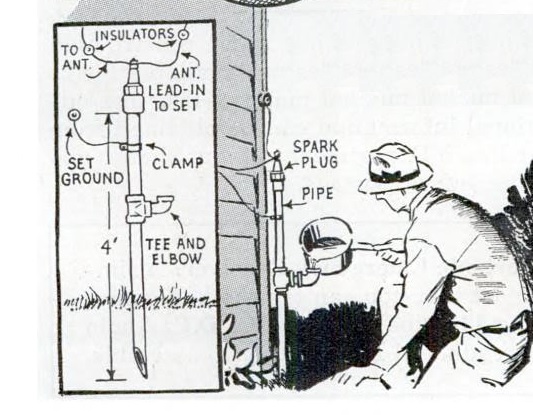
Eighty years ago, the November 1938 issue of Popular Mechanics showed this method of increasing your ground conductivity. The addition of water isn’t even mentioned in the text. But by adding the water, the ground near the rod becomes saturated, increasing the conductivity.
The actual hint being discussed is the use of a spark plug as a lightning arrestor. The lead-in is connected to one terminal of the spark plug, with the other end grounded.
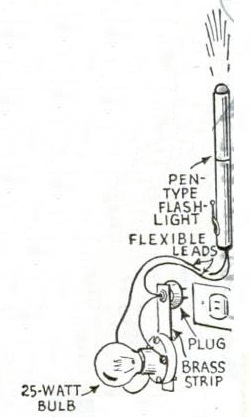
Another hint shown in the same issue is shown here. Batteries are cheap enough these days that I don’t think it would be worth trying to put together this contraption, which doesn’t look very safe. But if you really want to run your small flashlight off AC power, then wiring it in series with a 25 watt light bulb, as shown, would do the trick.
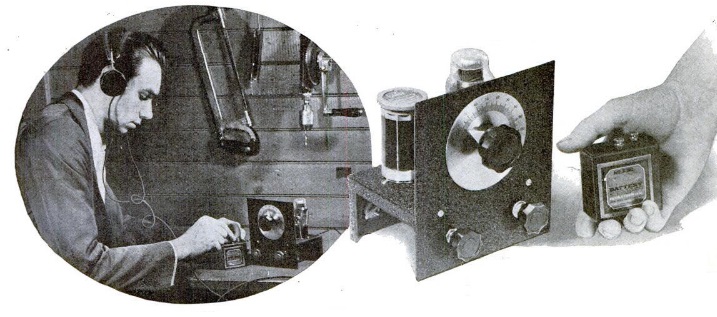
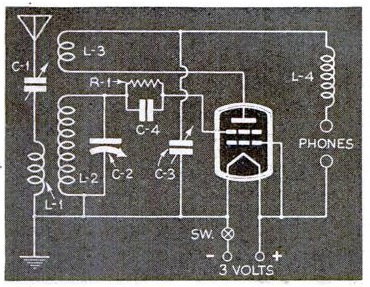
The November 1937 issue of Popular Science carried the plans for this midget one-tube regenerative receiver for the broadcast band using a dual-grid type 49 tube. The notable feature of the tiny set was that it employed only a single battery, a 3 volt “A” battery that powered the filaments as well as supplying the modest B+ voltage.
The low power requirement apparently meant that the set was just a bit finicky, since the article cautioned that many of the parts had to be exactly as specified in the article. But when done, the midget tube set was said to produce good headphone volume with 10-20 feet of insulated wire tossed on the floor as the antenna.
The modest battery requirement meant that the set was ideal of hikers and campers, or for use in isolated areas without electric power.
A hundred years ago this month, the November 1917 issue of Talking Machine World offered some advice for phonograph retailers seeking to “reach talking machine buyers of foreign birth.” The magazine noted that dealers in cities with a large foreign element had come to realize the profitable opportunities presented by featuring foreign records. “It has been found that nothing so stimulates the sale of talking machines and records in foreign sections as the fact that foreigners can secure records of their native music offered in their native language.”
One success story was Grinnell Bros. of 243-247 Woodward Avenue, Detroit. (It appears that the streets had been renumbered, since the previous link identifies the company’s building as being at 1515 Woodward Avenue.) That company had great success with advertising in foreign-language newspapers catering to the many immigrants working in Detroit’s auto industry. Examples in German and Polish were shown, in addition to the Russian ad shown here. The magazine noted that the newspapers would be happy to translate the ad copy.
The image shown above appeared elsewhere in the magazine. It is a window display offered by Columbia to highlight the company’s foreign records.
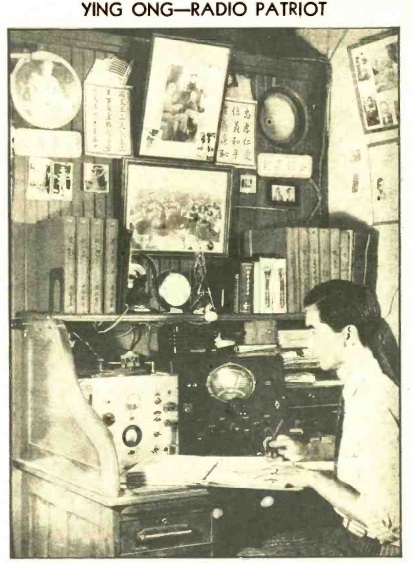
Shown here in the November 1942 issue of Radio Craft is Ying Ong of Phoenix, Arizona, rightly described by the magazine as an American radio patriot.
Mr. Ong took it upon himself to listen to and transcribe the broadcasts from Chungking Radio. He took the contents down by shorthand, and then relayed them to his fellow Chinese-American countrymen and to American news services. His dispatches often were made by telegram, and he bore the expense himself. He also sent copies to the FCC, Chinese-American newspapers, and the Chinese consulates.
The nationalist Chinese government took note of this, and at one point sent him a check for $100 to help cover his expenses. He endorsed the check over to the China War Relief Fund.
The broadcasts of the powerful GE San Francisco shortwave station KGEI often, the magazine noted, contained in its newscasts the phrase “Chungking radio says….” These reports were able to hit the air so quickly thanks to Mr. Ong’s transcripts of the broadcasts.
I was not able to find a listing for Mr. Ong in either the 1940 or 1946 call books, so I don’t believe he was a licensed ham. But as an SWL, he certainly performed a service to both China and America by ensuring that nationalist broadcasts were received in this country by all who needed to hear them.
According to the Social Security Death Index, a Ying Ong, born on 25 August 1918, with a place of residence in Phoenix, died on 17 July 1992. He is buried at Greenwood Memory Lawn Cemetery in Phoenix.
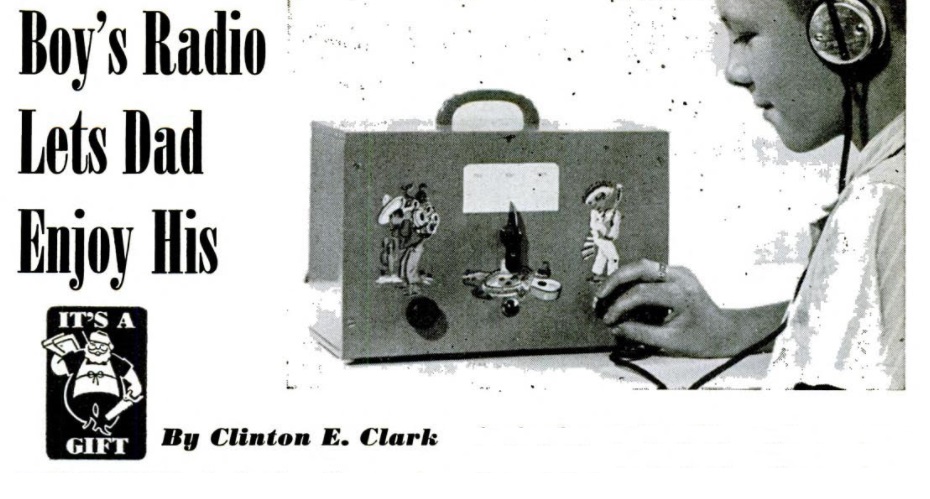
While this project from the November 1947 issue of Popular Science is ostensibly a Christmas present for Junior, the text of the construction article reveals that Mom and Dad might have an ulterior motive: “Everyone in the family will enjoy this little two-tube headphone set. Junior can listen to all the programs especially meant for him, and Pop and Mom will escape the nerve-shattering tommy guns and thundering herds.”
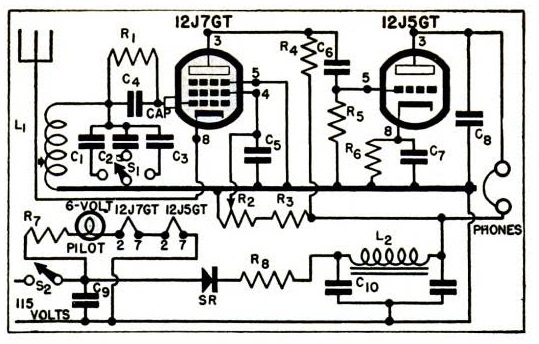
The set is a two-tube regenerative receiver for the broadcast band, using a 12J7GT detector with a 12J5GT serving as audio amplifier.
It’s an AC/DC set, meaning that Junior should probably make sure he doesn’t use it close to the water pipes. It appears to be electrically isolated from the chasis, and as long as capacitor C8 doesn’t short out, the headphones will be isolated from the AC line.
To tame the regenerative receiver, and keep Junior from becoming a squeal hound, the controls are preset, and tuning is accomplished with three or four trimmer capacitors set to local stations, and a switch is used to pick the station.
No external ground is used (probably to keep the AC-DC set from blowing a fuse or zapping Junior). The article notes that an outdoor antenna is desirable but not absolutely necessary.
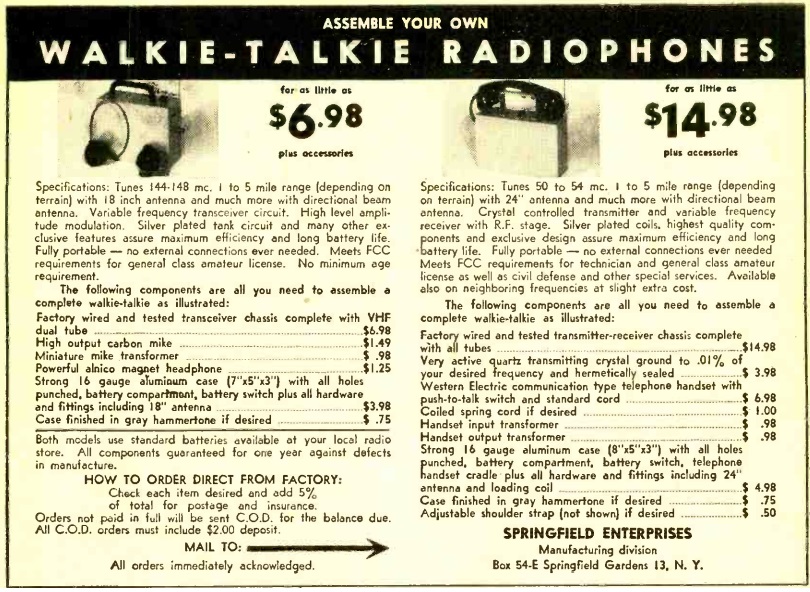
This ad from sixty years ago, in the November 1957 issue of Popular Electronics, was for two little VHF rigs I had never seen before, from a company called Springfield Enterprises of Springfield Gardens, New York. The prices shown in bold print certainly look reasonable. The two-meter version is priced at $6.98, and the six-meter version is $14.98. But the fine print reveals that these are the prices for the chassis only. It is already assembled, but it doesn’t include the microphone, “miniature mike transformer,” headphones, or even the case. With these “accessories,” the price increases.
The description is lacking in details, but the two-meter version is a single tube with VFO. It’s probably similar to the transceiver shown previously at this link.
The six-meter version contains a crystal-controlled transmitter with variable frequency receiver, and uses multiple tubes. Both sets were billed as having a range of 1-5 miles with a built-in whip, and “much more with directional beam antenna.”
I’ve never seen any reference to either of these rigs, other than this K3DSM’s website, in which he states that he owned one of the two-meter versions.
These scouts didn’t have to worry about the modern Guide to Safe Scouting, and the procurement of materials right run afoul of modern Leave No Trace principles. But these scouts 75 years ago put together this primitive canoe according to plans appearing in the November 1942 issue of Boys’ Life.
The plans given don’t go into great detail, but with a little common sense, exact instructions are not necessary. The frame of the craft is made out of several saplings, and the shell is a 12′ x 12′ tarp. The author, William “Green Bar Bill” Hillcourt, notes that “a river should be no obstacle for your Patrol if you have an axe, some string and a waterproof tarpaulin. Then you can produce a primitive canoe, and paddle yourself across, using a couple of trench shovels, pieces of bark or your hands.”
The frame is constructed by lashing the various saplings together, and then the tarp is added. It should be within the skill level of any scout who has mastered the basic lashings for First Class.
Note: In my opinion, constructing and using this canoe is a perfectly appropriate activity for modern scouts. However, proper safety precautions should be followed, and if it’s a BSA activity, then the Guide to Safe Scouting must be followed. In particular, the 1942 Scouts shown in the picture would not pass muster, since they are not wearing approved life jackets.
They are, however, following the buddy system, and I assume that they have both passed the BSA swimmer test. They’re obviously staying close to shore, and the craft appears to be seaworthy for that location.
Under current BSA rules, the “craft must be suitable for the activity, be seaworthy, and float if capsized. All craft and equipment must meet regulatory standards, be properly sized, and be in good repair.” Depending on the conditions, a boat like the one shown should qualify.
Since the boat “must meet regulatory standards,” this means that the boat must be legal under state law. In Minnesota (and probably in other states) no registration is required, since the boat is less than 10 feet in length and non-motorized.
Since constructing this boat requires cutting living trees, great care should be taken in their selection. Other materials (such as, perhaps, PVC pipe) should be considered. But in my opinion, with a little planning, there’s no reason why scouts today shouldn’t be able to duplicate the craft built by their predecessors three quarters of a century ago.

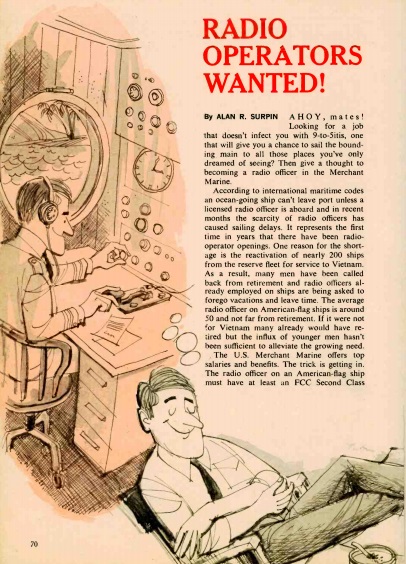 Fifty years ago, the November 1967 issue of Electronics Illustrated explained how the gentleman shown in this drawing could achieve his dream of seeing the world as a ship radio operator.