Shown here on the cover of the February 1958 issue of Radio & TV News is Dorothy Hicks, K0BRZ, of Omaha, Nebraska, at the controls of the demonstration ham shack of World Radio Laboratories (WRL) in neighboring Council Bluffs, Iowa. The store maintained the station to showcase available products, both its own and those of other manufacturers, which were rotated through the station on a regular basis. The station was made available to hams passing through who might need to maintain a schedule, as well as to new novices.
Dorothy’s husband was Curt Hicks, K0AMM, the president of the Ak-Sar-Ben Radio Club. Their son Paul received his novice ticket at age 11, with the call KN0GZJ.
Today marks the 75th anniversary of the beginning of production of the 1943 steel U.S. cent coin on February 23, 1943.
Wartime shortages of copper forced the mint to look into alternatives, and the final choice was to produce the 1943 cent with zinc-coated steel.
The coin was not a popular success. People confused them with dimes, and the lack of zinc plating on the edges gave the coins a tendency to rust. And becasue they were magnetic, the coins would not work in vending machines. For 1944, the mint began using recycled shell casings with a small amount of copper, resulting in an alloy similar to that used before the war.
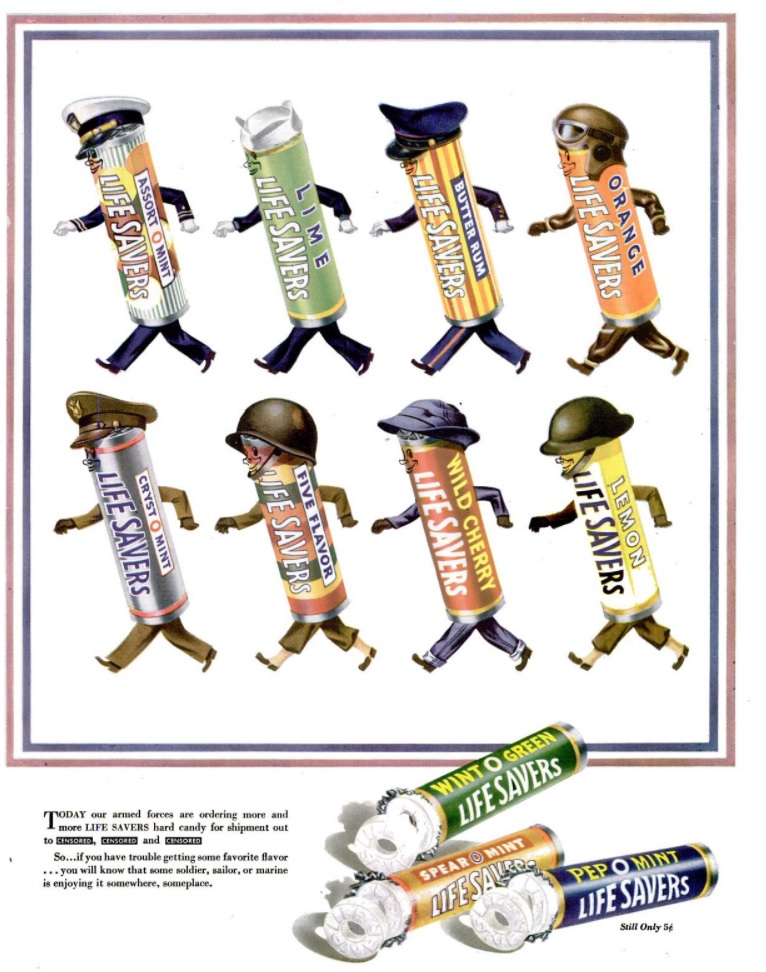
Seventy-five years ago today, the February 22, 1943, issue of Life Magazine carried this important announcement.
The armed forces had just ordered a large shipment of Life Savers for censored, censored, and censored, meaning that the civilian supply might have been short in some areas. It reminded customers that if they couldn’t find their favorite flavor, they should remember that some soldier, sailor, or marine was enjoying it somewhere.
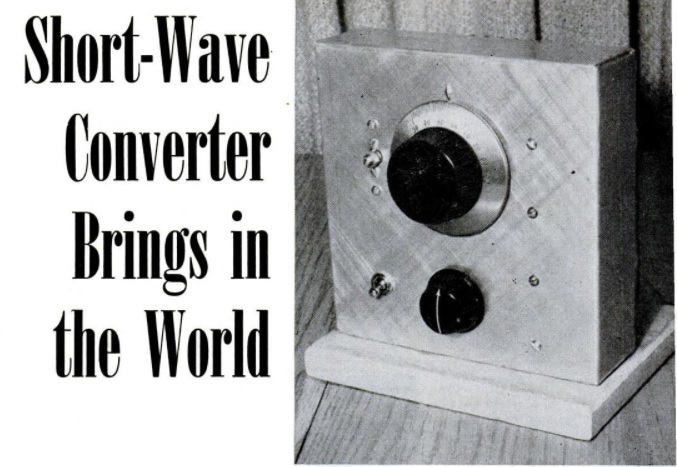
Seventy years ago this month, the February 1948 issue of Popular Science showed how to put together this handsome one-tube converter to pull in shortwave signals with a standard broadcast receiver.
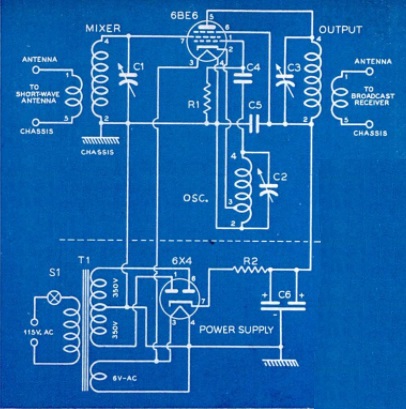
The simple circuit, by S.T. Van Esen, W2OXD, was built around a 6BE6 pentagrid converter tube, and tuned 6-16 MHz. The radio was set to an empty spot on the dial near 1500 kHz, and tuning was accomplished with a tuning dial on the converter. A second variable capacitor was used to peak the mixer section.
For power, you could tap into the power supply of a transformer set. Or if the proper voltages were not available, or if an AC-DC set was being used, the schematic for an appropriate power supply was also included.
The article promised the ability to pull in London, Lima, Sydney, Johannesburg, and other sources of news, information, and entertainment that were pouring out of foreign skies.
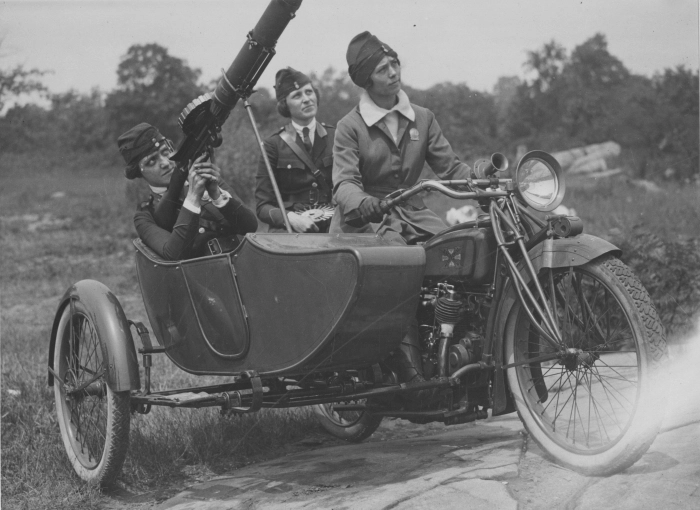
If the Kaiser had met these women, he would have realized that he didn’t have a chance. And any miscreants in New York would have known that policing the city wouldn’t suffer when the men were overseas at war. Shown here are three members of the Women’s Machine Gun Squad Police Reserves, New York City.
In this International Film Service photograph dated August 1918, Capt. Elise Reniger is shown at the ready with the machine gun, reported to have a killing range of two miles and be able to fire 500 shots per minute. Miss Helen M. Striffler is in the rear seat, and Mrs. Ivan Farasoff is driving the Harley-Davidson.
This and other photos of the role of women on the home front of World War I can be found at the National Archives.
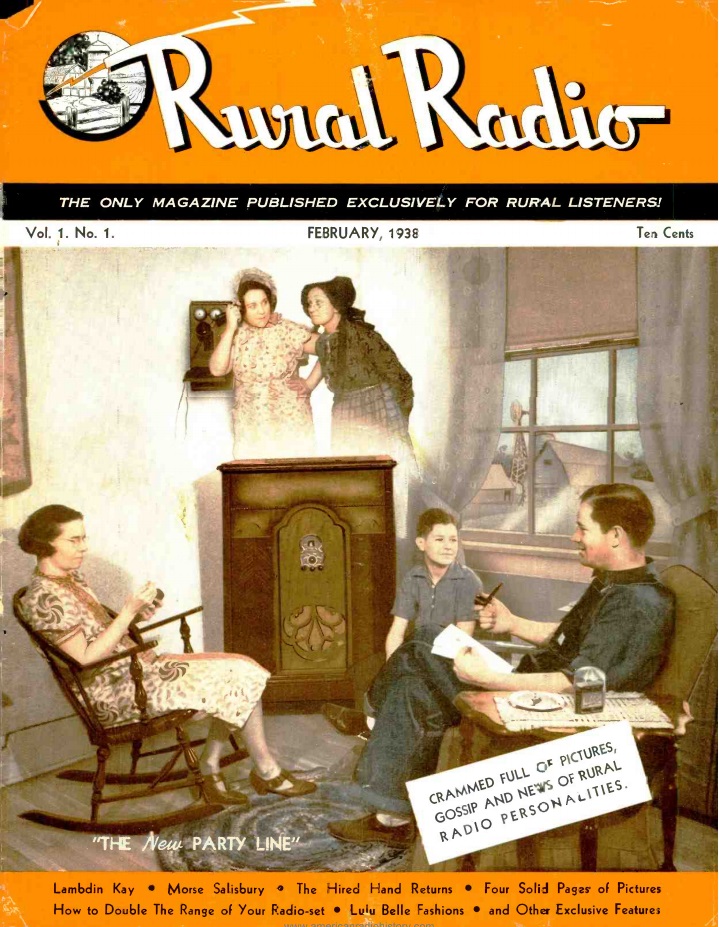
This month eighty years ago saw the beginning of the short-lived run of Rural Radio magazine with the February 1938 issue. That issue’s cover, shown above, depicts a modern progressive farm family listening to the modern version of the party line, with an image of the old-fashioned version also shown.
The magazine was published by Rural Radio, Inc., of Nashville, which, of course, just happened to be the home of WSM. Edwin Craig, the President of the company that had founded WSM, in 1934 invited fourteen other clear channel stations to a meeting in Chicago where an organization called the Clear Channel Group was formed to lobby on behalf of the powerful stations. One result was the magazine, designed to promote the interests of the clear channel stations to their rural listener base.
The magazine lasted less than two years, since the editor, Ed Kirby, was wooed away by the National Association of Broadcasters to head its public relations department. The magazine was left in the hands of the printer, and was merged into Radio Varieties in 1939.
Morse Salisbury
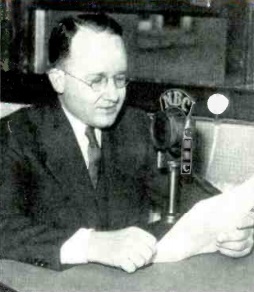
The first issue carried an article, “What Radio Means to the Farmer,” penned by Morse Salisbury, the Radio Chief of the U.S. Department of Agriculture. Salisbury was the host of the “Farm and Home Hour,” which was heard over 93 NBC stations for an hour each weekday. (A script of a 1937 broadcast is available at this link.) Salisbury noted that farm families, in addition to having access to the same entertainment, culture, and news as their city counterparts, also relied upon radio for “quick and close contact with knowledge that is important in a business way.”
He noted that the nation’s six million farm families did not have the capability of gathering the scientific and economic information necessary to their livelihood, but the Government provided that information through the Land Grant Colleges, extension services, and now radio.
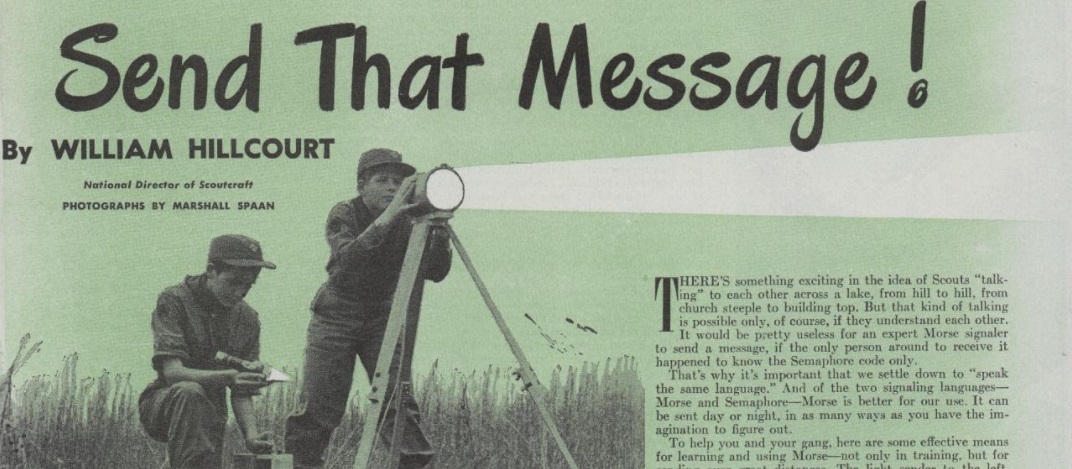
Seventy years ago this month, the February 1948 issue of Boys’ Life carried this feature by William “Green Bar Bill” Hillcourt teaching scouts the finer points of signalling by Morse code. He notes that there were two possibilities–semaphore and Morse–but that it was important for those on both ends of the message to “speak the same language.” He concludes that Morse was the superior option since “it can be sent day or night, in as many ways as you have the imagination to figure out.”
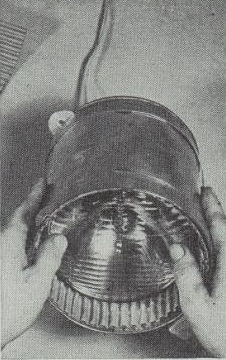
He includes the plans for this signal light, with a range of three miles. It consists of a 6-volt sealed beam headlamp, mounted in a number 10 tin can. The headlamp is held in place with corrugated cardboard and then glued, as shown at left. He includes plans for the tripod base shown above.
While less common these days, round sealed beam headlights are still readily available, such as this one which can be ordered on Amazon. It’s probably possible to pull one from a junkyard at even lower cost. Of course, it’s likely the modern equivalent will be 12 volts, rather than the 6 volt model shown in the magazine. Power could be provided with 8 alkaline D-cells in series, which can be mounted in holders such as this one. Another alternative would be a small rechargeable battery, or even an old car battery.
The magazine shows the plans for a simple code key, or an inexpensive one can be purchased. But the article also proposed another method, similar to an idea shown here previously. “Since one of the hardest things about signaling is learning to receive, we’ve included an ‘automatic’ sender that enables a Tenderfoot to send a Morse message for others to receive–as long as he has learned to spell with ordinary letters,” and that device is shown below. The Tenderfoot merely traces along the path of the letters, resulting in flawless Morse.
For more information about the Signs, Signals, and Codes Merit Badge, see my earlier posts here and here. And for more information about visual signaling, see this post.
If you recall from my Eclipse Camping for Newbies page, I’m sometimes a fan of cheap camping equipment. If you want to buy something that will last a lifetime, then you want to get the very best. But occasionally, you want to get something that you’ll use once or twice. That’s why I was intrigued by this $12 tent at WalMart. You can order online and pick it up at the store with no shipping charge. If you just need something for a couple of nights in reasonably good weather, this one will meet your needs.
As I mentioned in that other post, you want to practice setting it up at home. According to the reviews, this one doesn’t come with instructions, but by looking at the picture, the process is pretty intuitive, as long as you practice once in your living room.
(The links on this post are affiliate links, meaning that we are paid a small advertising fee if you purchase after clicking on the link.)
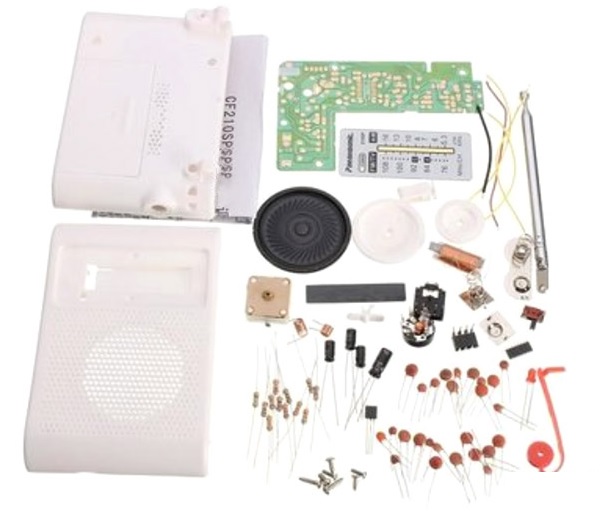
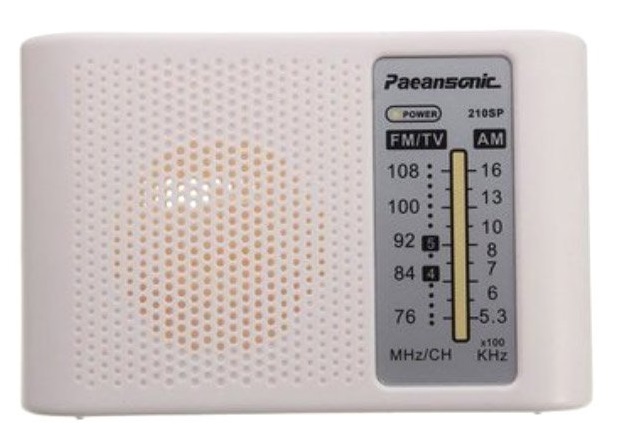
While looking for something else, I discovered this product which I suspect will be of interest to many readers. It is a kit for a pocket AM-FM radio that looks like a real consumer product, albeit a very cheap version of a consumer product. It bears the impressive Paeansonic brand name. When the radio is complete, it won’t look like a kit. It will look just like it rolled off the Paeansonic assembly line in China!
The best part is that you can get the kit direct from China for just over $5, including shipping. It is available from Fasttech, a distributor in Hong Kong of electronic devices, parts, and a wide variety of other goods. I’ve ordered from them many times in the past, and have always had a good experience. Amazingly, shipping all the way from China is usually free. Occasionally, when I check out, I’ll need to pay a dollar or two in shipping, but on most orders, there is no added cost for shipping. Orders generally arrive in 2-3 weeks by registered mail, having been deposited in the mail in Singapore. Payment is by PayPal, although I believe you can use a credit card if you don’t have a PayPal account. Despite my original trepidation of buying direct from China, all of my experiences have been good.
This radio kit sells for $5.25 (and an additional 10% off coupon code is explained below), and it’s obviously more of a novelty than a high-quality radio. I have not ordered one yet, but there are a number of videos and websites showing how to put it together, and that it works after assembly. It appears to work about as well as you would expect a $5 radio to work, but it does seem to pull in both AM and FM stations.
Despite the apparent simplicity of this kit, it does not appear to be something for the first-time kit builder. The parts are very small, and it includes a surface-mount IC that requires a delicate touch to get it soldered in place. It also requires a bit of alignment, which might not be intuitive to someone with no prior experience. If you’re new to electronics, or buying a kit for someone who is, then I would recommend one of the other kits shown at the bottom of this page.
But if you want a cheap kit to put together, that looks like a real (albeit cheap) product, this seems to fit the bill. And if it doesn’t work when you’re done, you’re only out $5!
Fasttech also offers this model for $7.50, shown at left. It appears to offer slightly more circuitry, and in theory might pull in a few more stations than the cheaper model. However, it lacks the trusted Paeansonic brand name. Instead, most of the markings are in Chinese. It does have one nice touch in that the FM dial is reportedly calibrated in “kMHz”.
The instructions are in Chinese, but this website has an excellent set of instructions for assembling and aligning the kit. This page also has some pointers. To get some idea of what you’re getting yourself into, the following videos will be helpful:
https://www.youtube.com/watch?v=CnWpgQcmgwk
As noted above, this kit probably isn’t for beginners. On the other hand, it’s only $5, so if you want something to practice on, you don’t have much to lose. But if you’re looking for something for a beginner in electronics, there are better options.
For an absolute beginner, you can’t go wrong with a kit like the one shown here, which is available on Amazon. This one does require soldering, but it’s well within the capabilities of any beginner, and there’s very little that can go wrong with the completed circuit. It will do a reasonably good job of pulling in FM stations.
If you don’t own a soldering iron, this FM radio kit comes complete with a soldering iron and the other tools you’ll need to put it together.
And if you want something really simple that even the youngest kid can put together, then I recommend the Snap Circuit FM radio kit shown at the right. As the name implies, the parts just snap together, and it’s foolproof.
If you’re interested in the kind of radio from the early days of radio, which is still a solid performer, then you might consider the two-tube regenerative receiver kit shown at left, which will pull in both AM and shortwave stations at a reasonable price.
And of course, this site contains many plans for simple receivers, both crystal sets and powered radios. You can find them by browsing my radio history pages. For ideas on where to get the parts, see my crystal set parts page.
If you’re interested in the Paeansonic kit, I’ll probably have a few available for sale at Ozarkcon in April. However, the price will probably be $10. So if you want it cheaper and faster, I encourage you to get yours direct from China!
Fasttech is currently on its holiday schedule due to the Chinese New Year and will reopen on February 22. Orders will be taken during that time and shipping will start on February 22. During this time, Fasttech is offering a coupon for 15% off orders of $150 or more, or 10% off for all orders. Orders must be placed by February 20, and you must use the coupon code KUNGHEI.
(Some of the links on this page are affiliate links, meaning that we get a small advertising fee if you purchase after clicking on the links.)
Sixty years ago this month, at the height of the Cold War, the February 1958 issue of Popular Science had as its cover feature an account of a motor trip by two Americans, with their dutiful Intourist guide in the back seat, across the Soviet Union from Brest to Moscow and then south to Yalta.
The author, Harry Walton, along with Dennis Michael O’Connor, made the trip in a Belgian-made 1957 Rambler station wagon. After reciting the preconceptions he had of the trip, Walton writes:
The preconceptions were wrong. The Russians I met were not hostile, and the roads and mechanics were first-rate. In several cities I met friendly, curious, wide-awake students (including some who regularly read Popular Science in the technical library). Often I talked with earnest, unsmiling but not unfriendly adults who took to hear their government’s much-repeated slogan: “Beat America.” Everywhere I saw evidences of a dedicated national effort to cram into two decades the industrial revolution that has taken the West two centuries.”

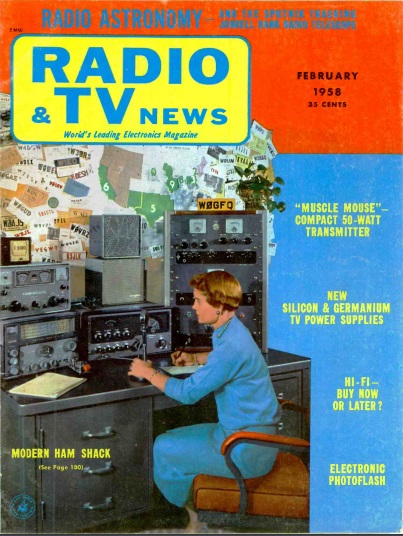 Shown here on the cover of the February 1958 issue of Radio & TV News is Dorothy Hicks, K0BRZ, of Omaha, Nebraska, at the controls of the demonstration ham shack of World Radio Laboratories (WRL) in neighboring Council Bluffs, Iowa. The store maintained the station to showcase available products, both its own and those of other manufacturers, which were rotated through the station on a regular basis. The station was made available to hams passing through who might need to maintain a schedule, as well as to new novices.
.jpg)

 While less common these days, round sealed beam headlights are still readily available, such as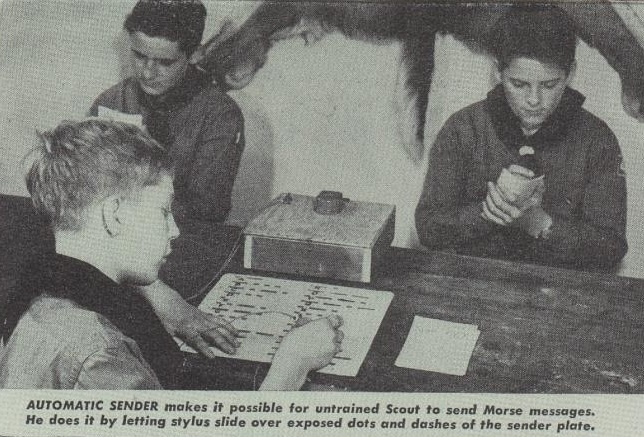

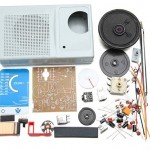

 For an absolute beginner, you can’t go wrong with a kit like the one shown here,