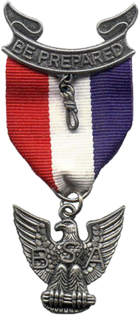
 A few months ago, the Boy Scouts of America (BSA) announced that membership in its Cub Scout (ages 6-10) and Boy Scout (ages 11-17) programs would be open to girls. For decades, the organization’s Exploring and Venturing programs for youth ages 14-21 have been open to young women. But the most important part of the change is that female members will be eligible to earn the BSA rank advancements, including the prestigious Eagle Scout award.
After the initial announcement, there was some discussion on social media and elsewhere, but it seems to have hit a frenzy after the announcement this week fleshing out some of the details. This week, the BSA began registering girls for the Cub Scout program, and announced that the Boy Scout program will be known as “Scouting BSA,” with the name of the organization being unchanged.
Local Option for Separate Troops
Admission of young women will be on a local option basis. In keeping with long-standing practice, individual troops and packs, which are “owned” by community organizations such as churches and service clubs, will make their own local decision of whom a particular troop will admit. If individual Cub Scout packs (up to age 11) so chose, they will be able to form separate dens (small groups of a single grade level) for girls. Girls and boys will be in separate dens, although at the Cub Scout level, these dens may be part of a Pack made up of both boys and girls. Typically, the entire pack meets about once a month.
At the Scout level (ages 11-17), girls and boys will be in separate troops which community organizations will now have the option to form. (They way the change has been structured, it will actually be impossible for a girl to join any existing troop.) In many cases, one community organization will form two troops in order to serve both boys and girls, but this will not be required. The two troops will be permitted to have the same committee of adult leaders overseeing both troops, although each troop must have its own separate trained scoutmaster.
It is quite possible that troops made up of boys and troops made up of girls might have some activities together. In fact, because of the local autonomy that scout troops have always had, it has always been possible for troops to pair up with girl scout troops, or any other organization, for joint activities. But boys and girls will be in separate troops. In short, very little will change for boys currently in the program.
In general, three groups have commented, and I think it’s safe to say that most of the discussion comes in three categories.
The first group is those (like me) who are currently involved in the BSA as parents or volunteers. Many of these comments (such as mine) are favorable. And the comments in opposition have generally focused on practical concerns, some of which are quite reasonable.
The second group consists of those connected with the Girl Scouts of the USA (GSUSA). It’s safe to say that most of those comments are angry, since many in the GSUSA believe that the BSA is trying to steal membership away.
Outside Intermeddlers Crying “Political Correctness”
But the largest group of comments seems to be from those who are not involved in scouting in any way. Many of these commenters, even though they are not involved, believe that the BSA caved to political correctness. They generally believe that they know better than the BSA how the program should be run, even though they don’t express any desire to help the BSA run the program. In general, they’re outside intermeddlers, and I want to spend most of my time addressing them.
I am not an outside intermeddler. I am an Eagle Scout (1978), and also an active volunteer. I currently serve as Assistant Scoutmaster of my son’s troop (and hope to have a similar role in my daughter’s future troop) and merit badge counselor. In the past, I have served as Cubmaster, and member of troop and pack committees. I’ve served on the staff of a national scout jamboree, attended a national jamboree as a youth, and I’ve been involved in district and council activities. As a youth, I served as a lodge officer in the Order of the Arrow (OA), and am a Vigil member of the OA.
Many of these complainers believe that girls should be in the Girl Scouts, boys should be in the Boy Scouts, and the two programs should be kept separate. There’s a certain logic to this argument, and it would even be a sound argument if the BSA and GSUSA were two branches of one larger scouting organization. But they are not. BSA and GSUSA are completely separate entities, and there is essentially no cooperation between them. The programs they run are very different. Girls currently have no program comparable to the BSA’s program. The only connection between the BSA and GSUSA is that they are both members of international scouting organizations. The BSA is a member of the World Organization of the Scouting Movement (WOSM), and GSUSA is a member of the World Association of Girl Guides and Girl Scouts (WAGGGS). Since both are closed organizations, there is no possibility for youth in the USA being part of a scouting program sanctioned by them, other than the BSA and the GSUSA.
As far as I know, GSUSA does not allow boys to join, so boys can join only the BSA. Until now, BSA did not allow girls under 14 to join, So girls who wanted to join scouting had no choice but to join the GSUSA. (When they turned 14, many made an exodus to the BSA Venturing program.)
Now, fortunately, girls under 14 have a choice. They can join the BSA starting in kindergarten. And when they turn 11, they will be eligible to earn BSA rank advancements, up to and including the rank of Eagle Scout.
No Changes in Requirements
The requirements for advancement will not change. The requirements are similar to what they’ve been for years. And importantly, they are very similar to what the GSUSA requirements were in past decades, before the GSUSA largely watered down the program.
When Juliette Gordon Low founded the GSUSA, the program was remarkably similar to the BSA’s. It focused on outdoor activities such as camping, and even the rank advancements were very similar to the BSA’s. For most of the 20th Century, American girls had the opportunity to take part in a program as good as, or perhaps better than, the BSA’s.
At some point, however, this changed. The BSA is often accused of having a right-wing political agenda, but the GSUSA has a justifiable reputation of having a left-wing political agenda. While there are many local exceptions of GSUSA troops providing excellent outdoor programs, this is no longer the norm, and GSUSA’s national leadership does not concentrate on the kind of traditional scouting program envisioned by Juliette Gordon Low.
Some girls have been able to find the good GSUSA programs. But unfortunately, many have not been able to find traditional scouting available to them. Even when good troops exist in an area, they are often closed to new members, whereas BSA troops are almost universally welcoming to all new members.
There is no longer an internationally sanctioned traditional scouting program for young women under 14, and someone needed to fill the gap. And in the United States, there is only one other WOSM or WAGGGS member organization eligible to provide an internationally sanctioned scouting program. That organization is the BSA. With the BSA’s recent announcement, virtually all American girls who want to take part in a traditional scouting program will be able to do so, just like their brothers and 14 year old sisters have been able to do all along–they can join the BSA.
In short, the BSA had not caved in to political correctness. The GSUSA caved into political correctness long ago by departing from the traditional outdoor program of scouting. The one organization that was able to correct this injustice, the BSA, did so, and I applaud their courage for making a quality program available to all American youth.
Not a “Watered Down” Program
Now, let me address those who believe that allowing girls into the BSA somehow waters down the accomplishment of those–such as me–who earned the rank of Eagle Scout as a youth. My accomplishment is not watered down just because young women are now able to join me in achieving those same requirements. The requirements for Eagle Scout are tougher now than when I earned the award.
My Dirty Little Secret About a “Watered Down” Program
I became an Eagle in 1978, which was during a time when the BSA had switched over to an “improved” scouting program. In a misguided attempt to become “relevant” to 1970’s urban youth, the BSA did, indeed, “water down” the requirements. And I became an Eagle during the time that the requirements were watered down.
Before I joined scouts, there were many requirements for the rank of Eagle. A young man (and I always disliked referring to scouts as “boys”) had to do a number of things. He had to camp many nights. He had to hike many miles. He had to know how to swim. In fact, he had to know how to swim well enough to earn the Lifesaving Merit Badge. He had to cook meals while camping. He had to show a lot of practical skills, most of which focused on the outdoors.
Until the early 1970’s, it was impossible to earn Eagle without doing all of these things. That changed while I was a member. I was not required to camp a single night. I wasn’t required to learn how to swim. I wasn’t required to hike even one mile. I wasn’t required to cook a single meal.
If I had wanted to, I could have earned Eagle without setting foot outdoors. But I didn’t, and I don’t know any scouts who did. I was in a good troop, and we kept doing the things that scouts did. I earned Camping Merit Badge, which required me to camp. I earned Canoeing Merit Badge, which required me to canoe. I earned Hiking Merit Badge, which required me to hike. I earned Swimming Merit Badge, which required me to swim. And I even earned Lifesaving Merit Badge, although I have to admit that I was tempted to skip it, since it was no longer required. In short, I did all of the same kinds of things that scouts had done in the decades before me. The only difference was that they had to do those things. I didn’t have to, but I did them anyway. I did them because I was in a good troop, and these were the things that good troops did.
Somewhere, there are probably a handful of 1970’s scouts who took advantage of the “watered down” requirements. Somewhere, I’m sure there’s a 1970’s Eagle Scout who never camped a day in his life, never got in the water, and never left the comfort of his living room. I never met one, because the troops in my area were all good troops. But I’m sure there are a handful of them out there who took advantage of the “watered down” requirements. Does the existence of that scout diminish my accomplishment? I don’t think so.
Fortunately, the BSA saw the error of its ways. They brought in William “Green Bar Bill” Hillcourt to bring the program back to its past glory. A few years after I earned Eagle, the “watered down” requirements were erased, and once again, the Eagle rank proved that a scout knew how to camp, knew how to cook a meal outdoors, knew how to swim, and had accomplished all of the traditional things we associate with scouting. And the fact that a handful of scouts earned the rank in the 1970’s without knowing those things doesn’t diminish the honor.
For the most part, those same requirements are in effect today. When a youth earns the rank of Eagle, it means that he has camped a lot, that he knows how to swim, and that he’s been engaged in a vital outdoor program. Today, more so than in my day, it also shows that the scout took part in a meaningful leadership service project. Starting now, just as in Juliette Gordon Low’s day, American girls can prove themselves in the same way.
In a few years, the first young woman will achieve the rank of Eagle Scout. When she does, she will have proven that she accomplished all of the same things I accomplished in scouting, even though I was not required to. Perhaps the case can be made that those “improved” scouts of the 1970’s watered down the award. But I’ll proudly shake the left hand of that young woman, because I will know that she proved herself more than I was required to.
For those who do object to having girls under 14 in the program, individual troops are not required to have girls as members. (For some reason, nobody seems to object to the 14-21 year old young women who have been in the BSA venturing program for years.) In fact, I suspect that within a few years, we will see BSA Scout troops and patrols of boys, others of girls, and probably some mixed. Since BSA troops and packs are owned by their chartered organization, there has always been considerable local autonomy. So there will be young men in all-boy troops earning Eagle. The fact that some young women across town earned the award by doing the exact same requirements does not diminish that young man’s accomplishment.
Perhaps it would be better if there was a solid scouting program by the GSUSA for girls, and a totally separate BSA program for boys. Unfortunately, the GSUSA has made this impossible for American girls. The programs are very different, and I wish the GSUSA the best in carrying out its good, but very different, program. But for those girls who want traditional scouting, I applaud the BSA for coming forward and making it available. They took this action not because of misguided political correctness, but because of a sincere desire to provide for girls something that the GSUSA is not providing.
The New Name: Scouts BSA
Finally, some have complained about the new name of the BSA’s program for 11-17 year olds, “Scouts BSA”. This is actually not a new name. From 1973 until 1978, the uniform I wore said “Scout BSA” above the pocket. Prior to 1973, it said “Boy Scouts of America.” And after 1978, it once again said “Boy Scouts of America.” This is the one change made by the “improved” scouting program that I actually agreed with, and I’m glad this name is back.
Yes, I guess I was a Boy when I showed up at my first troop meeting in 5th grade. But the whole point of the program was to turn me into an adult. And it worked. It never felt right to me to call the scouts “boys.” We were scouts, and I always refer to youth members as scouts, rather than boys.
In a year, there will be female youth joining Scouts BSA. But I won’t call them girls, just as I don’t call the current members boys. They’ll be scouts, just like I was, just like the current members are, and just like the members of GSUSA were back in the organization’s history.
I’ll be proud to call them scouts, and I’ll be proud to wear with them the uniform of Scouts BSA. And when they earn the rank of Eagle, I’ll be proud to welcome them into the ranks. And I’m sure they’ll welcome me, even though I became an Eagle during the “watered down” requirements of the 1970’s.

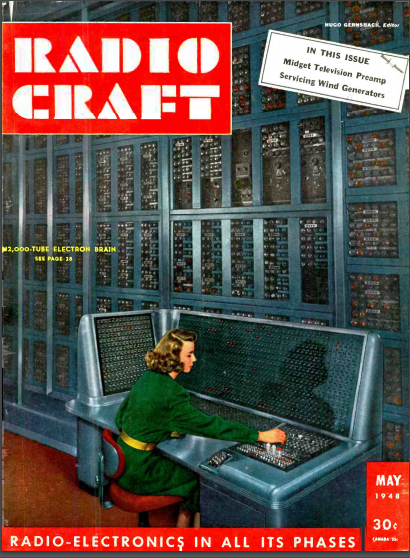 Seventy years ago this month, the cover of the May 1948 issue of Radio Craft showed the latest in electronic computing equipment, this 12,000 tube electronic brain, the IBM Selective Sequence Electronic Calculator.