Author Archives: clem.law@usa.net

Arvin Model 302 Radio-Phono

1940JanRadioRetailingIf you needed an inexpensive radio-phonograph 80 years ago, then the Arvin model 302 (brown with ivory trim) or 302A (ivory with chrome trim) was just the thing.  The four-tube (12SK7, 12SQ7, 50L6GT, and 35Z5GT) superhet would pull in the local stations, and the would also play either 10″ or 12″ records.

For full portability, a carrying case was available for only $2.95 extra.

The ad, which also shows a car radio, table radio, and portable, appeared in the January 1940 issue of Radio Retailing.


Radio Scouting: 1940

1945JanBLEighty years ago this month, the December 1940 issue of Boys’ Life shows this enthusiastic group of Atlantic City Scouts preparing to get their ham licenses. Fifty Scouts were taking the eight month class, and were hoping to be able to render important communications assistance in the event of disaster. The council’s camp already had its own station.


Bringing the Car Radio Inside: 1945

1945JanPS1During World War II, one recurring theme in radio and handyman magazines was bringing the radio from the car inside the house. There were two practical reasons for doing this: First, no new radios were being manufactured, so if you needed another one in the house, you had to use some ingenuity. Second, the radio wasn’t doing much good in the car, anyway, due to gas and rubber rationing.

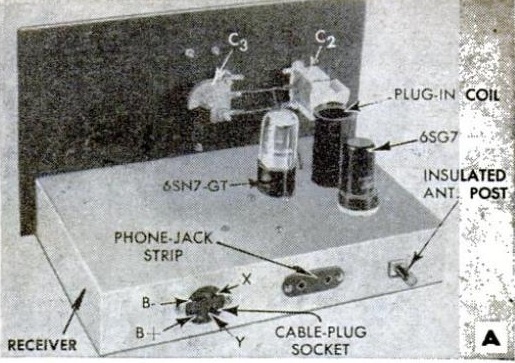
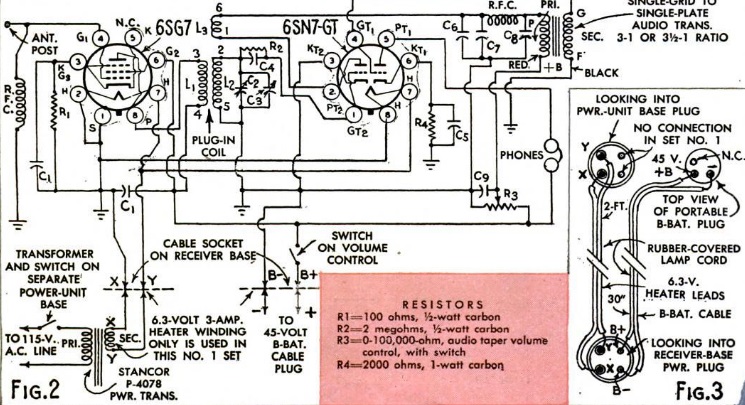
The January 1945 issue of Popular Science contains some pointers for doing the job. The radio probably used 6 volts for the tube filaments, and a higher voltage for the B+. The high voltage came from a vibrator power supply. The mechanical vibrator changed the car’s 6 volts from DC to AC, which was fed into a transformer to increase the voltage. The radio had a rectifier tube to change it back to the DC required by the circuit. To do the conversion, you needed a transformer that changed the 120 volt household current into 6 volts, with another winding of about 120 volts. This replaced the radio’s vibrator and transformer, and the set’s existing rectifier was used. The wiring for two common circuits is shown below.

For an antenna, the article pointed out that about 20 inches of wire would do a good job, since this is about the length of antenna the set was designed for.

1945JanPS2

Nan Grey, 1940

1940Jan5RadioGuideShown here, on the cover of the January 5, 1940, issue of Radio Guide, is actress Nan Grey, who was then appearing as the leading lady of NBC’s “Those We Love.”

Grey was born in Houston, Texas, in 1918. At sixteen, she went to Hollywood with her mother on vacation, and was persuaded to take a screen test. Her film credits prior to her radio career included starring opposite John Wayne in the 1936 film Sea Spoliers, which you can view below. She was one of the stars of the 1940 film “The Invisible Man Returns.” In that role, she appeared with Vincent Price. However, Price actually appeared for only a minute or so in the film, and spent most of the time as a disembodied voice.

Those We Love ran on NBC until 1945. In the 1960s, she invented a cosmetic mirror for nearsighted women. Princess Grace of Monaco was said to be one of its users. Grey died in 1993 on her 75th birthday.

https://www.youtube.com/watch?v=Fkd2XfitKl8


Freddy Fender Museum, San Benito, TX

20191227_142105

We recently had the opportunity to visit the Freddy Fender Museum in San Benito, Texas. We are shown above in front of Freddy’s motorcycle and one of the suits in which he performed.  The museum is part of the Museums of San Benito, along with the San Benito History Museum and the Texas Conjunto Music Hall of Fame and Museum.

We were shown around by a friendly volunteer, and the visit was well worth the small detour we took to get there.  Unfortunately, the exact future of the museum is in question, and it might not be there when you read this.  On the very day we visited in December 2019, some of the Freddy Fender exhibits were being removed.  The museum will be moving to a new location, but the exact new location is not known at this time.  Some of the exhibits were apparently on their way back to Freddy’s widow in Corpus Christi.  The volunteer seemed optimistic, however, that the museum would continue in either San Benito or Corpus Christi.  But the exact future location has not been determined.  Before making a special trip, I would contact the museum to check on the status.  The museum is currently open Thursday, Friday, and Saturday.

Fortunately, some of the exhibits remained, and are shown here.  Notably, Freddy’s two gold records are still on display, for Before the Next Teardrop Falls, and Wasted Days and Wasted Nights:

FreddyFenderGoldRecords

WastedDaysGoldRecord   TeardropGoldRecord

FreddyFenderZenithChairFreddyFenderZenithChair2Of particular interest to our readers is this chair, marked “Zenith Arm Chair Radio,” in which Freddy Fender probably sat.  I’ve heard of Zenith chairside radios, but this is the first I ever heard of an actual Zenith chair.  The tag on the exhibit indicated that the chair was from “the 1970s”.  Perhaps it was in use then, but my guess would be closer to the 1930s or 1940s.  The tag indicated that the chair was last used at the Rio Grande Music Company recording studio, 1165 Sam Houston, San Benito, TX.

The museum also contained another room displaying some of the equipment from the studio, shown below:

FreddyFenderRecordingStudio1

FreddyFenderRecordingStudio2


The “Rek-Kut” record cutting machine is shown below.  You can click on the images for a larger version:

RekKut1

RekKut2RekKut3RekKut4

There were also two Ampex recorders, one identified as a Model 354:

Ampex1Ampex2Ampex3

As mentioned above, there were two other museums in the same building, and this radio was part of the display in the general history museum:

FreddyFenderRadio

I couldn’t make out any brand name, but it appears to be from the late 1930s or 1940s, and covers the broadcast band and 5.8-15 MHz shortwave.

Finally, this shell casing was in the museum.  It was from a captured German gun from World War 1, and was engraved with the names of the American soldiers against whom it was directed.  The engraved text was very hard to read, and I unfortunately didn’t have time to try to transcribe much of it.  It would be a great service if some reader in the area could take the time to transcribe the text and post it online somewhere.  I’m sure that the relatives of the soldiers listed would be very appreciative.

Shell1Shell2Shell3


Two 1940 Broadcast Sets

1940JanPS1940JanPS2This young woman is getting ready to tune in a favorite program, thanks to the radio designed to look like a book, described in the January 1940 issue of Popular Science. The design was intended to “appeal to all builders who prefer housing their receivers in some unusual type of cabinet.” It was perfect for the library table, where it would make an attractive decoration while pulling in the local stations.

The cabinet was constructed with the covers of a scrapbook purchased for less than a dollar. The jigsawed decoration on the cover was retained, and sides were build from matching wood. The circuit itself was a two-tube regenerative receiver. It ran directly off line current, with the filaments voltage provided by a “curtain burner” cord.

1940JanPS3

For those seeking a compact but more conventional design, the same issue of the magazine1940JanPS4 showed the design at right. It was a three-tube regenerative set featuring a small two inch speaker.  Like the book radio, it covered the broadcast band.  It was also an AC-DC set, with the filaments in series powered by the ubiquitous curtain burner.

1940JanPS5


New Year’s Eve

For your listening pleasure, here’s what you would have heard on the radio 75 years ago tonight, New Year’s Eve 1944, the Jack Benny show:


Bering Strait Bridge Plan: 1979

1979DecPMForty years ago this month, the December 1979 issue of Popular Mechanics shows this idea, a version of which comes up every few decades: A bridge connecting Eurasia and America across the Bering Strait.

This design was by California engineer T.Y. Lin and was dubbed the Peace Bridge. It was designed for highway traffic and featured smoothly curved piers to deflect upward advance ice floes. The average water depth over the proposed route was a modest 150 feet, making the project somewhat feasible. This design used 1000 foot prefabricated sections that would be brought to the site by barge.

Lin set the price tag for the bridge at about $3 billion, which he noted was a drop in the bucket compared to the cost of the arms race.


Border Refugees

RCbordercamp1This week, we were visiting Matamoros, Mexico, which is the border city adjacent to Brownsville, Texas. When driving across the international bridge, one of the first sights is a fairly large encampment of refugees from Central America.  Most are from El Salvador, Honduras, and Nicaragua, but there are exceptions.  Inexplicably for people who ostensibly came on foot, some are reportedly from Cuba and even Africa. They came as part of the migrant caravans.   The picture above shows part of the camp.  (Click on any of the images for a larger version.)

RCbordercamp2These persons are living in small tents, all set up in the border zone under the control of the Mexican federal government (indicated by “Zona Federal” on the sign in the bottom picture).  A few yards further south, the area is under the jurisdiction of the State of Tamaulipas, and the state authorities do not allow them to make camp there.  The camp is orderly, and there is a strong armed military presence.  A hundred yards to the north is the United States.  I should note that the fence is pre-existing, and is not there to keep the people inside.   The area is open on other sides.  This picture is taken on the sidewalk leading to the international bridge, and the fence is there to serve as a barrier between the line leading to the bridge, and the rest of the town.

I asked around whether it would be a good idea to speak with any of the refugees, and the consensus was that I shouldn’t.  However, I’m not one to listen to consensus, and when the opportunity presented itself, I took advantage of it.  Part of the camp is immediately adjacent to the sidewalk leading to the international bridge, and we were only feet away from people on the other side of a fence.

I had the opportunity to speak with a woman named Sandra, who told me that she had come from El Salvador. She has two daughters with her, 11 and 7 years old. She also has an 18 year old daughter and an older son, both of whom are already in the U.S.  She was living in one of the tents shown at the top of the page.

When I asked if they had walked all the way, she said they had, but there might have been a misunderstanding, because it sounded like she had rides for at least part of the way. But in any event, she had come a very long way, and I asked her why.

Her story sounded very compelling and very honest. She said that the government in El Salvador was unable or unwilling to protect its people from gang violence. When the government did try to crack down and imprison gang members, some of them infiltrated the elementary schools to recruit new members to replace them.  When they asked, they wouldn’t take no for an answer. She told the story of one gang member who branded his own infant son with the gang’s symbol, to show that the gang would pass on to another generation.

The last straw for Sandra came as she was running her business, which sounded like selling something in the marketplace. One day, gang members came to her, shoved a gun in her side, and told her that she worked for them now, and that she would start handing over her profits. She feared for her life, so she said yes. But that night, she decided to sell all she owned and start heading for the United States.  The same thing had happened to some of the daughter’s classmates.  The children were told that they had to join the gang.  Instead of doing so, they left on their own and headed north.

I did get the impression that she had been misled by someone to at least some extent. She told me that she was disappointed when she got here and not immediately allowed to enter the U.S., because someone told her that the “law had changed” from when she started until when she arrived at the border. She told me that before she left El Salvador, someone told her that she would “get right in” to the U.S. When she got here and that wasn’t the case, someone explained it away by saying that the law had changed.

I asked about conditions in the camp, and she didn’t seem to have complaints. I asked her if she had food and water. She told me she did, and even pointed out a 5-gallon bottle of drinking water inside her tent. It looked to be a commercial bottle of water of the type found in most Mexican homes. She didn’t mention what food she had, but she wasn’t complaining at all.  She said that she had many donated goods such as food and blankets.  She pointed to the wood fire that she used to cook. It looked to be made up of scavenged branches.

RCbordercamp3She specifically mentioned the military, and seemed genuinely thankful that the Mexican authorities were there providing protection. She was quite clear that she viewed the military presence as a positive. There was no hint that the heavily armed presence was there to keep her in. In this picture, you can see some of the military near the river. Most of the tents appeared to be up at street level, but people did go down to the river, presumably to wash (and likely, to go to the toilet, as I didn’t see any evidence of portable toilets in the actual encampment). The military presence (marines and sailors, I’m told) was there keeping a watchful eye.  She said that she felt safer inside the camp, with the military presence, than she did outside.

Sandra had even found work in Mexico, but I doubt if it paid particularly well. She and some of the other refugees had been recruited to hand out flyers for TelCel, a Mexican cellular provider. It sounded like this was just a one-time opportunity, but she was at least able to earn a few pesos. And it shows that even though she had to make her residence in the federal border
zone, she was able to move about the city freely.

She had already had one appointment with U.S. immigration, and had another scheduled in about six weeks. At some point, she was given a list of lawyers, but so far, she hasn’t found one who would take her case. I asked her what Americans could do if they wanted to help. She didn’t ask for anything.  She was quite adamant that her material needs were being met, and she seemed grateful as she pointed to the donated items in her tent.  But she did start to cry, and told me that she just wanted a safe place for herself and her children, and to be reunited with the older children who were already in the U.S.

I asked Sandra if I could take her picture, and as I suspected she would, she said no, because she was afraid. When I first introduced myself, she had told me her last name, but I told her I wouldn’t use it. I gave her my card, and pointed out the address of this website where her story would appear. I also pointed out that I’m a lawyer, but not an immigration lawyer, and not in Texas, so I wasn’t in a position to provide much practical help. My wife (who was serving as my interpreter) and I both asked God to bless her before we went our way. After I left, I wondered if I should have given her something, perhaps a treat for her children. But she wasn’t asking for anything like that–she was asking only for safety, something I didn’t have to offer.

I still have little doubt that Sandra and her children are pawns in someone else’s political game. But I also have absolutely no doubt of her sincerity, and that she is fleeing an impossible situation of lawlessness in El Salvador. It seemed clear to me that she has a well-founded fear of
persecution there, and I hope whoever is assigned to hear her case sees it the same way.

The residents of Matamoros with whom I spoke were generally sympathetic, but did have a somewhat different perspective.  From them, I learned that of those who originally arrived in these caravans, about 80% have returned home.  It seems apparent to me, and to those I talked to, that most of these people were themselves victims.  They were victims of people who, for whatever political motivation, made promises that they knew they wouldn’t be able to keep.  Eventually, it dawned on most of the people waiting at the border that they were victims.  They presented themselves to the Mexican government, and were given a bus ticket back to the border with Guatemala.

Most of those like Sandra who remain at the border–about a fifth of the original number–already have appointments with U.S. Immigration for an asylum interview, and they are waiting to take their chances and plead their case.

Many Mexicans have strong feelings on the subject.  There’s a certain amount of anger based upon reports–all secondhand, I should add–that assistance has been rejected by the members of the original caravan.  Not only in Matamoros, but as the caravan passed through Mexico, Mexicans were generous, and offered food and other supplies.  In many cases, these were personal gifts from residents who were sharing the food from their own table.  There are stories that this aid was rejected as not being good enough.  Naturally, after this happens a few times, the presence of the newcomers is resented.  (I should add that Sandra seemed genuinely grateful for the donated goods she had received.)  Mexicans also point out that the caravans entered Mexico illegally, and that their continued presence is in violation of Mexican law.

There’s also a sense that the caravan is there for the specific intent of destabilizing Mexico, the United States, and Canada.  The reports of gifts being rejected seem to have certainly fed this sense.

I think it’s an important distinction that many, but not all, of the migrants have returned home.  They got to the border, and it was soon apparent that they weren’t going to get easy entry.  At best, they would need to stay at an austere camp within sight of the border.  It seems reasonable that if someone had only a tenuous claim on asylum, that it would make sense to turn around and head home.  On the other hand, if one truly had a valid claim of fear of persecution, then it would make perfect sense to remain–even in poor conditions–until their case is heard.  Sandra’s story sounded credible to me.  And one of the things that made it credible was the fact that she was willing to live in a tiny tent until she had an opportunity to present her case.

Also, as far as I can tell, Sandra has violated no law.  She seeks to become a legal immigrant to the U.S., based upon a claim of asylum.  As far as I can tell, she scrupulously complied with U.S. law–she presented herself to the authorities at the border and told them why she was there.  They set an appointment for her, and told her that she would need to wait outside the United States.  That’s exactly what she did, and then she showed up for her appointment as scheduled.  She was told to go back and wait for her next appointment, and that’s exactly what she did.  And she gave me every indication that she was grateful for the opportunity.

Under U.S. law, a person is entitled to asylum if they have a credible claim of persecution.  I have no doubt that this is true for Sandra, and I have no doubt that she will be given a fair hearing to prove her case.  Eighty percent of the refugees apparently went home after learning how the system worked.  She did not, and that adds to the credibility of her case.

I asked residents of Matamoros what Americans can do to help.  We don’t want to encourage the opportunists who convinced people to make a dangerous journey.  But on the other hand, the people who remain need help to meet their basic needs.

The consensus is that the local Roman Catholic churches–in both the United States and Mexico–are doing the best to meet this need.  This article (in Spanish) describes part of that relief effort, a joint effort between the two neighboring dioceses. Interestingly, the Mormon Church also got high marks for the humanitarian services it provides to refugees, as shown by this article about the cooperation between the two denominations.

If you would like to donate, one charity that is making a very real difference in the lives of these refugees is Catholic Charities of the Rio Grande Valley, who are spearheading efforts on the U.S. side of the border.  You can make a monetary donation by clicking on this link. If you want to donate needed supplies, they have a wish list on Amazon, and orders will be shipped directly to them. When ready to purchase items on their list, please select the “Humanitarian Respite Center (In-Kind)” address listed for the shipping.  As Sandra made clear, at this point, there’s not a pressing need for material goods on the southern side of the border.  Catholic Charities is busy processing those whose applications were approved, and donations are needed at their respite center on the northern side of the border.

The same Savior after whom Sandra’s country is named said, “I was hungry and you gave me something to eat, I was thirsty and you gave me something to drink, I was a stranger and you invited me in.”


Border


1939 Transmitter and Receiver Kits

1939AlliedCatalogXmtrEighty years ago, the newcomer to amateur radio could get on the air with this transmitter kit from the 1939 Allied catalog.  It was patterned after the transmitter shown in the ARRL publication How to Become a Radio Amateur, and used two type 47 tubes running push-pull. The set could be put together in about two hours, and would put out up to 10 watts on 80 meters.

The cost of the kit itself was $2.60, but it wasn’t quite ready to go. The accessory kit included the 1939AlliedCatalogRcvrtwo tubes, a crystal, and key. If the beginner was lacking all of those items, that would be an additional $4.80.  If the new ham already had a commercial receiver, then he could probably tap into the power supply to run the transmitter. Otherwise, the power supply would be an additional $5.35, for a grand total of $12.75.

If he didn’t have a receiver already, then the bare minimum would be the kit shown here on the same page. The kit, using a single type 30 tube, cost $4.45. The tube and battery would be an additional $1.75. The coils that came with the radio covered the broadcast band, so getting on the ham bands would also require the shortwave coils, for 85 cents.