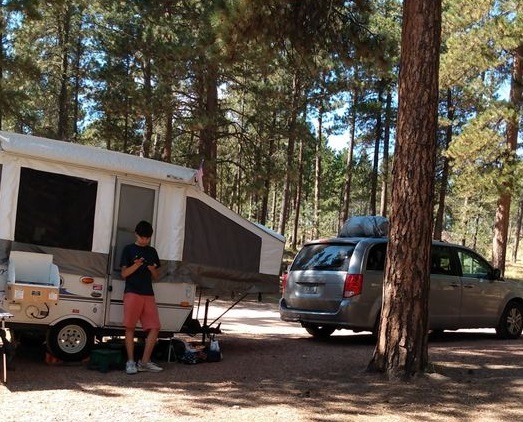
Custer State Park, SD.
One segment of the economy that has boomed due to the pandemic is anything involving the outdoors. Americans have discovered that outdoor activities are a safe source of recreation. One industry that has seen a particular boom is the recreational vehicle industry. According to this recent article, RV sales in July were higher than they had been in 40 years. And campgrounds, whether it is state parks or private campgrounds, have been packed.
This is understandable for a few reasons. First of all, I for one, am not about to get inside a pressurized tube with a bunch of strangers, so it’s unlikely that I’ll be taking any commercial flights any time soon. Similarly, it will probably be a long time before the cruise industry rebounds. So the best choice for long distance travel is driving, and an RV allows one to not worry about the cleanliness of a hotel room.
And there’s another factor at work. Millions of Americans are working remotely, and their kids are attending school remotely. Since they don’t have to show up at work or school on Monday morning, many of them realized that they could go to work and go to school from the road, as long as they had an internet connection. That’s exactly what we did recently. We waited until after school started, and then took a working vacation to Yellowstone. I would have preferred to do it in a $100,000 diesel pusher motorhome, but we don’t happen to have one of those. What we do have is an 8 foot popup towed behind our minivan, and we decided to use that.
Staying Connected on the Road
In campgrounds, we saw quite a few people, adults and children, sitting at picnic
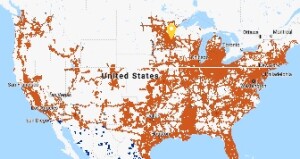
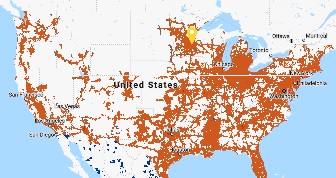
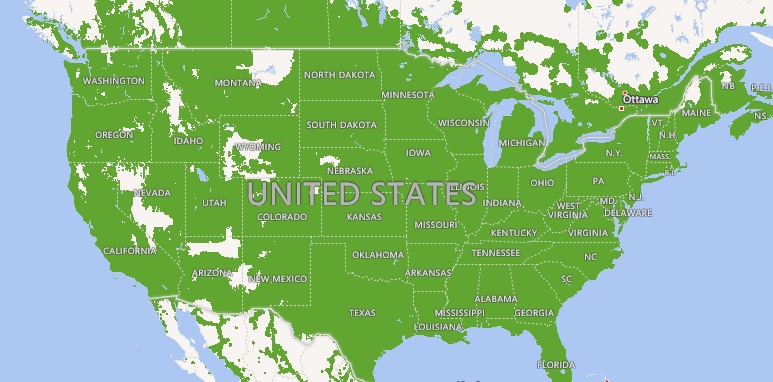
Boost Mobile Coverage Map.
tables with a laptop. So I assume that they, like us, were at work or at school. We stayed mostly at KOA campgrounds, most of which have very good WiFi connections. When we were driving, or in state park campgrounds, we used a cell phone hotspot to connect. While our connections sometimes failed, they were reliable most of the time. There were a few occasions when we had a meeting that we absolutely had to attend at a certain time, and
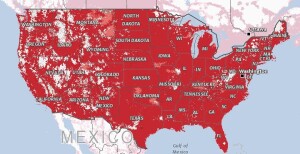
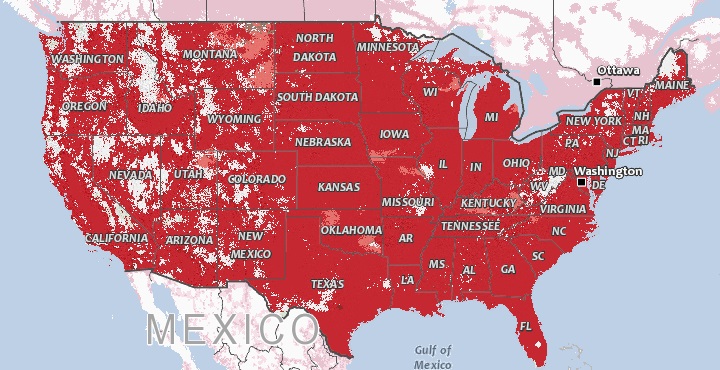
Verizon Coverage Map.
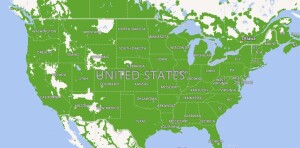
Cricket Wireless Coverage map.
on those occasions, we did need to plan ahead a bit. Overall, we found that Verizon had the best connections in the Western states we visited. For example, in Yellowstone National Park, Verizon had service available near all of the major centers. Between the four of us, we had three cellular providers, and Verizon was the most reliable where we were. My phone, which uses the prepaid provider Boost Mobile, which uses the Sprint network, had absolutely no service for most of the trip. I looked at their coverage map after the fact, and while they have very good coverage in the eastern half of the country (especially along interstates), they have essentially zero coverage in much of the Intermountain West. My kids both have service with Cricket Wireless, which uses the AT&T network, and they also had good coverage in most areas. Verizon seemed a bit more reliable, but there were a couple of occasions when they had service but my wife’s Verizon phone did not.
If your work depends on having internet available, the moral of the story is that you should plan ahead. Between our three providers, we had very reliable service. But occasionally, the best provider was unavailable, but another one was available. One workaround to increase your reliability if you have only one provider would be to buy a cheap prepaid phone from another providers. If both your primary carrier and that carrier have reasonably good service in the area where you plan to travel, you’ll increase your chances of having a good connection from any given spot. Phones are available for about $60 or less, and a month’s service is generally about $30. The inexpensive plan might run out of data, but you can generally buy more. Having a second cell phone with a different provider could be good insurance if you need coverage. You can turn either phone into a hotspot and use that for your other devices.
Prior to the trip, we did buy a dedicated hotspot with Verizon service, but it didn’t seem to provide any better service than the Verizon cell phone. And unfortunately, the hardware stopped working during the trip, and will have to be returned. Frankly, I don’t think there was any advantage over simply using a cell phone as a hotspot.
Inside Yellowstone Park, there was cellular coverage near all of the major destinations, such as Old Faithful, Fishing Bridge, Mammoth Hot Springs, etc. On one occasion, we were touring the park when my wife had a Zoom meeting to attend. We stopped at Fishing Bridge, where she had a good signal, and she worked in the car while the kids and I viewed the sites. However, when we strayed even a few miles from one of these sites, there was no service. Our base of operations during our stay at the park, the West Yellowstone KOA, had very good WiFi. So we generally attended school and work from the campground in the morning, and then toured the park without regard to connectivity.
There were a few times when the kids simply missed a class because an internet connection was unavailable. So you need to be flexible, and if you have an important meeting you need to attend, you need to plan to be in a place with a solid connection.
Social Distancing on the Road
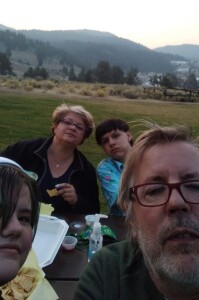
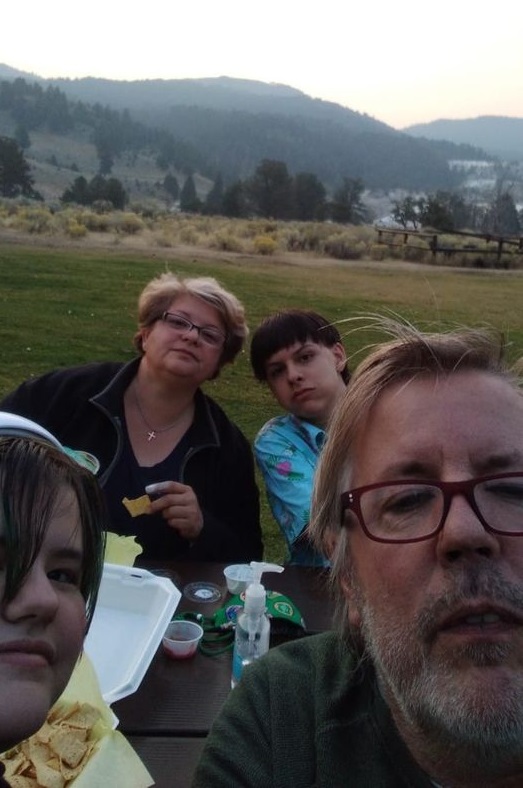
Family dinner at Mammoth Hot Springs, Yellowstone, of buffalo burgers purchased at food truck outside the park.
We are being very careful with social distancing, and the trip had few challenges. We recognized beforehand that there would be some situations where we would have to go inside buildings to interact with others, although we kept those situations to a bare minimum. When we did need to go inside and/or interact closely with others, we wore KN95 masks, which provide some protection to the person wearing them. I’d feel better if I had an N95 mask that was made in the USA, but those aren’t available yet. Camping does not always allow the opportunity to wash your hands thoroughly with hot water, so we also brought along and used plenty of hand sanitizer. In addition to the N95 masks, we always had with us either a cloth mask or a disposable surgical mask.
I would say that about half of the people we saw were wearing masks when it was appropriate to do so. Buildings inside the national park required masks, and most were honoring that requirement. A few people had what appeared to be N95 or KN95 masks. Most had simpler cloth face coverings.
For the most part, other people we encountered respected our social distance. In campgrounds, when we talked to other campers, they instinctively kept their distance. We did have to keep up our guard, however, since others would sometimes decide to intrude upon our personal space. For example, at Old Faithful, my daughter and I were holding a spot at a bench for the rest of the family when an unmasked woman simply came to our bench and sat down a couple of feet away from my daughter. There was little we could do other than move as far away as possible from her, tighten our masks, and try to breathe in the other direction.
At Mount Rushmore, I was sitting minding my own business when an elderly woman, in an apparent effort to impress her granddaughter, started hopscotching toward me. I held my breath, quickly got up, and found another place to sit.
Buying Supplies on the Road
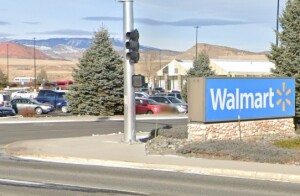
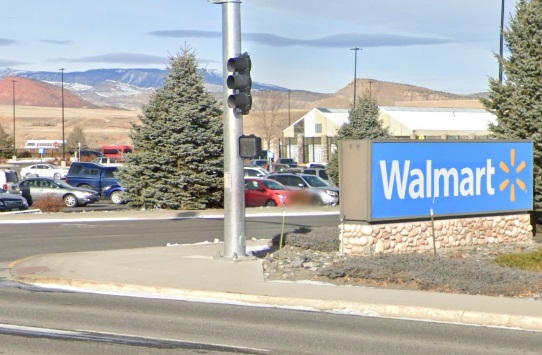
Cody, WY, Walmart. Google Streetview.
Without exception, when we bought gas, we paid at the pump and didn’t have to go into the store. Since the process did require handling the pump and entering a zip code on the display, I made a habit of slathering my hands with hand sanitizer when done.
For an almost two week trip, we did have to buy groceries. To avoid having to go into the store, we placed an online order at Walmart, and picked up our order at the Walmart in Cody, Wyoming. In most cases, it’s necessary to place an order about two days in advance, so this requires some advance planning. But we placed the order from a cell phone while driving, and later added some items we thought of.
One good resource for buying things on the road without direct contact is Walgreens. The Walgreens website allows you to order a limited selection of items, and pick those up at the drive-thru window. In one case, we needed a charging cable for an iPad, which wasn’t listed on the website. But when we called the store, they were happy to leave it at the drive-thru, and we were able to pick it up a few minutes later. For staples like bread and milk, you can place your order online, and then pick it up and pay at the window.
Most (but not all) major supermarket chains have online ordering for in-store pickup. In many cases, the service is through InstaCart, and their website will show available stores in the area where you are travelling. Walmart’s ordering is done directly through their website, and as far as I know, all Walmart stores offer curbside pickup.
Sanitation Resources

 As the song goes, “it’s a problem to be faced, what to do with human waste.” This is one great advantage of traveling in a larger RV with its own toilet. In our case, we have a small portable toilet in the camper, like the one shown here, which is really best for emergency situations. And it also needs to be emptied by going into the bathroom.
In some cases, the only option was a public restroom, which meant using the KN95 mask. After using the bathroom, I washed my hands thoroughly, but I usually had to touch the doorknob before leaving. So my routine was to stop outside the restroom, apply hand sanitizer, and then remove my mask.
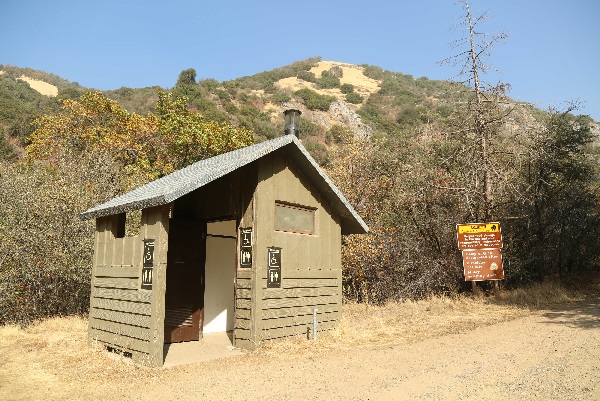
One advantage of state and national parks is that they often have what are euphemistically called “vault” toilets, or pit toilets. To the squeamish, these might seem to be less than ideal. But in general, they are kept clean. And they have the great advantage of providing automatic social distancing. You are isolated from everyone else, so there’s no chance of breathing in a virus exhaled by the person in the next stall. In general, if I had the choice between a “vault” toilet and a “modern” restroom, I opted for the vault, since I believe it is safer. At one of our campgrounds, the campground had a “modern” restroom, but there was a picnic area about a mile away with a rarely used vault toilet. I made the short drive to take advantage of the added safety. I also took advantage of the vault toilets to empty our portable toilet, a job that for some reason always devolves upon me.
In many cases, such as state parks, a vault toilet is available in the campground. So even if you’re not camped there, a drive into the campground will allow you to find this facility.
Many locations, such as Mt. Rushmore, had a bank of portable toilets set up, even though the modern restrooms were in operation. Again, even though it sounds counterintuitive, it seems to me that the portable toilet, where you are isolated, is safer than a public restroom. I did notice that this toilet was out of hand sanitizer, so you do want to carry a small container with you at all times. I kept mine stored in a fanny pack, along with my KN95 mask, stored in its own paper bag. (Here is CDC guidance on re-use of “disposable” masks.)

 To avoid public showers, we did have a solar shower and shower tent which we used a couple of times. The shower is designed to be hung from a tree, although we found that the most convenient option was usually to put it on the roof of the car. (For more information about solar showers, see my earlier post.) It did prove to be an inexpensive and convenient option.
One thing that I noticed, particularly in Yellowstone National Park, was the huge number of rental RVs. We must have seen hundreds of motorhomes with a prominent ad for CruiseAmerica.com. They aren’t exactly cheap, but the cost is comparable to a hotel room. If one doesn’t own an RV and wants to travel, this seems like a viable option.
I’ve never been to Yellowstone National Park in the fall, but it did seem to be quite crowded for the off season. The crowds weren’t an issue, but I believe they were higher than usual, since others probably had the same idea we did. For most of the nights of our stay, we did have campground reservations, and most of the campgrounds where we stayed appeared to be full or almost full.
My experience with the Minnesota State Parks is that if you want to go camping, you’ll find many options available during the week. If you’re flexible, you’ll find many interesting places to camp. On weekends, there are fewer options. Previous years, I’ve almost always been able to find a weekend camping spot on very short notice. This year, that might not be possible on a weekend, but it still is on a weekday. I suspect other states are the same. The campground host at Custer State Park in South Dakota said that this year, the campground is full almost every night, whereas in previous years, there were often spots available.
Every segment of the industry seems to be at its limits. We had recently purchased a new vehicle and had to have a hitch installed. The dealer who installed it (Bauer’s Custom Hitches in Minnetonka, MN, which did an excellent job) was unable to get the hitch from their normal supplier. I eventually found one at O’Reilly Auto Parts, which had the right hitch in stock locally. The dealer was so surprised that I found one that they bought them retail for the other customers who were waiting for the same part.
We were gone for about 12 days, and traveled from Minnesota first through North Dakota and Montana to Yellowstone, and then back through Wyoming in South Dakota. In retrospect, we should have stayed put at some of those sites a few more days, rather than driving so much. Since we can, we’ll probably take more similar trips this year, but probably put in fewer miles. The $100,000 diesel pusher would probably provide more convenient options for four of us to be working or going to school. But since we don’t have one of those, the 8 foot popup seems to work almost as well.

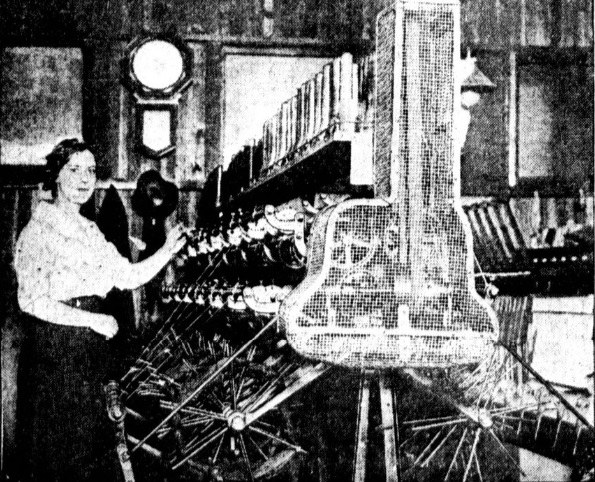 A hundred years ago, Miss Elise Updyke, of 2320 West Harold St., Philadelphia, worked as the operator of a bobbin winder machine at the Belmont Manufacturing Company, 2545 North Broad Street. a one mile walk away from her home. Today, both addresses are within a block of the same bus line, and it’s likely there were then as well. The material on the bobbins was woven into neckties.