Author Archives: clem.law@usa.net

1950 Grocery Prices

1950Nov20PghPressHere’s a snapshot of grocery prices 70 years ago today, from the November 20, 1950, edition of the Pittsburgh Press.

With Thanksgiving just around the corner, it was only natural that turkeys featured prominently, at 69 cents a pound (or 59 cents a pound for those 16 pounds and up). For 29 cents, you could get two pounds of cranberries, two pounds of apples, or three pounds of sweet potatoes. If you preferred your cranberries out of a can, the canned cranberry sauce was 7 cans for a dollar.

If you were stocking up on other meat, pork roasts were 33 cents a pound, and beef roasts were 59 cents a pound.

For the pantry, you could get ten cans of Campbell’s Tomato Soup for a dollar, a two pound jar of grape jelly for 43 cents, olives for 43 cents, and asparagus five cans for a dollar. Two loaves of bread were 27 cents.

You could wash it all down with a carton of cigarettes for only $2, and for the bathroom, four bars of soap would set you back 36 cents.


1960 Handwriting Recognition

1960NovEE3
Shown here in the November 1960 issue of Electronics Illustrated is 17-year-old Belmont Frisbee, then a student at Burroughs High School in China Lake, California. He was one of the winners of the 1960 National Science Fair and is demonstrating his winning entry here. The device he constructed is dubbed “Adicof,” and allowed the entry of numbers into a computer by writing them by hand.

The digit is written with a metal stylus onto a panel with inlaid copper strips, as shown in the diagram below. For example, when making a “2”, the stylus will pass over strips 1, 2, 3, 4, 5, and 7.

The nearly forgotten art of relay logic is used to determine which number was being written. A partial diagram is shown below. Each strip is attached to the coil of a relay. The first relay is single pole, double throw (SPDT). The next one is DPDT. The one after that is 4PDT. Unfortunately, there probably weren’t any 128PDT relays on the shelf for the seventh relay, so multiple relays were used for the higher stages.

I believe the circuit shown here is simplified in one respect: For this to work, it would be necessary to use some type of latching relay, since the stylus would no longer be in contact with the pad when the next pad is contacted.

The simplified diagram shown here uses light to indicate the digit drawn, but for his exhibit, Mr. Frisbee hooked the output to a computer.

Today, it’s a trivial matter for a computer to recognize hand input, but the concept is nothing new. Sixty years ago, a high school student accomplished the task with electromechanical relays.

Mr. Frisbee continued as an engineer after high school. He was issued at least two patents (4,477,812 and 8,009,084), both of which involve radar, and both of which list the U.S. Navy as the assignee.

The magazine highlighted some other winners of the 1960 National Science Fair. Remarkably, it includes an electron microscope constructed by Marvin Hutt, a New York high school student, despite having experts tell him that making one at home was impossible. For students looking for inspiration for a science fair project, perhaps there are a few who could build an electron microscope from scratch. But in an age when computing power is taken for granted, there’s something to be said for being able to use mechanical relays for programmable logic. The science teacher might not even realize that it’s possible, and proving the impossible is always a good way to take home the blue ribbon.

1960NovEE4


Pulling In Blacked Out Games: 1970

1970NovPMcoverI don’t remember if I saw this particular magazine, the November 1970 issue of Popular Mechanics, but I did see magazines like it, and I was intrigued. I had absolutely no interest in sports, but I was interested in pulling in distant TV stations. We had it pretty good for television signals in Minneapolis-St. Paul. We had 5 VHF stations, and if you moved the loop antenna just right, you could pull in channel 17 on the elusive UHF dial. Our local newspaper and the local edition of TV Guide listed only these channels. In the paper, channels 2-11 were shown in a grid, with the schedule for channel 17 printed in small type in a corner of the page.

But occasionally, we would travel to surrounding areas, and when we did, if I could scrape together enough change, I bought a copy of TV Guide. The Minnesota edition listed all of the Twin Cities stations, but it was also chock full of listings of other stations. By and large, they were all the same programs. But some of my favorites were on at different times. I just needed a way to pull in these stations.

We never did it, because the rabbit ears worked just fine for our local channels. But I dreamed of putting up an outdoor antenna to pull in those elusive signals. Articles like this spurred my dreams.

This particular article was penned by prolific electronics writer Len Buckwalter. The target audience was sports fans. Games were “blacked out” in those days. Football was particularly affected by these “blackouts”. Today, sports is a television event. But then, the thinking was that if the game were on TV, attendance at the stadium would suffer. They figured that nobody over a hundred miles away would drive to see the game, so it was safe to put it on TV there. But unless the game was sold out, it wouldn’t be televised locally.

So if you were in the team’s city, if you wanted to watch the game, you had two choices. Either you could buy a ticket and see it in person, or you could watch it on a distant TV station. Some people drove to other cities to watch the game. It was cheaper to rent a hotel room and drive there, so that’s what some people did. But some people put up a big enough antenna so they could watch the game at home, and that’s what Buckwalter’s article told you how to do.

He explained a number of possibilities. If you already had an outdoor antenna, then what you needed was a rotor, so you could steer it toward the city where the game was playing. Of course, your picture might still be full of snow, so putting a pre-amp on the mast might do the trick.

1970NovPMantennaswitchParticularly avid sports fans could purchase a separate yagi antenna tuned to the channel carrying the game, and point that toward the out-of-town station. They could install a knife switch like the one shown here. On game day, they would switch on the yagi. On other days, you would switch back to the antenna receiving the local channels.

To demonstrate the art, the article carried screen shots showing a baseball game broadcast on Channel 8 in New Haven, CT., being pulled in by an antenna in New York City. With an outdoor antenna a pre-amp, the picture quality was actually better than a New York channel with an average antenna setup.


1960 One Transistor CB Receiver

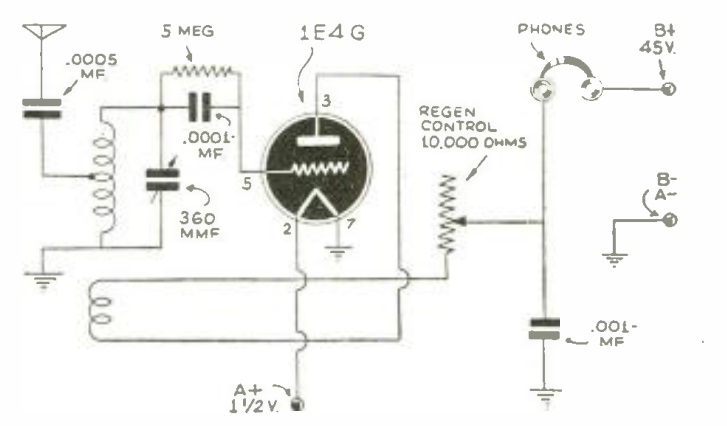
1960NovEISixty years ago, this New York scout made the front cover of the November 1960 issue of Electronics Illustrated by demonstrating this one-transistor superregenerative receiver for the 11 meter Citizen’s Band.

According to the accompanying article, a pair of CB transceivers would set you back about $150. But for many uses, one-way communication was sufficient. The example shown on the cover was “the Boy Scout out on a hiking expedition who wants to tune in home camp.” In addition, the article suggested that a physician might carry a small receiver on a large hospital campus to be paged. Or a TV serviceman working on a roof antenna could hear instructions from the ground.

This simple circuit would satisfy all of those needs. According to the article, the set would provide clear reception up to three miles without fading.

1960NovEI2


1940 Motorola Bike Radio

1940NovPS4Eighty years ago, this cyclist was able to enjoy her favorite program no matter where she happened to be pedaling, thanks to this three tube set shown in the November 1940 issue of Popular Science.  The set had a loudspeaker that faced the rider, and included an antenna that attached to the tip of the front fender and curved back. A separate battery box, supplying 90 volts B+ and 1.5 volts for the filaments, clamped securely to the bicycle frame.

While not identified by the magazine, the set appears to be a Motorola model B-150, featuring a tube lineup of 1A7GT,3A8GT, and 1Q5GT. If the set looks familiar, it’s probably because we previously featured it in connection with an ad allowing boys to win a free example by selling subscriptions to Radio Guide magazine.

Since this cyclist clearly isn’t a boy, she presumably paid the retail price of $19.95.


1940 Grocery Prices

1940Nov14PittsburghPressHere’s a snapshot of what grocery prices looked like 80 years ago, from the November 14, 1940, issue of the Pittsburgh Press.

When you look at these old prices, one way to translate them to modern prices is by remembering that each dollar was made up of ten silver dimes or four silver quarters. Either way, it was one ounce of silver. Today, the price of silver is about $24 per ounce, so if you multiply these prices by 24, you’ll get the rough modern equivalent.

Chicken would set you back 29 cents a pound, which would be about $7 a pound in today’s money. Ham was 19 cents a pound, or the equivalent of about $4.50 today.

Fish from Lake Erie was 25 cents a pound. You could buy it fresh, or for the same price, you could buy it cooked, and warm it up at  home. At the lunch counter, a meal of either halibut or ham would set you back 56 cents for two people.


1970 Soviet Fax Machine

SovietFaxThe magazine doesn’t show all of the construction details, but if you want to be accused of Russian meddling in the science fair, here’s the project for you. For the young Soviet comrade wishing to take home the blue ribbon in the oblast science fair, the November 1970 issue of Юный техник (Young Technician) magazine gave enough information to build a fax machine. Apparently, it was called a “phototelegraph-integrator”, since that is the title shown here.

Both of the drums are spinning at exactly the same speed.  A scanner is moving across one of them, and a printing element, such as a pen, is moving across the other one, at exactly the same speed.  One of the machines scans a picture of the word Mir (peace), and this is transmitted to the printer, which makes an exact facsimile.

The bright American student can also build a device that can transmit pictures through a wire. The key is to have two drums that are spinning at exactly the same speed. The easy way to accomplish this, for demonstration purposes, is to simply have both of them revolving together on the same shaft. Both of them need to have something that moves along the drum at exactly the same speed. The easy way to do this, for demonstration purposes, is to have the sending and receiving elements connected together with a shaft.

One of those elements needs to have a method to detect the picture. In a fax machine, that’s done with light. But an easy way to do it, for demonstration purposes, is to create the image using aluminum foil. Then, the sensor can be nothing more than a piece of wire that comes into contact with the foil.

This wire is hooked to a circuit which operates a solenoid. The solenoid raises and lowers a pen which comes into contact with the other drum. Whenever the wire on the sending drum comes into contact with the foil, the circuit is closed, and the pen starts drawing on the other drum.

Turn the drum while slowly moving the two sensors. The result will be a drawing exactly the same shape as the piece of foil.

The crude drawing below shows the general idea. An advanced student should be able to work out the invariable bugs and build their own fax machine. When you take home the blue ribbon, the other students will probably accuse you of winning due to Russian meddling. When they do, point out that there was nothing in the rules prohibiting it.

FaxMachine


1950 Hi-Fi Demonstration Console

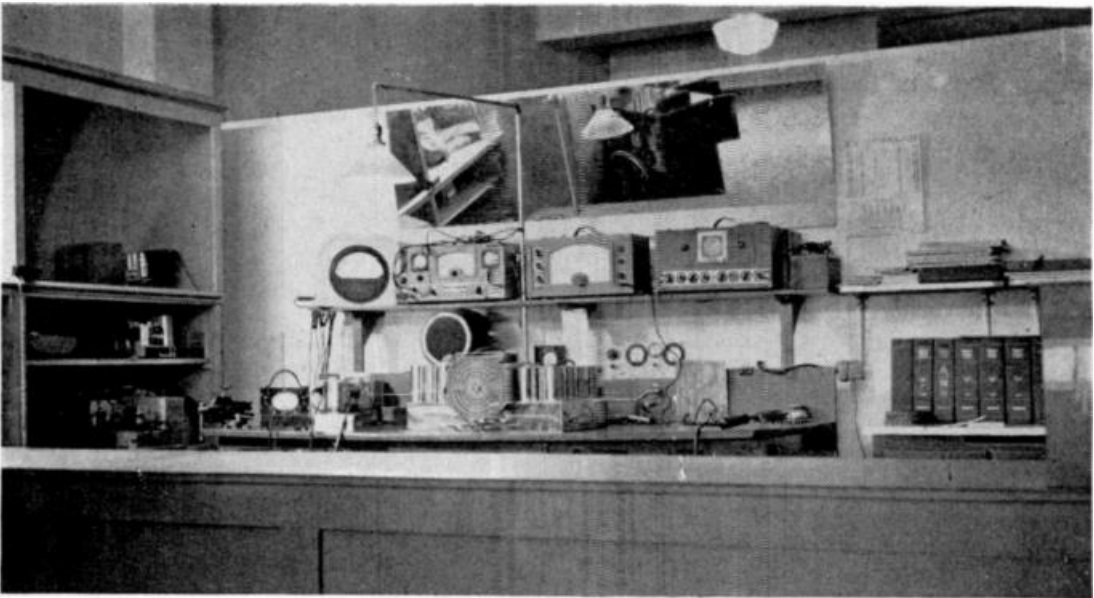
1950NovRadioNewsEighty years ago, this intriguing room could be found at Allied Radio in Chicago. Here, the Hi-Fi enthusiast interested in the very best equipment could be given a demonstration showing exactly how different pieces of equipment would sound together. Around the room were various tuners, amplifiers, preamplifiers, cartridges, tape machines, and other devices. From the console, different elements could be switched into and out of the circuit, and the discerning listener would be able to pick out exactly the right combination that met their needs.

The photo appeared on the cover of Radio & Television News, November 1950, which also included an article going into the room’s technical details.


Armistice Day Blizzard: 80th Anniversary

Armistice Day Blizzard, Excelsior Blvd., West of Minneapolis.  Minn. Historical Society photo, NOAA.

Armistice Day Blizzard, Excelsior Blvd., West of Minneapolis. Minn. Historical Society photo, NOAA.

Wednesday, Veterans’ Day or Armistice Day, is the 102nd anniversary of the end of World War I. But in Minnesota and the Upper Midwest, it is remembered as the 80th anniversary of the Armistice Day Blizzard of 1940, which was responsible for taking 145 lives. Here are two previous posts about that blizzard:

Newton “Jack” Baker III, 1920

NewtonJackBaker1920Shown here is Newton D. “Jack” Baker, III, the son of U.S. Secretary of War Newton D. Baker.

The picture appeared a hundred years ago this month in the November 1920 issue of Radio News, which reported that he had studied radio telegraphy enthusiastically, and had mounted this portable set on his bicycle, on which he listened while riding around Washington. With just the frame of the bike as an antenna, he was able to pick up NAA Arlington.

1919XmasRadioIf Master Baker and his radio look familiar, that’s because we’ve seen both of them previously. He had been an exceedingly good boy during 1919, and Santa Claus brought the radio as a reward, as shown in this close-up from the picture we previously shared. This photograph is clearly the same boy, the same radio, and even the same headphones as the Christmas photo.

I don’t see any record of Baker having received an amateur license, but it appears that he was an enthusiastic listener in the earliest days of radio.