Here’s an update on the Ration Challenge I will be taking from June 13-19. Please consider donating to Church World Service to assist Syrian refugees. You can read more and donate at this link:
https://www.rationchallengeusa.org/richard-clem

Here’s an update on the Ration Challenge I will be taking from June 13-19. Please consider donating to Church World Service to assist Syrian refugees. You can read more and donate at this link:
https://www.rationchallengeusa.org/richard-clem
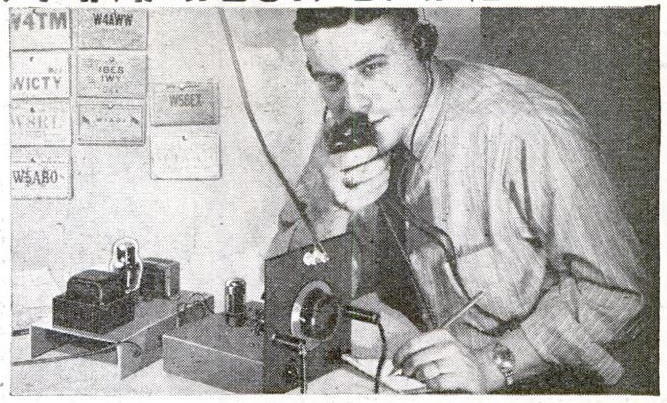 Seventy-five years ago, this ham was just getting back on the air after a wartime hiatus, thanks to a two-tube two meter transmitter described in the June 1946 issue of Popular Mechanics. The magazine noted that for the ham licensed prior to Pearl Harbor, as well as the newly licensed, the simple set would provide an efficient way of getting on the air for local contacts while the big rig was still under construction.
The set used a 6N4 to serve as oscillator, with a 7C5 modulating. On receive, the 6N4 became a superregenerative detector, with the 7C5 serving as audio amplifier. Also shown above is a 300 volt power supply, although another supply, such as a vibrator supply in a car, could be used to power the rig. The recommended antenna was a folded diple constructed of 300 ohm twin lead.

 Eighty years ago today, the June 9, 1941, issue of Life magazine showed some of RCA’s offerings. The portable was the main feature, and was billed as the perfect Father’s Cay gift. The superhet weighed in at only 4-1/2 pounds, but was a full toned powerful set. It featured a built-in antenna in the lid, and the speaker was said to pay symphony music with amazing tone and volume. The set sold for $20, and if you acted fast, they would toss in the leather case.
The set appears to be model BP-10, a four-tube set powered by a 67.5 volt B battery and 1.5 volt filament battery.
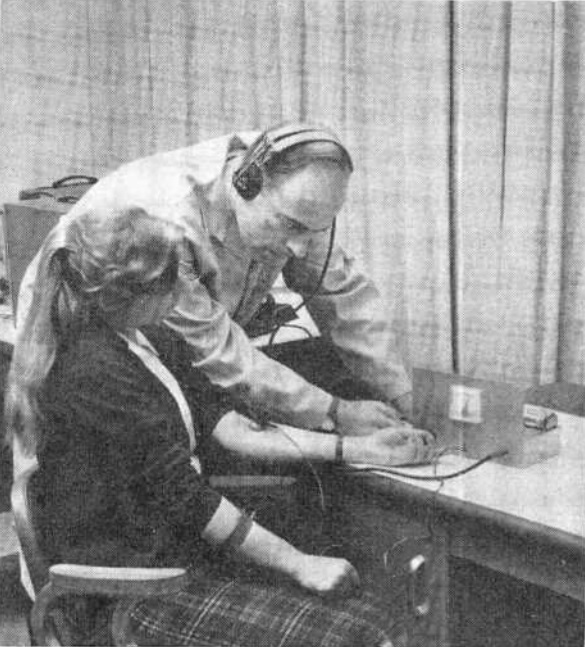 If Junior is looking for a spectacular science project in the field of biomedical engineering, this one is a sure winner.
Sixty years ago, the June 1961 issue of Popular Electronics showed how to construct this simple cardiac monitor. The circuit was simple, amounting to a 4 transistor audio amplifier. The diagram called for 2N279 transistors, which are apparently unobtainium today, but this substitution guide lists the 2N2431 as equivalent, and it is available at a reasonable price.
The input comes from two electrodes, one of which is placed on each arm. In this position, they will pick up the currents from the heart, which are alternating currents of up to 100 kHz. The audio portions will be audible in the headphones, and also displayed on the meter. The magazine notes that you are not hearing the actual sound of the heart, merely the amplified voltage sent to the heart muscle. Other muscles can be monitored by placing the electrodes on either side of the muscle in question.
The electrodes are simply pieces of metal placed on the body. Prior to placing them, the skin needs to be scrubbed to improve the conductivity. This is done by scrubbing with Lava soap
or Ajax cleanser. (However, since Ajax is now billed as “non-scratching”, I’m not sure it would still work.) The article notes that the device is completely safe, even for children. First of all, it runs off only three volts. And the connection to the electrodes goes through a capacitor, so even that voltage has no pathway to the body.
More advanced versions are available today, but the advanced student will almost certainly bring home the blue ribbon in the science fair by building the medical device at home.

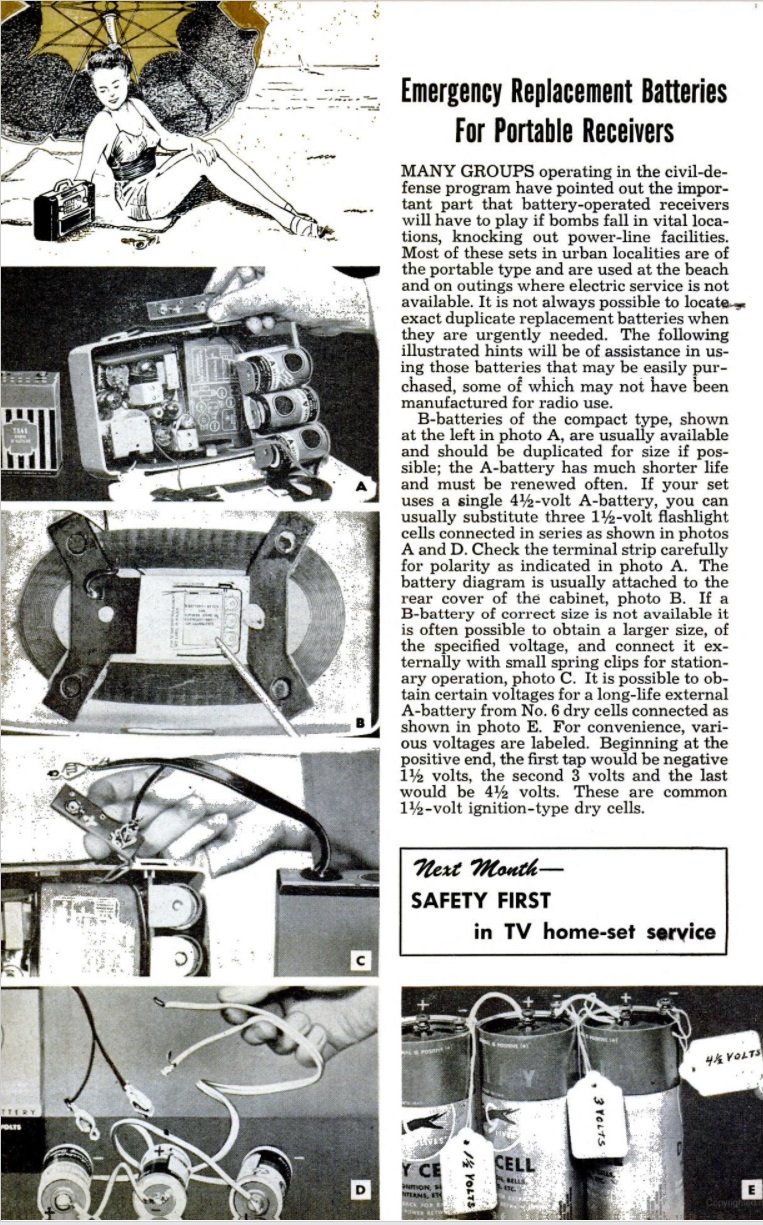 This young woman shown above in Popular Mechanics 70 years ago this month, June 1951, is using her portable radio to pull in some entertainment at the beach. But she also realizes that in a civil defense emergency, the set might have a vital role to play if the bombs started falling.
The problem, of course, is that you need batteries for the radio, and many sets had oddball shapes and sizes, some of which might not be available in the runup to an emergency. Therefore, the magazine gives some pointers on substituting what’s available. Even though the batteries might not fit in the case, with a little thought, it was a relatively easy matter to power the radio for emergency information.

Eclipse of May 31, 2003, Bavaria. Wikimedia Commons image by Sch, licensed under the Creative Commons Attribution-Share Alike 3.0 Unported license.
On Thursday, June 10, 2021, much of North America will experience a sunrise similar to the one shown above. As we previously reported, on that day, there will be an annular eclipse of the sun. Normally, this isn’t a really big deal, since enough of the sun remains visible so that it doesn’t get noticeably dark outside. But this one is an exception, since it takes place at sunrise. Depending on your location, as the sun rises Thursday morning, the sun will be either a crescent or a ring.
The map below (courtesy of Michael Zeiler, GreatAmericanEclipse.com) shows approximately what the sun will look like at sunrise. In some cities, such as Minneapolis and Chicago, there will be a noticeable chunk missing from the sun as it rises that morning. Other cities, such as New York, Philadelphia, Washington, and Toronto, will have only a tiny crescent sun come over the horizon.
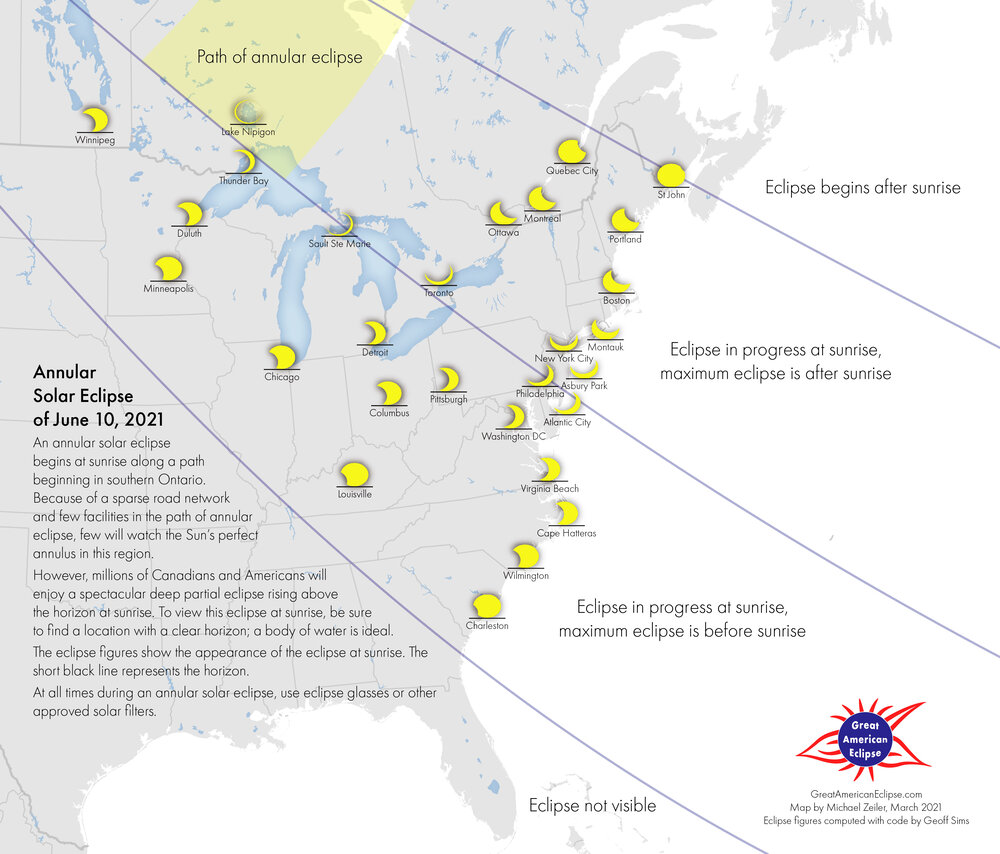
As the sun is rising, it’s as safe to view as any other sunrise. But as it goes above the horizon, if you want to keep watching, you’ll need eclipse glasses or an indirect viewing method. If you still have glasses from the 2017 eclipse, you’re all set. You can also use indirect methods, as we discussed in 2017.
My original plan was to view the eclipse near Longlac, Ontario at Macleod Provincial Park. Unfortunately, the border remains closed, and it looks likely that the park will remain closed to camping due to COVID. Therefore, the official OneTubeRadio.com eclipse headquarters will be located at Cascade River State Park, near Lutsen, Minnesota. While there probably won’t be a good view of the sunrise from the campground, we will use the day before the eclipse to scout out a spot along the shore of Lake Superior to view the sunrise. That campground is fully booked, but the last I checked, there were a handful of sites available at Judge C.R. Magney State Park and Gooseberry Falls State Park. There are also some hotel rooms available in the area.
Similarly, if you’re in Chicago or Detroit, it’s worth the drive to Sault Ste. Marie to view the crescent sunrise. And if you live in New York, Philadelphia, Toronto, or Washington, all you need to do is set the alarm clock early, and find a good place to watch the spectacular sunrise.
For a week starting June 13, I will be taking part in the “Ration Challenge,” a fundraiser for Church World Service (CWS). Funds are designated to feeding Syrian Refugees in Jordan (or wherever the need is greatest). CWS does not engage in proselytizing, but they are sponsored by numerous Protestant and Catholic denominations. They are a highly rated charity, as you can see at sites such as Charity Navigator.
For that week, I will be eating essentially the same rations as those refugees, as explained in the video below.
Please consider donating at the following link:
https://www.rationchallengeusa.org/richard-clem
Both small and large donations are greatly appreciated. I’ll be posting updates during the challenge, here and on Facebook.
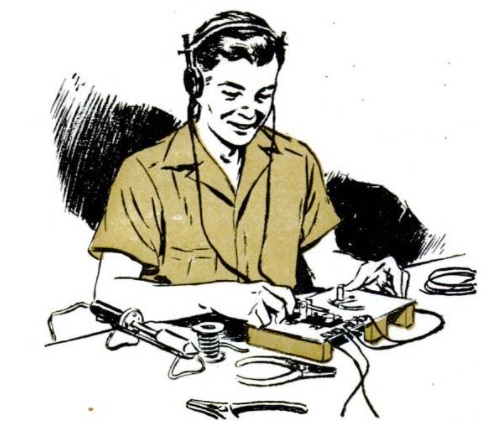 This young man is pulling in the proverbial strong local station thanks to one of two sets described in Popular Mechanics 70 years ago this month, June 1951. Both sets are billed as low-cost sets for young radio experimenters, and the magazine noted that such designs re not as plentiful as they should be.
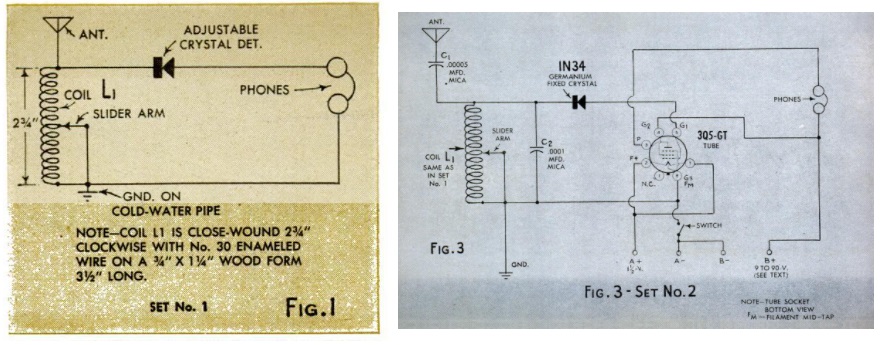
The set above is a crystal set using a galena detector. The tuning coil is wound on a rectangular piece of wood under the chassis, and there is an opening on top for a slider.
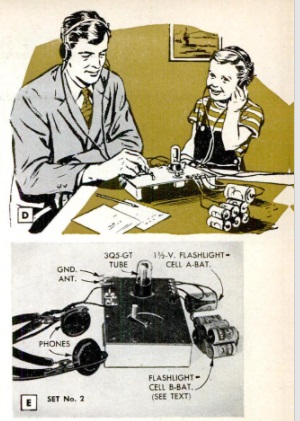 The father-son team at left have upgraded the set. First of all, instead of a galena detector, this set uses a 1N34 diode. And for added volume, it employs a 3Q5-GT tube as audio amplifier. For the B+, the set uses 9 volts, but the article points out that for added volume, as much as 90 volts can be used.
If you are thinking of recreating one of these designs, you might find ideas for sourcing parts at my crystal set parts page.
 A hundred years ago this month, the June 1921 issue of Popular Mechanics showed these self-explanatory plans for a homemade raft. The magazine specifies that the hulls should be logs of about 12 feet. However, in many states, such a craft would require a license. In most cases, this can be avoided by making the craft slightly smaller. For example, Minnesota requires no license for a non-motorized craft of 10 feet or less.

While most states do not require adults to wear the flotation device, in the case of this homemade expedient raft, it would be highly recommended.
 Eighty years ago this month, as shown in the June 1941 issue of Popular Mechanics, Junior was so pleased with his new crystal set that Dad decided to make a second one for himself. The set was so small that it was built right in to an old set of “Baldwin” style headphones, which had an extra large Bakelite shell and cap to house the set.
Into the bottom of the shell was placed a spiderweb coil, and the the shaft of a small tuning condenser was mounted in a hole drilled in the bottom. A wire with a spring clip was used for the optional but recommended ground connection, with another for any convenient antenna.

