1955 Sleep Learning

Screenshot 2025-05-23 12.19.34 PMShown here, in the June 1955 issue of Popular Electronics, is French actress Jeanne Demery hard at work learning Swedish for an upcoming play, all while she sleeps. We’ve reported previously (here, here, and here) about the concept of sleep learning. According to Wikipedia, it doesn’t work, but as a kid, it sounded reasonable to me, and sounded like a good way of bypassing the drudgery of studying.  I had to sleep anyway, so it seemed reasonable to take advantage of that time to learn.

The problem I ran into was the lack of suitable equipment.  The tape had to play while I was deep asleep, and ideally keep repeating.  I had a tape recorder, but once the tape ran out after a few minutes, I would be left without anything to learn.

With one of the devices shown in this article, I would have been all set up.  It looked like a phonograph with a timer, but it could also be used as a magnetic recorder.  The normal cartridge was replaced with a magnetic head, and speech could be recorded onto a magnetic disc.  The device was the Dormiphone, and was manufactured by Modernophone, Inc., 30 Rockefeller Plaza, New York.  It retailed for $229.50, which works out to $2747 in 2025 dollars.  That would have been out of my price range as a kid, so I guess that was another reason why I had to do my learning the traditional way.

(We searched in vain for more information about actress Jeanne Demery, but about the only thing we were able to find was this newspaper article also detailing her sleep learning achievements.)


1945 Automatic Relaying System

Screenshot 2025-05-22 12.57.36 PMThe first automatic amateur radio repeater station was put on the air in 1956 by Art Gentry, W6MEP, and it’s been on the air ever since. But you can see that the idea had been around for a while, as shown in this article 80 years ago, in the June 1945 issue of QST.

At the time, Amateur Radio was still off the air for the duration of the war, but some hams involved in civilian defense activities did have authorization to operate as part of the War Emergency Radio Service (WERS), usually on the 2-1/2 meter band. One such WERS station was WKKW in Hanipshire County, Mass.  The network was headed up by a net control station (NCS) at one of the highest points in the county, which ensured good coverage.  The problem was, however, that not all stations could hear each other.  So if a message needed to be relayed, it meant an added step of the NCS relaying it.

Screenshot 2025-05-22 1.13.42 PMThe solution was an automatic relaying system at the NCS station.  While the article called it “automatic,” it did not automatically hit the air as with a more modern repeater.  Instead, the NCS merely patched the audio from a second receiver into the transmitter, with the patch cord shown here.  He monitored through headphones, and switched back when the message was over.  Of course, the transmitter and receiver had to be on different frequencies, so when a message had to be retransmitted, the originating station was told to QSY to 112.7 MHz, and the repeated signal was on the net frequency of 114.6 MHz.

The equipment had to be reasonably well shielded, and the antennas had to be separated.  (The article noted that the feed line was a twisted pair.)  The article concluded by noting, “it is to be hoped that others will experiment with this and other simple means of relaying, since it is an interesting field of experimentation and one which offers a good return in the way of improved WERS operation. It suggests, also, interesting possibilities for postwar amateur activities at the high frequencies.”


1955 Radio Controlled Boat Receiver

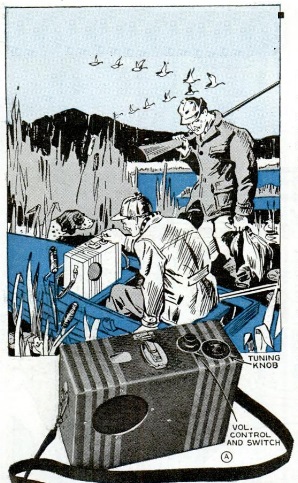
Screenshot 2025-05-20 10.40.02 AMSeventy years ago this month, this couple are enjoying some quality time together with their radio control boat, as shown on the cover of Radio News, May 1955. The secret of a successful cruise was a reliable receiver, such as the one described in the magazine.

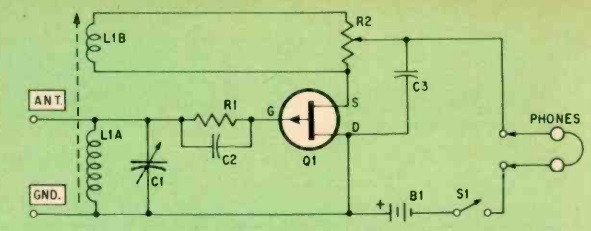
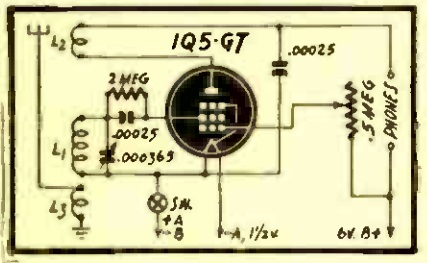
The author’s three-tube set reported very reliable service on 27.255 MHz. With a three-watt transmitter, it had a safe range of a mile. The three-tube supreregenerative circuit used an RK61 gas tube detector. While this type of tube sometimes experienced a short life, this was ameliorated by very low current.

Screenshot 2025-05-20 10.49.52 AM


German Spy Radio, 1945

Screenshot 2025-05-20 10.02.17 AMEighty years ago this month, the May 1945 issue of Radio News showed this transmitter-receiver mounted in an “innocent-looking traveler’s suitcase,” and seized from a German spy by agents of the FCC Radio Intelligence Division.  It was said to be substantially built and of an up-to-date circuit design.  It included a tool set, vibrator power supply, and wire for erecting antennas.

You can see what appears to be the same model at the Imperial War Museum.


Temporary Indoor Antenna, 1940

1940MayPMEighty-five years ago, this father-daughter team is hooking up a temporary indoor antenna. But to avoid marring walls or woodwork, they’re following a hint shown in the May 1940 issue of Popular Mechanics. They are using several small rubber suction cups, which can be easily removed when not required.


1925 Carryola Master Portable Phonograph

1925MayTalkingMachineWorldOne hundred years ago this month, the May 1925 issue of Talking Machine World reminded dealers that there was money to be made in the Big Outdoors, namely by selling portable phonographs to those at camps and summer cottages, those on motor tours of fishing and canoeing, or anywhere that a phonograph would add enjoyment.

Specifically, they were selling the Carryola Master, from the Carryola Company of America, 647 Clinton Street, Milwaukee. It was said to give beautiful tone, and its motor was silent in winding and operation.


1950 SILAVOX Private TV Listener

This ad appeared 75 years ago this month, in the May 1950 issue of Radio Retailing, for the SILAVOX, manufactured by Skinner & Pelton, Inc., 100 N. LaSalle St., Chicago. The add-on device allowed you to use headphones with your television. For private listening without annoying others in the household, the speaker could be shut off. But for the hard of hearing, you could leave the speaker turned on. Both the headphone and the speaker had independent volume controls.

Screenshot 2025-05-22 12.09.28 PMWhen I worked for Radio Shack in an earlier lifetime, we sold a similar device, shown here in the 1980 catalog. One day, we received an urgent communication from headquarters in Forth Worth that they were to be immediately removed from the shelves. I never heard the exact details, but I believe that someone had managed to electrocute themselves.

Many TV sets of the day had a hot chassis, meaning that there was a 50/50 chance that the chassis was hooked to the hot side of the AC power connection. In addition, there were extremely high voltages inside the set, and even with the set unplugged, there was a possibility that the capacitors still held a deadly charge. So the prospect of a consumer installing one of these was problematic. And if they did the job wrong (or maybe even if they did it right), there was a chance of high voltage running to the earphone attached to someone’s head. It’s actually surprising that they lasted as long as they did.


1940 Four-Tube Portable

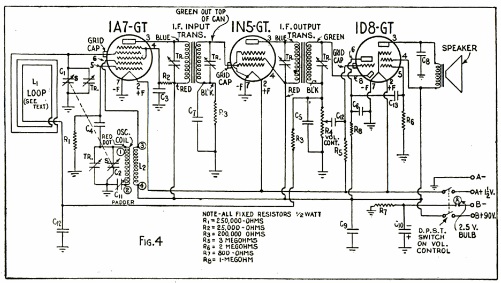
1940MayPM11940MayPM3Eighty-five years ago this month, the May 1940 issue of Popular Science showed how to put together this four-tube (1A7GT, 1N5GT, 1H5GT, 1C5GT) portable receiver. As shown in these illustrations, it was guaranteed to enhance any activity at home or on vacation. Powered by a 1.5 volt A battery and 90 volt B battery, the superheterodyne design could pull in stations 100 miles away during the day, or 500 miles at night, with only the built-in loop antenna. For greater DX, an outside antenna could be connected.

The magazine provided proof, in the photo at left, that the set weighed in at a mere eleven pounds.

1940MayPM2

1940MayPM4


Wavelength in Feet?

Screenshot 2025-05-20 11.43.35 AMHere’s something I’ve never seen before. Radio News carried lists of new TV stations to come on the air, and periodically had complete lists. This one is from the May 1955 issue.

Among the data presented is the wavelength (of the video carrier), but it’s given in feet, and not meters!  The only reason I can think of for this is for antenna construction.  If you needed to build an antenna of a half wavelength, then  you would probably be measuring in feet, and I guess it would save a little bit of time to have the conversion done for you.

But almost anyone building an antenna would know that if you started with frequency, then the formula for the length of a dipole was 468/f.  And that formula took into account end effects, and was really 95% of the true wavelength.  Has anyone else ever seen radio wavelength expressed in feet?


1925 One Tube Regen

1925MayPS

The plans for this handsome one-tube receiver appeared a hundred years ago this month in the May 1925 issue of Popular Science. The set was said to be ideal for the beginner, but still boasted long-distance reception. Regeneration was controlled by a variable capacitor, and this was said to reduce squealing, by virtue of the fact that only RF, and not audio, was fed back. The set called for an antenna of 75-100 feet. In testing, the set pulled in Chicago from a less than ideal location in New York.

1925MayPS2