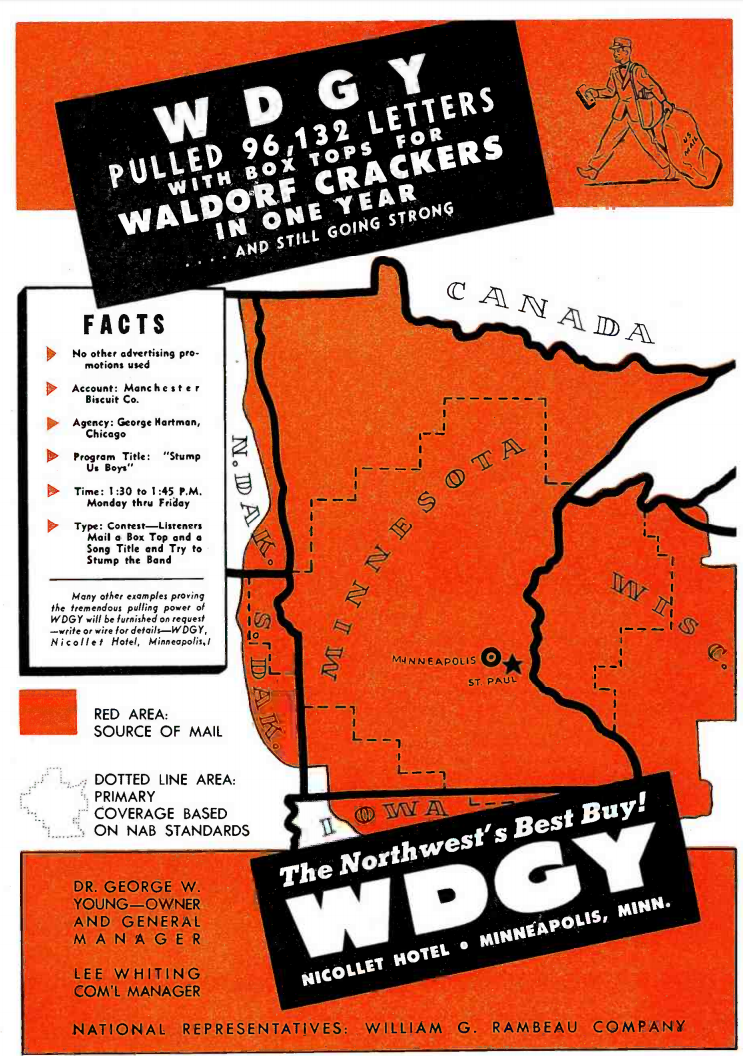
This ad for WDGY radio appeared 75 years ago today, in the July 10, 1944, issue of Broadcasting. The ad maps the station’s impressive coverage area, and notes that letters were recently received from over 96,000 letters from listeners. The letters all included a boxtop for Waldorf Crackers, and were part of a promotion for an afternoon program.
The station is currently KTLK, with a similar pattern with its nine-tower array beaming north at night. The WDGY call letters are in use by an oldies station serving the Twin Cities market from its Hudson, WI, city of license.
Seventy-five years ago today, the July 9, 1944, issue of the Milwaukee Journal carried this ad showing why America won the war. The secret weapon was bread, and this housewife knew to put it first on her shopping list.
Thanks to your Government, bread was packed with vitamins, minerals, protein, and carbohydrates, and served as the basis for a healthy diet.
A postscript reveals the probable sponsor of the ad, as it notes that most good bread is made with Fleischmann’s yeast.
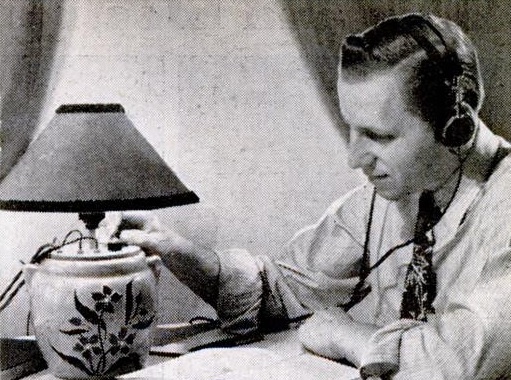
The gentleman shown here has plenty of light to read, and he’s able to pull in local radio stations thanks to this combination radio-reading light described in the July 1949 issue of Popular Mechanics. The magazine noted that the set was easy to build, and was ideal for the family member who frequently wanted to listen to programs that weren’t popular with the rest of the family. With this headphone set, he was able to excuse himself and listen to what he wanted, while the rest of the family was listening to a different program in another room.
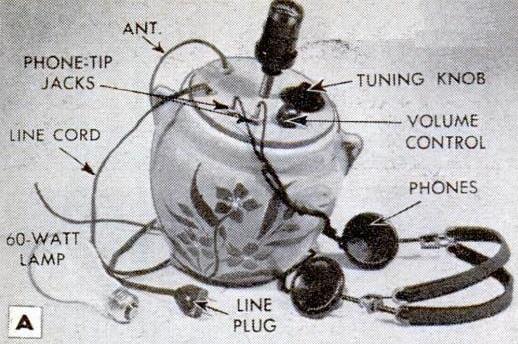
The 60 watt lamp allowed him to read in peace. The whole set was built into a cookie jar, which made an ideal base for the lamp and cabinet for the radio. The set was a one-tube regenerative receiver using a 117N7GT tube. One half of the tube was the rectifier, with the other half serving as detector. A volume control mounted on the base was actually a regeneration control. According to the magazine, the set would pull in the local stations with just a short piece of wire tossed on the floor. The set was of the AC-DC type, meaning that there were some safety issues, but the domestic tranquility achieved was probably worth it.
The cookie jar and lamp shade could be had for about a dollar each at the local “ten-to-a-dollar” store. A short piece of curtain rod was used to hold the lamp in place.
Eighty years ago this month, the July 1939 issue of Popular Science shows Mr. H.B. Funston of Columbus, Ohio, who enjoyed putting a hot soldering iron on his tongue. According to the magazine, “how he applies the iron to his tongue without injury remains a mystery.” We suspect that some injury is, indeed, involved. Therefore, we offer the reminder to kids not to try this at home.
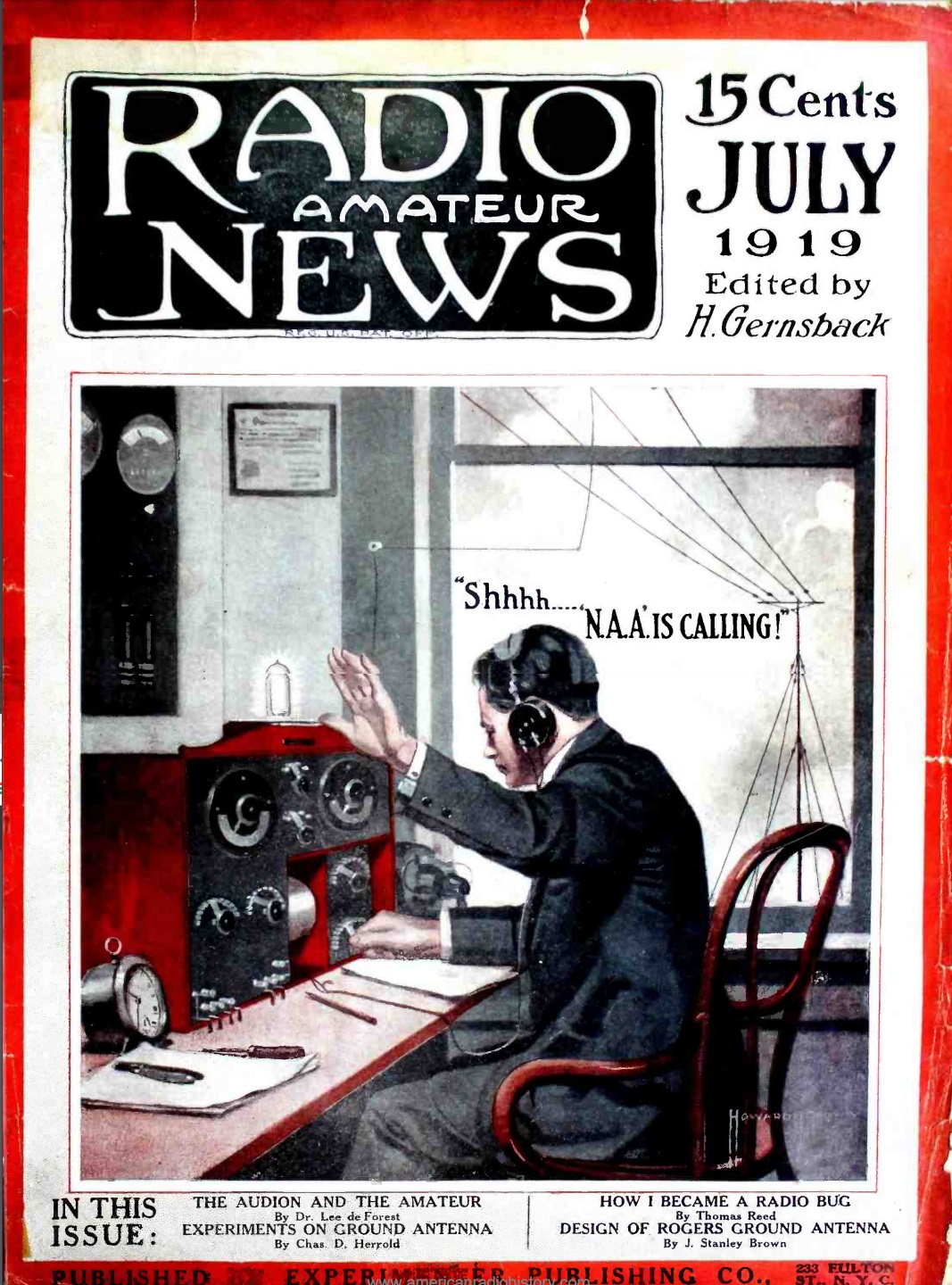
A hundred years ago this month, the first ever issue of Radio Amateur News rolled off the presses. The publication remained in existence for many decades, although the name changed over the years. The first issue, as shown above, was Radio Amateur News, although the issue contained a survey asking whether it should remain that, or be simply Radio News.
Apparently, Radio News won out, since the magazine changed to that name in June 1920. In 1929, the publisher, Hugo Gernsback‘s Experimenter Publishing Company, went bankrupt. Almost immediately, Gernsback started Radio Craft magazine.
Starting in May 1929, Radio News was in the hands of the bankruptcy trustee. Ownership changed hands over the years, and the name changed to Radio & Television News in July 1948. In September 1959, the name changed again to Electronics World. It merged into Popular Electronics in January 1972.
In the cover art of the first issue, this listener is hushing those in the room, as an important bulletin from NAA’s powerful Arlington, VA, transmitter is about to come in.
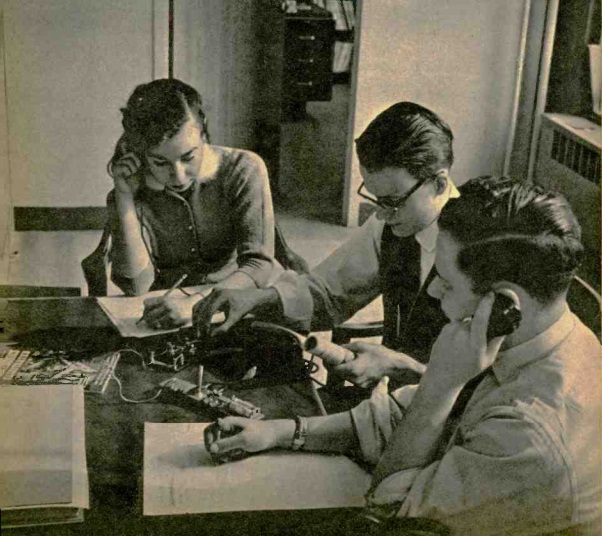
The students shown here are mastering the Morse Code by adhering to some hints contained in the July 1959 issue of Electronics Illustrated.
The article, penned by prolific writer Len Buckwalter, W2GKI, reviewed some of the records and tapes that were currently available. Most of them were on 33 RPM records, but one set was available on 45, and another was available on tape. The reader was cautioned not to accidentally erase the tape, but the article also pointed out for those interested in economy, that the tapes could be erased and reused after the code was mastered. In addition, the venerable Instructograph paper tape system was covered.
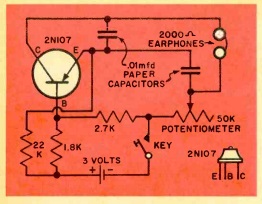
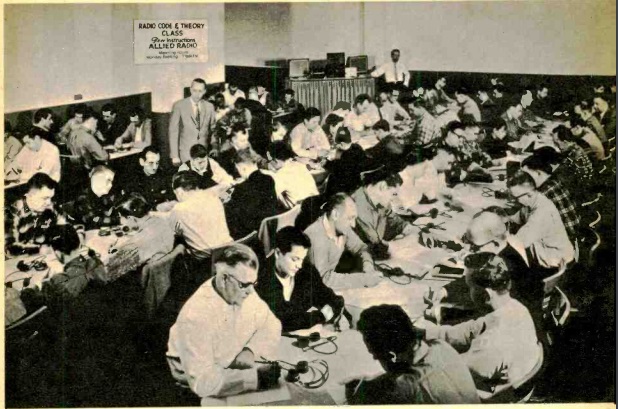
But the article also stressed the importance of either taking a class or simply teaming up with another person learning the code. The schematic for a simple code oscillator was provided, and it is shown in the photo above next to the key. The photo below shows a class put on by Allied Radio in Chicago. According to the caption, over a hundred students, “young and old,” took part, although the old seem to make up the majority of the class. In addition, it appears that the class is almost entirely male.
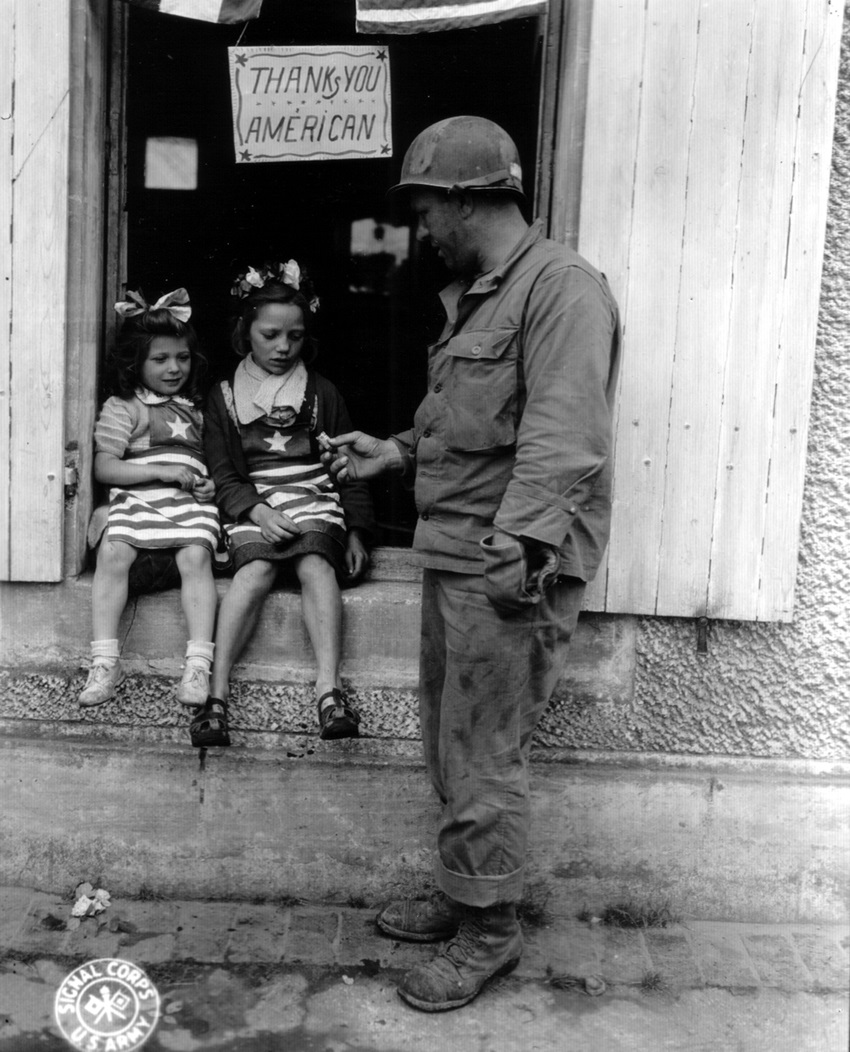
On July 4, 1944, this American GI celebrates America’s 168th birthday somewhere in France by sharing candy with these grateful but somber girls. According to this website, the soldier is Sgt. Walter Goworek of Jersey City, NJ.
If your travels ever take you through Iowa on Interstate 80, then you owe yourself a stop at West Branch, IA, to visit the museum and the adjoining historic site.
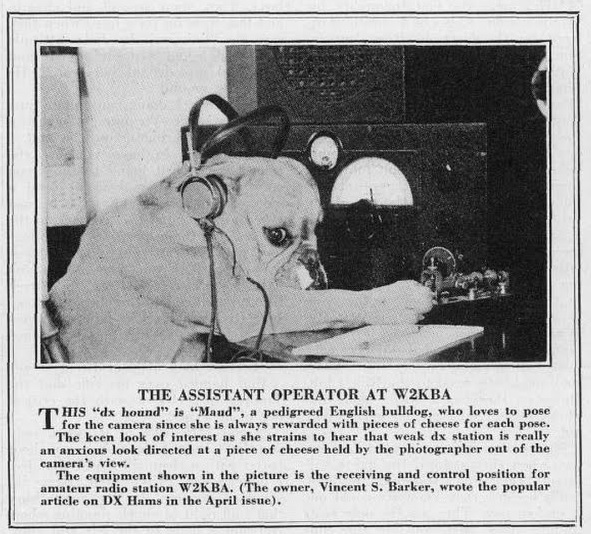
According to the familiar adage, on the Internet, nobody knows you’re a dog. But as shown by the photo above, the general concept predates the Internet by decades. The photo, from the July 1939 issue of Boys’ Life, shows Maud, an English Bulldog, at the controls of W2KBA, the station owned by Vincent S. Barker, who had written a feature about Amateur Radio for the magazine’s April issue.
Maud appears to prefer operating CW, and is busy putting a weak DX station in the log.
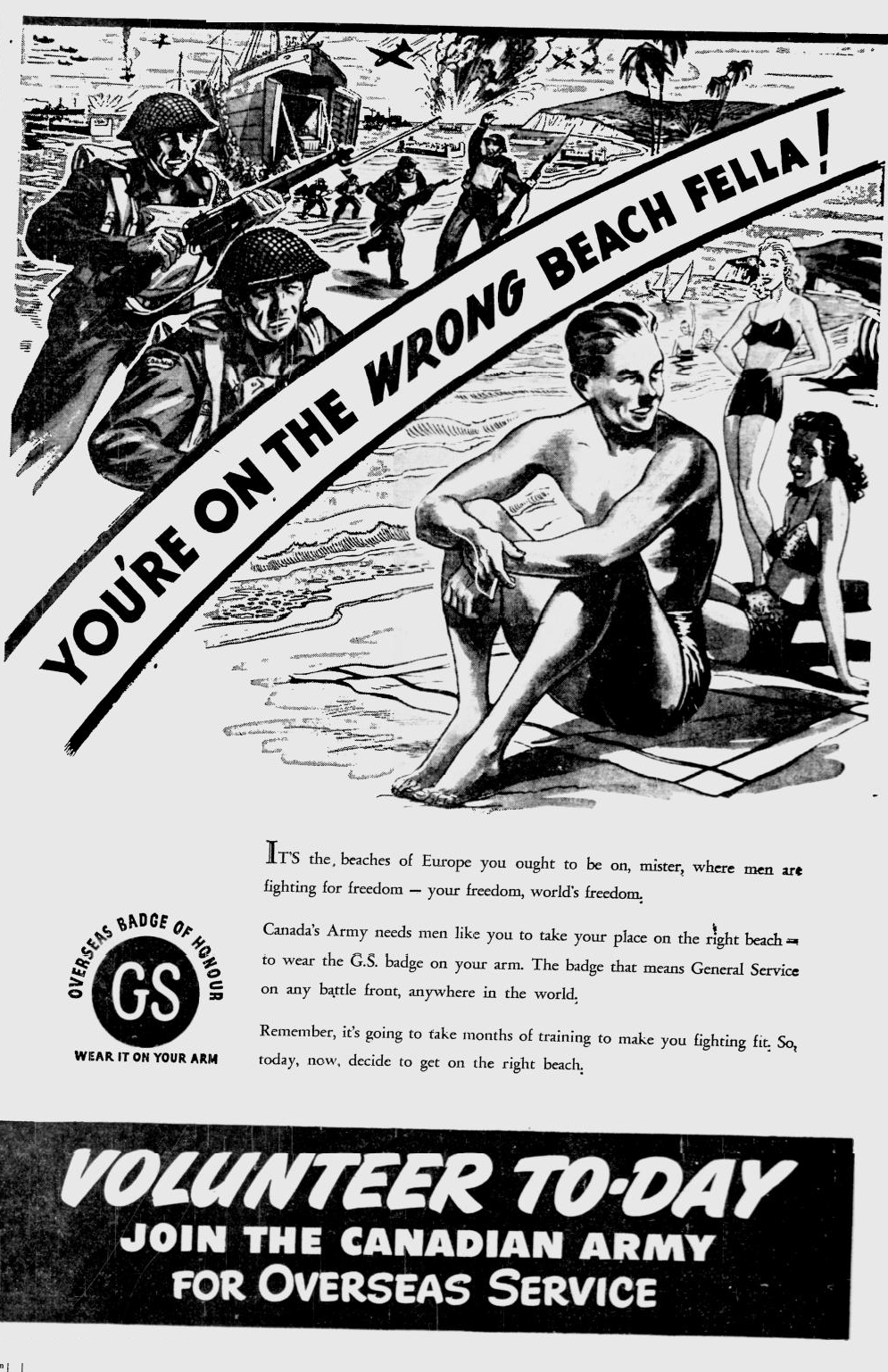
On Dominion Day (now known as Canada Day) 75 years ago today, July 1, 1944, the gentleman on the right is enjoying a nice summer day on a Canadian beach. The gentlemen on the left, however, were busy on Juno Beach in France, and offered a friendly reminder that the first guy was on the wrong beach.
Surprisingly, the guy relaxing on the Canadian beach (with the pretty girls keeping their distance) was probably also a soldier in the Canadian Army!
After Canada entered the War in 1939, the government of Prime Minister Mackenzie King was eager to avoid violent opposition to the draft, as had happened in 1917. Conscription was instituted in 1940, but with the condition that drafted soldiers were to be used only in North America, and not overseas. Other than the Aleutian Islands Campaign, there was little need for combat soldiers to serve in North America. It wasn’t until late 1944 that drafted soldiers were sent overseas. In the meantime, soldiers had to volunteer. This ad is part of the persuasion, which of course also came from their comrades who had volunteered. Those who volunteered for overseas service wore the “GS” (General Service) insignia. Those who didn’t volunteer wore distinctive uniforms with a black necktie, to make sure that nobody got the two groups mixed up.
This means, of course, that the 340 Canadian soldiers who died taking Juno Beach on D-Day
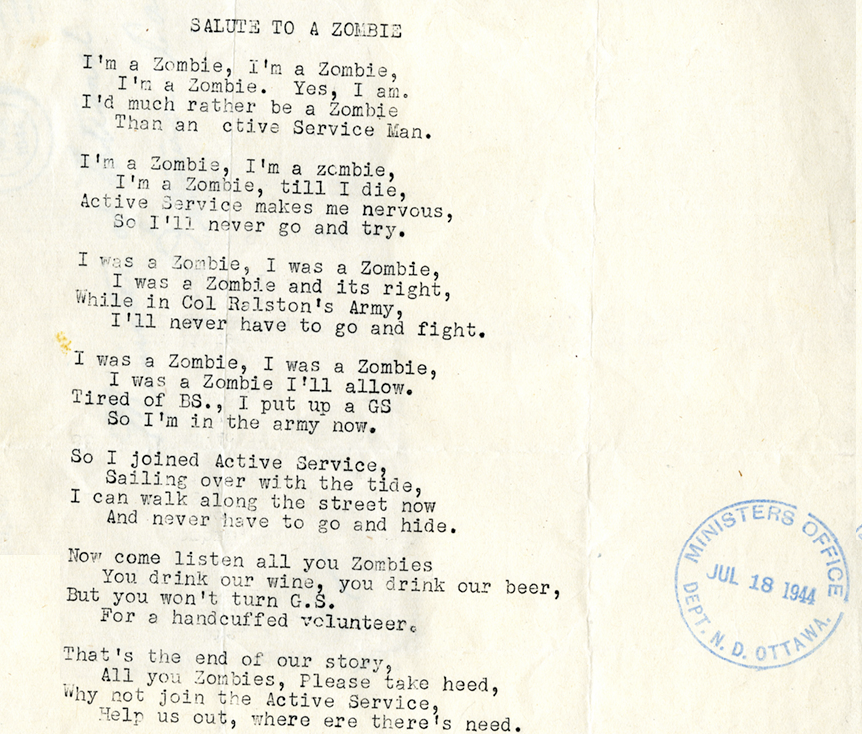
were there only because they volunteered to be there. By 1943, the men who declined to ship out as part of the GS were being referred to as “zombies,” neither alive nor dead. The force came to be called the Zombie Army. The song “Salute to a Zombie” (sung to the tune of Darling Clementine) became popular throughout Canada.
The song probably hasn’t been performed in almost 75 years, which seemed like a shame. A 1943 performance of the song at a Calgary military base caused a riot after General Service men sang it to taunt the zombies. Ironically, the military police who had to break up the fight were probably themselves zombies, as it would be unwise to waste a GS man with that domestic role.We put out a call for volunteers, and loyal reader David Cripe agreed to perform the song. We are confident that tempers have cooled after 75 years, and no riots will ensue.