Category Archives: Television History

1951 Raytheon Model RC-1720 Starlight

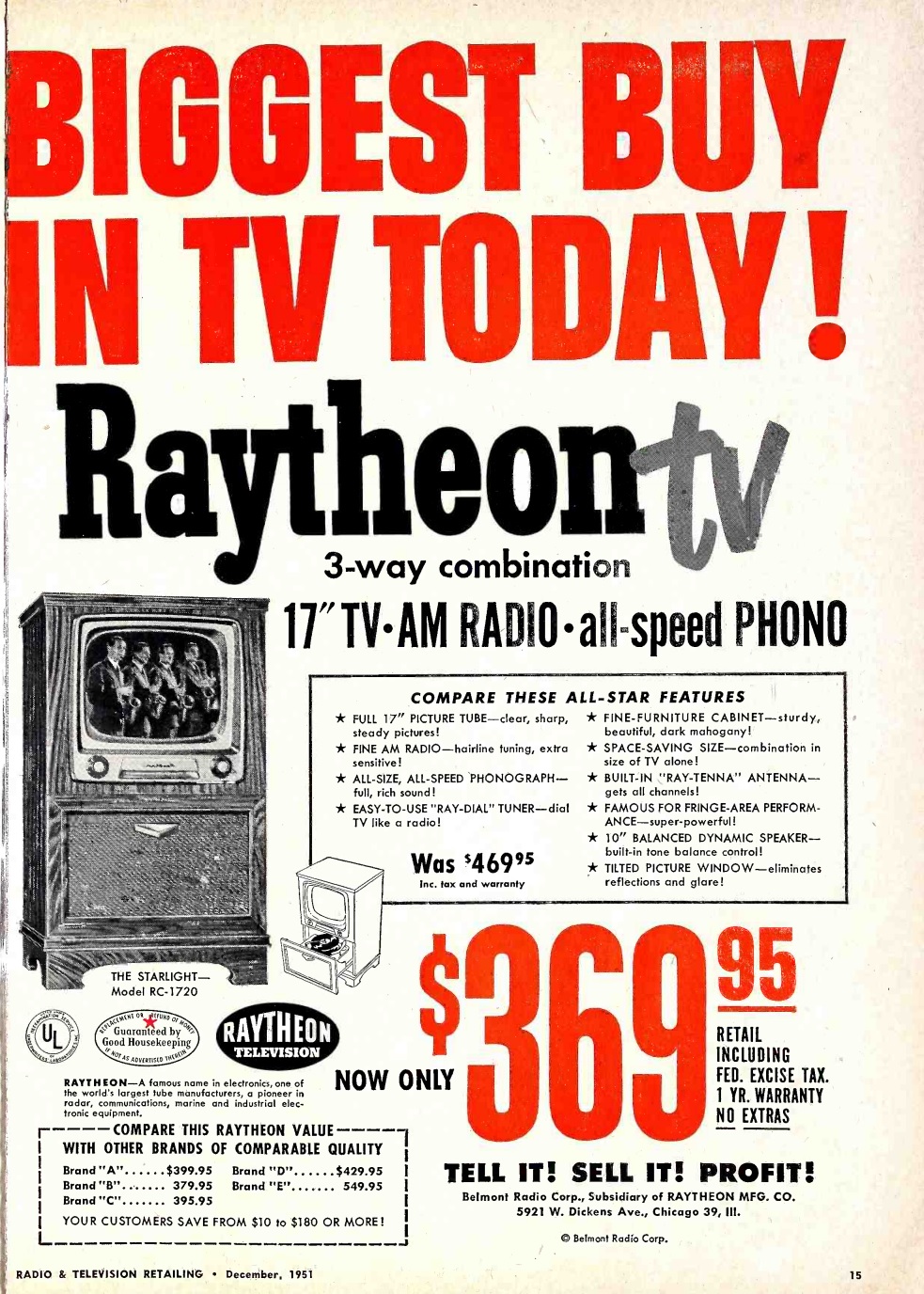
1951DecRadioRetailingShown here from 70 years ago is an ad for Raytheon Television’s deluxe offering, the model RC-1720 “Starlight” set. According to the ad, the set was famous for fringe area performance, and it boasted a 17 inch picture tube, along with room-filling volume from a 10 inch speaker.

The set retailed for $369.95, which was down from the previous price of $469.95. That price included the federal excise tax, as well as a one year warranty. In addition to the TV, the set included an AM radio (but no FM), and a three speed phonograph.

In 2021 dollars, the price of the set works out to almost $4000, according to this inflation calculator.  The ad appeared in the December 1951 issue of Radio & Television Retailing.


McKee’s Modern Home Center, Longmont, CO 1951

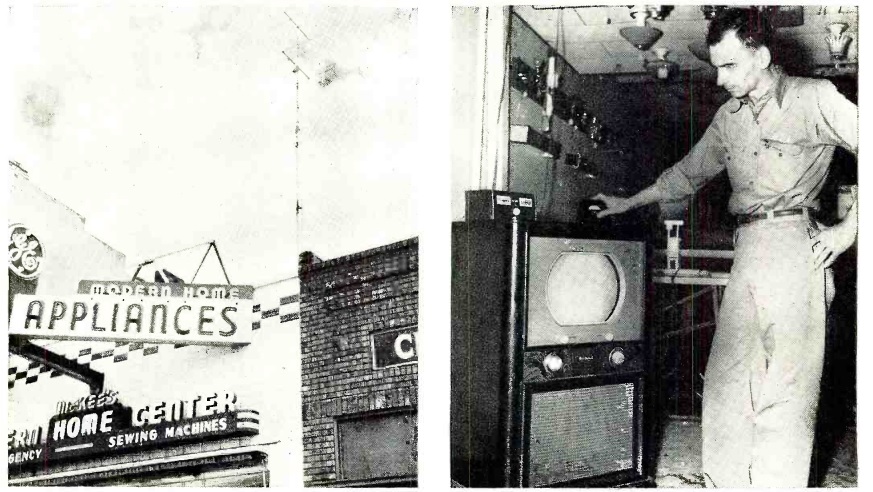
1951DecRadioNewsShown here seventy years ago is Lawrence Pickerell, technician for McKee’s Modern Home Center of Longmont, Colorado. The store had entered the television business, notwithstanding the fact that the closest station was 500 miles away in Omaha, Nebraska.

Pickerell, along with owner Howard McKee, had been associated with another store in Iowa. While at that store, a closer-in station was scheduled to be built, but originally, the closest station was a hundred miles away. But their store went right wo work doing everything to pull in the fringe station.

At times, reception was poor, but at other times, it was acceptable. While they didn’t make many sales at that time, they gathered a tremendous amount of local publicity, and their service department gained a lot of practical experience with television. When a local station came on the air, they already had the reputation as “the television store,” and they wound up with most of the business.

When McKee bought the store in Colorado, the situation was even worse, and they weren’t even in the fringe area of any station. Undaunted, they decided to put up a tower and hope for the best. Since the closest station in Omaha was channel 6, WOW-TV, so they put up a stacked array tuned to channel 6, and had the foresight to include a rotor. During the sprint of 1950, they pulled in other stations quite frequently due to Sporadic E, with similar results in 1951. They noted that reception was best over the noon hour, from 5:00 – 6:00 PM, and after 8:30. During 1951, 8:00 AM and early afternoon were the best. They noted that conditions were consistent with short skip on the 10 meter band.
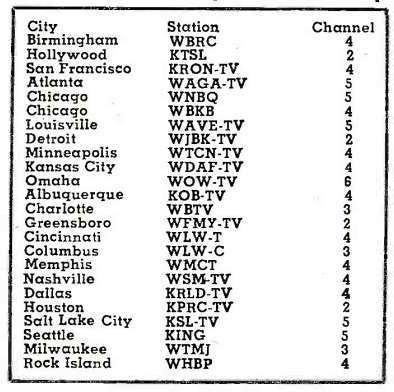
1951DecRadioNews2About 25% of the stations received were “program quality,” with another half being passable quality. The other 25% were intermittent. The complete log is shown here, ranging from Seattle to Atlanta. Even though the antenna was tuned to channel 6, most stations were channels 2-5. As would be expected, they didn’t pull in any high-band stations. The most consistent logging was KPRC, channel 2, Houston, Texas.  In many cases, the best signal was obtained by pointing the antenna at nearby Longs Peak, elevation 14,000 feet.

According to this undated matchbook, the store was playing up television, and was located at 350 Main Street. According to Google Street View, the building is still standing, and until a recent move, housed Jensen Guitars and the Willow River Music Emporium. The TV antenna appears to be gone.

The photos appeared in the December 1951 issue of Radio & Television News.



1961 Distance Learning

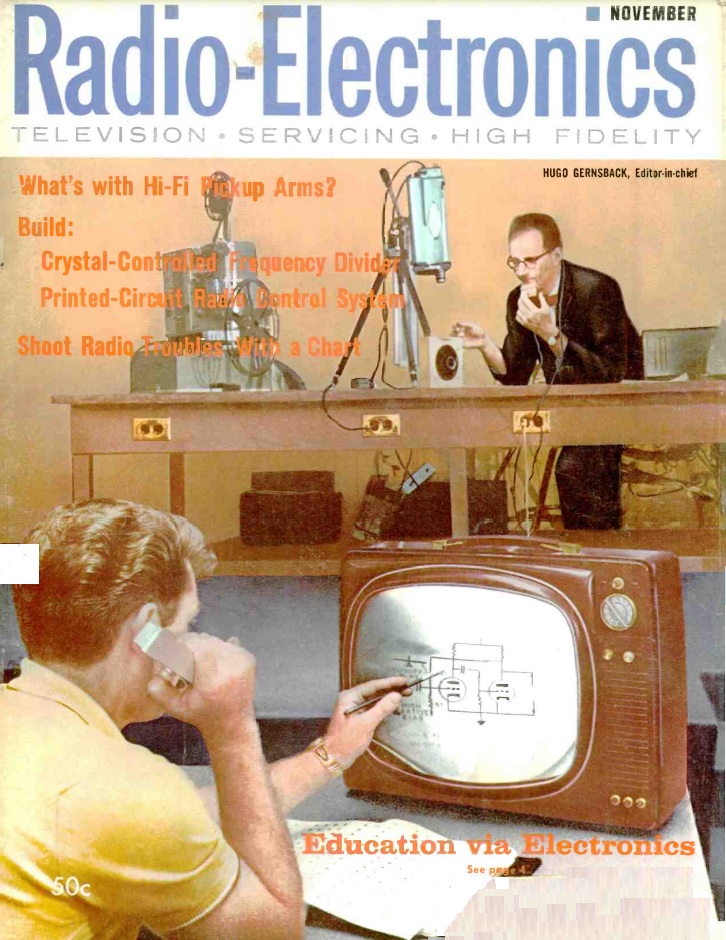
1961NovRadioElecAs we’ve seen earlier, distance learning is nothing new, and sixty years ago this month, the November 1961 issue of Radio-Electronics carried a summary of the state of the art. It noted that television, either broadcast or closed-circuit, was the leading method in use at that time. The most famous was the NBC “Continental Classroom” program, which ran from 1958 to 1963, which offered college credit. While not mentioned in the article, a similar program, Sunrise Semester ran from 1957 to 1982.

And as we’ve previously covered, the article mentioned the Midwest Program on Airborne Television Instruction (MPATI), which broadcast from an airborne transmitter over much of the Midwest.

The most elaborate system in use, what we would call interactive, was that used by the New York Institute of Technology, shown above. The student listened to a recorded lesson, and then answered multiple-choice questions which were reviewed by the instructor. There was an intercom through which the student could ask questions of the instructor, and any visuals were shown to the student on a nearby TV monitor.

The magazine concluded by noting:

The exact methods that electronic instruction will follow in the future are not clear, but the question “Will it be a factor in future education?” has been answered. Make no mistake about it- electronic education is with us, and extending fast.

CB Radio on 77 Sunset Strip: 1961

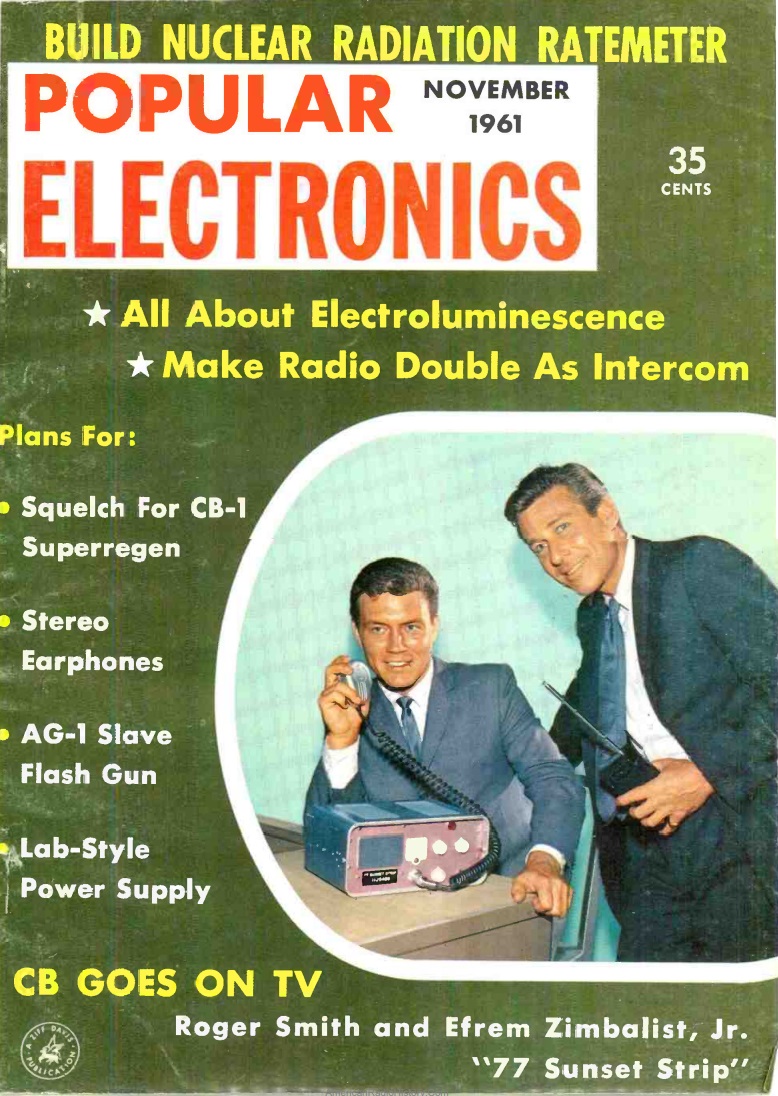
1961NovPECoverSixty years ago this month, the cover of the November 1961 issue of Popular Electronics featured the stars of the hit TV private detective drama 77 Sunset StripRoger Smith and Efrem Zimbalist, Jr., are shown with a new co-star, namely CB radio. Smith is shown at the mike of a base transceiver, and Zimbalist is shown with a handheld unit. The base unit looks like it might be a Polytronics Poly-Comm Model N.

The magazine was proud to announce that it had been consulted relative to placement of CB radio on this network program. The detectives used a phony call sign, 11J5486. The format for the call was right, but the letter would have been W. But the number 11 was correct for southern California.

The magazine reminded readers to tune in to ABC on Friday night at 9:00, especially for the following episodes which prominently featured the CB equipment: The Bridal Trail Caper (season 4, episode 20),  The Bel Air Hermit (season 4, episode 22), The Unremembered (season 4, episode 6).

.


1951 Mobile TV Service

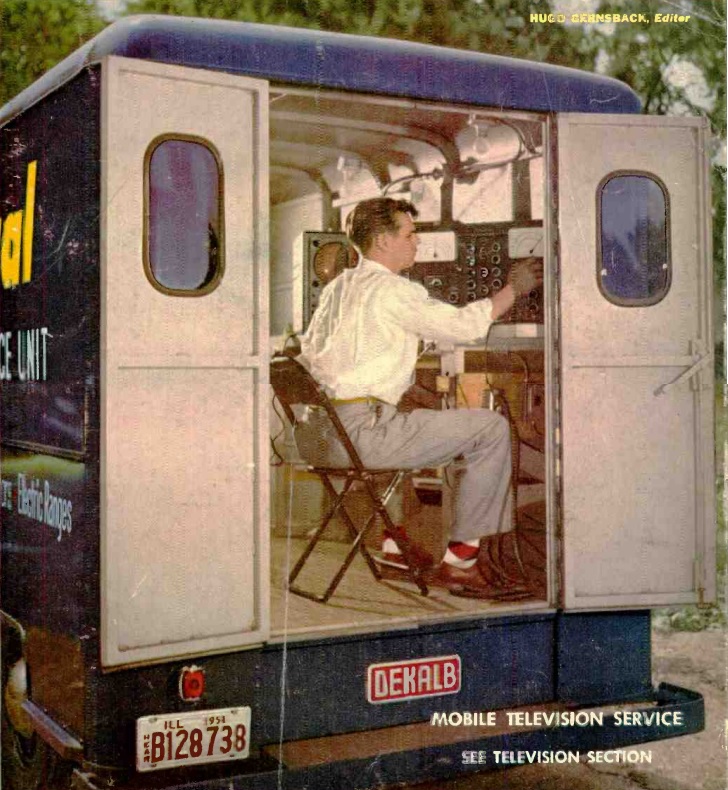
1951OctRadioElectSeventy years ago, the state of the art in television service was provided by Appliance Distributors Inc. of Chicago using a fleet of vehicles that included three mobile service vans like the one shown here. Repairs were usually done the same day thanks to a very efficient operation. The company had begun by having servicemen in cars, and the system worked well, since most repairs could be done in the field with limited tools, and only about 10% of the jobs required bringing the chassis back to the shop. But with a large business, that ten percent amounted to a lot of work, and those sets would take a few days to finish.

To streamline the process, the shop purchased three vans like the one shown here. At the beginning of the day, the trucks, along with servicemen in cars, would be stationed strategically throughout the city, often at service stations. The men in cars would handle the calls, but if the job required time in the shop, the truck was dispatched right to the home in question. The chassis was brought outside and worked on in the truck. Power was provided by a shore power cord that could be plugged in to the customer’s house. In situations like an apartment building, where no outlet was available, the set could be taken to a nearby service station where the company made arrangments to use the power. Virtually all jobs could be finished the same day, meaning that customers could watch their programs.

The company also serviced radios and phonos, but time was less critical on these jobs, and they were handled back at the shop.

The photo and accompanying article appeared in the October 1951 issue of Radio-Electronics.


1951 GE Television

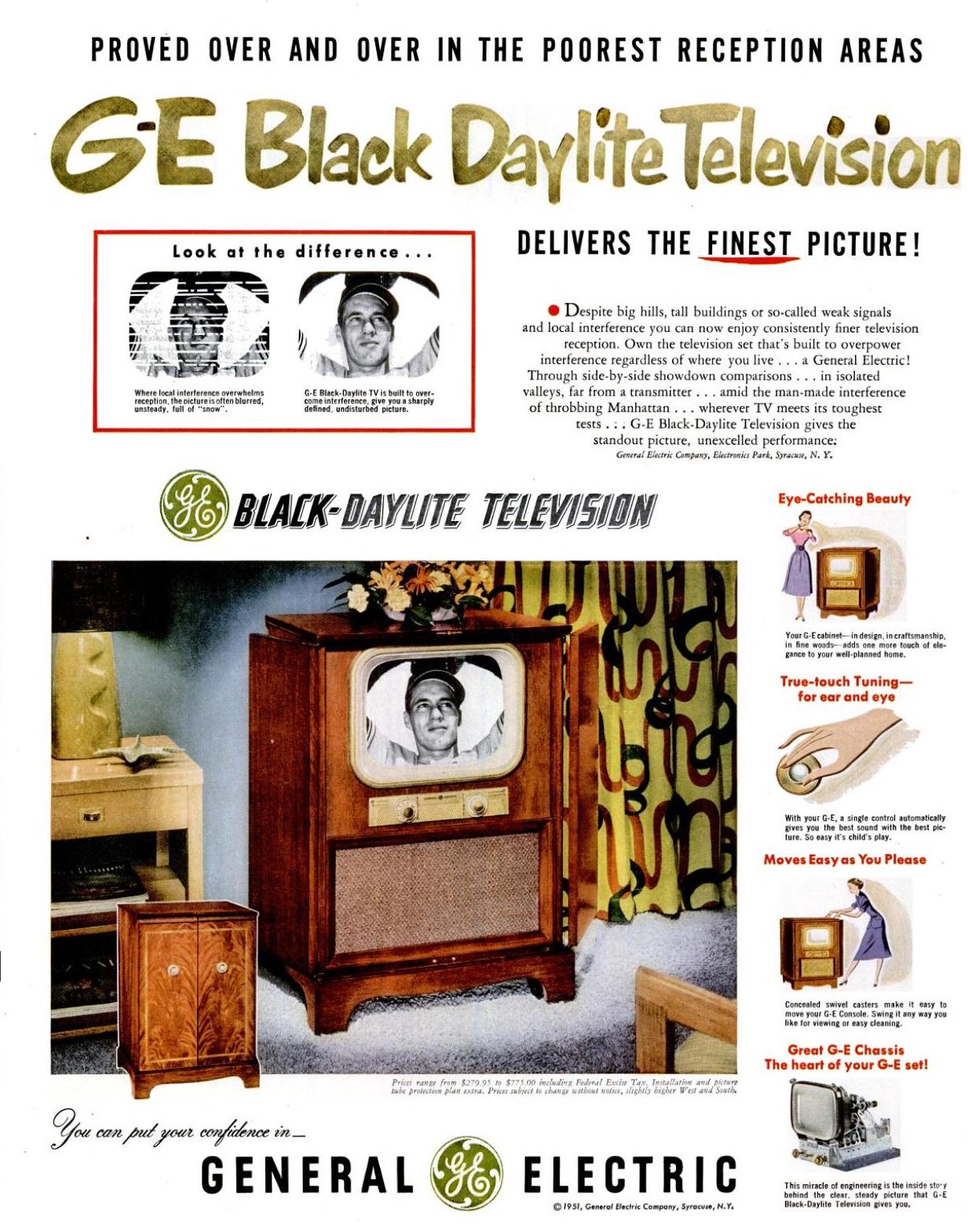
1951Aug27LifeSeventy years ago today, the July 27, 1951, issue of Life magazine carried this ad touting the features of General Electric televisions.  Without explaining any of the technical details, the ad claims that GE’s “Black Daylite” guaranteed the best picture, even in the poorest reception areas.

Prices started at $279, which, according to this inflation calculator, works out to over $2900 in 2021 dollars.


Safely Fixing Your TV: 1951

1951JulPMSeventy years ago this month, the July 1951 issue of Popular Mechanics gave some pointers on how to safely do some repairs to your television. The magazine noted that sets were much more complex than radios, but even inexperienced owners were often able to bring a radio set back to life by swapping tubes, and there was no reason that they couldn’t do the same thing with a television.

Of course, the first step was to make sure you knew which tube went in which socket, and the magazine provided sources for this information. The second issue was the high voltages, which could prove lethal, and the magazine noted how to make sure the capacitors were discharged before tackling the job.

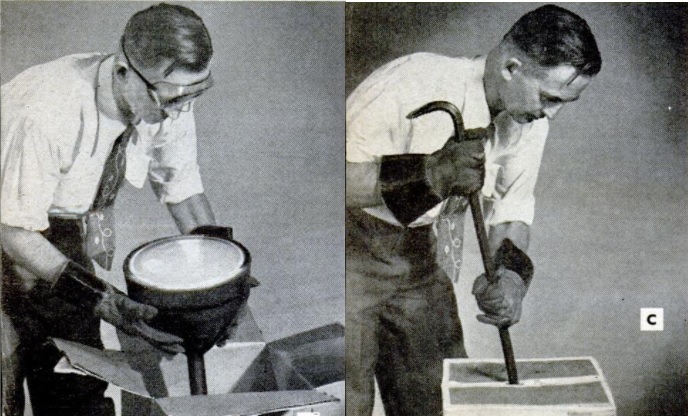
If the picture tube had to be replaced, one important safety factor to keep in mind was that the tube could implode if dropped, sending chards of glass all over the room. As shown above, when doing this delicate job, it was important to wear gloves and safety goggles. To dispose of the old tube, it was put in the box in which the new one came. Then, it was taken to the back yard, and a crowbar was used to smash it to smithereens inside the box, so it didn’t risk implosion when the garbage man hauled it away.


1971 Portable TV’s

1971JulyPM1971JulyPM2Fifty years ago, this young woman was doing something one wouldn’t have dared doing in the first decades of television–she was watching it in the pool. In the 1950s or 60s, this would have been a highly reckless thing to do, since the high voltages involved could have lethal consequences if they came into contact with water. But by the 1970s, the art had progressed to the point where battery operated televisions were available. And the July 1971 issue of Popular Mechanics contained a review of the available offerings, penned by prolific electronics writer Len Buckwalter (who has appeared here many times previously).

Buckwalter starts by noting that the “portable” TV had been around for a long time, but it had an AC power cord and weighed up to 90 pounds. The only concession to portability was the handle slapped on top as an afterthought. But now, there were true portables hitting the market: Sets that ran off batteries and/or 12 volts, and weighing as little as 2 pounds, although the average was 15-20. There were even two color sets hitting the market, and prices started at under $100.

There were still power requirements, and most of the battery sets used rechargeable batteries. Those were good for only a couple of hundred recharge cycles, so he cautioned that for viewing outside, it would be wise to install a power outlet. Some of the very small sets used standard flashlight batteries, but most had a special rechargeable power pack. In some cases, it was built in, but in others, it was a separate unit, which made the set more compact when the battery was not necessary, such as in a car or boat.

A few of the samplings are shown at the left. At the top was Heathkit’s offering, which sold for $124.95, and could be put together in 15-20 hours. The detachable base of this set, the GR104A, contained the batteries.

Below that was the Symphonic 3-incher, with a built-in cassette recorder and AM-FM radio. Below that, for the well heeled, was Hitachi’s 12 inch color set, which sold for $369.95. Below that was a Panasonic 5-inch model whose screen folded away when not in use. It also contained an AM-FM radio.


Converting TVs to Larger Picture Tubes: 1951

1951MayRadioElecSeventy years ago, these Philadelphia television technicians made the cover of the May 1951 issue of Radio Electronics by their ambitious service of converting small screen television to larger tubes. The magazine carried a feature penned by their boss, Larry Oebbecke of Philadelphia Television Service Corp., 19011 W. Cheltenham Ave, Philadelphia, who reported that the job could be profitable “if you know what you are doing.” He reported that his shop had been doing the work for about a year, and averaged 25-35 sets per week.

Some sets were simply not good candidates for conversion, and the author identified many. He stressed the importance of taking good notes when doing the jobs. The first conversion of a particular model might not be profitable, but armed with good notes, subsequent jobs would be much simpler. Also, the jobs required cutting a new front panel, so saving the templates was key to doing the job economically. Normally, the job would take one technician 6-10 hours to complete. In general, 7 inch sets weren’t worth the trouble to convert, since a new set would wind up being cheaper. But larger sets could be upgraded to 14, 16, 19, and 20 inch screens. Older sets with round tubes could get a more modern look with the newer rectangular tubes.

The shop provided a 90 day warranty on the conversion work, and a one year guarantee on the tube itself. The author noted that the guarantee did not extend to parts of the set on which no conversion work had been done.


1951 Remote TV Tuner

1951MayServiceThere was a time when, if you wanted to change the channel on the television, you had to get up and turn the knob on the set. Attempts at overcoming this shortcoming date back to the early days of television. And in 1951, if the entrepreneurial TV serviceman wanted to sell a valuable service to his customers, he could offer a remote tuner such as the one shown here. The May 1951 issue of Service magazine explains everything that needs to be done, and it’s clear that it would be a lot of work.

All of the coils would need to be removed from one unused channel in the set, and replaced with a coaxial cable running to the output of the remote tuner. But it wasn’t quite that simple. The remote tuner would need an antenna input of its own, and it might require a separate preamp. And if the customer wanted to adjust the contrast or volume, that would require additional wiring.

But once done, the customer would be able to change channels from the comfort of his easy chair, a luxury unknown to most people.