Category Archives: Television History

1952 Transatlantic Television Ideas

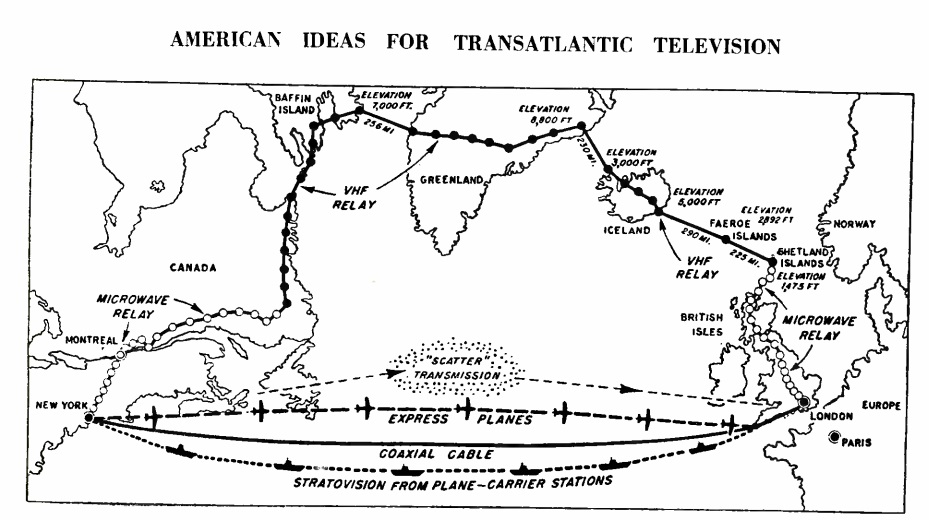
1952OctWirelessWorldSeventy years ago this month, the October 1952 issue of the British Wireless World carried this illustration showing possible methods of linking American and European television. The diagram had actually first appeared two months earlier in the August 1952 issue of Tele-Tech as part of an open letter to the President of the United States (which would have been Harry S Truman) imploring action on TV networking with Europe and South America.  According to the magazine, American homes would be able to view the great events of Europe, live, but “the underprivileged of Europe can be shown the wonderful richness of life in America.”

The diagram showed the potential methods, the first of which being an “airplane-relay between a dozen or more express planes continuously flying a regular route across the ocean,” presumably carrying 16-mm film.

The next idea was Stratovision, the use of a string of aircraft aloft, each relaying the signal to the next plane. As we previously showed, this system was tested, and even used to a certain extent, in the United States. But doing it over the Atlantic would require a set of aircraft carriers on which the planes could land, which would likely make the idea much less feasible.

The next idea was a string of VHF relay stations through Labrador, Baffin Island, Greenland, Iceland, the Faeroe Islands, and the Shetland Islands. The longest link would be 290 miles, meaning that the idea might be feasible. If this idea sounds familiar, it’s because it’s similar to one we talked about earlier, one proposed by David Sarnoff in 1951, although his plan envisioned the link going the other way, over the Bering Strait. Other ideas included a submarine coaxial cable, or scatter transmission, essentially the use of brute force to propagate VHF signals over the horizon. It also mentioned “miscellaneous marginal proposals,” such as use of moon reflections, which of course depended on the moon being visible over both continents, which would happen for about five hours per day.

One of the first transatlantic broadcasts was the coronation of Queen Elizabeth the following year. It was first seen on American television courtesy of 16-mm film flown by the RAF to Gander, Newfoundland, to the CBC, which was then picked up by American networks. The first live transatlantic broadcast didn’t take place until 1962, and it relied upon a method not anticipated by the 1952 article, namely, the use of the Telstar 1 satellite.  While Telstar was the first transatlantic use of satellite, it should be pointed out that it wasn’t the first television transmission by satellite. Those honors go to Echo 1, which successfully relayed signals via a passive reflector between the east and west coasts of the U.S.


1947 Homemade Television

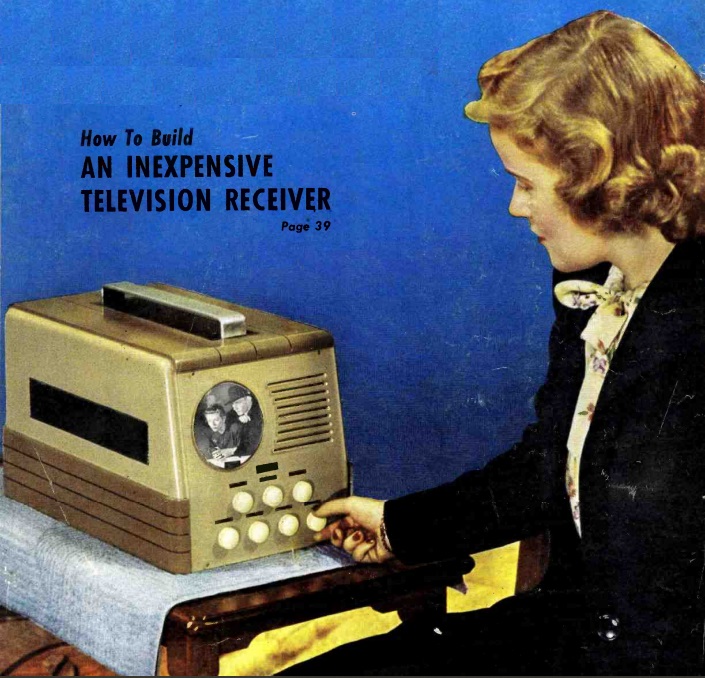
1947SepRadioNews2Seventy-five years ago this month, this viewer was undoubtedly the first on her block to have a television, courtesy of a design contained in the September 1947 issue of Radio News.

The magazine contained detailed plans, and suggested that the set could be constructed in one of three ways. The experienced constructor could employ the usual method of following the schematic, aided by photos of the completed set. For larger groups, it could be done with a series of step-by-step instructions prepared by an instructor. Finally, it could be done by a group using typical factory production methods.

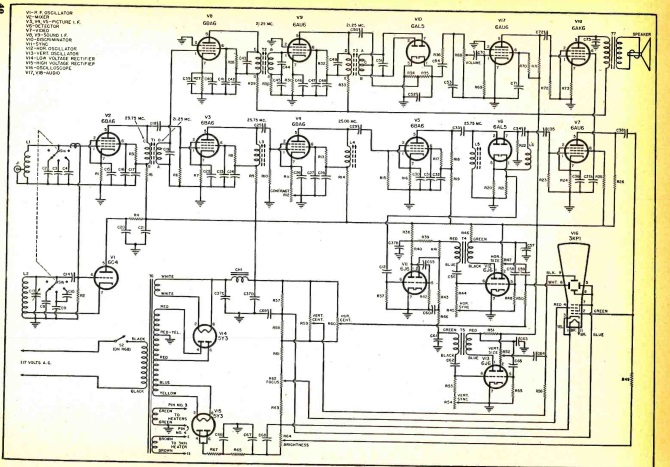
Whichever way they decided to make the 18-tube set, the builders would become acquainted with the basic requirements of both video and FM sound reception. The schematic was shown in the magazine, but for those desiring factory-sized blueprints, they were available from the author for $1 per copy.

1947SepRadioNews3


1962 Television Monocle

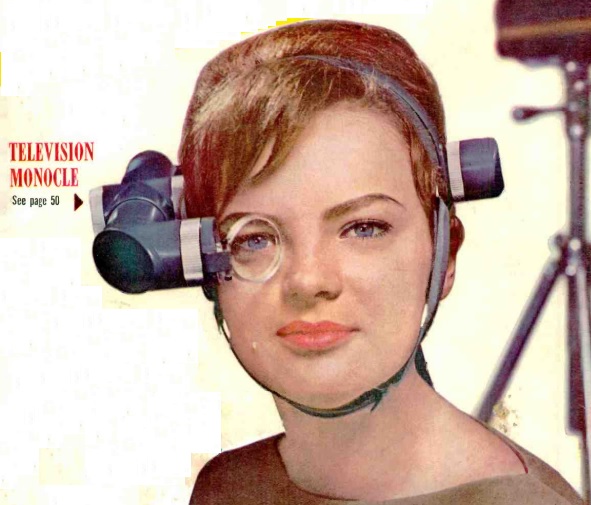
1962SepRadioElecShown here is 1962’s answer to the Google Glass.  The cover of the September 1962 issue of Radio Electronics shows this wearable CRT display, dubbed a “television monocle.”

The picture tube is directed through a light-splitting lens, which allows the viewer to see the picture superimposed over the actual view ahead. One possible application suggested was for air traffic controllers, who could continually watch one screen while looking at other things. An officer on the bridge of a ship could view radar screens and other displays while also viewing their surroundings. In industry, complex instructions could be displayed.

Google isn’t currently selling their version retail, but wearable displays such as the one shown here are currently available.


Some links on this site are affiliate links, meaning that this site earns a small commission if you make a purchase after using the link.

Prediction of Television: 1922

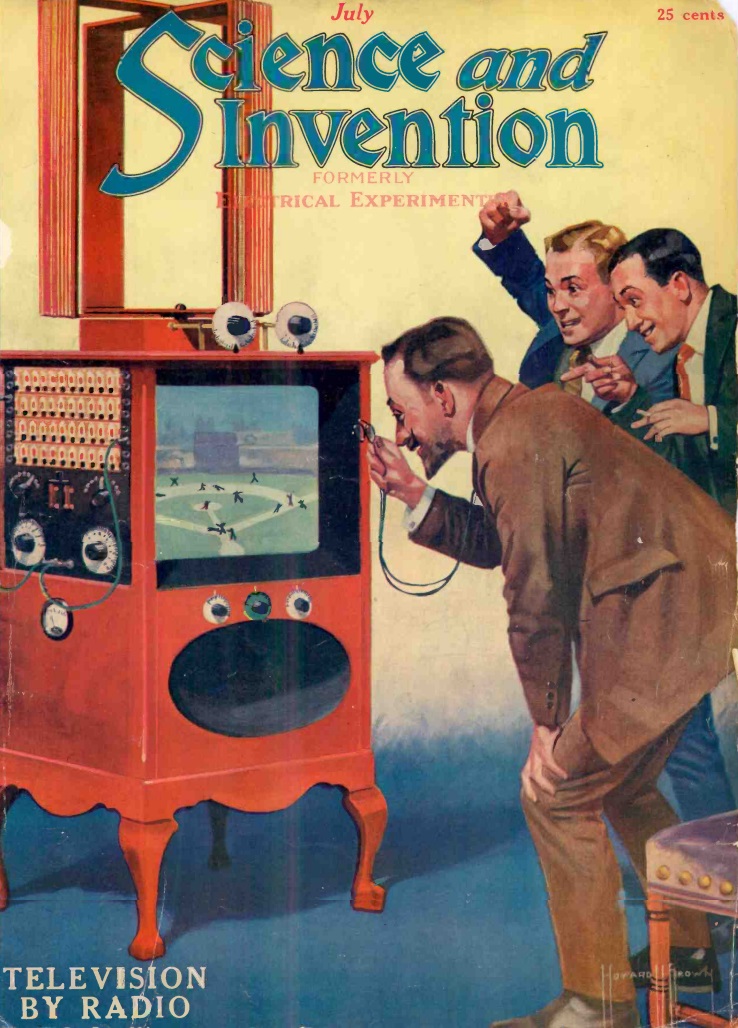
1922JulySIA hundred years ago this month, the July 1922 issue of Science and Invention made its prediction of what television would look like. The accompanying article, written by Hugo Gernsback, got most of the technical details wrong. But the artist’s conception, by illustrator Howard V. Brown (1878-1945) doesn’t look very different from the sets that started showing up in American homes a quarter century later.  If the style looks familiar, it’s because we’ve seen Brown’s artwork before.


1952 Tenna-Ship

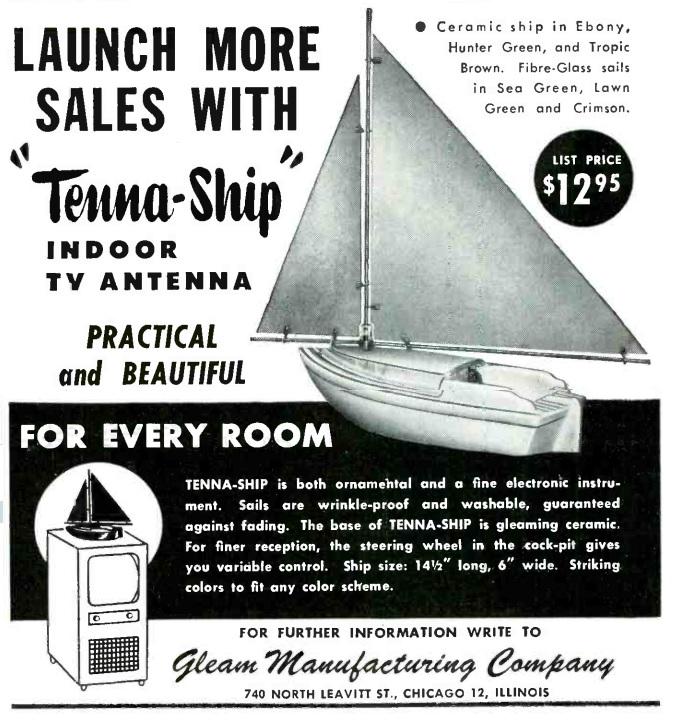
1952JuneRadioRetailingSeventy years ago this month, if you lived in a strong signal area, but didn’t want an unsightly set of rabbit ears on top of your TV, you could instead get the Tenna-Ship for only $12.95, from the Gleam Manufacturing Company, 740 North Leavitt St., Chicago.

This ad appeared in the June 1952 issue of Radio Retailing.


1947 TV Kit

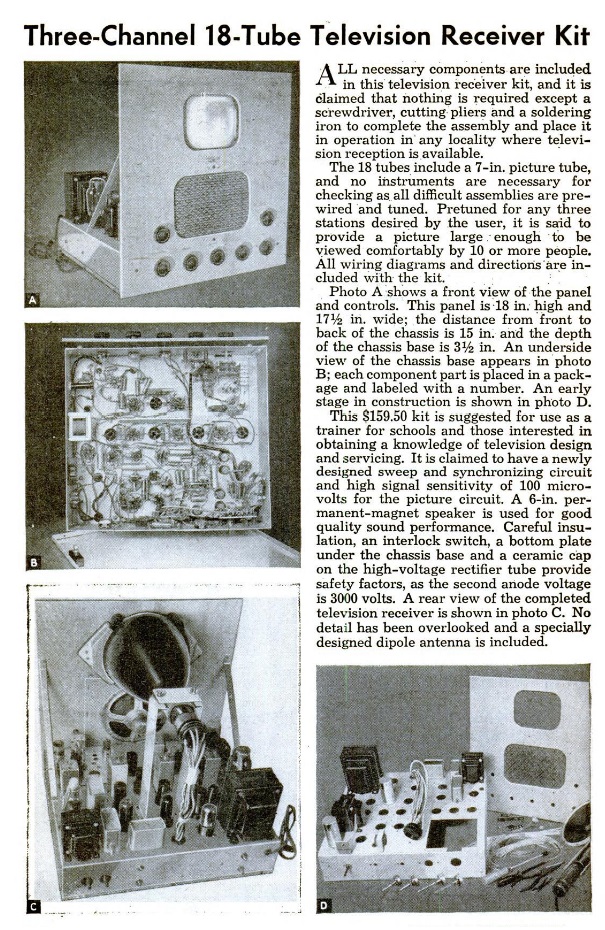
1947MarPMIf you wanted to be the first on your block to have television 75 years ago, and you were reasonably adept with a screwdriver and soldering iron, then this kit might be just the thing you needed. When you were finished, you would have a set with a 7-inch picture tube, large enough to be viewed comfortably by 10 or more people. You could put it into operation at any locality where television reception was available.

The kit retailed for $159.50, and was geared up especially for schools. All difficult assemblies were prewired, so you didn’t have to worry about getting it into alignment. It cam pre-tuned for three channels of your choice, dictated by which stations were on the area in your area.

While no cabinet was included, it is noted that the 3000 volts were carefully protected by insulation, an interlock switch, and a bottom plate under the chassis. This description appeared in the March 1947 issue of Popular Mechanics.


TV Relay Tower, 1952

1952FebRadioElecI remember as a kid seeing a structure similar to this one. I don’t remember exactly where, but it was somewhere along the route between Minneapolis and Duluth, with one horn facing south, and the other facing north. I asked my parents what it was, and they said it was for relaying TV signals. It made perfect sense to me, since the two horns looked a lot like TV screens.

I didn’t know what was inside, but now I do. The electronics were on the top floor, the B+ power supply was on the third floor, the filament power supply was on the second floor, and a backup generator was on the ground floor.

This diagram appeared 70 years ago this month in the February 1952 issue of Radio-Electronics.  Click on the image to see the full size version.


1951 Military Distance Learning

1952JanRadioElecSeventy years ago this month, the January 1952 issue of Radio-Electronics showed “the boldest stroke in education by television ever made.” The 31-foot TV truck of the Army Signal Corps would be used to televise intricate military exercises and maneuvers, allowing them to be viewed back at base on television screens by much larger numbers than would otherwise be able to witness them. In fact, the camera would make visible all of the little things you wouldn’t see if you were there, making the experience superior to attending in person.

The signals were relayed back to base with a 7 GHz microwave link.


Worldwide TV: 1951

1951DecPMSeventy years ago this month, the December 1951 issue of Popular Mechanics carried a feature with the byline of RCA Chairman of the Board David Sarnoff discussing the prospects of international television. He predicted that before long, viewers would be able to bring exciting events from distant lands to their armchairs with a flick of the dial, all at the instant they’re taking place.

He outlined the ways this might happen, but interestingly, he fails to mention the technology that did make it happen, namely orbiting satellites.

His most promising idea is shown above, namely a network of microwave relays about 20-50 miles apart. This network was already taking shape in the US, and Sarnoff pointed out that it could easily be expanded from Patagonia to Alaska. And since it was only 40 miles acroos the Bering Strait, there was no technological reason why the network couldn’t be thus extended into Eurasia, and from there to Africa. He notes that there were plans for a telegraph land line along the same route 90 years earlier, which was abandoned only after the success of the transatlantic telegraph cable.

Another idea for connecting America and Europe was a string of artificial islands in the Atlantic, 200 miles apart, each with a 1000 foot tower.

We’ve previously mentioned the idea of stratovision, namely, using aircraft both to broadcast and relay programs. Sarnoff hinted at a possible expansion of this system to link America and Europe. He noted that there were already enough commercial flights flying the route, and that if these planes were fitted with television relays, they could provide a permanent microwave link across the Atlantic.


1951 Raytheon Model RC-1720 Starlight

1951DecRadioRetailingShown here from 70 years ago is an ad for Raytheon Television’s deluxe offering, the model RC-1720 “Starlight” set. According to the ad, the set was famous for fringe area performance, and it boasted a 17 inch picture tube, along with room-filling volume from a 10 inch speaker.

The set retailed for $369.95, which was down from the previous price of $469.95. That price included the federal excise tax, as well as a one year warranty. In addition to the TV, the set included an AM radio (but no FM), and a three speed phonograph.

In 2021 dollars, the price of the set works out to almost $4000, according to this inflation calculator.  The ad appeared in the December 1951 issue of Radio & Television Retailing.