Category Archives: Scouting

Henry L. Carter, Jr., W8FTB

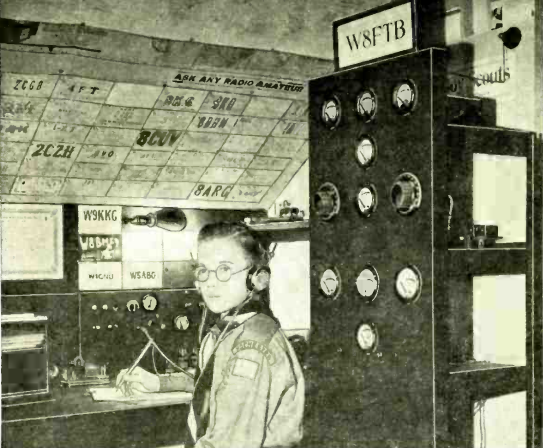
1934AprSWcraftShown here in the April 1934 issue of Short Wave Craft magazine is the well equipped station of Henry L. Carter, Jr., W8FTB, 45 Sheldon Terrace, Rochester, N.Y., at the time, the youngest licensed amateur in the United States. Carter was first licensed at the age of 10 on January 14, 1932. He got his first station set up with the assistance of his father, ex-8BOW, who had been licensed in 1923. The transmitter was a crystal controlled three tubes on 3530 and 3840 kHz. Carter reported that he could copy “20 per, and send ‘plenty fast.'”

He had worked stations throughout the U.S., Canada, and Mexico, and held an Army Amateur Radio Station appointment. He was also the youngest member of the Scout Amateur Radio Net, and as you can see from the uniform, he kept himself busy with Scout work. His troop had organized a radio club consisting of sixteen members.

According to a Sept. 27, 1939, article in the Rochester Times Union contained in this scrapbook,
Carter, then residing at 297 Plymouth Ave. S., joined the Army Signal Corps at the age of 18.

I wasn’t able to find any reference to Carter after the War.  If he had gone back to Rochester, his call would have become W2FTB, but I wasn’t able to find any reference to him holding that call.  He would be about 97 today, so if Mr. Carter or a relative is out there, we would enjoy very much hearing from you to follow up.
How to Make a Rope Ladder

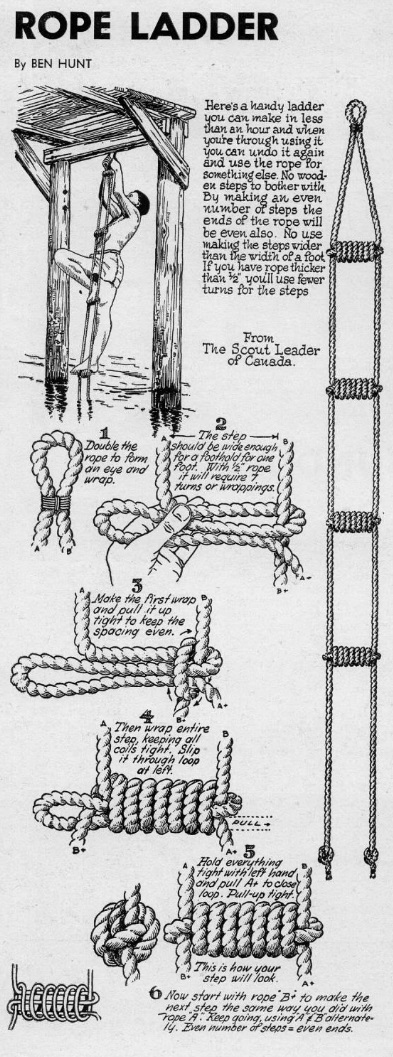
1959MarBL3If you ever need to make a rope ladder, the March 1959 issue of Boys’ Life magazine shows you exactly how to do it. This design has two great advantages. First of all, no steps are required, since the rope itself is used. And once you’re done with the ladder, you can easily undo it and have your rope back in its full length.

An even number of steps ensures that you have an even number of ends of the rope when you’re finished.


1959 Boys’ Life Code Oscillator

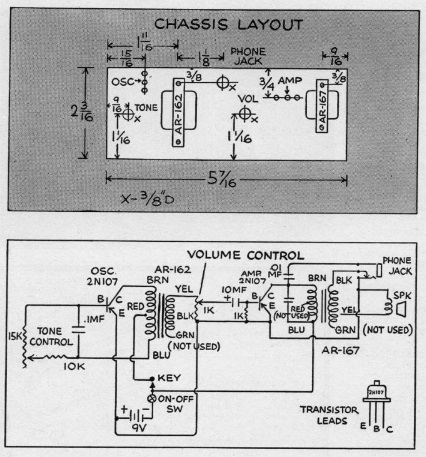
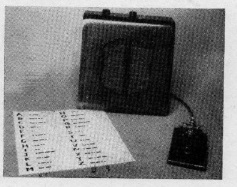
1959MarBL1959MarBL2Sixty years ago this month, the March 1959 issue of Boys’ Life showed scouts how to put together this two-transistor code practice oscillator. Powered by six penlight cells, one 2N107 transistor served as oscillator, with the other as an audio amplifier. So chances are, the output was both clean and loud. The set featured both tone and volume controls, and had provision for headphones or a built-in speaker.


1944 Expedient Winter Clothing

1944FebBL

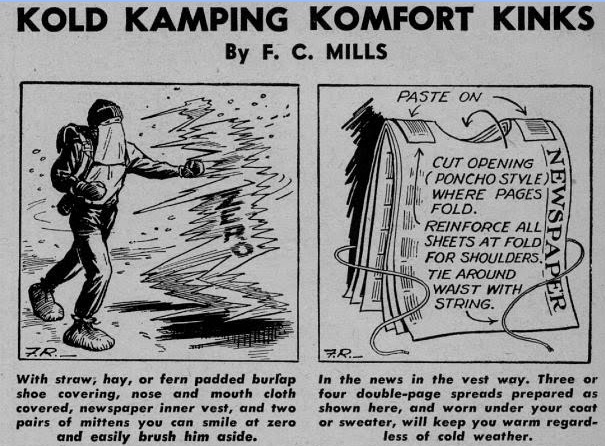
Seventy-five years ago this month, the February 1944 issue of Boys’ Life gave some pointers on how to keep warm on a budget. The burlap foot coverings are the same general idea as what we previously offered for expedient winter footwear. And if your jacket isn’t quite warm enough, then lining it with a few layers of newspaper will surely do the trick.


1959 Hamming Is Fun

1959JanBL
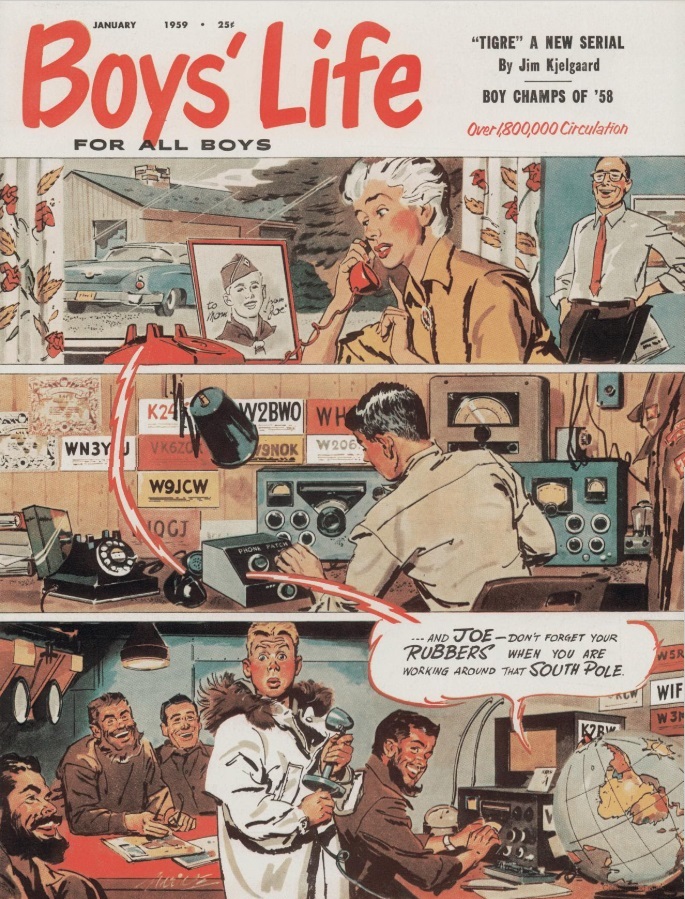
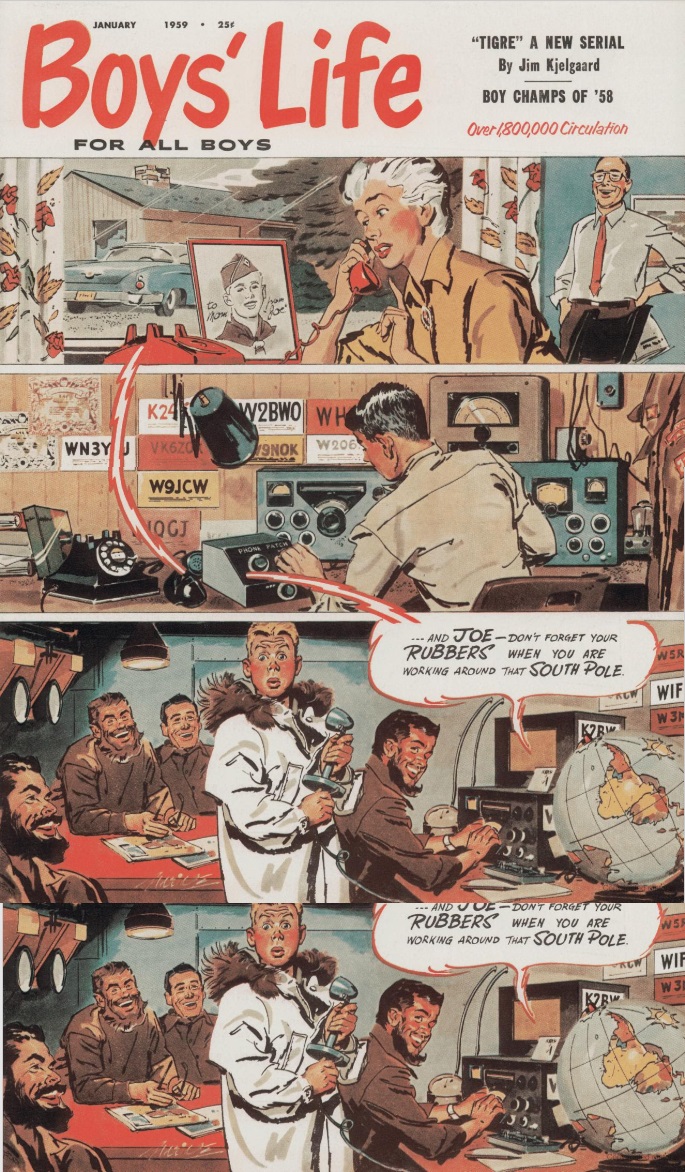
Sixty years ago this month, amateur radio made the cover of Boys’ Life magazine’s January 1959 issue, which featured an article entitled “Hamming is Fun” by long time ARRL staffer Perry Williams, W1UED.

The article featured the radio adventures of a number of young hams, including Jules Madey, K2KGJ, of Clark, NJ, who apparently inspired the cover. Madey, a high school student, put in as many as 49 hours a week running phone patches for men at the McMurdo base in Antarctica. Since the best conditions were in the middle of the night, Madey made a habit of going to bed right after supper and setting the alarm for 10:30 PM.

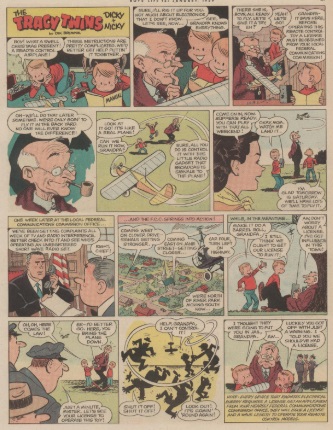
1959JanBL2The magazine contains two more radio features.  First of all, the Tracy Twins comic shows the boys receiving a radio control airplane that Grandpa insists on operating without a license.  Of course, he gets busted as an FCC helicopter and car swoop in.  Fortunately, he gets off with a warning.

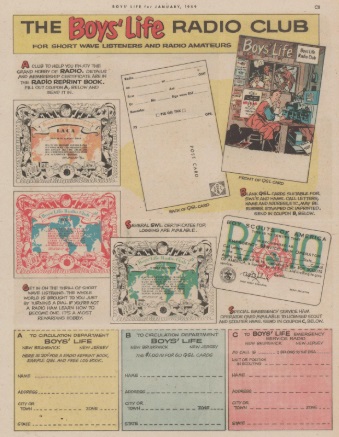
Finally, the Boys’ Life Radio Club had three offerings.  For just 20 cents, they would send out the Radio reprint book containing reprints of earlier articles, along with a free log book.  One dollar would get 60 QSL cards.  And for no cost, the club would send any licensed ham operator scout or scouter a card identifying the bearer as an emergency service ham.

1959JanBL3


Fun With Morse: 1949

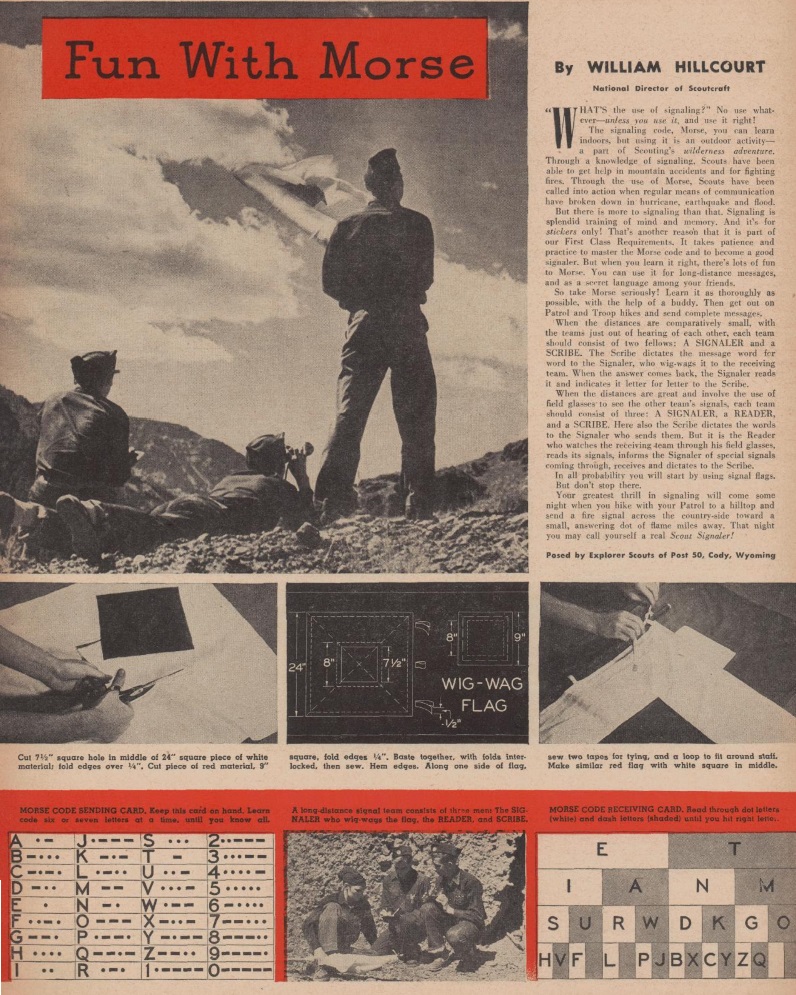
1949JanBLSeventy years ago this month, the January 1949 issue of Boys’ Life carried this article by William “Green Bar Bill” Hillcourt on the subject of Morse Code.

He points out that in addition to being a requirement for First Class, the skill was part of a Scout’s wilderness adventure. Through the use of Morse, Scouts have been called into action in hurricane, earthquake, and flood.

The article focuses solely on the use of wig-wag flags for sending messages. For relatively short distances, a team consisting of signaler and scribe was ideal. For longer distances, an additional reader was called for, since he would be watching through field glasses.


1928 Puerto Rico Hurricane

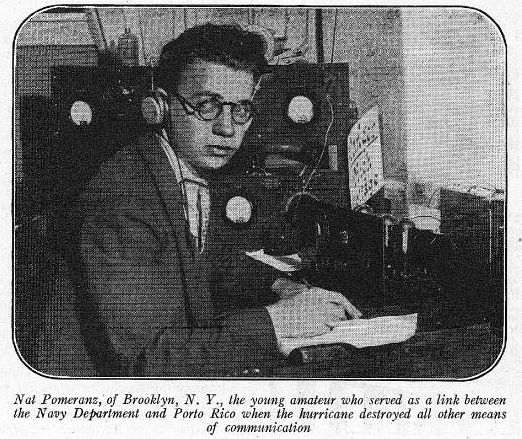
1928DecBLNinety years ago this month, the December 1928 issue of Boys’ Life carried this picture of Nat Pomeranz, 2APD, of Brooklyn, New York. When a September hurricane devastated Puerto Rico, the Navy’s station was destroyed, but a hasty emergency setup was made. Pomeranz was the first to pull in their weak signal and establish a communications link with the mainland.

The accompanying article noted that the Boy Scouts were in the process of setting up a radio network which could be of service not only in times of emergency, but in establishing closer contact between various troops.


1959 Boys’ Life Radio Contest

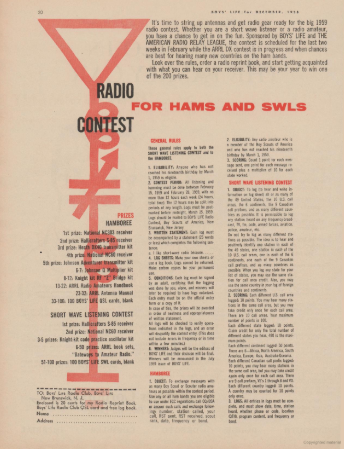
1948DecBLSixty years ago this month, the December 1958 issue of Boys’ Life magazine ran the rules for the 1959 annual Boys’ Life radio contest.  The contest was set for February 15-28.  To make sure scouts got their sleep, contest time was limited to 12 hours per week.

The contest featured separate categories for hams and SWL’s.  In the Ham category, the top prize was a National NC303 receiver.  The SWL top prize was a Hallicrafters S-85.


American Basic Scientific Club

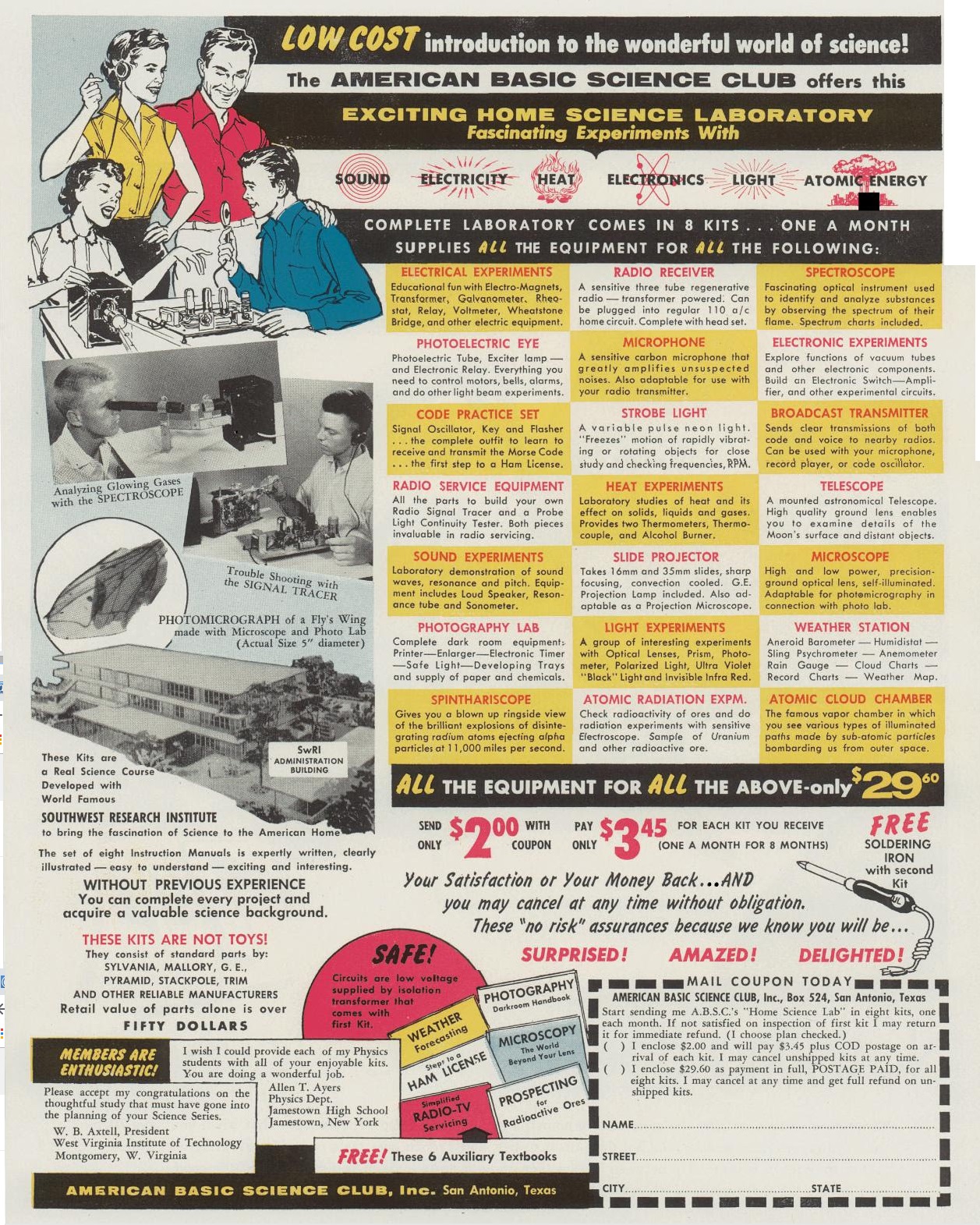
1958NovBL This ad for the American Basic Scientific Club appeared inside the back cover of Boys’ Life 60 years ago this month, November 1958.  For only $3.45 each, the club would send one scientific kit per month for eight months, each containing an interesting project on subject such as radio, meteorology, atomic energy, and photography.  At the end of eight months, the student would have a working regenerative receiver, signal tracer, code practice oscillator, darkroom (including enlarger), and many other scientific instruments.

I don’t recall hearing about this club, which was apparently in decline by the 1970s when I would have been interested.  There’s an interesting history of the club at this website, written by the son of the founder.  And a picture of the three-tube regenerative receiver, along with a partial schematic, can be found at this link.  The set appears to be mounted on a chassis made of a single piece of metal, mounted on the cardboard box in which the kit arrived.  It does have a power transformer, making it relatively safe for the young experimenter.

One of the books included with the kits was a guide to obtaining a ham radio license.  It appears that the receiver could be built for either the AM broadcast band or 80 meters, meaning that it probably made a workable receiver for a new novice.


1948 Periscope

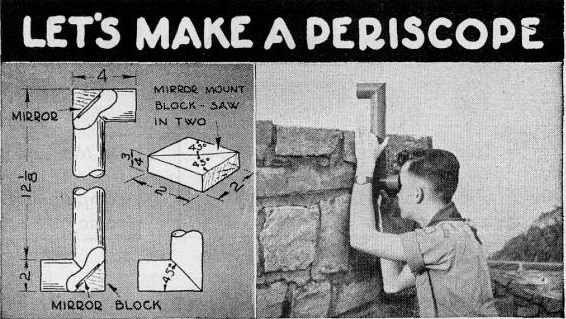
1948OctBLFor anyone desiring to see around corners, the periscope is the ideal solution to the problem. 70 years ago this month, the October 1948 issue of Boys’ Life showed how to make this simple but effective model.

In addition to a small wood block, only two parts were necessary.  And if you can’t find them locally, you can order them on Amazon:  Two two-inch mirrors and an 18 inch, 2 inch diameter mailing tube.  For making the precise 45 degree cuts, a miter saw was recommended.  Rounding out the bill of materials was some glue, and black shoe polish to paint the interior angles to reduce glare.

For older scouts, the completed periscope could be a useful tool for any number of purposes.  And for younger students, the project could serve as the basis for an interesting science fair project.

And for the more impatient modern youth, another option is to simply buy the genuine plastic periscope shown here.