Category Archives: Radio history

More Century Old Radio

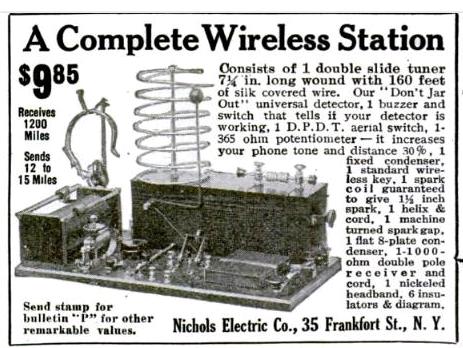
April1914PMwirelessThe  April 1914 edition of Popular Mechanics includes this Complete Wireless Station for $9.85 from the Nichols Electric Company of 35 Frankfort Street, New York.  That address had housed the “Clean and Ready Company” in 1893.  It now appears to be part of the campus of Pace University, next to the Manhattan entrance to the Brooklyn Bridge.

According to this inflation calculator, the $9.85 cost would be $232.75 in today’s dollars. To look at it another way, that would cost ten silver dollars, or about ten ounces of silver, which would be worth about $200 today. This apparatus seems very similar to one described by Alfred Powell Morgan in his book published in the same year, Wireless Telegraph Construction for Amateurs,  with two exceptions: This set doesn’t appear to have the variable condenser shown in Morgan’s schematic, below.  On the other hand, this set includes a knife switch in order to use the same antenna for both transmitting and receiving.
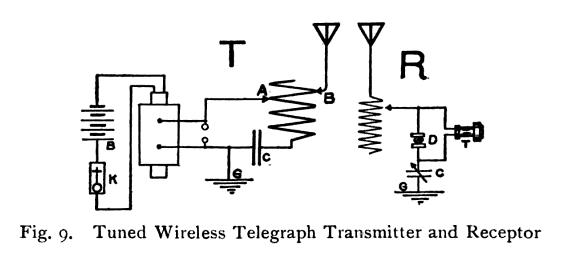
1914 Morgan Schematic

1914 Morgan Schematic

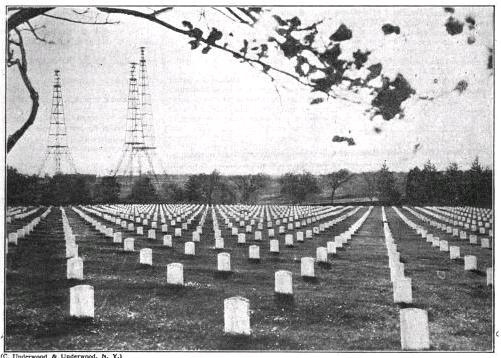
The receiver is a simple crystal set, billed as being able to receive 1200 miles. I suspect this figure involves a bit of hyperbole, but I suppose with a good antenna and good conditions, it might be possible to occasionally log stations such as NAA, transmitting time and weather from massive towers overlooking Arlington National Cemetery, shown here in 1922.
NAA Towers 1922

NAA Radio Towers, Overlooking Arlington Cemetery. Radio World, November 25, 1922.


The transmitter is billed as being capable of transmitting 12-15 miles. The ad doesn’t mention anything about a license. Licenses had been required since 1912, but it’s quite likely that the owner of this set wouldn’t have bothered. In fact, it’s unlikely that he would have been able to receive a license after explaining to the radio inspector what kind of equipment he was using.

The license requirements are explained in Morgan’s book.  Morgan explains:

An amateur may not use transmitting apparatus which is sufficiently powerful to send radio signals across any of the boundaries of the state in which he is located and which can be detected by a sensitive receiving set located just beyond the state boundary, nor can he use apparatus which is powerful enough to interfere with the reception of signals by others from beyond the state boundaries unless he has a license….

In other words if the amateur possesses a receiving outfit only which is in working order or if he has both transmitter and receptor and the.former is not powerful enough to send signals out of the state in which he fives, or to interfere with the reception of messages by another when the messages come from beyond the state boundary a license is unnecessary.
This is of course somewhat unfair for those living near the center of large states for they may operate almost as they please with ordinary instruments with no fear of the signals going beyond the border, while those living within a few miles of another state must secure a license.

Morgan goes on to explain why this set probably wouldn’t qualify for a license:

The law also says that the transmitting wave must be pure, and must be sharply tuned, which means that the wave must be of one length and not, as is very often the case, composed of two or more waves of different lengths.

In order to comply with this restriction, the use of an oscillation helix or loosely coupled helix is necessary. A rotary or quenched gap is also necessary in place of the ordinary spark gap.

The transmitter shown here fails in two regards. First of all, there’s no way of quenching the spark, although I suspect if it was run on batteries, that wouldn’t be much of a problem. The main problem is that the “helix” is basically a tapped autotransformer, and it will probably radiate quite well on at least two wavelengths. In addition, the signal from a transmitter like this is going to have a very wide signal.

I suppose, with a good antenna, this transmitter might be heard 12-15 miles away. But if the owner was more than 15 miles from the state line, it would appear that he could use this without fear of the radio inspector, as long as a licensed station didn’t complain of interference.

By the way, if the name Alfred Powell Morgan rings a bell, you’ll recall why when you visit my Alfred Powell Morgan page.

Radio and Timekeeping a Century Ago

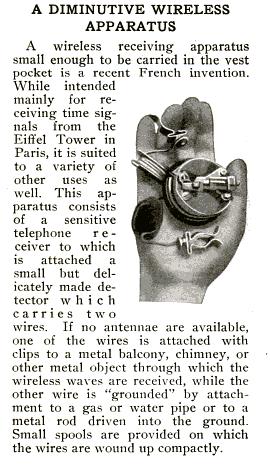
1914PortableRxThe April 1914 issue of Popular Mechanics includes this interesting portable zero-tube radio.  It appears to be a crystal set consisting of a detector mounted directly to the headphone, with two wires for clipping to a convenient antenna and ground connection.

This particular receiver is billed as being for receiving time signals from the Eiffel Tower, which had begun on May 23, 1910.  The station, FL, was operated by the French
Bureau des Longitudes, and transmitted time signals from the Paris Observatory. It operated on 2000 Meters (150 kHz) with a spark transmitter of about 40-50 kW. Service even continued during the war, which began for France about three months after this magazine was published.

Despite the apparent lack of any tuner, a crystal set such as this ought to have been able to receive the signal for quite a distance from Paris. As you can see, the two wires had clips for attaching to any suitable antenna and ground. The signal from the powerful station was so reliable that a guide to receiving the signals, published by the Bureau of Longitude in 1913, was translated and published in English in 1915. The translation is available to read at Google Books.

The original 1913 edition, Réception des signaux radiotélégraphiques transmis par la Tour Eiffel, is also available online.

Any doubts about whether a crystal set would be able to receive the powerful signal should be put to rest by the mere fact that this guide book was published in England. The guide states that the “energy radiated by the Eiffel Tower Station in transmitting signals is great enough to permit the use of receiving aerials of reduced height and dimensions throughout the whole of France and in the French possessions in North Africa.”

Station FL transmitted the exact time nightly at 11:45, 11:47, and 11:49 PM.  And it seems quite likely that the little pocket receiver shown here would have been suitable for receiving it throughout much of France.

The Eiffel Tower time signals had the very practical purpose of an indispensable aid to navigation. There are many ways by which one can determine latitude. But longitude depends on knowing the exact time at a fixed location on Earth, and then comparing that to the local time. One early method of determining the exact time was by observing the moons of Juipter.  Good chronometers largely solved the problem of having to go to these lengths, but there was still the matter of having to periodically set the chronometer. And time signals such as those provided by the Eiffel Tower greatly simplified the process.  A pocket sized receiver such as the one shown here would have been a most useful accessory.


On The Air as W1AW/0

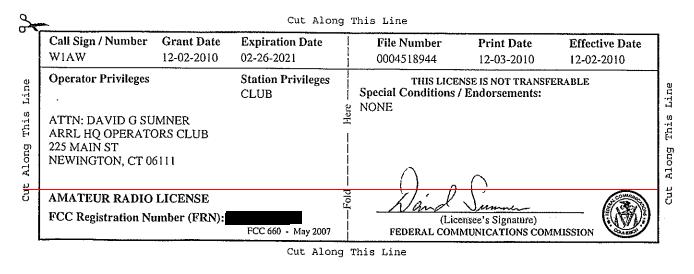
W1AW License

The license under which I was operating, signed by W1AW trustee Dave Sumner.

I had the privilege of being able to operate last night and today with the call sign W1AW/0.  In commemoration of the 100th anniversary of the ARRL, the League is operating the Hiram Percy Maxim Memorial Station from all fifty states.  This week (and again in June), it is being operated in Minnesota and Texas.  This is all part of the ARRL Centennial QSO Party.

In Minnesota, the coordination is being done by the Minnesota Wireless Association and the Northern Lights Radio Society.

The Old Man, W1AW


The call 1AW was issued to Hiram Percy Maxim after Amateur Radio returned to the air after the First World War.  When national prefixes were issued in 1928, the call became W1AW, which he held until his death in 1936.  It later became the call of the headquarters station of the ARRL.

I’ve worked W1AW several times.  It’s often active in contests, so it’s not a particularly rare catch, but it’s always a thrill to get this historic call sign in the log.

I noticed that the VHF slot for yesterday hadn’t been assigned.  Even though I don’t have much in the way of a VHF station, I decided to at least get the call on the air on FM, rather than let it go unused for 24 hours.  I made an announcement on a couple of local repeaters, and then camped out on 146.55 MHz and handed out contacts.  N0AIS made a recording off the air, which you can find posted at this link.

I had a relatively leisurely time of it, and had a chance to “ragchew” with a few of the contacts.  This was in contrast to the pileup on 40 CW, where I had to exercise a great deal of patience to break through and make my own contact with W1AW/0.  I later scored another one on 80 CW.

A few of the contacts I made were with hams using handhelds.  Several of the calls looked like they had been only fairly recently issued.  I think the Old Man would be glad to know that they worked his old call.

The following calls made it into the Old Man’s log on my watch:  N0AIS, W0ERP, KB0LYL, KD0LQQ, KD0UIH, WD9IGX, K0SHF, KC0VFP, KD0TTG, KD0WBM, W0COE, K0TI, KG0SF, W0ZQ, KC0IYT, K0IKV, WX0Z, WB0EBG, W0GHZ, KC0OIA, K0LAV, K0GJX.

External Links


1920 Ad for Maxim Silencer

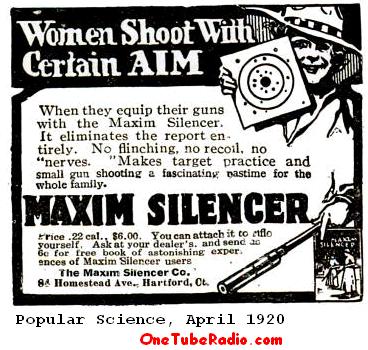
On my way to looking up something else, I found the following advertisement for the Maxim Silencer in a 1920 issue of Popular Science.

1920 Ad for the Maxim Silencer

1920 Ad for the Maxim Silencer


To Amateur Radio Operators, Hiram Percy Maxim is best known as the founder of the ARRL.  But he was also the inventor of the first commercially viable silencer for firearms, and the same techniques were adapted to automobile mufflers.  In fact, Maxim Silencers, Inc., is still in business producing silencers for industrial equipment.

The following links may be of interest: