Category Archives: Radio history

Homemade Vacuum Tubes

HomemadeTubesFifty years ago this month, QST carried an article entitled “Vacuum Tubes The Hard Way.” The author was Sam Diaz Pumara, ex-LU2DII. The Argentine ham’s address was listed as being in care of HRB-Singer, Inc., of State College, Pennsylvania, which is now part of Raytheon. Diaz details the meticulous process for building vacuum tubes in his basement. The end result is some of the samples shown here.

Making a vacuum tube at home is not a trivial proposition, but it is within the capabilities of an experienced craftsman. The first problem is creating a sufficient vacuum, which the author accomplished by using a variety of oil pumps, the last of which produced a vacuum of 10^-8 Millimeters (presumably meaning a column of mercury of that height). But the vacuum wouldn’t last, since the elements of the tube (and the glass itself) would occlude gasses. This problem was solved by heating the tube during the evacuation process to a temperature of 500 degrees centigrade.

The actual construction of the internal elements of the tube is a simpler proposition, but the painstaking detail needed in this work is also described in detail.

Another interesting article on the construction of homemade tubes can be found at the website of Dr. Rüdiger Walz. He mentions some of the other experimenters in this field, including Diaz.  One of the experimenters in this field had a call similar to my own, Marold Ross, W6IS, of Baldwin Park, California.

Finally, the video below shows Claude Paillard, F2FO making tubes:

You can view the 1965 article at this link.  (You need to be logged in to your ARRL account to download the QST article.)  For a much simpler method of making a diode vacuum tube, see my earlier post.

Click Here For Today’s Ripley’s Believe It Or Not Cartoon


Lily Pons on the Ham Bands, 1938

LilyPons1938

We recently shared a 1940 picture of opera singer Lily Pons listening to her GE radio-phono combo. But it appears that Miss Pons had more than a passing interest in radio. Here, we see her in the April, 1938, issue of All Wave Radio magazine at the mike of amateur station W2JKQ. Shown in the picture are, from left to right, maestro Andre Kostelanetz, Miss Pons, and W2JKQ.

Miss Pons was probably first introduced to ham radio by her camera man, C. Roy Hunt, W6CNE. Mr. Hunt had allowed her to speak to her South American manager, who was at the mike of LU1DA in Buenos Aires. In this photo, she duplicated the contact from W2JKQ’s New York station. She also chatted with a fan in Greece, SV1KE.

Lily Pons in 1940.

Lily Pons in 1940.

Click Here For Today’s Ripley’s Believe It Or Not Cartoon



1967 One Tube Receiver

1967OneTube

In 1967, the publishers of Electronics Illustrated and Mechanix Illustrated presented this little one-tube receiver in a publication entitled Practical Electronics.

1967OneTubeSchematicThe receiver tuned the AM broadcast band, amateur bands, or shortwave broadcast with the use of plug-in coils wound on the bases of old octal tubes. It used a dual-triode 12AT7 tube. One half served as the regenerative detector, with the other half serving as an audio amplifier. It used an isolation transformer, making the set relatively safe to use with 120 volts.

It was set up mostly as a low-cost starter receiver for the ham, as most of the coil data was for the ham bands. However, it would also make a good SWL receiver, and coil data was given for the 31 meter broadcast band.

Click Here For Today’s Ripley’s Believe It Or Not Cartoon


Hope Hampton, 1922 Queen of the “How To Make”

HopeHamilton

Film actress Hope Hampton starred in several silent movies. With the dawn of the sound era, she retired from the cinema and turned to opera, singing with the Philadelphia Opera. She returned to the screen in 1938, in The Road to Reno. She died in 1982 at the age of 84.

And in the 1920’s, she had an interest in radio. In the top photo, she is shown using one of the piano wires as an antenna. And the lower photo shows her confidently handling a soldering iron as she solders the tuning coil of her set. The pictures above appeared in the July 15, 1922, issue of Radio Digest.

Here, she appears with Lon Chaney in The Light of Faith (1922):

https://www.youtube.com/watch?v=U8zPmWFZn-Q

Hope Hapmpton, undated photo. (Wikipedia)

Hope Hapmpton, undated photo. (Wikipedia)

Click Here For Today’s Ripley’s Believe It Or Not Cartoon


QST and 73 Archives

I’m occasionally asked where I find material for this site. Most of it is found at AmericanRadioHistory.com, which has an archive of millions of pages of old radio and electronics publications. Much also comes from Google Books.

For Amateur Radio, a treasure trove of information is the QST Archive, which includes every issue of QST back to 1915. The search engine is not the best, and some of the scans are of rather poor quality. But it’s a great source of information.  (You must be an ARRL member and logged into your ARRL account to view articles.)  All issues of 73 Magazine are also available for free download at Archive.org.

If you’re looking for a more user-friendly version of these two resources, they are available at a reasonable price from Amazon at the links below. The QST CD covers up through 1941, and the 73 CD covers all issues.


1940 One Tube Shortwave Receiver from Popular Science

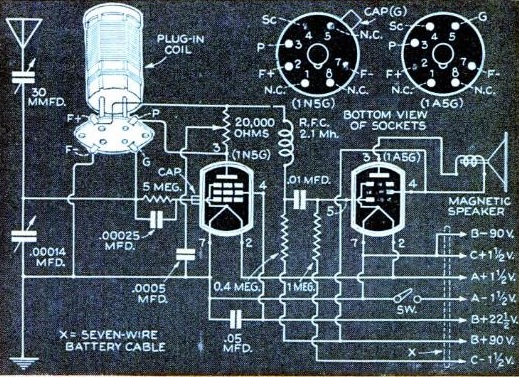
1940PSOneTubeThis little one-tube short wave receiver appeared in Popular Science 75 years ago this month, April 1940.  It uses as 12B8GT tube, a combined triode-pentode. The pentode section is used as a regenerative detector, and the triode is pressed into service as a diode, serving as the rectifier. The set runs directly from 120 volts AC. A 360 ohm resistor in series with the filament drops the voltage to 12 volts, and a hefty choke and two capacitors filter the power supply. Even though it’s run directly from the AC mains, the schematic shows no connections directly to the chassis, so as AC-DC sets go, this one is relatively safe to operate.

According to the accompanying article, the set could pull in signals from South America and Europe most evenings.

Click Here For Today’s Ripley’s Believe It Or NotCartoon


1955 CONELRAD Receiver

1955ConelradRXUnder the headline, “Are You Ready For CONELRAD?”, the April 1955 issue of Radio News carried the plans for this small CONELRAD receiver which could be easily carried in a pocket or glove compartment. The circuit is very similar to the Conelrad receiver carried by Boys’ Life the following year.  This receiver also consists of a crystal set followed by a one-transistor audio amplifier.

The article describes CONELRAD, and notes that “the responsibility of the individual citizen and particularly of the electronic technician and experimenter would be to provide themselves and their families well ahead of time with some means for receiving Conelrad broadcasts under any or all emergency conditions.” The article noted that receivers should be exactly calibrated, to avoid losing valuable seconds fumbling around trying to find 640 and 1240 on the dial. The article suggests using a signal generator to calibrate and mark the dial before an emergency.

1955ConelradSchematicIt then offers the circuit shown here, since it would be “highly advisable to have available at all times a portable battery-operated radio. The average portable radio is fairly cumbersome to carry about over any appreciable distance and its power requirements are high enough to make it impossible to keep in operation continuously.

The author notes that his original plan was to have one transistor serve as the detector, but had some difficulty in designing the circuit, due to the low input impedance of most transistors. Therefore, like the author of the Boys’ Life design, he settled on a diode detector, with one stage of audio amplification.

Unlike the Boys’ Life model, which was mounted in a cigar box, this one is mounted snugly in a small plastic box. The author notes that “as most old crystal set men will recall, a fairly long antenna and a good ground are required for best results.” Therefore, he recommended taping 25-50 feet of fine wire to the case for use as an emergency antenna.

Click Here For Today’s Ripley’s Believe It Or Not Cartoon


Marianne Brown, 2AOA, Radio Pioneer

MarianneBrown1920

Here, in the April, 1920, issue of Radio Amateur News, we see the station of Miss Marianne C. Brown of of 206 W. 86th Street, New York City, which is the corner of 86th and Broadway.

Her receiver, designed by herself, was able to tune 300-1200 meters, which took in nearly all of the commercial stations. She also reported that it was very satisfactory for reception of wireless telephone stations and arc stations. It was usable either with an indoor loop or an outdoor antenna.

Still under construction was her transmitter, consisting of a 1/2 KW transformer and oil condenser. She expected to have the transmitter in working order in a short time.

She was listed in the 1920 call book as 2AOA.  Another short biography of this wireless pioneer can be found at this link.  She held a commercial license and trained as a marine operator, but theNavy had a policy forbidding women serving in this position.  She did get a position with the Marconi company testing equipment.

Click Here For Today’s Ripley’s Believe It Or NotCartoon


1915 Radio Truck

1915RadioTruck

A hundred years ago, the public works department of Baltimore had equipped this truck with a wireless receiver, capable of receiving messages while the car was being driven at high speed through streets flanked with high buildings. The set was capable of receiving messages within a 10 mile radius, allowing crews to be dispatched quickly to any emergency situation. Among other equipment, the truck contained a pump capable of pumping 12,000 gallons per hour. It is shown here in the March, 1915, issue of Popular Mechanics.

Click Here For Today’s Ripley’s Believe It Or NotCartoon


The Record-A-Tape: 1971

recordatape

As far as I can tell, this is an idea that never made it. Other than this ad which appeared in Billboard on February 27, 1971, and on other dates, I’ve been unable to find any reference to the Record-A-Tape. The machine was loaded with up to fifty different albums. When a customer wanted to purchase one on 8-track, the machine would crank it out a copy in 3-1/2 minutes. The distributor would take care of royalties, the retailer didn’t have to worry about inventory, and the customer would never find anything out of stock.

Click Here For Today’s Ripley’s Believe It Or NotCartoon