Category Archives: Radio history

Dr. Norman Barden 1892-1926

The June 1911 issue of Modern Electrics magazine carries an interesting article written by one Norman Barden, detailing experiments being carried on at East High School in Minneapolis. Among other things, the reason why the article caught my eye was that this school was the predecessor of my alma mater, Minneapolis Edison.

East High was opened in 1900 and operated under that name until 1927, at which time it was used as a vocational school for a number of years. It was located between University Avenue and Southeast Fourth Street on what was then First Avenue Southeast, which was later renamed Central Avenue. Edison opened in 1922 and Marshall High (in whose old building I had my office for a number of years) opened in 1924, eliminating the need for East High. So in a sense, I went to the same school.

Barden starts his article by pointing out that the “public has been startled” to learn that a high-frequency current can pass through the human body with no ill effects. He explains that “there are several different theories put forth to explain why high frequency current does not produce fatal results upon animals and the human body,” even though the same current and voltage at a lower frequency or at DC, “fatal results occur.”

BardenTeslaUndaunted by the possibility of fatal results, and apparently oblivious as to the reason why they were non-fatal, Barden went ahead and sent the potentially fatal currents through humans, including himself, as shown in the picture here.

(It turns out that the explanation for the non-lethality is somewhat mundane.  The equipment appears to be an ordinary Tesla coil, meaning that while the voltages are very high and will generate a most impressive spark, the current passing through the human subject is extremely small.)

It turns out that this wasn’t the only dangerous science going on at East High.  Mr. Barden was apparently shooting guns in the photography lab, as detailed in other published articles.  In articles in the May 1911 issue of Popular Electricity and the 1914 Journal of the U.S. Artillery, he publishes photos of bullets photographed in flight after being shot from a .22 caliber rifle and a .32 caliber revolver.  Not surprisingly, he points out that when you fire guns at school, “a back-stop must be provided to keep the bullets from penetrating the wall.”  He used a piece of boiler plate behind a 2-1/2 inch piece of wood.  He also points out that you need to be careful, since you’re doing the experiment (including firing the gun) in a totally darkened room.  If you are going to replicate his experiment, it’s probably not a good idea to walk around after turning out the lights.  Barden is shown below with his co-experimenter, Loyle Dobbs.  The 1914 article also appeared in Scientific American.

BardenDobbs

As you can see, the rifle is plainly visible in this photo.  Apparently, East High didn’t have a “no guns” sign on the front door.

In addition to these publications, Barden also had published in a 1910 issue of Popular Atronomy a photograph of a comet he had taken through a telescope he had constructed himself.

When I saw the original article, I assumed that Mr. Barden was a teacher at the school.  But it turns out that he was actually one of the students.  A hundred years ago, high school students could get their articles published in Scientific American.  Today, they’re not allowed to touch the experiments.

BardenYearbookThe first record of young Mr. Barden is an article in the the June 14, 1906 Minneapolis Journal, where he is listed as a seventh grade student at Holmes School.  He’s shown here in his East High yearbook photo, which shows that he graduated in January, 1912.   In 1913, he is listed as a sophomore at the University of Minnesota College of Science, Literature, and the Arts.  And in 1919, he graduated from medical school in Ohio.

He returned to Minneapolis in time for the 1920 census, and went into practice.  In this 1921 directory, he is shown as having an office in the Donaldson Building and a home address of 1209 7th St. SE.  According to the 1921 Journal-Lancet of the Minnesota State Medical Association, He was the assistant to Dr. C.D. Harrington, a “pioneer in the therapeutic use of radium and the x-ray,” and the rongenologist of Northwestern, Asbury, Abbott, and St. Mary’s Hospitals.

Unfortunately, Dr. Barden’s promising scientific career came to a tragic end with his mysterious death in 1926.

The newspapers of August 18, 1926  reported that one Mrs. J.D. McDermott, the wife of a Chicago millionaire contractor, was being held by Minneapolis police following Dr. Barden’s death. His body was found by police in a room occupied by the couple in a downtown hotel. According to news accounts, the doctor was found “fashionably dressed and wearing several diamond rings said to be worth more than $10,000.” Two days later, the papers reported that Mrs. McDermott had been released, the post mortem having determined that the doctor had actually died from “acute alcoholism.”

Dr. Barden is buried at Lakewood Cemetery in Minneapolis.

Click Here For Today’s Ripley’s Believe It Or Not Cartoon


Morkrum Code of 1915

MorkrumTape

Many hams and others will instantly recognize the picture above as being the tape from a teletypewriter machine.  The machines were capable of sending faster than operators could type, so to reduce transmission time, the message could be punched onto the paper tape shown here and fed into the machine for later transmission.  I remember such devices still in use into the 1980’s by hams using radioteletype (RTTY), and the machines invariably originated from landline telegraph systems.

And most hams who look at the image closely will immediately notice that it’s a 5-bit code, and they will probably proclaim pretty quickly that it’s Baudot, since the Baudot 5-bit code was in use for many years.

They might be surprised to learn the age of this particular tape, and they will also be surprised to learn that it’s not Baudot.  This tape is a hundred years old, shown here from the May 1915 issue of Electrical Experimenter.  The technology was relatively new at the time, and the accompanying article describes it in some detail.    The particular tape shown here came from 1915APoperatorthe Associated Press, and is the beginning of a news item.  The AP New York office sent out 32,000 words a day over the wire, and this type of automation was necessary to handle the volume of news.  During the office’s busiest hours of the day (11:00 AM – 1:00 PM), three or four operators were perforating tape simultaneously so that these tapes could be fed into the machine that sent them out.  One of those operators is shown here.

MorkrumCode

And despite the similarities, the code being used in this tape is not Baudot.  It turns out that standardization didn’t take place for a few more years.  The code shown here is “Morkrum Code.”  If you look closely, you’ll see that the code for the letter A appears to be the same.  And like Baudot, it required the operator to shift from letters to characters and back again.  But the encoding is different.  If you’re interested in the history of the various codes in use, you’ll find them in an article entitled The Evolution of Character Codes, 1874-1968 by Eric Fisher.

The code that’s undoubtedly bringing these words to your screen are the ASCII code, an 8-bit code which came into use in the early 1960’s.  But the basic idea has been around for over a century.

The tape at the top of the page, read from right to left, reads as follows:

MER PAWNEE.  PHILADELPHIA. TO THE CLYDE
S S CO. WITH MDSE PASSED IN QUA

This scrap of tape appears to have originated five years earlier, since this snippet appeared in the shipping news of the  New York Tribune on August 25, 1910, in the clipping shown below.

1910ShippingNews

Click Here For Today’s Ripley’s Believe It Or Not Cartoon



1925 Portable Radios

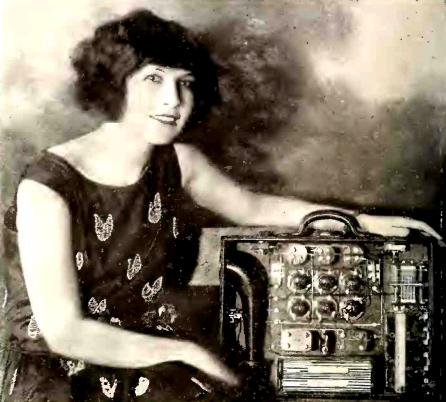
PortableKodelP11Ninety years ago this month, May 1925, Radio in the Home Magazine featured a number of portable sets then available on the market. The young woman shown here is listening to the Kodel P11 one-tube model, which measured only 5-3/4 x 4-1/4 x 3 inches, and which would operate either with or without an aerial. It appears that this is the portable version of the model C11, some pictures of which are available at this link.

The Kodel listener is anonymous, but that is not the case of the young woman shown here in her fur coat getting ready to listen to her Crosley portable. She is Miss Phyllis Sacia of Galesville, Wisconsin, who was the winner of the 1925 Crosley-Dolly Varden Annual Beauty Contest. According to her 1953 obituary, she married the year after this picture was taken and taught home economics in Menomonie, Wisconsin.PortableCrosley

Finally, the young woman shown in the final photograph below appears to be listening to an ordinary home set. But this set, the Operadio convertible, had a special cabinet which allowed the radio to be removed and used as a portable. A surviving example of this six-tube TRF set can be found on this website.  The article warned that “there is a saying in the radio industry that you can put a strap and a handle on a grand piano and call it a portable instrument if you want to.” That advice might have applied to this set, which weighed in at about 40 pounds.

PortableOperadio

Click Here For Today’s Ripley’s Believe It Or Not Cartoon


Cecil Powell, 1WX, 1915

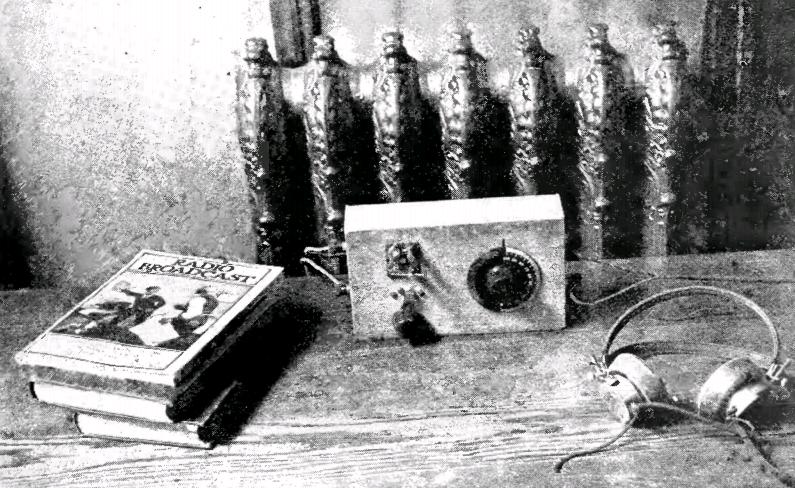
CecilPowellOne hundred years ago this month, the May 1915 issue of Wireless Age carried this photo of the station of Miss Cecil Powell, 1WX, of Hartford, Connecticut. She owned and operated this 1/4 kW station, and the article notes that she had passed the First Grade Amateur License and was working on the First Grade Commercial License. She was said to be the “only girl wireless operator in Connecticut.”

The accompanying article is written by Miss Powell, who explains that she was a stenographer employed by an inventor, but doesn’t name the inventor. The inventor, it turned out, was Hiram Percy Maxim. She notes that her employer had a station, and that she enjoyed listening to his discussions of the radio art. Maxim and a friend asked if she would like to be the owner of her own station, and she answered in the affirmative. She describes the station and antennas.

Miss Powell, with the encouragement of Maxim and his wife, conducted classes for other women interested in wireless, and every one of her students went on to pass the license exam.

Over the years, Miss Powell served as an officer of some of Maxim’s companies, such as the Maxim Silencer Company. I didn’t find any references to her in QST, other than as the notary in one of the statements of circulation.

References

 
Click Here For Today’s Ripley’s Believe It Or Not Cartoon


DX’ing From Outer Space

PopElecApr77


Quick Links


For about the past century, the planet Earth has been sending out into the cosmos radio signals, and it’s not uncommon to wonder whether anyone has heard them. The subject sometimes comes up in science fiction. For example, in the 1997 movie Contact, the first message received from an extraterrestrial source was, of all things, a speech by Hitler (conveniently complete with both audio and video). It was reasoned in the movie that this was one of the first television broadcasts from Earth, and as soon as the TV DX’ers in some other part of the galaxy received it, they sent it back. Presumably, I Love Lucy and other programs would follow within a couple of decades.

For the reasons explained below, this is relatively implausible. While it would be a relatively easy matter for another civilization to detect the presence of our signals, actually demodulating them (not to mention sending them back) would be considerably trickier. But it’s not totally impossible.


DX’ing From The Moon

But there’s another related question lurking here, and that is how difficult it would be for me to receive radio signals from Earth if I decided to visit the moon or some other place in space. Obviously, radio communications is possible at very great distances, since NASA does this on a daily basis. The question is what those of us with more modest equipment would be able to do.

The question is answered by an April 1977 Popular Electronics article written by Glenn Hauser.

Hauser’s focus in this article is primarily on the moon, and he convincingly shows that reception of FM and TV signals would be relatively easy to accomplish with reasonably good receivers and antennas. When the subject comes up, naysayers frequently point out that very few terrestrial stations use antennas that radiate very much energy “straight up.” It turns out, though, that this is actually the reason why many signals could be heard on the moon. After all, the moon is rarely “straight up.” It can be at many points in the sky, and at some of these points, it’s within the main lobe of broadcast stations on Earth.

Most FM and TV stations use what we think of as “omnidirectional” antennas: In other words, antennas that radiate equally strong signals in a full 360 degrees. But most of these antennas have a certain amount of gain: The effective radiated power of the signal is greater than the transmitter’s output power. This is because the “omnidirectional” pattern of the antenna is not omnidirectional at all. Instead, most of the power is concentrated into a single plane. It’s “omnidirectional” in the sense that it’s headed off toward the horizon in all directions. But it’s directional when you think of it in three dimensions. All of the energy is concentrated toward the horizon. This makes sense for the broadcaster, since all of their listeners are located on an (approximate) plane, bounded by the horizon.

This means that a station’s signal is being beamed toward the moon at two times per day: At local moonrise and local moonset. From the point of view of the listener on the moon, this means all of the stations along the Earth’s approaching and receding limbs, a narrow band circling the Earth. A station located at the North or South Pole would have its antenna pointing at the moon on a constant basis. Every other station on Earth would have its antenna pointed at the moon approximately every twelve hours.

There would still be a slight problem, however, since even on this narrow band, there would be multiple stations on any given frequency. I suspect that on some popular frequencies, this problem would be insurmountable, since the QRM would be just too great.

But there would be some signals that would be quite easy to copy, since they have the frequency to themselves, or share it only with much lower powered stations. Two examples given in the 1977 article is no longer relevant, but they’re good illustrations. Prior to the switch to digital television in the United States, TV channel 68 was occupied by only one station, KVST-TV in Los Angeles, with an ERP of a million watts. And on channel 67, WMPB, the Baltimore PBS channel, was in a similar position. These channels would be relatively easy to monitor from the moon whenever it was moonrise or moonset in Los Angeles or Baltimore. Hauser notes other such examples in Europe and Brazil.

Most of the FM band would be more cacophonous, but there would be some stations operating on relatively clear channels. Due to the FM capture effect, some of these would be relatively easy to hear, even if there was a bit of other activity on the same channel. For example, he cites a number of cases in the educational portion of the FM band (88-92 MHz), where there’s a single high-power station in the United States, with other stations on that channel having much lower power. In those cases, the dominant signal would be easily heard. He also cites a number of high powered Canadian stations operating on channels where only low powered stations existed in the United States. Since the FM situation has been relatively static since 1977, most of these stations would remain fairly easy catches from the moon.

Hauser does point out that longwave and mediumwave (standard AM broadcasts) would be unlikely to penetrate the ionosphere.  Only signals above the maximum usable frequency (MUF) could be heard outside the confines of the Earth.  Therefore, he notes that it’s unlikely that we had much radio leakage to speak of prior to about the 1930’s, when relatively strong shortwave stations started coming on the air.  Since most of these stations operated on regular schedules, it’s likely that they were still radiating, even when the MUF dipped below their transmitter frequency.  Those signals would radiate into space.  Hauser cites one example of a BBC transmission from the VOA station in Delano, California, being copied by a satellite.


DX’ing by Extraterrestrial Civilizations

The issue raised by the movie Contact is touched on by Hauser, but it’s studied in scholarly detail by a NASA report entitled Eavesdropping Mode and Radio Leakage from Earth by Woodrull T. Sullivan III.  While this report doesn’t show a date, it appears to be written post-1978.  It answers the question of what extraterrestrial listeners, with equipment comparable to that available on Earth, would be able to hear.  It turns out that those extraterrestrial viewers would be able to determine quite a bit, although it’s unlikely that they would be able to demodulate the video of speeches by Hitler.

Even though they might not be able to watch our shows, extraterrestrial monitors within several light years of the Earth would be able to make quite a few reasonable deductions about the Earth, even if they were equipped with only Earth-level receivers and antennas.  At least they would have been able to.  It turns out that the best source of information would be the video carriers of UHF television stations.  With the switch to digital television, some of those extraterrestrials might have concluded that the Earth has gone dark.

But those UHF carriers from a few years ago are still working their way through space, and it’s possible that someone is analyzing them.  The article makes clear that the modulation of those signals (the actual audio or video) would be too weak to decode with Earth-level technology.  But the presence of the carriers would be apparent.  And even with this information, extraterrestrials would be able to come to some intelligent conclusions.  They would be able to figure out which star the signals were coming from.  And by keeping close track, they would be able to figure out the diameter of the Earth’s orbit around the sun.

They would even be able to figure out the approximate latitudes and longitudes of individual stations.  This is because the signals would come and go on a regular schedule as the Earth made its 24-hour rotation.  As noted above, stations near the poles would be audible most of the time.  As stations got closer and closer to the equator, they would be audible for shorter periods each twelve hours.  The Doppler shift of received signals would give further clues as to the latitude of the signals being heard.  Eventually, the extraterrestrials would be able to crunch the numbers and figure out the approximate terrestrial locations of the stations.  If the correctly assumed that the locations of these signals were close to the locations of greatest human population, they would even be able to roughly map out the population distribution of the Earth.

Click Here For Today’s Ripley’s Believe It Or Not Cartoon


1935 Belt Radio

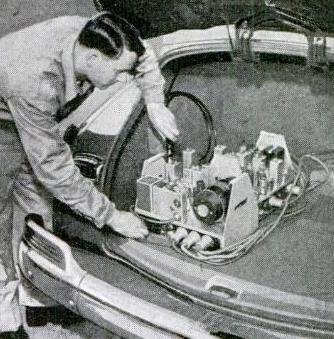
1935BeltRadioThe gentleman shown here would probably be shot dead if he got within a mile of a modern airport or other public building. But it’s not what it seems, since this 1935 radio enthusiast is just out for a stroll with the radio he constructed from the pages of Popular Mechanics, May 1935. He’s sporting the “one tube belt receiver” which allows him to “go for a walk and at the same time enjoy your favorite program, or listen in on a detailed broadcast description of a ball game or other sporting event while watching the action.”

That ominous looking contraption spanning his waist is nothing more than  “flexible ribbon-type B-batteries of new design.” The A battery to run the filaments of the dual triode type 19 tube are contained within the radio itself. The receiver used half the tube for the regenerative detector, with the other half serving as an audio amplifier sufficient to power headphones or a small speaker. 4 or 5 feet of antenna was sufficient for local stations, and for distant stations, the antenna could be clipped to a fence wire. The ground wire was held in the hand.

Click Here For Today’s Ripley’s Believe It Or Not Cartoon


Sinking of the Lusitania, 1915

Today marks the 100th anniversary of the sinking of the Lusitania on May 7, 1915, as the ship sailed from New York to Liverpool. 1198 passengers and crew died in the German u-boat attack, including 128 Americans. Even though the U.S. didn’t enter the war for two more years, the sinking of the ship galvanized public opinion against the German side of the war.

The ship carried two wireless operators, American Robert Leith and Scotsman David C. McCormick, both in the employ of the Marconi Company. Leith, a former railroad telegrapher, entered the company’s service in 1906, and McCormick in 1913. Both men survived, despite remaining at their stations until the last useful moment.

McCormick was on duty at the time the ship was torpedoed. Leith was then at lunch, and immediately returned to the wireless station, at which time McCormick was already sending the SOS.

The ship’s modern wireless station would have been similar to the one previously depicted here in a previous post for the ship’s sister ship the Franconia.

Leith died of cancer in 1933. I was unable to find any subsequent history for McCormick.

References


Click Here For Today’s Ripley’s Believe It Or Not Cartoon


1965 Fridley Tornado

Fridley tornado aftermath. NOAA photo, via Wikipedia.

Fridley tornado aftermath. NOAA photo, via Wikipedia.

Today marks the 50th anniversary of the Fridley Tornado  of May 6, 1965. That night, six tornadoes hit the Minneapolis-St. Paul area, with two of them hitting the suburb of Fridley, near University Avenue and Interstate 694. Thirteen people were killed, and property damage totalled $14.5 million. Of that total, $5 million was to the Fridley school system, where the Fridley Junior High was badly damaged. The storm struck in the evening, but about 300 people were attending an evening program. Only one child, however, suffered injuries. In Fridley, 1100 homes were damaged and 425 destroyed.

I don’t have a specific recollection of this storm, since I was four years old at the time.  I do, however, remember being in the basement with a flashlight and a radio close at hand, and I’m sure this was one of the occasions, since this was about 3 miles from where I grew up.  Chances are, we were following the storm on WCCO radio (or perhaps on our built-in basement TV, if the power was still on).  The WCCO radio coverage of the storm has been preserved, and you can listen to all of it at RadioTapes.com.

In addition, this week’s Access Minnesota radio program from the University Minnesota has an interesting look back at the storm.    You can listen to the program online at their website.

References

Read More at Amazon

Click Here For Today’s Ripley’s Believe It Or Not Cartoon


W2HBK, 1935

W2HBKShown here is the 1935 station of Howard Critchell, W2HBK, which was located at 170 E. 79th St., New York City.  The picture is from the May 1935 issue of QST and describes the “nice-looking layout” with a transmitter containing a 47 crystal oscillator and 46 amplifier. The antenna was a 66-foot flat-top, center fed with a twisted-pair feeder. The receiver was a National SW-3.

What makes this fairly typical looking station unusual was that Critchell lived in a part of Manhattan served by DC power rather than AC, which required him to be creative when it came to power supplies. For the 500-volt plate voltage, he used a motor-generator set. For the tubes filaments, he used the 110-volt DC line through a dropping resistor. The receiver he simply ran off batteries.

You can find the original QST article at this link.  (You need to be logged in to your ARRL account to view the file).

Click Here For Today’s Ripley’s Believe It Or Not Cartoon


Moses “Moe” Annenberg

RadioGuideMastheadOne source that we frequently take advantage of is Radio Guide Magazine, which was published from 1931 to 1943. In addition to program listings, it contained features regarding radio, including what was happening on the shortwave bands. The published, as can be seen from this clip from the masthead of a 1937 issue, was one Moses “Moe” Annenberg, publisher of the Philadelphia Inquirer as well as dozens of other publications.

He is shown here leaving the courtroom of federal Judge James Herbert Wilkersonn after pleading guilty to tax evasion. He had been indicted for evading over $3 million in taxes from 1932-36, and pleaded guilty to the count covering 1936, in which he ws charged with evading $1.2 million in taxes. It was the largest tax evasion case to date. Annenberg was sentenced to three years, and he died in prison in 1942.

He was the father of Walter Annenberg, who took over the reins of Radio Guide, and later founded TV Guide.

Click Here For Today’s Ripley’s Believe It Or Not Cartoon