Category Archives: Radio history

1960 CB Converter

1960JulyElecWorldSixty years ago this month, the July 1960 issue of Electronics World carried the plans for this CB converter. The magazine noted that inexpensive transceivers were available with superregenerative receivers, and that those worked well at first to get people on the air at a low price. But as the band became more and more popular, the lack of selectivity posed a problem, and a superheterodyne was becoming necessary.

This circuit used a single 6EZ8 triple triode, and would use a standard AM radio tuned to 1500 kHz as the IF stage. It circuit could also be tuned to cover any 400 KHz segment of the 10 meter band.


1920 Radio Ad

YoungMcCombsAd1920We’ve previously featured ads from Young McCombs department store in Rock Island, Illinois and its well-stocked radio department.  This ad appeared a hundred years ago today in the July 15, 1920, issue of the Rock Island Argus and Daily Union.


First FM Car Radio, 1960

1960JulyPMSixty years ago this month, the July 1960 issue of Popular Mechanics showed this car radio from Motorola, which, according to the magazine, was the first mass-produced transitorized FM car radio. The set installed under the dash, and despite its compact size, it was completely self-contained, with its own speaker.

The radio was in response to the demands of discriminating motorists who enjoyed a more specialized programming, and the set was capable of reproducing the full range of FM audio.


1950 Four Tube Pocket Portable

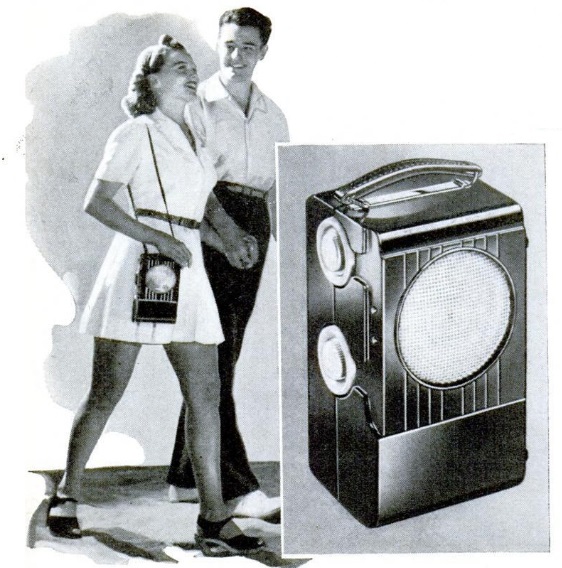
1950JulyPSThe gentleman shown here is listening to one of the first pocket-sized radios, the plans for which were shown in the July 1950 issue of Popular Science.

The magazine notes that you don’t have to carry your portable radio–you can wear it. The receiver is so small that it will slip into your pocket, and you’ll hardly know you have it with you. The set was a four-tube superheterodyne that would pick up everything on the dial, thanks to four subminiature tubes.

The article did state that one needed to have “a little practice in radio building” in order to put it together. Indeed, the mechanical construction looks very challenging, trying to squeeze all of the parts into a small makeup box.

Unfortunately, the project is challenging partly because it’s unclear which tube is which. The set calls for four tubes: 2G22, 2E32, 2E42, and 2E36. Unfortunately, they’re not labeled on the schematic, and the text gives only a few hints. The 2E36 is the audio output, the tube on the far right. I think the other three, from left to right, are 2G22, 2E32, and 2E42, but I’m not positive. In any event, the tubes are taped to the sides of the IF transformers to squeeze everything into place. Of course, it probably doesn’t matter, since these tubes are probably all unobtainium.

1950JulyPSschematic


Update:  A reader sent us a copy of the page below, which shows the missing tube numbers.  Apparently, the top of the page was cut off, but is visible in the scan below.  Thank you!!

1951 pocket radio circuit


Answer to Yesterday’s Quiz

1940JulyRadioCraftYesterday, we posted this quiz from the July 1940 issue of Radio Craft magazine. Based upon the symptoms shown, what was wrong with the radio?  As promised, here’s the answer:  R1 is open.  Here’s a more complete explanation:

1940JulyRadioCraft2

We’ll give you 24 hours to think about it, and then post the correct answer tomorrow.


1940 Quiz

1940JulyRadioCraftWould you have made the grade as a radio technician 80 years ago? You can find out from this quiz in an ad in the July 1940 issue of Radio Craft magazine. Based upon these symptoms, can you figure out what’s wrong? If you graduated from National Radio Institute’s home study course, you would undoubtedly identify the problem right away.

For a larger version of the image, click on it.  Then, in most browsers, click on it again to enlarge.

We’ll give you 24 hours to think about it, and then post the correct answer tomorrow.


War Surplus Predictions, 1945

1945July9BC

In this day’s issue of Broadcast magazine 75 years ago, the Broadcasting industry was alerted to something that hams would soon figure out as they got back on the air in the following years: There was going to be a lot of surplus equipment hitting the market soon. There were already rumors of a warehouse full of transmitters, and some 250 watt transmitters were already hitting the market.

A broadcast engineer with time on his hands could probably even track down most of the parts necessary for a 50 kW transmitter. With the war still going on in the Pacific, there was already an estimated $30 million in surplus available. And when hostilities ended, this was estimated to hit $5 billion.


100 Years of Extension Cords

1920JulElecExpOne hundred years ago this month, the July 1920 issue of Electrical Experimenter introduced its readers to a new concept, namely, something known as the “extension cord.” The magazine noted that the extension cord was one of the handiest little articles around the electrically lighted home, and the it was naturally one of the first things wanted.

The article gave detailed instructions on how to put together an extension cord, and stressed the importance of using all new components for the plug, socket, and wire. It warned that house wiring needed to be kept 2-1/2 inches from other wires, and at least a half inch from any surface. In the extension cord, the wires would be in close proximity, separated only by combustible cotton insulation. Therefore, only the very best new materials should be used. As for the length, the magazine suggested that 25 feet would be suitable for most purposes.

The modern reader will note that the ends are what we would call today light sockets. Most household electrical devices of the time were wired with a plug identical to that of a light bulb. The traditional two-prong socket came later.

For those wishing to save some work, extension cords are now readily available, and with the proper plugs.  The one shown at left includes three USB ports.  If you want to recreate the 1920 cord, I wasn’t able to find one off the shelf. However, it’s an easy matter of combining the cord shown at right and one of the the handy converters shown below.

Many savvy travelers toss one of the converters on the left into their suitcase.  It almost always guarantees an extra electrical outlet in a hotel room.


Some links on this page are affiliate links, meaning that this site earns a small commission if you make a purchase after clicking on the link.


US Forest Service Radio, 1920

1920JulyPS11920JulyPS2A hundred years ago this month, the July 1920 issue of Popular Science reported that the United States Forest Service had found a valuable ally in the radiotelephone. 42 sets like the one shown above were in operation at remote points in Wyoming, Montana, and Oregon. Range varied from 10 to 300 miles, with about 50 miles being typical.

The article noted that two such stations bore a cost of about $3000. However, that particular circuit covered 60 miles, and a comparable telephone system would have cost over $5000. Even though rangers started with no radio experience, the Service reported that after a few months, they were able to expertly take and send messages.1920JulyPS3

The trees themselves were pressed into service as antenna supports. At each site, two suitable trees would be stripped of branches and the wires stretched between them. Initially, storage batteries were packed back to the closest town for charging, but gasoline generators had just been installed to save that labor.

Mules, such as the ones shown at right, transported the equipment to its station. But when the trails got too steep for the mules, the rangers themselves carried the equipment.


Mounting the Radio On The Wall: 1945

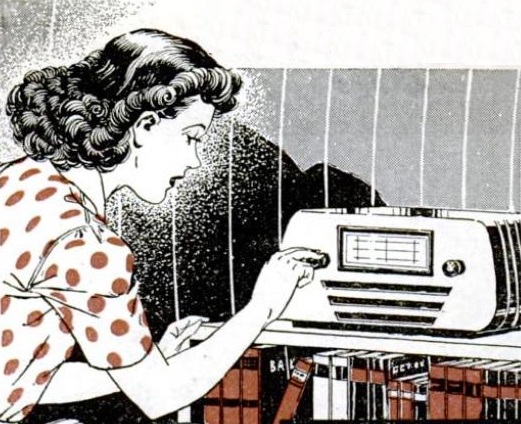
1945JulPSSeventy-five years ago this month, the July 1945 issue of Popular Science shared this self-explanatory helpful hint for mounting a radio on the wall. Many times, the radio wound up at the wrong end of the room, because that’s where the table was. With this idea, you can mount it wherever desired, and it had a sleek “built-in” look about it.

The magazine did caution that before following this scheme, you should make sure the radio’s cabinet is structurally sound.