Category Archives: Politics

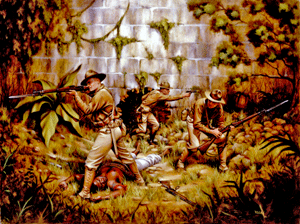
Battle of Fort Rivière, 1915

Battle of Fort Rivière. USMC image.

Battle of Fort Rivière. USMC image.

A hundred years ago today, November 17, 1915, the United States fought the Battle of Fort Rivière.  Chances are, most Americans have never heard of this battle, even though it resulted in three Medals of Honor being awarded to U.S. marines or sailors.

Among the Medal of Honor recipients was then-Major, later General Smedley Darlington Butler, who led the U.S. forces in the battle, which was part of the U.S. occupation of Haiti, which had begun on July 28, 1915.  The occupation had been motivated by two factors.  Those factors overlap a great deal, and historians have debated the relative importance of each.  First of all, there was a need to protect U.S. commercial interests in Haiti.  The country had potential with agriculture, minerals, and ports.  American interests were hampered by, among other things, the fact that foreigners were not allowed to own property.

The other concern was German influence in the Western Hemisphere, and the United States viewed Germany as having too much influence in Haiti.  While the German population was quite small, it did have a very great commercial influence, since a very large portion of the commercial activity was controlled by German families with strong ties to the old country.  Also, the Germans were more willing to marry in to prominent Mulatto families, thus skirting the property ownership laws.

President Wilson sent in the marines in July, and the largest battle took place on November 17 as U.S. sailors and marines stormed an old French fort where the peasant rebels were holed up.  The battle against the poorly equipped rebels was over quickly.  Over 50 rebels were killed.  The only U.S. casualty was a marine who had two teeth knocked out by a rock thrown at him by one of the rebels.  While a few later skirmishes took place, this was the decisive battle.

Under the occupation, Haiti adopted a new constitution written by then-Secretary of the Navy Franklin D. Roosevelt.  It gave U.S. officials more or less absolute veto power over acts of the Haitian government, and also guaranteed foreigners the right to own property.

The occupation did have the result of modernizing Haiti.  For example, Port-au-Prince became the first location in the Caribbean to have an automated dial telephone system.  Also, Haiti had radio broadcasting as early as 1926, as reported in the February 26, 1927, issue of Radio World.

General Smedley Butler

An adult male looking to the right in a military uniform; military ribbons are visible.

General Smedley Butler. Wikipedia photo.

As a result of the battle, Butler received the first of his two Medals of Honor, and he went on to become, at the time, the nation’s most decorated military hero, and made a name for himself two other times off the battlefield.

The first was in in 1934 when he testified before the House Special Committee on Un-American Activities, revealing what came to be known as the “Business Plot.”

He testified that he had been called upon by business leaders to lead a march of veterans on Washington, at which point he would stage a coup against President Roosevelt. Roosevelt would be kept on as a puppet figure, with Butler wielding most of the power. Butler had been a key figure in earlier marches by veterans, was respected as a military leader, and the conspirators, most of whose names were never publicly revealed, planned to use Butler as their puppet, so he testified.

The Committee, and the American press, generally dismissed Butler’s testimony as an implausible conspiracy theory.  The phrase “tinfoil hat” hadn’t yet been coined, but if it had, it probably would have been applied to Butler.  Compounding the problem was that Butler seemingly hadn’t named any names, although this wasn’t entirely true.  He had named names, but since most of his allegations amounted to hearsay, the Committee had refused to make them public.

The most plausible explanation, it seems to me, is that there was indeed a conspiracy to overthrow the government, and that Butler was approached to lead it. It doesn’t appear that he had any motive to fabricate the story. However, it also seems likely to me that the conspiracy wasn’t as large as he was led to believe by those who approached him.

In 1935, based upon his experiences as a career military officer, Butler published “War is a Racket,” a widely-distributed pamphlet in which he argues that war is, indeed, a racket, which he summarized as follows:

War is a racket. It always has been. It is possibly the oldest, easily the most profitable, surely the most vicious. It is the only one international in scope. It is the only one in which the profits are reckoned in dollars and the losses in lives. A racket is best described, I believe, as something that is not what it seems to the majority of the people. Only a small ‘inside’ group knows what it is about. It is conducted for the benefit of the very few, at the expense of the very many. Out of war a few people make huge fortunes.

Butler’s recommendation was to make war unprofitable by conscripting soldiers only after conscripting capital.  Of course, the naysayers would say that this runs roughshod over private property which, of course, it does.  But conscription of soldiers also runs roughshod over their own personal liberties, so the idea doesn’t strike me as too farfetched.  Butler also recommended that the declaration of war be done not by congress, but by a referendum of those subject to service, and also a restriction of the military to self-defense only.

The book is available online at numerous places, including archive.org.


Click Here For Today’s Ripley’s Believe It Or Not Cartoon


Celebrating Perversion of America’s First Freedom (or so I’m told)

logo-wide-mediumI’m in Des Moines this weekend at the  Freedom 2015 religious liberties conference.

I suspect that the vast majority of attendees are more conservative than I am. (My liberal friends will probably find it hard to believe that there’s anyone more conservative than I.) But despite that, I found everyone there to be respectful, and it’s been an interesting experience. According to a report at WHO-TV,  there’s another religious liberties conference taking place this weekend. And according to an organizer of the other event, the one I am at “embraces a perversion of America’s first freedom and encourages bias and prejudice, religious liberty is not and should never be discriminatory.”

I’m completely at a loss as to where this notion came from. I did not hear a single person encourage bias or prejudice, and I certainly didn’t hear anyone encourage anything discriminatory. Another speaker at the competing conference opined, “we don’t believe that religious liberty should be used as a weapon, against anyone.”

I didn’t agree with everything I heard today. But I honestly don’t understand the broad brush criticism.

I wasn’t able to arrive in time for the opening session. But the first speaker I heard, Michigan attorney and pastor Robert Whims, made the unremarkable plea that Christians have a duty to serve in Government.  He encouraged those in attendance to seek out opportunities to serve the civil government in appointed an elected capacities.

Mr. Whims is of the Reformed tradition, and pointed to the Westminster Confession to show that Christians have a duty not only to pray for an honor the civil magistrate, but to serve as such:

I. God, the supreme Lord and King of all the world, has ordained civil magistrates, to be, under Him, over the people, for His own glory, and the public good: and, to this end, has armed them with the power of the sword, for the defence and encouragement of them that are good, and for the punishment of evil doers.

II. It is lawful for Christians to accept and execute the office of a magistrate, when called thereunto: in the managing whereof, as they ought especially to maintain piety, justice, and peace, according to the wholesome laws of each commonwealth; so, for that end, they may lawfully, now under the New Testament, wage war, upon just and necessary occasion.

III. Civil magistrates may not assume to themselves the administration of the Word and sacraments; or the power of the keys of the kingdom of heaven; yet he has authority, and it is his duty, to take order that unity and peace be preserved in the Church, that the truth of God be kept pure and entire, that all blasphemies and heresies be suppressed, all corruptions and abuses in worship and discipline prevented or reformed, and all the ordainances of God duly settled, administrated, and observed. For the better effecting whereof, he has power to call synods, to be present at them and to provide that whatsoever is transacted in them be according to the mind of God.

IV. It is the duty of people to pray for magistrates, to honor their persons, to pay them tribute or other dues, to obey their lawful commands, and to be subject to their authority, for conscience’ sake. Infidelity, or difference in religion, does not make void the magistrates’ just and legal authority, nor free the people from their due obedience to them: from which ecclesiastical persons are not exempted, much less has the Pope any power and jurisdiction over them in their dominions, or over any of their people; and, least of all, to deprive them of their dominions, or lives, if he shall judge them to be heretics, or upon any other pretence whatsoever.

In short, this was hardly the stuff of “perversion” that “encourages bias and prejudice.”

Rafael Cruz

Rafael Cruz

The star of today’s events was Rafael Cruz, the father of presidential candidate Ted Cruz, who also appeared earlier in the day. The elder Cruz reminded us that the Bible tells us whom to vote for, a statement that would undoubtedly cause further consternation by the competing group. But sure enough, the Holy Writ says exactly what Cruz said it did. It tells us exactly who to vote for:

Select capable men from all the people–men [and women, Cruz added] who fear God, trustworthy men who hate dishonest gain–and appoint them as officials over thousands, hundreds, fifties and tens. Have them serve as judges for the people at all times, but have them bring every difficult case to you; the simple cases they can decide themselves. That will make your load lighter, because they will share it with you.

Exodus 18:21-22.

He pointed out that we’re given four qualifications for the people we should vote for:

  1. Capable
  2. Fear God
  3. Trustworthy
  4. Hate Dishonest Gain

(Mr. Cruz quoted from a different translation, which used the word “covetous” in connection with the fourth point, but one gets the idea.) He also pointed out that the second verse quoted above sounds a lot like federalism. I suppose this represents “bias and prejudice” only if one thinks that we should elect incapable people who are not trustworthy and who are in favor of dishonest gain. If that makes me biased, so be it.

Ted Cruz

Ted Cruz

According to Salon, Rafael Cruz “is even more frightening than Ted Cruz.” I guess if you’re an incapable untrustworthy covetous leader who doesn’t fear God, then you’re probably right.  But that doesn’t describe most of us, and I’m leaning toward voting for his son.

For more (and probably less biased) coverage of the conference, you can listen to Jan Mickelson’s live broadcast this morning on WHO Radio. (The broadcast includes a good interview regarding Samaritan Ministries, a topic about which I’ve written previously.)

If you’re interested in my own offerings on related topics, feel free to listen to my Continuing Legal Education programs:

Feel free to listen to these programs at no charge. If you are an attorney and would like to take either of these programs for CLE credit, please visit the course description page.

Click Here For Today’s Ripley’s Believe It Or Not Cartoon


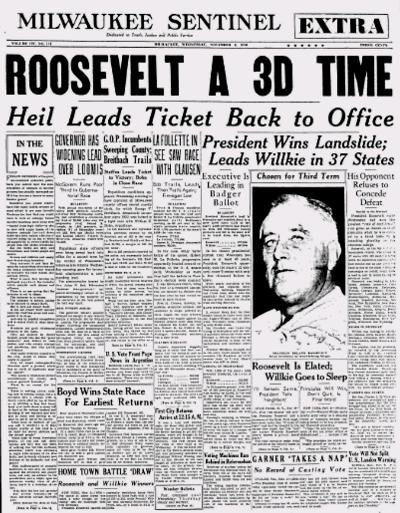
FDR Wins Third Term, 1940

Seventy-five years ago today, November 5, 1940, it was the first Tuesday after the first Monday in November, and Roosevelt was elected to an unprecedented third term as President.

Click Here For Today’s Ripley’s Believe It Or Not Cartoon



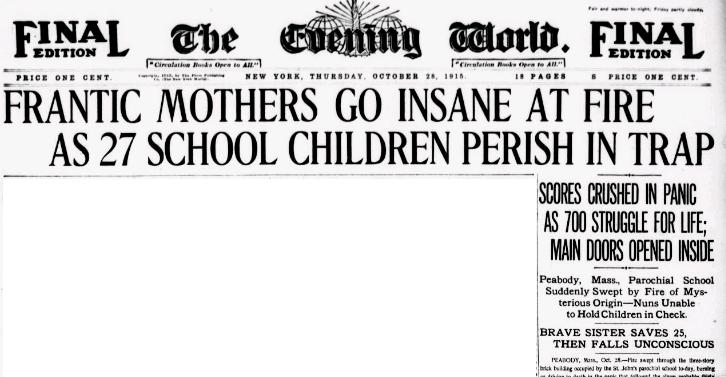
St. John’s School Fire, Oct. 28, 1915

One hundred years ago today, twenty-one girls between the ages of 7 and 17 were killed in a fire at St. John’s School in Peabody, Massachusetts. Under the school’s established fire procedure, most students were to leave the building through a rear exit. But because the route was blocked by thick smoke, most instead tried to exit through the front door, where they became blocked in the vestibule. A major contributing factor was the fact that the front doors opened inward. The crowded vestibule was soon engulfed in flames, and the entire building was soon fully engulfed.

Most students were able to escape through first-floor windows, or even by jumping from higher windows. The school’s teachers, nuns of the Sisters of Notre Dame, acted heroically, by dropping many of the students to improvised life nets made of coats and blankets.

One lesson learned from this fire was that the exit doors of public buildings need to open out to avoid bottlenecks in case of fire. In the wake of the fire, Peabody became the first city to impose this requirement.

Every school with which I have been involved takes fire safety very seriously, and it is natural to ask the question of how successful these efforts have been. In other words, how often do we see a headline like the one at the top of this page?

The answer is that school fire safety has been extraordinarily successful. In the past half century, zero American schoolchildren have been killed by fires. There have, of course, been fires. But in over fifty years, there has not been a single fire fatality. Not a single one. And when we stop to think of why this is true, we can learn some lessons that will help prevent other tragedies.

The important thing to remember is that we cannot point to a single magic bullet that has prevented school fires. There is no one thing that we did to prevent them. We did a lot of things. And when we did them, we didn’t waste time worrying that we shouldn’t do them because that one thing wouldn’t prevent all fire fatalities.  Nobody would call us paranoid for taking all of those precautions against something that hasn’t happened in 50 years.  And nobody would argue that we shouldn’t take fire precautions because they might scare the children.

In the St. John’s fire, the critical lesson learned was that doors to public buildings should open out. But no sane person would stop there and conclude that by changing the doors on the school that we could prevent fire deaths. We fixed one safety hazard, but continued identifying other hazards. Here are some of the other things we have done for school fire safety over the years:

  • We use fire-resistant building materials.
  • Students and staff have routine fire drills.
  • Firefighters are familiar with the layout of the schools in their area.
  • Exits are well marked and the exit signs have backup power.
  • Adequate fire hydrants are in place near schools.
  • The locations of fire stations take into account proximity to schools.
  • Fire extinguishers and fire alarms are required.
  • Most schools are equipped with sprinklers.

There are probably others that I’ve forgotten. But you get the idea. We haven’t had any fire fatalities because we have multiple redundant layers of protection. And nobody says that doing all of these things makes us paranoid. We’ve had zero fatalities because we do them.

During the same half century of extraordinary success in school fire safety, there have been more than 300 deaths from school shootings.  Security expert Lt. Col. Dave Grossman makes the compelling case that we have to stop being in denial about school violence. Invariably, in the wake of a school shooting, the inclination is to come up with a single solution that will prevent the next one. But we need to take the same approach that we do to fire safety: What we really need are multiple redundant layers of protection. Some of the possibilities suggested by Grossman include:

  • Have an (armed) police officer in the school.
  • Have a single point of entry to the building and classrooms.
  • Have regular drills
  • Allow police officers to carry weapons off duty. Grossman points out that nobody considers it paranoid for an off-duty firefighter to have a fire extinguisher in the trunk of the car when dropping his or her kids off at school. And it would be no more paranoid for a parent who was a police officer to be prepared.
  • Equip all patrol officers with rifles and smoke grenades.
  • Be prepared to use fire hoses to deal with active shooters.
  • Finally, Grossman points out that “armed citizens can help.”

Will any one of these steps prevent every possible school shooting scenario? No. Having a police officer in the school is not the one magic bullet that will prevent every school shooting. Having the responding officer equipped with a rifle in his or her trunk is not the one magic bullet that will prevent every school shooting. And having a handful of random citizens armed is not the one magic bullet that will prevent every school shooting.

But having sprinklers is not the one magic bullet that will prevent every fire death. Having fire drills is not the one magic bullet that will prevent every fire death. Having doors that open out is not the one magic bullet that will prevent every fire death. But we did all of those things anyway, because if we do all or most of these things, then it is very likely that these multiple redundant precautions together will prevent most fire deaths. The last half century of American history proves that this is true.

A hundred years ago, when 21 girls were killed in a school fire, we learned one lesson, but we also kept on learning our lessons. Lessons were learned from the fire at Our Lady of the Angels School in Chicago on December 1, 1958 when 95 were killed. The net result is that we have learned these lessons, and we continue to have multiple redundant layers of security to prevent them. And because those measures have proven so successful, we keep at it.  Nobody says that we’re paranoid.  Nobody tells us to stop because we’ll scare the children.  We simply do what we need to do because it works.

According to findagrave.com, these are the names of the girls killed in the fire a hundred years ago today:

  • Agnes Ahearn
  • Mabel Theresa Beauchamp
  • Helen Theresa Bresnahan
  • Florence Burke
  • Nellie Elizabeth Carty-Burns
  • Patroni Chebator
  • Elizabeth Comeau
  • Catherine M. Compiano
  • Ann Daleski
  • Florence Doherty
  • Mary Ida Essaimbre
  • Mildred Fay
  • Marion Hayes
  • Annie Jones
  • Helen Keefe
  • Annie L. Kenney
  • Mary Elizabeth McCarthy
  • Mary Meade
  • Elizabeth Nolan
  • Annie E. O’Brien
  • Catherine M. O’Connell

At that same site, you can view the statue erected in 2005 in memory of the girls who were killed. It depicts two of them in the embrace of their Saviour.

Click Here For Today’s Ripley’s Believe It Or Not Cartoon


See Us at Freedom2015, Nov. 6-7, Des Moines

When we’re not busy posting pictures of old radios, one of our more serious concerns is the state of religious liberty in America.  Therefore, we will be attending Freedom2015, a religious liberty conference in Des Moines, Iowa, Friday November 6 and Saturday November 7.  The conference has a number of nationally recognized speakers scheduled, including presidential candidate Ted Cruz.  If you’re attending, please look for me.  I’ll probably be wearing my bright yellow OneTubeRadio.com shirt.

One of the conference sponsors is Samaritan Ministries, about which I’ve written in other posts.  If you plan on attending, please let me know so that I can say hello!

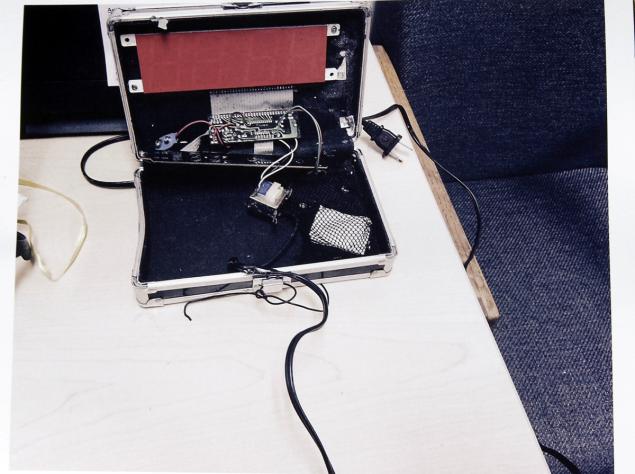
Ahmed’s Clock

Irving, TX, Police Dept. photo, via NY Daily News.

Irving, TX, Police Dept. photo, via NY Daily News.

Ahmed Mohammed is a bright 14-year-old student in Irving Texas.  He made the digital clock shown above in a pencil case, and this week brought it to school.  He showed it to one teacher who was impressed.  He then put it away in his backpack, but it started beeping during another class.

The other teacher apparently believed that bright kids shouldn’t bring unusual looking things to school.  The principal was called, and then the police were called.  Ahmed was arrested for having what someone believed to be a “hoax bomb.”

Nobody thought it was a real bomb.  Ahmed didn’t think it was a hoax bomb.  It was a clock, and it presumably told time.  He told the police that it was a clock.  He didn’t elaborate any further, because there was nothing to elaborate about.  He could have said that it told time, but presumably the cops in Irving, Texas, already knew that clocks told time.  But because he didn’t elaborate further, he was arrested.

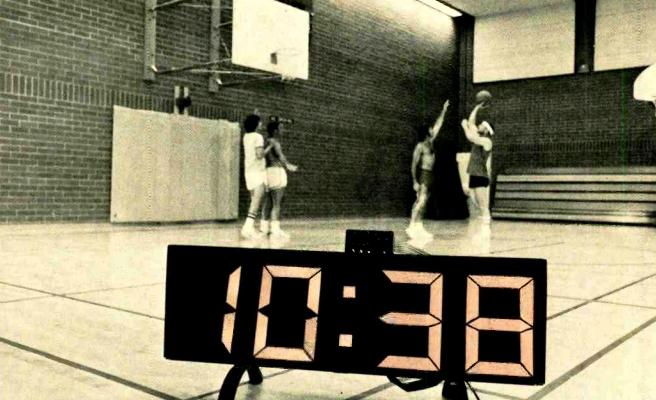
Last month, I posted on this site the digital clock shown below in a 1975 picture.

1975Scoreboard

As you can see, this clock is just like Ahmed’s, just a lot bigger.  As you can see, there are students in the background, and they don’t appear to be freaking out because there’s a big homemade clock in the room.  The teacher wasn’t alarmed.  The principal wasn’t alarmed.  The police weren’t alarmed.  They realized that it was a homemade clock, built from plans in a magazine.  And even though it presumably had a much greater explosive potential than Ahmed’s clock, nobody was concerned.

In 1975, there was nothing wrong with a kid making something unusual and bringing it to school.  Today, a kid might get arrested for doing the same thing.  And it’s a damn shame.

Stop it, people.  Use a little bit of common sense for a change.

Click Here For Today’s Ripley’s Believe It Or Not Cartoon


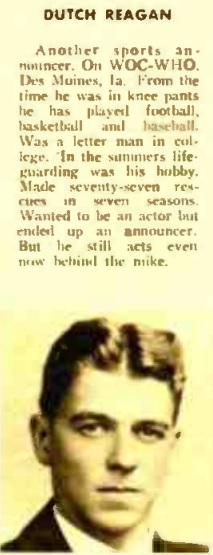
Ronald “Dutch” Reagan, WHO Radio, 1934

1934ReaganIn 1932, Ronald “Dutch” Reagan walked into WOC Radio in Davenport, Iowa, looking for a job as a sports announcer. He was given an audition at the conclusion of which he was told, “you get five dollars and bus fare to Iowa City. You’re doing the Iowa-Minnesota game.” (Minnesota won 21-6.)

WOC was co-channel with WHO in Des Moines, and the two stations were under the same ownership. When attempts at synchronous broadcasting proved unfruitful, WHO’s power was increased to 50,000 watts and operations took place from Des Moines. Reagan was transferred there in 1933, and worked for the station until 1937, eventually becoming sports director.

Here, Reagan’s photo and brief biography are as they appeared in the April 1934 issue of Radio Stars magazine.

References


America Needs You, Harry Truman/Mister, We Could Use a Man Like Herbert Hoover Again

Seventy years ago today, President Harry Truman sent this handwritten letter to former president Herbert Hoover, inviting him to come to the White House to discuss the brewing humanitarian crisis in Europe.  With the war in Europe over, the population would need to be fed.

As Hoover would put it the next year, “we do not want the American flag flying over nationwide Buchenwalds,”

In making this invitation, Truman set aside partisan differences to seek out the man with a proven record in fighting wartime hunger.  Both during and after the First World War, he had headed American relief efforts.  They started in 1914 assisting Americans who had found themselves stranded in Europe at the outbreak of war.  From his own resources, he made loans and cashed checks for Americans.  He went on to save millions of lives, first in Belgium, and then elsewhere in Europe at the war’s end.

It was a welcome change.  In the days following Pearl Harbor, President Roosevelt had summoned adviser Bernard Baruch and asked who was best fit to organize the home front.  Baruch quickly replied that Hoover would be best suited, but the suggestion was rebuffed.  Since Hoover was a convenient scapegoat throughout Roosevelt’s presidency, Roosevelt reportedly replied, “I’m not Jesus Christ. I’m not raising him from the dead.”

After Truman’s summons, Hoover approached the problem the same way he had approached it during and after the First World War, as an engineering problem.  He set out on a tour of Europe to determined the needs and resources of each country, and saw to it that resources were directed appropriately.

There was a lifetime friendship between the two presidents.  Truman spoke at the dedication of the Hoover presidential library in 1962 and told the crowd, “I feel sure that I am one of his closest friends and that’s the reason I am here.”  Later that year, Hoover wrote to Truman:

Yours has been a friendship which has reached deeper into my life than you know.  I gave up a successful profession in 1914 to enter public service. I served through the First World War and after for a total of about 18 years. When the attack on Pearl Harbor came, I at once supported the President and offered to serve in any useful capacity. Because of my various experiences . . . I thought my services might again be useful, however there was no response. My activities in the Second World War were limited to frequent requests from Congressional committees. When you came to the White House, within a month you opened a door to me to the only profession I know, public service, and you undid some disgraceful action that had been taken in prior years.

Truman had the letter framed and placed on his desk at the Truman library.

Harry, is there something we can do to save the land we love?

References

Read More at Amazon

Click Here For Today’s Ripley’s Believe It Or Not Cartoon


March 8, 1965: Vietnam War and Civil Rights

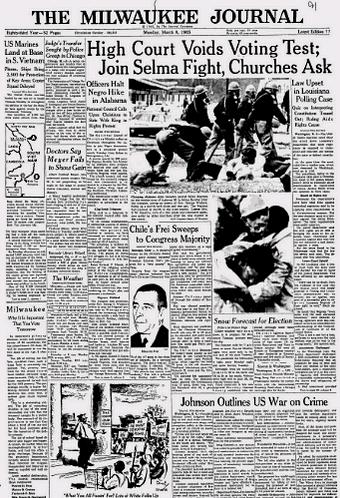
MilwJournal030865

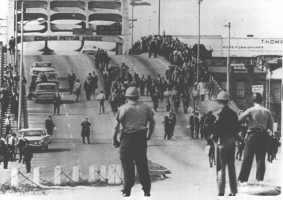
Fifty years ago today, it was anything but a slow news day, as shown by the front page of the Milwaukee Journal, March 8, 1965.

In the left column, almost lost in the clutter, is an article with the headline, “US Marines Land at Base in S. Vietnam,” which reported that 3500 U.S. Marines from the Third Marine Division at Okinawa had landed at Da Nang, or were in the process of arriving. This marked a major escalation in U.S. involvement in the war. In 1964, there were about 16,500 American servicemen in Vietnam. The March 2 attack on the U.S. Marine barracks at Pleiku marked the initiation of a three year bombing campaign, and a rapid escalation of U.S. forces on the ground. These 3500 Marines arrived on March 8, marking the beginning of the ground war. At the time, U.S. public opinion overwhelmingly supported their deployment. By the end of 1965, there were 200,000 U.S. servicemen in Vietnam.

"Bloody Sunday" in Selma, AL, March 7, 1965. Wikipedia photo.

“Bloody Sunday” in Selma, AL, March 7, 1965. Wikipedia photo.

But the escalation of the war was dwarfed by other news. The photo shows not fighting in Vietnam, but on the streets of Selma, Alabama. According to the caption of the UPI photo, it shows “charging Alabama state troopers passing fallen Negroes on the median strip after the troopers, acting on orders of Gov. George Wallace, broke up a march with clubs and tear gas. The Negroes had planned to march to the state capitol.” The article notes that the march consisted of “600 praying Negroes” and had been “broken up by Alabama state troopers and deputies who used clubs, whips, ropes and tear gas. Sixty-seven Negroes were injured.” An FBI agent filming the troopers was also injured after being attacked by a group of white civilians.

The paper reported that the National Council of Churches had called upon Christians throughout the nation to join the demonstrators in another march scheduled for the following day. Catholic authorities were conferring on a plea from Rev. Martin Luther King and promised a statement as well. Rabbi Richard G. Hirsch of the Union of American Hebrew Congregations also announced that he planned to attend the march.

A number of race-related decisions from the U.S. Supreme Court were announced in the paper. The banner headline went to announcing the decision in Louisiana v. United States, 380 U.S. 145 (1965). Louisiana had vested in its election registrars virtually unbridled discretion in administering an “interpretation test” to prospective voters. Under the state law, in order to register, a voter was required to read, “be able to understand” and “give a reasonable interpretation” of any section of the state of federal constitution. According to the Court, there was ample evidence that the provision was used as a ruse to deprive otherwise eligible African-American voters of the right to vote. The court noted that “colored people, even some with the most advanced education and scholarship, were declared by voting registrars with less education to have an unsatisfactory understanding of the Constitution of Louisiana or of the United States. This is not a test but a trap, sufficient to stop even the most brilliant man on his way to the voting booth.”

The Supreme Court unanimously affirmed the district court’s striking down of this provision.

The front page also contained an editorial stressing the importance of voting in a school board primary to be held the following day. To drive home the importance, the front page cartoon shows a stereotypical southern politician addressing a group of African-Americans protesting for voting rights. He’s telling them: “What you all fussin’ for? Lots of white folks up north don’t think voting’s important.” And he was probably right. The paper notes that only 11% of registered voters bothered going to the polls in the 1963 primary.

Finally, the paper reported that President Johnson had asked congress for help in the “War on Crime.” He asked for a ban on mail-order firearms, tighter control over drugs, and for provisions to “strengthen safety in the streets” with “development and testing of experimental methods of crime control.”


Fare For All: A Nonprofit that Makes Cents

Review of Fare For All

For those of you who were following me during the SNAP Challenge, you recall that I ate for a week with less than $31.50 per week in groceries, the average amount received by SNAP (formerly known as Food Stamp) recipients.  It wasn’t particularly difficult, but you undoubtedly noticed that I didn’t have much in the way of meat, and I didn’t have any fresh produce.   This year, that was even more true, since I relied almost entirely on foods that could be used for emergency food storage.  But even the previous year, when I had the run of the supermarket, these items were mostly lacking, simply because they were too expensive.  People having to feed themselves on a tight budget often can’t afford these items.

FareForAllI recently became aware, however, of a non-profit organization called Fare for All.  They are part of The Food Group,  formerly known as Emergency Foodshelf Network.  But Fare for All is not a foodshelf.  They are more like a cooperative that purchases food wholesale and sells it to the public.  They rely on volunteers, and they have distribution locations at neighborhood locations such as churches and community centers.  Each month, they put together pre-packaged baskets of food which they sell at a fixed price.  The exact contents of these baskets vary from month to month.  They have two main products.  The first is a produce package consisting of fresh fruits and vegetables, which sells for $10.    The second is a meat package consisting of about four meat and fish items, which sells for $11.  If someone buys both packages together, the total price is discounted to $20.

Here are the two packages that were for sale this month.  First, here is the $10 produce package:

20150217_161854

I didn’t price this at the supermarket, but it seems like it would cost considerably more than $10.  (The large loaf of bread shown to the right is also included for those purchasing both packages together.)

The $11 meat package is shown below.  It consists of turkey sausage (about 13 ounces), frozen fish, chicken breasts, and frozen meatballs.

20150217_161132

Some months, additional items are available.  For example, in November and December, they have holiday packages containing a turkey or ham, as well as other items, for $30.  They apparently had some left over, and were selling them this month for $27.  In addition to the ham, they included a whole chicken and some other items.

20150217_162404

I decided to check them out today, so I visited one of their distribution sites to buy some of their food.  Of course, I was already thinking the question that they probably get asked a lot, since it’s on their FAQ’s:

Q: If I purchase food through this program, am I taking away food from someone else who may need it more than I do?

A: Absolutely not. The more people who participate in Fare For All, the more purchasing power the program has. This means that greater savings will be passed onto our customers.

Emboldened by this reassurance, I decided to give them a try.  I purchased the items shown above:  One produce pack, one meat pack, and one holiday pack.  The total was $47.

The process is quite simple.  Their website lists their sites and gives the dates and times.  Most of the locations are open one day a month for about two hours.  Most are during the day, but some are evenings.  They have about 30 sites in the Twin Cities and outlying areas.  The closest one to me was Real Life Church in Roseville, although there are others that are conveniently located in Minneapolis, St. Paul, and suburbs.  That church appears to be affiliated with the Assemblies of God, but the distribution event was not in any way geared toward proselytizing.   In fact, the volunteer I spoke with wasn’t affiliated with the church himself.  The church appears to serve mostly as a location for the distribution.

The event began at 3:00, and I arrived at about 3:30.  There was a short line, but I only had to wait about five minutes.  Samples and photos of the various baskets are displayed, and you pick out which package(s) you want.  At the end of the line, you pay, and you’re given a ticket which you hand to another volunteer.  (They accept cash, credit and debit cards, and EBT cards.)  The volunteer then loads up your cart, and another volunteer helps you take it to your car.

You get your food in a sealed box, so I was slightly skeptical that the produce inside might be blemished somehow.  But it wasn’t, as you can see from the photos above.  They look like the same ones I would have picked out from the display at the supermarket.  The only difference seems to be the price.

On the way out, those making a purchase above a certain amount pick out a free loaf of bread.

Overall, this program performs a very real service to the community:  It makes high-quality food available to all at a reasonable price.  Furthermore, I’ve only been able to find one negative thing said about Fare For All.  A 2012 Pioneer Press article contains reports from a few naysayers who believe that this is unfair competition to retailers.  They don’t mind poor people buying food from a nonprofit, but they think that people should have to qualify by being poor enough.

I don’t think that criticism is well founded.  Fare for All does have a clear price advantage.  But retailers can still compete easily, because of wider selection, more convenient hours, and any other advantage they can think of.  For-profit corporations are quick to point out that a nonprofit such as Fare For All is tax exempt.  However, a for-profit corporation pays income taxes only on its profits.  If a cooperative organization voluntarily decides to operate on a non-profit basis, there are no profits to tax.  Grocery stores pay property taxes, but since Fare For All is operating from its locations only a few hours a month, any lost property tax revenue is minuscule.

It seems to me that there are some great advantages of having this program open to everyone, regardless of need.  First of all, there is absolutely no stigma associated with it.  I have no idea whether the other people in line were low income persons who desperately needed the food, or whether they are simply taking advantage of the reasonable price.  I assume most were in the latter category.

And more importantly, having the program open to all makes the program more economical for everyone.  As the Fare For All website points out, the additional buying power benefits everyone.  If nonprofits were required to “stick to helping the needy,” as one critic said they should, this would actually add more costs, as the nonprofit would have to verify need.  The end result would be that the truly needy would receive less and pay more.

With its current model, it seems to me that Fare For All is a win-win situation for all.