Author Archives: clem.law@usa.net

Belgian Carrier Pigeons, 1914

CarrierPigeons

Radio was coming to the fore as a method of communication during the great war, but the tried and true methods of the past were still being used. A hundred years ago today, the Philadelphia Evening Public Ledger for September 23, 1914, shows a carrier pigeon, which the paper notes were being used with great success by the Belgian Signal Corps. This bird is shown before its release containing a coded message. The french words bois (woods), pont (bridge) and cole (mine) are included in plain text.

In other war news, the paper reports that 31,200 Canadian troops, along with 7500 horses would be sent to Europe within the week, to be sent to the front immediately. In addition, the Canadians planned to recruit 19,000 more men who would be sent to the front before November.


The 1914 Victrola

VictrolaAd

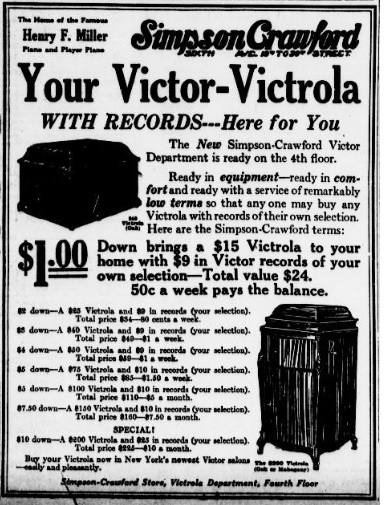
A hundred years ago, owning a phonograph was a reasonably priced proposition. This ad, from the September 10, 1914 edition of the New York World, advertises that you can purchase a $15 Victrola, along with $9 worth of records, for only a dollar down and 50 cents per week.

Today, you can listen to most of those records online, since the Library of Congress National Jukebox has them available for download or online listening. The audio quality today, as it was a century ago, is surprisingly good, and much better than most people expect.


Legislator Missing in Action

20140920_150255


UPDATE (Oct. 13):  After my letter to the editor detailing this incident appeared in the Roseville-Little Canada Review newspaper,  I did get a phone call from Rep. Hausman. I wasn’t home, but she left a message on my answering machine, and I followed up by e-mail. She told me that she hadn’t received my three letters. At first, she was under the impression that I had sent them by e-mail or left a voicemail. I explained that I had sent them by “snail mail” to her campaign address as listed on the Campaign Finance Board website.  I had sent them to the Commonwealth Avenue address listed on that site.

In a follow-up e-mail, she thanked me for the information, and told me that the Commonwealth address was that of her former campaign treasurer. She said that the former treasurer had become too busy and “we had to change treasurers.” She also stated that the information had been corrected with the campaign finance office. This explanation seems plausible, since the Campaign Finance Board site lists the new treasurer’s name, with a different address. But for the campaign’s main address, it continues to list the old treasurer’s home address, presumably in error.

A check of the campaign finance reports shows that the treasurer changed sometime in 2014. A report filed on January 29, 2014,  shows the old treasurer’s name and the old address. A report filed on July 28, 2014, shows the new treasurer’s name and the new address.

So this is quite possibly a case of an innocent mistake at the Campaign Finance Board. And I can tell you from experience that the job of campaign treasurer is both thankless and involves a lot of work.

But it still seems troubling to me that the outgoing treasurer apparently didn’t see the importance of forwarding to his candidate three pieces of first-class U.S. Mail. The address on the Campaign Finance Board website, even if it’s wrong, is still the one they have in their records, and important mail presumably gets sent to that address. And even if they did so incorrectly, the state published that address as being that of the candidate’s committee. At the very least, this episode represents a serious lapse in responsibility on the part of the campaign, one that kept Rep. Hausman insulated from her constituents.

I do appreciate the fact that Rep. Hausman took the time to call me and follow up. And I’m sure she’ll be on the phone tomorrow morning to the Campaign Finance Board to correct the error on their website. But I still think this reflects poorly on how she relates to her constituents.


I believe that local politicians should be accountable to their communities and be willing to listen to their constituents’ concerns.  Unfortunately, I don’t believe that Rep. Alice Hausman shares that value.

This afternoon, my wife and I hosted an ice cream social to give our friends and neighbors the opportunity to meet both candidates for this November’s legislative race, Rep. Hausman and her challenger, retired educator Jon Heyer.  I previously posted an invitation on this blog and on my law office website, and I thank those of you who were able to attend.

Both candidates were given flexibility with regard to scheduling the event.  We mailed a letter to each of the candidates in which we proposed four possible dates.  We included a postage-paid reply postcard and asked the candidates to return the card if one of the dates did not work for them.  We also included our phone number and e-mail address.  Jon Heyer returned the postcard indicating that he was unavailable one of those dates.  We received no response from Rep. Hausman.

We then scheduled the event, and mailed an invitation to each of the candidates.  We even sent a third letter reminding them of the date, and offering each of them the opportunity to bring a campaign sign, and to distribute any campaign literature.  All of the letters we sent to both candidates were addressed to their campaign committee addresses as listed on the website of the Minnesota Campaign Finance and Public Disclosure Board.

Jon Heyer meeting with voters.

Jon Heyer (right) meeting with voters.

We were pleased to have Jon Heyer attend and speak to our friends and neighbors.  Even though many of those people were Alice Hausman supporters, they now know that if Jon Heyer is elected, they will have a representative who is willing to listen to their concerns.

Unfortunately, if Representative Hausman is re-elected, her constituents will not have the same opportunity.  She did not attend the event, nor did she tell us that she was unable to do so.  She didn’t even supply any campaign literature.  I took it upon myself to print out her website, and this was the only contact she had with her constituents.

This is not the first time that Representative Hausman has failed to respond to constituent concerns.  In March, I sent her an e-mail with my thoughts concerning the proposed constitutional amendment regarding judicial elections.  As an attorney, I believed that I could provide some insight into the measure.  I previously wrote about that subject on this blog, and I think I raised an important point that had been overlooked by both sides in that debate. It is quite possible that Rep. Hausman disagreed with my views, but I will never know for sure.  I never received any response whatsoever to my e-mail.

Representative Hausman has served in the Legislature for a quarter century.  It could be argued that she has already done her share of meeting with grassroots voters over long legislative career.  Unfortunately, however, most of her service in the Legislature has been in a district that is very different from the one she now represents.  For her first 23 years in the Legislature, she represented a district covering St. Paul.  But after 2012 redistricting, she now represents Roseville, Falcon Heights, and Lauderdale, along with the tiny sliver of St. Paul in which she and I happen to reside.  Her district is now very different from what it was for the first 23 years of her service.  If she wishes to represent her new very different district, then she needs to make a conscious effort to listen to the concerns of her new constituents.  She has shown me twice that she is not willing to do that.

Jon Heyer also lives in St. Paul, but he grew up in Roseville.  And more importantly, he has shown that he is willing to take the time to meet with constituents, whether they live in Roseville, Falcon Heights, Lauderdale, or St. Paul.  He has earned my vote, and that of many of my neighbors.



Army Signal Corps Field Buzzer, 1916

U.S. Army Signal Corps Field Buzzer.  Technical Equipment of the Signal Corps: 1916.

U.S. Army Signal Corps Field Buzzer. Technical Equipment of the Signal Corps: 1916.

A hundred years ago today (September 21, 1914), the Calumet (Mich.) News carried an article entitled, “Communication Big Factor in Modern War Machinery,” which explained the technological developments in communications in use in modern warfare. The article runs down the developments in telegraph, telephone, and wireless in use in the war.

One that caught my attention was a rather ingenious telephone-telegraph that was used in situations where the lines were in poor shape. As the article points out, lines near the battlefield “are often laid at high speed, are of high resistance and are frequently leaky.” In those cases, it described a “special instrument known as the buzzer.”

It describes the instrument as a metal-lined leather case with a dry battery, induction coil and interrupter, key, telephone transmitter, and telephone receiver. It could be used as a field telephone, or by use of the buzzer, the key could send out an intermittent current which would traverse the line where the distant receiver would give out a sharp note. Thus, the telephone could be used to send Morse code via audio.

It notes that these “Morse signals are audible over an incredibly bad line.” It cites one case where a signal was successfully sent over bare wires lying on wet ground.

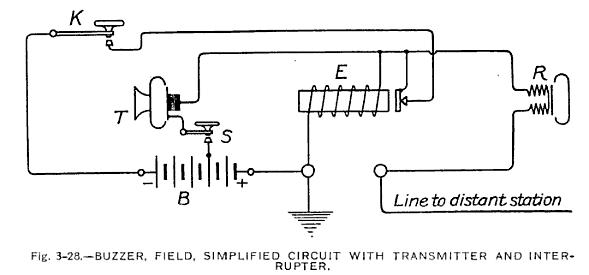
The schematic of the instrument is shown here:

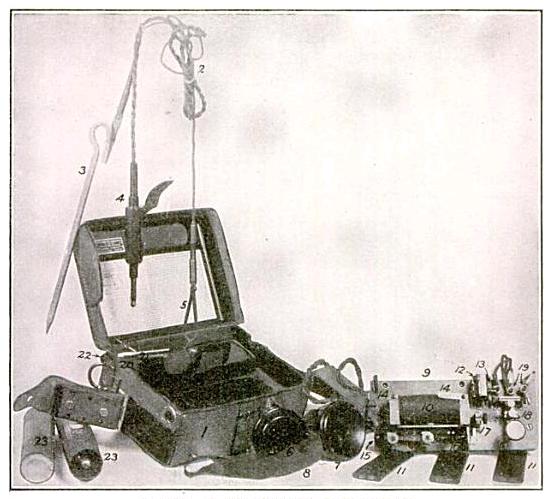
The field buzzer itself is shown above as it would be carried, and it is shown dismantled here:

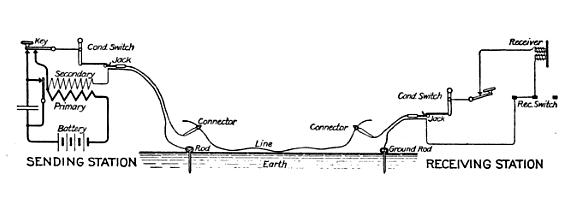
This diagram of a typical hookup of the buzzer shows its use with a line of dubious quality:


References

Camp Telephone for the Army, Telegraph and Telephone Age, July 1, 1917, page 302.


Free Ice Cream Social!

If you live in Minnesota house district 66A (Falcon Heights, Lauderdale, most of Roseville, and parts of St. Paul), you are invited to attend an ice cream social to meet both candidates for this November’s election.  Rep. Alice Hausman and Mr. Jon Heyer are both expected to attend.  For more details, click here.  It’s Saturday, September 20 at 2-4 PM.

Battle of Mons, 1914

BattleOfMons

This dramatic illustration, apparently a photograph, appeared in the Washington Times a hundred years ago today, September 20, 1914.

The picture was probably taken on August 23 at the Battle of Mons, Belgium. While the Germans ultimately forced a British retreat, the suffered heavy losses as they attempted to cross the Mons-Conde canal on pontoon bridges.  The ultimately successful Germans suffered over 5000 casualties, while the British defenders suffered 1638.


Acting Bears Come to Indy, 1864.

ActingBears

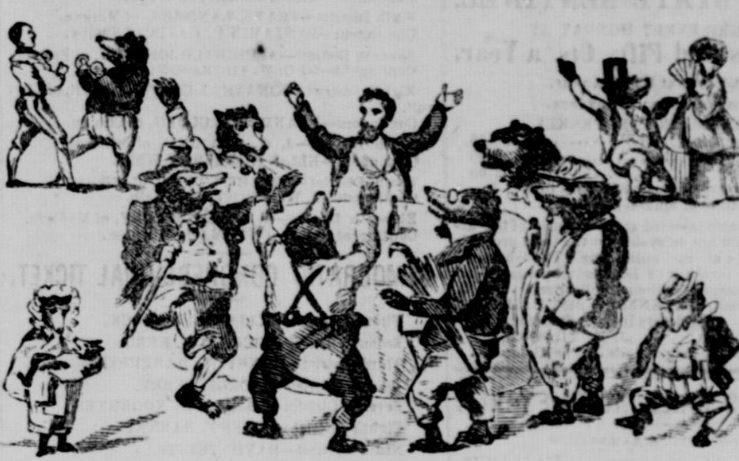
150 years ago today, Hoosiers were undoubtedly excited by the soon to arrive circus. But this wasn’t just any circus. The acting bears depicted here (realistically, no doubt) were but one of the many attractions to be featured at what was billed as “positively the largest exhibition of the amusement world,” The Monster Equescurriculum! It was going to be an immense and unparalleled combination, heralded here in the September 19, 1864, edition of the Indianapolis Daily State Sentinel.

The bears shown here were “Old Grizzly Adams’ Troupe of Acting Bears, from California.”  Adams himself, it would appear, wasn’t traveling with the bears, since he died in 1860 from a succession of injuries caused by the bears (and in one case, a monkey).  The bear depicted on the California state flag is apparently one of Adams’ bears.  It is not known whether that bear was one of the bears to visit Indiana, although the bear wearing a top hat bears a strong resemblance to the one on the flag.

But according to the announcement, since the combination of acts is such as had never before been attempted by private enterprise, it gave notice that the management will be “pardoned for directing attention to the fact that this magnificent phalanx of exhibitions not only combines and infinitely greater degree of novelty, variety and effect within itself than can be found in any other place of amusement in the world, but also a nearer approach to perfection in every detail.” It also notes that the performance entailed such an enormous expenditure of money that only the most liberal patronage could render it remunerative.

Admission for one of the four performances was fifty cents, 25 cents for children under 12.


1939 British Gasproofed Room

Life18Sep39

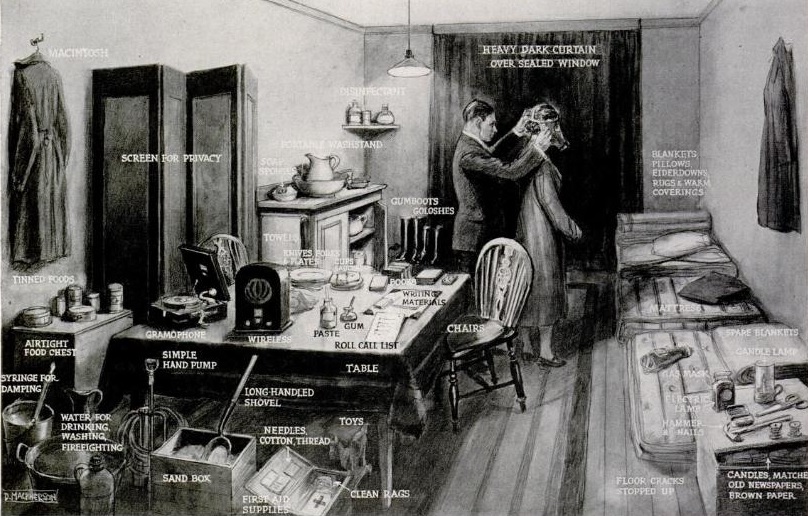
Seventy-five years ago today, September 18, 1939, Life Magazine carried this illustration from the British Home Office showing a basement room equipped and gasproofed. The caption notes that if the occupants remain quiet, there will be enough oxygen in the sealed room to accommodate five persons for twelve hours.

Presumably, the gramophone is to keep you entertained between bulletins from the wireless.


Allied Radio Newspaper Ad, 1964

AlliedAd17Sept1964

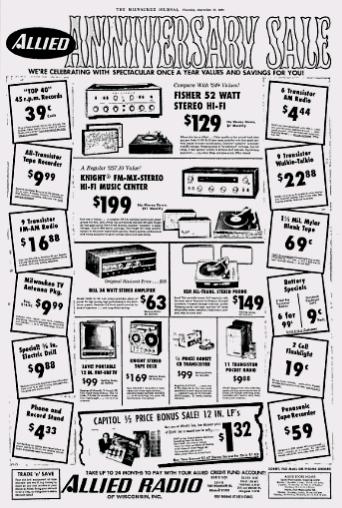
We didn’t have an Allied Radio store in my neighborhood, but they were still big in 1964, as evidenced by this full-page newspaper ad fifty years ago today, in the Milwaukee Journal, September 17, 1964.

Having good stereo gear was a rather expensive proposition. A turntable, amplifier, and speakers would set you back $129. A set including an AM-FM stereo receiver was $199. A twelve-inch black and white TV was $99.

A 3-1/4″ reel-to-reel tape recorder was available for only $9.99 (limit one to a customer). For the serious audiophile, a stereo tape deck was $169. Transistor radios started for $4.44. The nine-volt batteries for that radio were six for 99 cents, and flashlight batteries were nine cents each, but both limit 6 per customer.

While those prices appear modest, 1964 was the last year that that money was made out of real silver. By comparison, other ads in the same issue show that you could buy a case of beer for $1.79. At the Walgreen’s lunch counter, you could get a turkey dinner for 65 cents. Tires for your car started at $5.99. And at the supermarket, chuck roast was 45 cents a pound, carrots and bananas were a dime a pound, and five pounds of flour was 42 cents.

One would think that very few products made by Gonset showed up in normal commercial newspaper advertising, but this is a case where one did.  The ad shows the Gonset G-15 CB transceiver, normally $199.95, on sale for $99.  The 10-tube radio had four crystal-controlled channels, and its receiver tuned all 23 channels.  It operated on either 120 volts AC, or 6 or 12 volts DC with its built-in vibrator power supply.