Author Archives: clem.law@usa.net

The Millionth of an Inch Girls: 1943

MillionthOfAnInchGirls

The New York war workers shown here are the “millionth of an inch” girls of Reeves Sound Laboratories. They are etching quartz crystals to set the exact transmitting frequency of the completed crystal.

Prior to World War 2, quartz crystals were not manufactured in large quantities. But wartime needs called for crystals in massive quantities. One of the manufacturers that went to work to fill the need was Reeves Sound Laboratories of New York City. In October 1942, the company procured the equipment and leased a former furniture warehouse at 52 West 47th Street, near Times Square. In the first month of production, the company turned out sixteen crystals. The company had a contract to ship 1600 crystals by the end of December, and actually shipped 2200. By February, it was shipping 8700 per month.

The whole painstaking process of turning raw quartz from Brazil into precisely cut crystals can be seen in the army film in the video below. The purity of the crystal, the angle of the cut, and the exact thickness of the crystal are all critical in determining the crystal’s operating frequency. The “millionth of an inch girls” shown above were the last step in the manufacturing process. They carefully etched the crystal by hand that last millionth of an inch while checking their work with an oscillator showing whether the crystal was on frequency. It was highly skilled, but also highly monotonous, work.

https://www.youtube.com/watch?v=b–FKHCFjOM

References

Read More at Amazon

Click Here For Today’s Ripley’s Believe It Or Not Cartoon


The First CB Transceiver

StonerArticle

In an earlier post, we saw the Heathkit CB-1 CB transceiver.  The CB-1 was actually released before its more famous amateur radio cousins, the Sixer, Twoer, and Tener.  And it turns out that the CB-1 was actually copied from a popular construction article.

Kathi Martin, 1975.

Kathi Martin, 1975.

I was unaware of this until I noticed an item in a 40 year old issue of Elementary Electronics magazine by CB radio editor Kathi Martin, KGK3916.  In her column “Kathi’s CB Carousel” in the May-June 1975 issue, she talked enthusiastically about the FCC’s proposal to establish a “communicator” class of amateur radio license.  The proposal was never adopted by the FCC, but Martin’s enthusiastic embrace of the proposal revealed what most hams believed to be true.  Licenses would be “yours almost for the asking,” and would open up the two meter band to the unwashed code-free masses.  And most tellingly, she admits what most hams already knew:  The FCC proposal for the communicator license, “if read carefully, is CB.”

The proposal never went through, mostly because hams resisted it for exactly that reason.  I’m sure I read her column 40 years ago, and if I did, I’m sure I was outraged by her frankness.

Time must have mellowed me a bit, since reading the article today, it is a good beginner’s look at what two meter FM was like in the 1970’s, and I can understand that CB’ers like Martin would have looked forward to the possibility of migrating from the bedlam that reigned on 11 meters in that era.

But I also noticed a reference that I hadn’t seen before: “If the CB clubs–and individual CB’ers–don’t louse things up with a big mouth [which apparently they did, since the proposal didn’t go through], we CB’ers are going to wind up with the best deal since Don Stoner’s magazine article ‘exposed’ class D CB to the general public–creating a billion-dollar industry.”

Having never heard of Don Stoner or his magazine article, I did some research and found it.  She’s undoubtedly referring to a construction article that appeared in the March 1959 issue of Radio News. (Stoner was licensed as a ham as W6TNS, and was involved in the first OSCAR satellite.)

CB radio took over the former 11 meter ham band (which had only come into being after the war, and was shared with diathermy machines) on September 11, 1958.  None of the major electronics magazines made much fuss about it initially.  It doesn’t seem to be mentioned in Popular Electronics until the March 1959 issue.  That article is a very matter-of-fact look at the new service, and a review of the few pieces of equipment that were then available.  Electronics Illustrated carried a few articles about the new service in the June 1959 issue.  In these articles, Electronics Illustrated went out of its way to stress that CB was not intended as a service for hobbyists nor as any kind of replacement for amateur radio.

Stoner’s article, however, announced the presence of the new bandwagon, and invited everyone to jump aboard.  He enthusiastically starts:

Did you know that now you can build a radiotelephone transceiver and talk on a short-wave band without having to obtain an amateur radio license? The recent FCC decision to open the 11-meter band to Class D Citizens Band operation makes it possible for anyone (except those under 18 and aliens) to own and operate a short-wave transmitting and receiving station.

He then goes on to point out that 11-meter signals “can travel to the far corners of the earth. It is not at all uncommon to hear stations coming in from clear across the country every day during the winter and on most days during the summer.” He even concludes the article by wondering “who will be the first to issue a certificate for ‘Worked All States–Citizens Band (WASCB)?”

Whether or not the FCC intended it, Stoner certainly let the cat out of the bag as to the hobby potential of CB radio.  And in the absence of much commercial equipment, he describes how to construct a 5-tube transceiver which is (with the exception of the power supply) identical to Heathkit’s later CB-1.

Even though the FCC probably didn’t intend it, Stoner was correct in his interpretation of the rules.  Those original rules failed to include a number of provisions that were added in later years.  For example, initially, licensees were allowed to build their own transmitters.  There was no explicit prohibition on hobby use.  And the restriction on maximum distance of communications did not appear in the initial rules.  So Stoner was right, and someone could very well have offered a WAS-CB certificate, and this would have been a perfectly legitimate activity.

Stoner’s design was apparently popular, as evidenced by Heathkit’s wholesale adoption.  In fact, it was so popular that the non-selective superregenerative receiver quickly became useless on the crowded band, and many of the CB-1’s were converted to six or two meters by hams.

(Any hams who are still bitter about the “loss” more than 50 years ago of a ham band that had only been theirs for a little over a decade should take note of one important fact:  Stoner’s transceiver is quite simple.  But it’s probably beyond the construction skills of most hams today.  Yes, the CB’ers of 1959 were probably more technically adept than hams today.)

It appears that Kathi Martin was right in her 1975 column.  The other electronics publications initially took a very cautious view of CB.  But it looks like Stoner’s article really was the one that exposed the unwashed masses to the possibilities of CB.

(The QST announcement of the end of 11 meters for hams can be found in the QST archive.)

Click Here For Today’s Ripley’s Believe It Or Not Cartoon



Art Imitates Life, 1945

CardboardRadio


If the cardboard radio shown here looks vaguely familiar, then you are a faithful follower of this blog. The photo on which this was inspired appeared in Life Magazine on December 11, 1944, and on this blog a few months ago.


The Life photo inspired modern dance students in Westchester County, New York, to compose a ballet based upon the photos in the Life article. This rendition appeared in the same magazine 70 years ago today, May 28, 1945.


Click Here For Today’s Ripley’s Believe It Or Not Cartoon
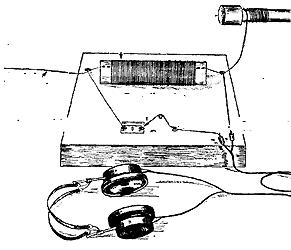


After my series on the Japanese Fu-Go fire balloons of World War II, a reader forwarded this cartoon, which appeared in the Chicago Tribune on August 8, 1945, about three months after the fatal Oregon attack.  It appears to be warning kids to stay away from unexploded bombs.  And while it doesn’t match exactly, the last panel sure looks to be bombs mounted on a balloon, complete with Japanese lettering on the side of the bombs.Balloon Bomb Warning


Thank you to Ed Maurus for sharing this!

FCC Reduces GMRS License Fee: Implications for Emergency Communications

2018 Update: This page was written in 2015, after the FCC reduced the fee for the GMRS license. GMRS remains a good option for many emergency communications applications.

You can obtain a GMRS license by mail or online. As with many bureaucratic activities, it’s somewhat more complicated than necessary, but not particularly difficult. The fee for the ten year license is currently $70. Just follow these steps:

Applying for the License Online:


You can read the full instructions at this page on the FCC website.  It’s basically a two-step process.  First, you will need to set up an account on the FCC Universal Licensing System (ULS).  When you do, you will receive an “FRN” (FCC Registration Number) and password.  If you have future business with the FCC, you’ll use this same account.  You will sign up at this page on the FCC website.

After you have the ULS Account set up, you will go to this page on the FCC website to start the application.  All of the questions on the application should be self-explanatory.

Applying for the License By Mail:

To apply by mail, you will actually need to send three separate forms from the FCC website:

Download form 605 first, since it contains most of the general instructions.  For more information, the full instructions can be found on page 9 of this FCC document.


On May 20, 2015, the FCC announced that it reduced the license fee for GMRS radio licenses.

This change has a significant implication for those looking for an inexpensive method of family communication, especially for emergency preparedness. The change allows hams and others to potentially provide an important service to their neighbors, at a very low cost.  To see how it’s important, we need to look at the history of GMRS radio, and the related FRS radio service.

FRS Radio

Inexpensive FRS radios.

In 1996, the FCC created the Family Radio Service (FRS), which allowed unlicensed use of UHF radios on 14 channels. millions of such radios were sold, and even the most inexpensive versions (often under ten dollars) provide quite reliable communications over short distances (less than a mile).

The FCC imposed a number of technical requirements for these radios. First of all, the maximum power allowed was 500 milliwatts (1/2 watt). In most cases, this low power is not a significant limitation. The most important limitation, however, was that the antenna had to be permanently mounted to the radio, with no method of connecting an external antenna.

This is a very significant limitation because on the UHF frequencies used by these radios, the main factor in determining distance is the height of the antenna. This is because UHF radio waves behave almost the same as light waves: they travel in a line of sight. Radio waves have some ability to penetrate obstructions, but this is very limited. Therefore, an FRS radio really has about the same range as a flashlight. If you can’t see the other radio, then you probably won’t be able to communicate with it. (Again, the radio waves can penetrate some obstructions, but this ability is very limited.)

If you have a flashlight in your hand, then you can’t be seen very far away, because the light beam will hit obstructions. And an FRS radio works under the same principle: Your signal won’t get out very far because it will hit obstructions. On the other hand, if you climbed a mountain with the flashlight, then it could be seen for many miles, because you would be up clear of the obstructions. And an FRS radio would work the same way. If you were on top of a mountain, then you would be able to communicate many miles, as long as the person at the other end was able to see the mountain off in the distance.

It’s usually not practical to climb a mountain to extend the range of your radio. However, it’s not the location of the radio that is important. The critical factor is the location of the antenna. There’s a reason why radio and TV stations spend money building expensive towers, and that reason is to increase the height of their antenna.

But this is not possible with FRS radios, because they are not allowed to have external antennas or any way to connect an external antenna. Therefore, their range was extremely limited.

One manufacturer cleverly exploited a  loophole to market an FRS radio with the functional equivalent of an external antenna. Radio Shack sold an FRS radio with an external microphone. The radio itself was sealed inside a unit that mounted to the top of a vehicle with a strong magnet. The antenna was permanently attached to the radio, so it met the FCC rules. But all of the controls were mounted on the microphone, which could be used inside the car. Having the antenna (and radio) on top of the car significantly extended the range of the unit.

GMRS

The General Mobile Radio Service (GMRS) dates back to the 1960’s. Initially, the equipment was very expensive, but it provided a very versatile method of communications. The rules allowed up to 50 watts, and external antennas were the norm. GMRS could provide reliable communication over many miles. Depending on local conditions (in particular, antenna height), a range of 20-50 miles would be quite common. But the equipment was rather expensive, and GMRS was never adopted to its full potential. Fifteen channels are assigned to GMRS. A license is required, and the license carried a fee. Given the versatility of GMRS, this was actually quite a bargain, especially considering that the equipment would cost hundreds of dollars.

When FRS radio was created in 1996, the situation soon changed. Seven of the fourteen FRS channels were shared with GMRS. In other words, an FRS user could talk to GMRS radios on channels 1-7. But there were relatively few GMRS users, and this option was rarely utilized. While they were compatible, the two services served different needs. GMRS used expensive equipment to communicate over fairly long distances. Most of the millions of FRS radios that were sold were used for very short-range communication, or even as children’s toys. While having the shared channels was probably a good idea, I don’t think the FCC anticipated how popular FRS radio would become, or how inexpensive the radios would be. The net effect was that the seven shared channels became cluttered with FRS users, and were generally avoided by GMRS users.

Some manufacturers, however, started marketing around the new possibilities. They started selling 15-channel portable GMRS radios, and the prices kept coming down. These units had the best of both worlds: They could use higher power than the FRS radios, but they could still communicate with the cheaper radios on 7 channels. And most importantly, they had provision for an external antenna. Therefore, they had the greater potential range of a GMRS radio.

When prices of such radios got less expensive, many users (probably most) started ignoring the licensing requirement. This is understandable, since from their point of view, they had in their hands a slightly better FRS radio, which probably cost less than $90. It made little sense to pay an additional $90 for a license, especially if they used only channels 1-7. While a license was technically required on these channels, it would be essentially impossible to tell whether the user was using a license-free FRS radio or a GMRS radio for which a license was required.

Meanwhile, the price of these radios kept getting lower and lower, and manufacturers had to come up with a marketing angle. They started by printing on the package the range of the radio in miles. Remember, the range of the radio is limited by the location of the antenna. If you are standing in a valley, the range will probably be less than a mile. If you’re standing on top of Mount McKinley, then the range will be hundreds of miles. And in general, the quality of the radio has very little to do with it. So the manufacturers started inflating the range estimates for their radios. These claims were not false–they were merely misleading.  After all, if you climbed Mount McKinley with the radio, you would easily get the advertised range.

So one manufacturer would be selling a radio with a “one mile” range, which would probably be a reasonable estimate in normal use. But another manufacturer could take a nearly identical radio to a small hill and truthfully state that it had a two-mile range. Another manufacturer could take his identical radio to a slightly larger hill and truthfully claim a range of three miles. The products didn’t need to improve–the manufacturer just needed to find a bigger hill.

Chances are, the “30 mile” radio wasn’t any better than the “2 mile” radio right next to it on the shelf. But understandably, consumers were more likely to buy the “30 mile” radio.

Soon, distance claims were strained to the point of incredulity, and the marketing people needed to come up with a different angle. Some manufacturers were selling 14-channel FRS radios. Some manufacturers were selling 15-channel GMRS radios. There were really only two differences. First of all, the 15-channel GMRS radios required a license, but this requirement was routinely ignored. The only real advantage that the 15-channel GMRS radios had was that they could be used with an external antenna, the one thing that would really increase their range. But most people used these radios only as portable walkie-talkies, and most people didn’t realize that they could get significant range by use of an outdoor antenna. So the ability to use an external antenna was never a selling point.

At some point, some manufacturer realized that they could distinguish their product by selling a 22-channel radio. The radio would be a combined FRS-GMRS radio that could use the 7 shared GMRS-FRS channels, the 7 FRS-only channels, and the 8 GMRS-only channels. This was legal, as long as the radio met the requirements for both services. They had to use the lower power on the FRS-only channels. (And I suspect that most of them simply used the lower power on all channels.) But more importantly, the combined unit had to have a permanent antenna, with no possibility of hooking up an outside antenna. In other words, the marketing angle of “more channels” had the result of taking away the one advantage of GMRS: The ability to use an external antenna.

Very few consumers appreciated the advantage of an external antenna, and most of the “inferior” 15-channel radios soon departed the market in favor of the “improved” 22-channel models. On the shelf, the competing products were distinguished mostly by the meaningless “mileage” claims on the package. Understandably, most purchasers didn’t bother to get the $90 license for their $20 radio. The license wasn’t even required for channels 8-14, and they could be used with virtually impunity on channels 1-7, even though a license might technically be required there.  There was no real advantage in using channels 15-22 where the license was required.

Millions of these radios were sold, and most of them were probably put away when the owners realized that the mileage claim on the package was meaningless.

Family Communications Tool

I’ve never bothered getting a GMRS license, mostly because of the $90 fee. While it would occasionally be nice to have, it’s really not worth it. As an amateur radio operator, I can get the same results with amateur radio. But occasionally, having a GMRS capability would be helpful. For example, a GMRS radio would make it possible to communicate with the kids within a mile or so.

In general, it’s not necessary to have both antennas at a high location.  Remember, an FRS radio is like a flashlight.  It can’t be seen very far away by someone else standing on the ground.  But it can be seen if the other person is at a high location.  Therefore, to turn it into a reliable method of family communication, it’s only necessary to have one good antenna at home, or on a vehicle.  The other person can be using an inexpensive FRS radio with a built-in antenna, but there will still be acceptable range.

Potential for Emergency Communications

And in an emergency, it would be possible to communicate with neighbors with an FRS radio. Several years ago, someone proposed a “National SOS Radio Network” to educate owners of FRS radios as to their possibilities for emergency communications, but the group’s website is now defunct and there appears to be no more effort to publicize the idea. It was a very good idea, although very limited in scope: After a disaster which wiped out other forms of communications, people would have the capability to talk to their neighbors, as long as they knew other people would be listening on the same emergency channel.

The DC Emergency Radio Network was a similar plan, but it also appears to be defunct.

Again, it’s not necessary for both sides of the transmission to have a good antenna.  But if one person in the neighborhood has a good antenna, then the other neighbors will be able to communicate with that person in an emergency, even with “toy” radios.  And if that person is capable of worldwide communication without commercial power (as I am), then the whole neighborhood is suddenly linked to the outside world.

It should be noted that an FRS radio would be a poor first choice for summoning help in an emergency.  It’s unlikely that anyone would be monitoring at any given time, and when I get my GMRS license, I have no plans to continuously monitor for potential emergencies.

But after a widespread emergency, such as a blizzard or earthquake, normal telephone service or even cell phone service might be unavailable.  After such an emergency, neighbors might have a need to communicate.  This wouldn’t necessarily be to summon assistance.  It might just be a matter of wanting to check on other neighbors.

If one neighbor has a GMRS station and can plan to monitor after other communications facilities are unavailable, this would provide a link to nearby neighbors with nothing more than a “toy” FRS radio.  If they know to turn it on in case of an emergency, and to what channel, then it seems to me that this could fill an important need after a disaster.

Getting a GMRS License and a Radio

Since I wanted to avoid the $90 fee, I’ve considered mounting an FRS radio in a weatherproof container outside, with the microphone, speaker, and power supply mounted inside. This could be used legally without the $90 license, and would function about as well as a licensed GMRS station.

With the fee reduced, it’s now more reasible to simply get a GMRS radio and the license.

Unfortunately, the very common and inexpensive 22-channel radios are useless for my intended purpose, since they don’t allow an external antenna. Fortunately, there are a few of the 15-channel radios available, and they do allow an external antenna connection.

One possibility, of course, is one of the many cheap Chinese handheld radios that are available. For example, my Baofeng UV-5R is capable of transmitting on the GMRS frequencies. Unfortunately, however, this is not a legal option. GMRS equipment needs to be specifically certified for GMRS use, and this radio is not. (In addition, the wideband receiver of the Baofeng desenses quite badly with an external antenna, and probably wouldn’t perform very well on receive.)

One of the Wouxun Chinese handheld radios appears to have received FCC certification for GMRS use, but I’ve been unable to find this model for sale.

One possibility would be a professional-grade transceiver such as the Icom IC-F21 GM, but that would entail more expense than I wanted. Cobra also makes a combination GMRS-Marine radio. This is somewhat out of my price range, but it could be a good choice for someone looking for a marine radio.

Fortunately, there are apparently a few manufacturers who didn’t get the memo about the marketing advantages of 22 channels, so there are a handful of the 15-channel GMRS transceivers available. At one time, the best bet was the Audiovox GMRS1535. This is a consumer-grade “blister pack” radio and sold at “blister pack” prices.

According to a couple of reports, the antenna appears to be removable with an SMA connector. If this is the case, then this radio can be used with an external antenna.  However, many of these radios do not have a detachable antenna.  The one I ordered had a permanent antenna.  Therefore, it appears that Audiovox made two versions of the same model.  Unless you can look at the radio you are buying, you can’t assume that the Audiovox has the option for an external antenna.

Currently, the best available option for a GMRS radio with external antenna appears to be the Midland MXT105.    This is a 5-watt radio.  It includes an external magnetic mount antenna with a cable of about 20 feet.  For most users, this antenna could be mounted on a metallic surface and give good results.  For better results, a more permanent antenna can be used.

This radio runs off 12 volts.  For many emergency applications, powering it with a battery would be the best option.  Another alternative would be a power supply such as this one.

This radio will be able to communicate with FRS radios.  Since it has an external antenna, you should get good results, even in connection with inexpensive FRS radios.  You can buy the MXT105 at Amazon or WalMart.  Many WalMart stores will have the radio in stock, but to make sure, you can order online at this link, and then pick the radio up at the store the same day.

Another possibility is the Blackbird RR5000, a 15-channel GMRS transceiver that appears to have provision for an external antenna.

Most of my readers have the technical wherewithal to set up a GMRS radio, and you should consider taking this step in order to serve your community in case of emergency.  If you’re a ham, you’ll probably recall that the Amateur’s Code says that your “station and skills are always ready for service to country and community.”  It seems to me that with a very small investment, you could be prepared to do just that.

For more information on the basics of emergency communications, please visit my emergency communications page, which is also available as a  Kindle book.


Dunkirk Evacuation, 1940.

Seventy five years ago today began the evacuation of Dunkirk. 40,000 British soldiers were stranded in France.  They were miraculously evacuated with a flotilla of hundreds of ships.  Since the soldiers were stranded on shallow beaches, larger ships were unable to approach the shore.  Admiralty officials scoured the Thames looking for suitable vessels, and the “Little Ships,” 700 smaller boats were hastily requisitioned.

Contrary to popular perception, most of these craft were not crewed by their owners, although a few were.  In most cases, they were crewed by the Royal Navy.  Most were used to shuttle soldiers to larger ships, but in many cases, the rescued soldiers made the crossing in these smaller vessels.

A number of recordings of broadcasts are available at the BBC.

Click Here For Today’s Ripley’s Believe It Or Not Cartoon


Memorial Day 2015

free-vector-poppy-remembrance-day-clip-art_106032_Poppy_Remembrance_Day_clip_art_smallThis Memorial Day marks the 100th Anniversary of the poem In Flanders Fields by John McCrae, a Canadian soldier and physician. He had previously fought in the Second Boer War and enlisted following the outbreak of the First World War. Even though eligible to serve in the medical corps, he considered himself a soldier first and volunteered to join a fighting unit as gunner and medical officer.

His unit was gassed on April 22, 1915. On May 2 when a close friend was killed, he performed the burial service himself and noted how quickly the poppies grew around the graves. The next day, he composed the poem:

In Flanders fields the poppies grow
Between the crosses, row on row,
That mark our place; and in the sky
The larks, still bravely singing, fly
Scarce heard amid the guns below.

We are the Dead. Short days ago
We lived, felt dawn, saw sunset glow,
Loved and were loved, and now we lie
In Flanders fields.

Take up our quarrel with the foe:
To you from failing hands we throw
The torch; be yours to hold it high.
If ye break faith with us who die
We shall not sleep, though poppies grow
In Flanders fields.

Click Here For Today’s Ripley’s Believe It Or Not Cartoon


America Needs You, Harry Truman/Mister, We Could Use a Man Like Herbert Hoover Again

Seventy years ago today, President Harry Truman sent this handwritten letter to former president Herbert Hoover, inviting him to come to the White House to discuss the brewing humanitarian crisis in Europe.  With the war in Europe over, the population would need to be fed.

As Hoover would put it the next year, “we do not want the American flag flying over nationwide Buchenwalds,”

In making this invitation, Truman set aside partisan differences to seek out the man with a proven record in fighting wartime hunger.  Both during and after the First World War, he had headed American relief efforts.  They started in 1914 assisting Americans who had found themselves stranded in Europe at the outbreak of war.  From his own resources, he made loans and cashed checks for Americans.  He went on to save millions of lives, first in Belgium, and then elsewhere in Europe at the war’s end.

It was a welcome change.  In the days following Pearl Harbor, President Roosevelt had summoned adviser Bernard Baruch and asked who was best fit to organize the home front.  Baruch quickly replied that Hoover would be best suited, but the suggestion was rebuffed.  Since Hoover was a convenient scapegoat throughout Roosevelt’s presidency, Roosevelt reportedly replied, “I’m not Jesus Christ. I’m not raising him from the dead.”

After Truman’s summons, Hoover approached the problem the same way he had approached it during and after the First World War, as an engineering problem.  He set out on a tour of Europe to determined the needs and resources of each country, and saw to it that resources were directed appropriately.

There was a lifetime friendship between the two presidents.  Truman spoke at the dedication of the Hoover presidential library in 1962 and told the crowd, “I feel sure that I am one of his closest friends and that’s the reason I am here.”  Later that year, Hoover wrote to Truman:

Yours has been a friendship which has reached deeper into my life than you know.  I gave up a successful profession in 1914 to enter public service. I served through the First World War and after for a total of about 18 years. When the attack on Pearl Harbor came, I at once supported the President and offered to serve in any useful capacity. Because of my various experiences . . . I thought my services might again be useful, however there was no response. My activities in the Second World War were limited to frequent requests from Congressional committees. When you came to the White House, within a month you opened a door to me to the only profession I know, public service, and you undid some disgraceful action that had been taken in prior years.

Truman had the letter framed and placed on his desk at the Truman library.

Harry, is there something we can do to save the land we love?

References

Read More at Amazon

Click Here For Today’s Ripley’s Believe It Or Not Cartoon


D-Day Army Radio Link

RadioCraftMay1945

In an earlier post, we looked at a 3-element VHF yagi shown in a historical photo of the Siege of Bastogne in December 1944. It was part of a U.S. Army Signal Corps FM relay which linked the isolated forces to the Army landline telephone network.

A similar setup was used a few months earlier on D-Day, as shown from this diagram in the May 1945 issue of Radio Craft magazine.  The link shown here was operational the second day after the initial Normandy landing and carried facsimile and voice traffic from London to the front. Within a few months, additional stations were added to the network, and the magazine notes that the network thus established covered an area equivalent to that from New York to Chicago and Detroit to Atlanta.

The army primarily relied upon wire communications, but even on the continent, radio links such as these provided an important backup function. On one occasion, the main cable across France had been cut, but nearly 2709 messages were handled during a 24 hour period.

Click Here For Today’s Ripley’s Believe It Or Not Cartoon


Japanese Fu-Go Fire Balloons of WW2: Part 4

US Army photo, via Wikipedia.

US Army photo, via Wikipedia.

In part 3 of this series, we looked at some of the remarkable distances covered by the Japanese Fu-Go fire balloons of World War II.  Some of these balloons were found far inland in North America, including balloons found in Iowa, South Dakota, Manitoba, and Michigan.  There’s no record of any of these balloons making it to Minnesota (although there’s the possibility that somewhere in Minnesota lies the rusting wreckage of one).  But one of them played an interesting role in Minnesota postwar aviation.

As we covered in part 3, one of the balloons landed near Grand Rapids, Michigan.  It was largely intact, and quickly whisked away by the FBI.  It ultimately found its way to Lakehurst Naval Air Station in New Jersey, where it remained until the end of the war.  In 1946, a young sailor named Don Piccard was stationed there, and was tasked with taking the craft to the dump.  (The balloon was labeled as having come from Flint, Michigan, but it’s believed that it was actually the Grand Rapids balloon.)

Lakehurst is famous for lighter-than-air flying, and Piccard was undoubtedly stationed there for a reason. His family had long been active in ligher-than-air flight.  His father was Swiss-born Jean Felix Piccard, then a professor of aeronautical engineering at the University of Minnesota.  His mother was Jeanette Piccard.  Jean Felix and Jeanette in 1933 had piloted a balloon 57,579 feet into the stratosphere.  This constituted the world record altitude for flight by a woman, a record held for 29 years until Valentina Tereshkova became the first woman in space.    If Wikipedia is to believed, Gene Roddenberry named the character Jean-Luc Picard after Jean Felix Piccard or his brother Auguste, another aviation pioneer.  In fact, Jean-Luc is supposed to be a descendant of one of the men.

(Jeanette also became, in 1974, the first woman ordained as an Episcopal priest.  At the age of 11, in response to the question of what she wanted to be when she grew up, she answered “a priest.”  Her mother reportedly ran out of the room in tears.  But after her long career in aviation, at the age of 79, she was ordained as one of the “Philadelphia Eleven.”)

Rather than taking the balloon to the dump as directed, the younger Piccard obtained a property pass to keep possession of the war trophy.  Upon his discharge, he became a student at the University of Minnesota where his father taught.  And he set out figuring out how to fly the balloon.

The Civil Aviation Agency had, at that time, the category of free balloon pilot, but no such license had been issued.  A license for an airship pilot carried privileges for free balloons, and Piccard had accomplished most of his flight requirements in balloons with airship pilots.  But he had not yet soloed, and he saw the war souvenir as an opportunity to do just that.

While the balloon was apparently in relatively good condition, it did have tears and was in need of repair.  A glue adequate to do the job had to be procured.  In addition, he needed funds to purchase the hydrogen, as well as kiln-dried sand to serve as ballast.  (Sand with moisture would freeze, making for a lethal projectile when dropped.)

Piccard preparing for the 1947 flight.  Image courtesy of Michigan Aviation Archaelogy.

Piccard preparing for the 1947 flight. Image courtesy of Michigan Aviation Archaelogy.

To get the necessary funding, he sought the sponsorship of the Minneapolis Daily Times, which was granted, and the craft bore the paper’s name, above its N number, NX79598.  Piccard was also a member of the Army Air Corps ROTC, which became the U.S. Air Force days before the flight.   It was also sponsored by the ROTC, and Piccard wore a hastily assembled U.S. Air Force uniform during the flight.  He later recounted that not only was his the first U.S. Air Force flight to take place in Minnesota, but also that his was quite possibly the first U.S. Air Force uniform ever worn.

The flight took place on February 16, 1947, from Minneapolis to White Bear Lake.  After launch, apparently from South Minneapolis, Piccard had to maintain his altitude by venting the balloon and dropping ballast.  He had originally intended to climb to the calculated maximum altitude of 12,000 feet and then begin his descent.  But an overcast required him to control the altitude throughout the flight.  The winds carried him to White Bear Lake, during which time Piccard had remained aloft for more than the two hours necessary to qualify for his solo flight, and he the CAA subsequently issued him the first ever free balloon pilot license.  (This was the balloon’s last flight.  Since Piccard didn’t have a bill of sale for the Japanese balloon, he was unable to register the craft.)

The flight received media attention nationwide, and also caused quite a commotion as it landed in White Bear Lake.  Apparently, nobody had told the White Bear Lake Police Department that the flight was headed their way, and they were unprepared for the resulting commotion as hundreds of curiosity seekers flooded the area, trespassing on private property.  At one point, the officers threatened to arrest the army personnel in the chase vehicle, who they determined must be responsible for the breach of the peace.

Scene of the landing in White Bear Lake.  Image courtesy of Michigan Aviation Archaeology.

Scene of the landing in White Bear Lake. Image courtesy of Michigan Aviation Archaeology.

The last flight of a Fu-Go balloon.  Image courtesy of Michigan Aviation Archaeology.

The last flight of a Fu-Go balloon. Image courtesy of Michigan Aviation Archaeology.

Since the Daily Times was actually an afternoon newspaper, the morning papers all managed to scoop the sponsor of the flight, although they didn’t refer to it in print as being the Daily Times Flight.  Piccard later wrote a detailed account of his flight for Air & Space Smithsonian.

Don Piccard. Licensed under Public Domain via Wikimedia Commons - http://commons.wikimedia.org/wiki/File:Don_Piccard-011.jpg#/media/File:Don_Piccard-011.jpg

Don Piccard. Licensed under Public Domain via Wikimedia Commons.

Piccard is regarded as the driving force behind the sport of ballooning, and is still active with his company, Piccard Balloons.  When I looked at Piccard’s personal web page, www.N6US.com, I mistakenly assumed that he was a ham.  While the URL looks like an Amateur Radio call sign, it should be remembered that aircraft tail numbers (or whatever they’re called on balloons) also use the same international prefixes as radio call signs.  In this case, N6US is not a radio call sign issued by the FCC, but an aircraft registered to Mr. Piccard.

In 2008, Piccard was inducted into the Minnesota Aviation Hall of Fame.  (The other member of the Minnesota Aviation Hall of Fame who has been mentioned in this blog was Sherman Booen, about whom we wrote in connection with the 1940 Armistice Day Blizzard.)

The balloon after launch.  Image courtesy of Michigan Aviation Archaeology.

The balloon after launch. Image courtesy of Michigan Aviation Archaeology.


Acknowledgement

I would like to thank Jeffrey Benya of Michigan Aviation Archaelogy for giving permission to use the images of the newspaper clippings shown here.

References

Read More at Amazon

Click Here For Today’s Ripley’s Believe It Or Not Cartoon