Author Archives: clem.law@usa.net

Kalaupapa Leper Settlement/National Historical Park, Hawaii

Kalaupapa National Historical Park. NPS photo.

Kalaupapa National Historical Park. NPS photo.

During the ARRL National Parks On The Air (NPOTA) event, Amateur Radio operators are setting up their stations in various units of the National Park Service and making contact with other Amateurs around the world. Since the beginning of the year, there have been over 3600 activations from 378 different parks, with over a quarter of a million individual contacts.

One interesting aspect of this event is learning about the different parks, some of which I did not even know existed. One of the most fascinating is Kalaupapa National Historical Park in Hawaii, located on an isolated peninsula of the island of Molokai.

The peninsula was originally the Kalaupapa Leper Settlement, created in 1866 to isolate Hawaiians suffering from Hasnen’s disease, commonly known as leprosy. From 1866 to 1969, a total of 8500 persons were relocated there for the rest of their lives. Since the 1940’s, Hansen’s disease has been curable with antibiotics, and it was also learned that the disease was not nearly as infectious as imagined. The settlement closed in 1969, but residents, many of whom were disfigured by the disease, were allowed to remain there for the rest of their lives.

Father Damien, photograph by William Brigham.jpg

Father Damien shortly before his death. Wikipedia photo.

For many years, the residents were cared for by Belgian missionaries from the Congregation of the Sacred Hearts of Jesus and Mary. The most well known was Father Damien, who served there from 1873 to 1889, when he himself died of leprosy. He was canonized by the Catholic Church in 2009. He was joined in 1883 by nuns including Mother Marianne Cope, who served there until her death in 1918. In 2012, she was also canonized by the Catholic Church.

When he arrived, Father Damien was instructed by his superiors not to touch his flock, and to eat only meals that he himself had prepared. Finding it impossible to minister under these conditions, he eventually ceased following these directives. After he had been there about fifteen years, he was cooking and spilled some boiling water on his foot but felt no pain. He purposely poured boiling water on his foot, but felt nothing, because he himself had leprosy.

He would normally begin worship with the words, “my fellow believers.” But that Sunday, he began “my fellow lepers.”

The historical park was established in 1980 to preserve the physical settings, which is still home to a few elderly surviving patients. The park also constitutes Kalawao County, Hawaii, the second least populous county in the United States, with a 2010 population of 90. (after Loving County, Texas, with a 2010 population of 82).

Access to the park is extremely limited, requiring an advance permit. Access by sea is prohibited. The park is serviced by Kalaupapa airport. The only land access is by a 3.5 mile mule trail connecting the penninsula to the rest of the island atop a 1600 foot cliff.

KH6BWG Silent Key notice, June 1959 QST.

KH6BWG Silent Key notice, June 1959 QST.

The Amateur Station at the park was KH6BWG, the William O Kupele Memorial Club Station, which bears the call sign of the settlement’s last resident ham, William O Kupele, who died in 1959. Because of the park’s isolated location, Amateur Radio plays an important role in emergency communication. The main purpose of the KH6BWG team’s visit was to administer license exams to residents, and to ensure that the settlement’s station was in good operating condition. The settlement is connected to the outside world not only by HF, but also by VHF, since the team ensured that contact can be made with Hawaiian repeaters. A special concern was ensuring that the settlement’s emergency evacuation location had VHF access with the outside world.  The park is in the process of formulating a management plan for preserving the site, and recognizing the communications challenges, the plan includes the use of Amateur Radio as one of the park’s vital links.

As a secondary goal of the trip, the KH6BWG group made about 2000 NPOTA contacts with other hams, including one with me.

Read More At Amazon

For Young Readers

Click Here For Today’s Ripley’s Believe It Or Not Cartoon


1936 Wobbulator

Wobbulator

Eighty years ago, the well equipped radio service shop could very well have been equipped with a Wobbulator. Shown here, in the April 1936 issue of Service magazine is the Model 180 Wobbulator, manufactured by the Triumph Manufacturing Company of 4017 W. Lake Street, Chicago.  The unusual name is for a signal generator covering 100 kHz to 30 MHz.

The Wobbulator should not be confused with a Gonculator, a device used only on submarines.

Click Here For Today’s Ripley’s Believe It Or Not Cartoon



Amateur Exams, 1926

Taking the code test in 1926.

Taking the code test in 1926.

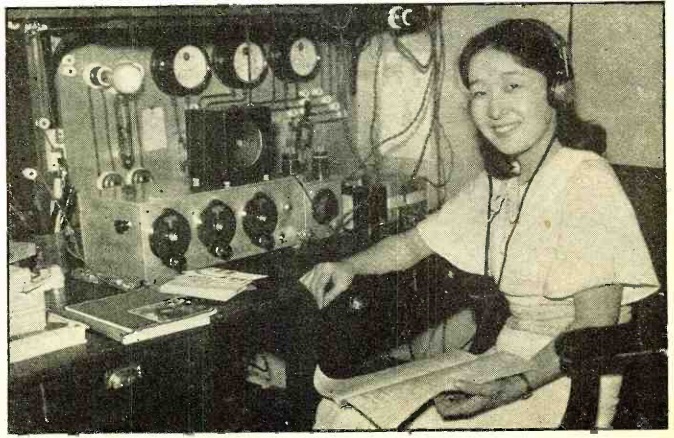
The April 1926 issue of Popular Radio contains an interesting article detailing the requirements to get an amateur radio license 90 years ago. Written by prolific author Howard S. Pyle, 7HP, W7ASL, and W7OE, the article notes that examinations were given at the various radio inspection offices on a regular schedule. In Detroit, for example, Amateur exams were given on Saturdays starting at 10:00 AM, “and it is wise to appear promptly at this time, for the examining officer dislikes to be compelled to run the code test again for late comers.” It also explains that for those living in outlying areas, a temporary permit could be issued based upon a questionnaire and sworn affidavit of code ability, to be followed up by a personal examination at a later date.

The code test was originally set at “an arbitrary speed of five words a minute, … but experience proved it to be too slow.” Therefore, the speed as of 1926 was 10 words per minute, meaning 50 characters per minute. “An applicant is really offered five opportunities to demonstrate his ability,” since a single minute of solid copy was all that was required. “It is assumed, however, that he will put down a reasonable portion of the balance, in addition to the required number.”

Until a few years earlier, no sending test had been required. But “large numbers of operators, notably at sea, were later found, on observation, to have extremely poor ‘fists’ as their sending hand and style is termed in radio phraseology,” including the “Lake Erie Swing.” Therefore, a sending test was also required.

The code test out of the way, the applicant was then tested on his knowledge of radio theory. This test was based not upon a transmitter “you’ve seen on a steamer or in a broadcast station, but the one that is actually on your own operating table.”

Therefore, the first part of the test was to prepare a complete diagram of the transmitter, receiver, and source of power. “This must be complete in every sense of the word.” Then, the applicant was to explain to the inspector how it worked.

This does not mean that you are to say, “I throw my antenna switch to the transmitting position; cut in my power and work my key.” What is wanted is something like this:

“Using the alternating current of the house lighting circuits, through the medium of a setp-down transformer, the filament of the vacuum-tube oscillator is brought to incandescence, thus emitting an electron stream, which is caused to flow to the plate by reason…”

The remainder of the exam consisted of showing similar familiarity with the radio laws, operating procedures, Q signals, and other items deemed important by the examiner.

Pyle concludes:

Let the aspiring applicants to the “blue ticket” of the full-fledged amateur be encouraged and may the great fraternity remain foremost among the country’s youthful experimenters!

Click Here For Today’s Ripley’s Believe It Or Not Cartoon


GE Model L-500, 1941

1941April7LifeSeventy-five years ago today, the April 7, 1941, issue of Life Magazine carried this ad for the model L-500, as a second set for the study or den, with which you could enjoy your own program, while the family enjoys theirs on the big set in the living room.

The set was a basic “All American Five,” with a tube lineup of 12SA7, 12B7, 12SQ7, 50L6GT, and 35Z5GT tubes.  This set was ready to tune the entire broadcast band, with coverage up to 1700 kHz.  With the recent NARBA reallocations, the band now extended up to 1600.  The speaker was four inches, and the plastic cabinet was award winning, having “won the top award for styling in the nationwide Modern Plastics contest.”

A nicely preserved specimen of this set can be found at the Radio Attic Archives, courtesy of the California Historical Radio Society,

Also shown in the ad is the Model J-602, a restored example of which can be seen in this video:

Click Here For Today’s Ripley’s Believe It Or Not Cartoon


Quist Quiz Solution

QuistQuizMay1959


Yesterday, we presented the problem shown above and promised that we would show the solution today.  The problem isn’t particularly difficult, and there are probably other ways to do it.

Since 15 volts is measured across the 30K resistor (and R2), this means that 30 volts is dropped across R1, which happens to be twice as much as 15.  This means that R1 is twice as large as the combined parallel resistors.  Since only the ratio is important, it’s easier to work in kilohms rather than ohms:

R1 = 2 (30 R2 / (30 + R2))

We’re also told that R1 + R2 = 15.

They might look a bit messy, but we now have two equations and two unknowns, meaning that we can solve them.  In my scribbling below, I used the variables X and Y to keep things a bit more legible.

After crunching the numbers (including use of the dreaded quadratic formula), we arrive at the answer:

R1 = 9416 ohms, and R2 = 5584 ohms,  [See the comment from eagle-eyed K3CHJ who caught my earlier typo!]

the same answer given in the June issue.  So when you asked your poor sainted algebra teacher, “when will we ever have to use this in the real world?,” he or she should have pointed out that you might need it someday for your blog.

ResistorProblem


Quist Quiz, 1959

QuistQuizMay1959

During the 1950’s, QST ran a regular feature called Quist Quiz, which presented an electronic brain teaser. This one appeared in the May 1959 issue.

I’ll provide the solution tomorrow.  If you can’t wait, you can look in the June 1959 issue, where the answer (but not the full solution) is shown.

Unless you want to do a lot of trial and error, you’ll probably need to use the quadratic formula,  Back in the day, the 1959 ham probably had to go dig out his old algebra textbook.  Today, you can just click on the link and Wikipedia will help you.


Largest Number That Can Be Written With Three Digits

Largest3Digits

In case you’ve been wondering what the largest number you can represent with three digits, the answer was provided ninety years ago this month, in the April 1926 issue of Science and Invention magazine.  That number is:

999

According to the magazine, this is equal to a is a 369,693,100 digit number, the first digit of which is 4, the last of which is 9.  In other words, rounded, it is 4 x 10^369,693,099.

According to the magazine, the number was calculated by one M. Laisant of the Ecole Polytechnique in Paris.  However, it’s unlikely that M. Laisant wrote down the answer, since, it would take 28 years to write down the number, as depicted by the presumably hypothetical gentleman shown in the illustration.  If written with the digits spaced a sixth of an inch apart, the number would stretch about 919 miles.  (The 919 mile figure is given by the magazine, although it seems to me that the answer ought to be 972 miles, since 387,420,489/6/12/5280 = 972.)

It should be noted that the order of operations makes a huge difference in the outcome.  To put it another way, the associate property of addition or multiplication does not apply to exponents.

(9^9)^9 is a very modest 78 digit number, 1.9662705 x 10^77, since it is merely 387,420,489 multiplied by itself nine times.  9^(9^9), on the other hand, is 9 multiplied by itself 387,420,489 times, which results in 4 x 10^369,693,099.

We can do a quick plausibility check of the magazine’s answer by noting that 9^(9^9) < 10^(10^10),  Ten to the tenth power is one followed by ten zeroes, 10,000,000,000.  Ten to the power of 10,000,000,000 is one followed by 10,000,000,000 zeroes, a ten billion and one digit number.  The answer given by the magazine, a mere 369,693,100 digit number, is indeed smaller.  The quick jump from 369 million to 10 billion digits isn’t surprising when you consider the following:

1^1^1 = 1

2^2^2 = 16

3^3^3 =  7,625,597,484,987

Unfortunately, Google calculator fails us, since it reports merely that the answer is “infinity.”  But on the other hand, that’s probably close enough.  Since there are only about 10^80 atoms in the observable universe, a number much larger than that probably has little practical use.

GoogleCalculator

The M. Laisant identified in the article is apparently Charles-Ange Laisant, who wrote more about the problem in Thresholds of Science: Mathematics, published in 1914.

Click Here For Today’s Ripley’s Believe It Or Not Cartoon


Warning: Suppressed Sideband AM Can Cause Death!

Traditionally, the April issue of QST magazine carries one groundbreaking technical article. The first one I recall came out the first year I was licensed, in the April 1974 issue.  This article espoused the virtues of a new form of modulation, namely, Suppressed Sideband A-M Telephony. The author, a Canadian genius named N.G. Attaway, VO1DER, proposed an alternative to single sideband. Instead of suppressing the carrier, he suppressed the sidebands and kept the carrier.

Attaway wrote:

One remarkable fact struck us: the amplitude of the modulated carrier was never modulated in amplitude modulation! To verify this, one needs only to listen to any a-m signal with the BFO on in the receiver. The carrier just sits there and carries. Only it doesn’t really even “carry” anything either. It just sits there.

Attaway presented a simple method to suppress the sidebands, but keep the carrier. Because the carrier has no bandwidth, he points out that SSA-M (suppressed sideband A.M.) doesn’t cause QRM. He points out: “In fact, in all of our transmissions to date, we have received no reports of having caused interference to anyone!”

The June issue contained a number of laudatory letters from readers. One, for example, from a confirmed CW man, was very encouraged by the way in which Attaway’s system eliminated phone QRM. A letter in the August issue took these letter writers to task, as the August letter writer was under the impression that the April article was actually an April Fools’ joke.

My favorite ever letter to the editor of QST appeared in the October 1974 issue, from a writer who was also apparently of the opinion that the April article was a joke. He called the article a “potential time bomb.”

The writer, Dr. Chas. R. Fisher, K0TYB/K4KGN of Oak Ridge, Tennessee (I’m guessing a nuclear scientist) had always been bothered by such articles. He noted that QST is “kept in all technical and scientific libraries as one of the foremost reference journals and is used more by non-hams than hams in this instance.” He noted that these scientists might be skimming through magazines, without “reading details which might clue them in on a gag and the articles are not plainly marked.”

Fisher notes that this could lead to death! “What about a deliberate, well designed deception resulting in damage or potentially death? I think every April issue you have put out is a potential time-bomb for the League in this sense. An [anonymous, of course] attorney agrees that if the articles appear as I say and intent is shown, the ARRL would porentially be found liable!”

Now that we have this Google thingie, it is my hope that researchers investigating SSA-M will find this post, in addition to the 1974 article. It is my fervent hope that they heed the warning: Suppressed Sideband AM can cause (by some mechanism which is unclear) death!

I hope I have defused that particular time-bomb.

Click Here For Today’s Ripley’s Believe It Or Not Cartoon


Hugo Gernsback’s 1905 TELIMCO Wireless Set

1906SciAm

Shown here is apparently the first ever advertisement for a home radio set. It appeared in Scientific American, January 13, 1906.  The manufacturer, the Electro Importing Company, was the venture of none other than Hugo Gernsback, the prolific radio and science fiction writer and the namesake of the science fiction Hugo awards.

Gernsback wrote about this set a half century later in the March 1956 issue of Radio-Electronics magazine, which he edited.  In the article, he recounts having started the company in 1905, at which time there were few wireless stations. Therefore, it was necessary to sell both a transmitter and receiver. The set was named the TELIMCO, a contraction of the company’s name. Only a handful of the sets were sold in 1905, but he began quantity production in 1906 and took out the ad in Scientific American.

In addition to selling the sets by mail order, it “was sold through many large outlets, including such famous ones as Macy’s, Gimbel’s and F.A.O. Schwartz.” He recounted the “incredulous looks of many of the store owners when there were first approached to buy ‘wireless sets.’ It was necessary to make a demonstration in each case before anyone would stock them.”

The set was originally priced at $7.50, but the price was later raised to $10, and most were sold for that price. The transmitter, powered by three dry cells, consisted of a spark coil and spark gap consisting of two balls 1/8 inch apart.

The receiver consisted of a coherer, which was wired to a very sensitive relay which ran a bell. The bell was set in such a way as to dislodge the iron and silver filings in the coherer.

According to Gernsback, the set had a range of about 300-500 feet without an external ground connection. With an elevated antenna 50-100 feet long and a good ground, many users were able to get reception over the promised one mile, with some reporting even greater distances.

The aerial wires on the transmitter itself, fashioned as a dipole, were about 1-1/2 feet long. Gernsback notes that the set had no tuning, but the antenna length indicates that the set was actually transmitting on frequencies above 30 MHz, long before those frequencies came into common usage.

In 1956, Gernsback built a recreation of the early transmitter, which is currently in the collection of the Henry Ford Museum in Dearborn, Michigan.  It is pictured in the book Henry’s Attic: Some Fascinating Gifts to Henry Ford and His Museum.  You can also read more about the set at The Gernsback Story by Ed Raser W2ZI.


Click Here For Today’s Ripley’s Believe It Or Not Cartoon


March 29 1941: Broadcasting’s Moving Day

1941MarRadioRetailing

1941MarRadioRetailing2As we previously reported, today marks the 75th anniversary of a major change in the standard AM broadcast band in North America.  At 3:00 AM on March 29, 1941, most stations in the United States and Canada moved up the dial slightly.  The broadcast band was expanded to accommodate Mexican clear channel stations, and the result was that most American and Canadian stations had to make changes to their transmitter frequency.

At the time, millions of American radio receivers had pushbutton tuning, and all of those buttons had to be reset for the new frequencies, resulting in a small boom for servicemen.  Shown above is the cover of the March 1941 issue of Radio Retailing, showing a serviceman making the change on a small table set.

The magazine stressed the fact that the change was an opportunity for dealers to make contact with customers, “an absolutely unique invitation to more more major merchandise, with the promotional expense at least partially covered by service and accessory sales.”

It noted that most dealers were charging about $1 for the service call, with higher charges in some areas. For example, the Philadelphia Radio Service Men’s Association recommended a $2 charge. Some dealers were charging $1 if the set was brought in, or $1.50 if the work was done in the customer’s home.

The magazine suggested that the service call could offer an opportunity to perform other service, such as cleaning or alignment, especially if the set had to be removed from its cabinet.

Being in the customer’s home also represented an opportunity to sell a new set or even another appliance.

The magazine’s April issue reported that the overall effects of the shift were good, with interference being eliminated in many cases. While dealers reported reports for service calls, there were not as many as expected, and there was no “service jam.” It also encouraged dealers to keep up their promotional efforts:

And a big job it is. The radio dealer’s opporunity to profit by using reallocation resetting as a stepping-stone to additional business is just beginning. 10,000,000 people with pushbutton-tuned radios can’t be contacted overnight. It will be weeks before the public becomes fully aware of what is missing through failure to have adjustments made. And it will take months of selling to induce them to do it.


Click Here For Today’s Ripley’s Believe It Or Not Cartoon