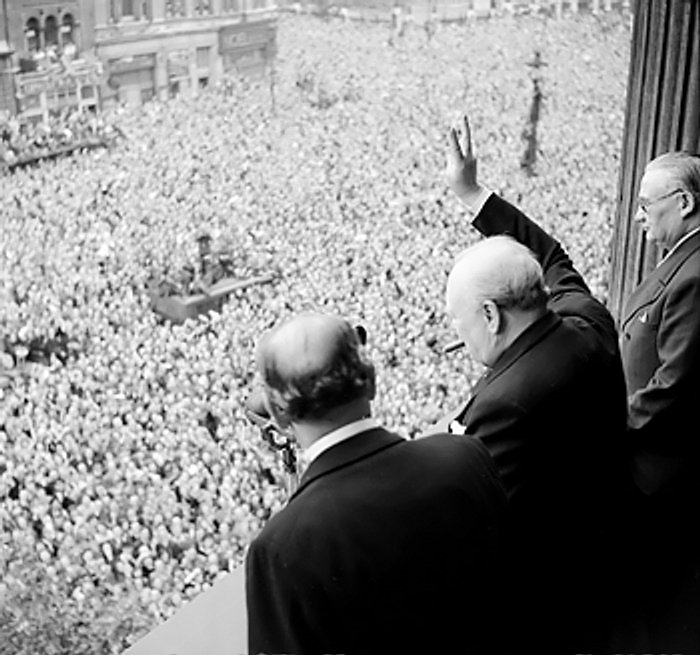
Churchill waves to crowds celebrating Victory in Europe, May 8, 1945. Wikipedia photo.
Today marks the 75 anniversary of Victory in Europe Day, commonly known as V-E Day.
The instrument of surrender was signed in Berlin by Field Marshal Wilhelm Keitel at 21:20 local time on May 8. The event coincided with President Truman’s 61st birthday, and was less than a month after the death of FDR. U.S. flags remained at half-staff for the remainder of the mourning period.
Truman broadcast that it was a victory only half won, since the battle against Japan still raged on.
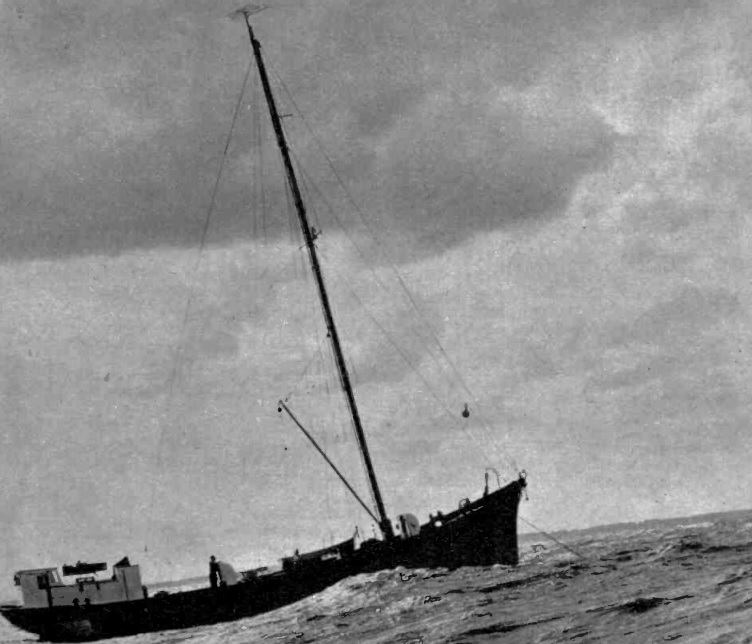
If you look carefully at this picture, from the May 1960 issue of Electronics Illustrated, you’ll see at the top of the mast a Yagi antenna for 89.55 MHz. The ship is the Cheeta, and flies the Panamanian flag.
The ship is in international waters off the Danish coast, and is serving as the transmitter site for Radio Mercur, a pirate radio station. From studios in Copenhagen, programs were recorded in Danish, Swedish, and English, and brought to the ship anchored in international waters.
According to the magazine, the sale of FM receivers boomed in the ship’s listening area of about 50 miles, with an ERP of about 1500 watts. The Danish government had been unable to silence the station, but this changed a few years later with legislation forbidding anyone in Denmark from cooperating with the broadcasts.
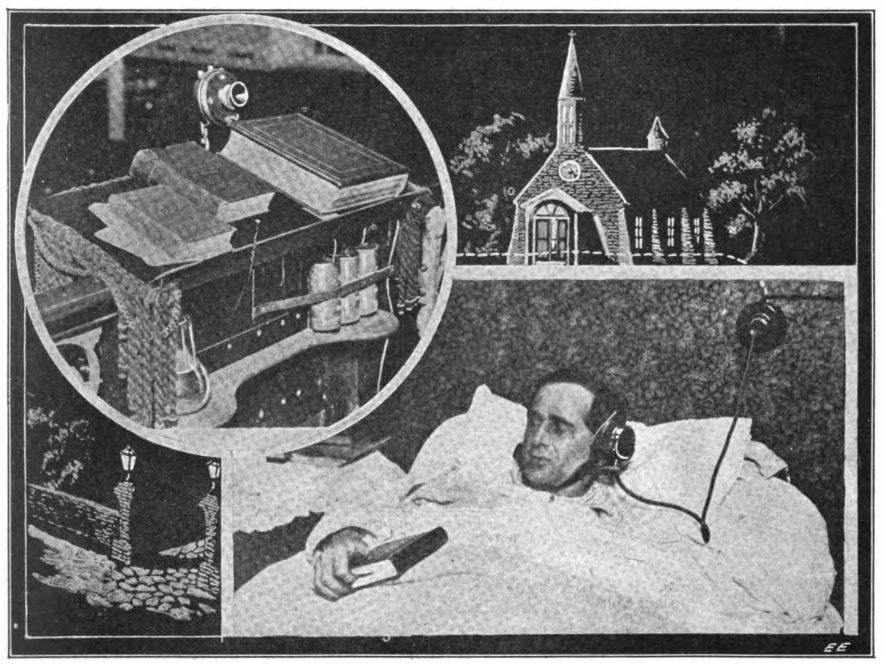
With most of the world locked down due to the threat of COVID-19, places of worship have been scrambling to deliver the Word of God to the faithful at home. But long before Zoom and YouTube were a thing, churches have relied upon technology to connect with members, as shown by this illustration from a hundred years ago this month, in the May 1920 issue of Electrical Experimenter.
Zion English Baptist Church, Pen-y-cae, Wales, the likely origin of the 1920 transmissions. Wikipedia photo.
Shown here is miner Sam Pritchard of Penycas, Ruabon, Wales. In 1919, he was injured by the fall of a rock. Undaunted, he was able to hear the service at the Baptist Church thanks to a telephone rigged by three of his friends.
A button microphone and batteries were strategically placed near the pulpit, with wires run to Mr. Pritchard’s bedside some distance away. A telephone receiver was strapped to his head, through which he was able to take part in the service. The magazine noted that the apparatus required was not expensive, and that such a setup could prove valuable in the northern or western United States where deep snows often cover the country.
Of course, over the years, churches have moved on to radio, then audio recordings, then television, and then the internet to deliver their message to those shut in at home. Incidentally, the OneTubeRadio Laboratories are currently hard at work preparing a 100 mW AM transmitter which will operate, with a 9 foot antenna, to broadcast church services within a parking lot. The internet works well for those who are at home, but everyone signal is slightly out of synch with everyone esle. At such time as it becomes possible to congregate a bit more closely, in parked cars, radio will allow everyone be able to listen simultaneously (or as simultaneously as the speed of light allows). We have verified that the transmitter is up to the task, and today, we received the parts necessary to provide a high-fidelity audio feed. We’ll post updates as the project is completed.
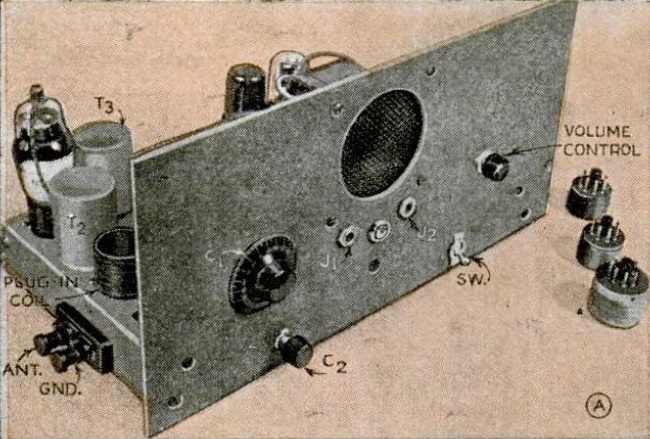
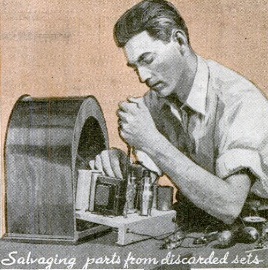
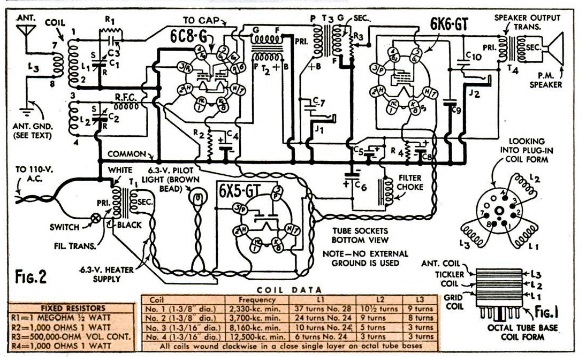
This three-tube shortwave set from the May 1945 issue of Popular Mechanics was designed around wartime parts shortages, and the magazine touted that it could be assembled entirely out of odds and ends of salvaged materials. The gentleman at left is shown scavenging parts from a discarded radio. Despite the low tube count, the set would pull in shortwave stations from around the world and fill the room with loudspeaker volume. It featured a 6C8-G as regenerative detector, 6K6-GT audio amplifier, and 6X5-GT rectifier. Plug-in coils allowed a tuning range of 160-19 meters. The magazine advised that the set was designed specifically for the short waves, and that the builder was advised not to try and alter it to tune the standard broadcst band.
The filaments were powered from a 6 volt transformer, and the B+ came straight from the AC line, with the familiar “hot chassis” design, and the familiar caution not to hook the chassis directly to ground.
Conventional wisdom is that, prior to the Internet, it was impossible for individuals to reach a wide audience. Fortunately, nobody bothered to share this conventional wisdom with Charles Edward Caswell of Concord, N.H. , who wrote, edited, printed, and distributed his own magazine, Friendly Cheer.
This article appeared in Popular Science, May 1940, which noted that copies of the magazine went to every state and 14 foreign countries.
We haven’t been able to figure out what happened to Friendly Cheer magazine, and the domain name friendlycheer.com is still available. So if anyone wants to pick up where Caswell, left off, there’s your opportunity. And if anyone has a copy of the magazine, we would love to see it.
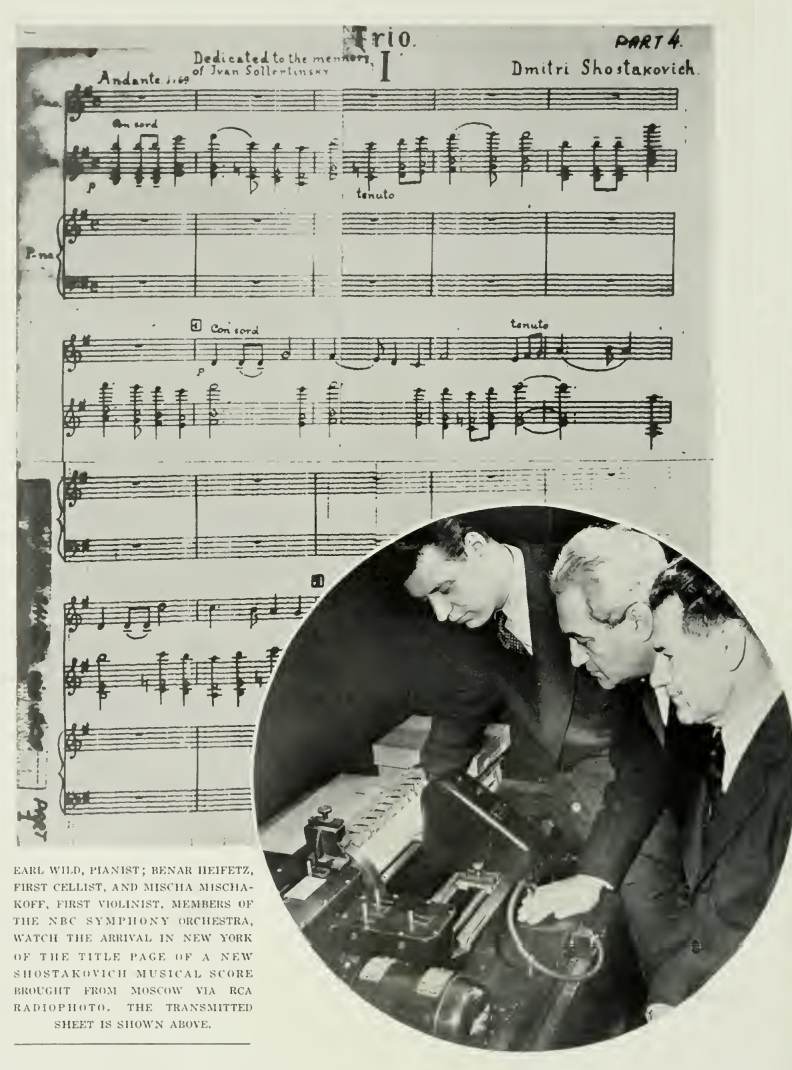
Shown here, in the April 1945 issue of Radio Age, is a musical score by Dmitri Shostakovich, sent from Moscow to New York via radio facsimile, and performed by the NBC Symphony Orchestra.
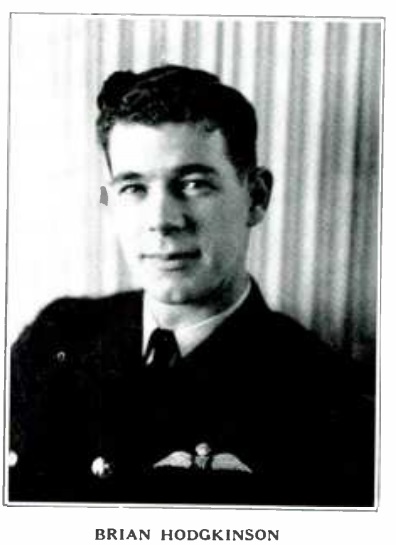
We wrote previously about Canadian airman Brian Hodgkinson. He was a former announcer for CKY Winnipeg, and was a German POW for most of the War. After the war, he moved to the United States where he was an announcer for WHK, WERE, and WDOK in Cleveland.
75 years ago this month, CKY’s program guide, Manitoba Calling, April 1945, carried this letter from a fellow POW:
Paris, 30 December, 1944.
Sir,
I would be very grateful to you if you could put me in touch with Brian Hodgkinson’s family. This request may appear somewhat indiscreet. Here is a brief exposé of the reasons which motivate my request.
We met in Stalag VII a in Germany, where, for many months, we were together and we became great friends. We were separated in the summer of 1942 following camp changes.
I had the luck of returning to France a year ago where I am enjoying absolute liberty, following the exploits of your armed forces and those of your allies. I would therefore be very happy to receive news of my gi and comrade, and he having communicated his address to
Radio Winnipeg, I, in turn, am taking the liberty of addressing myself to you.
I offer my excuses for having written you in French, but my knowledge of the English language is so restricted that it does not permit my use of it.
With my most heartfelt thanks, 1 offer you. sir, my distinguished salutations and the greetings of a Frenchman -friend and admirer of the Canadian people.
Lucien Villatte, 107 Rue du Chevaleret,
Paris 13, France.
Hodgkinson’s memoir of his days during the war, Spitfire Down, was published after his death. The book is not available in the United States, but used copies are available at a reasonable price on Amazon. In Canada, it’s also available at Amazon.ca.
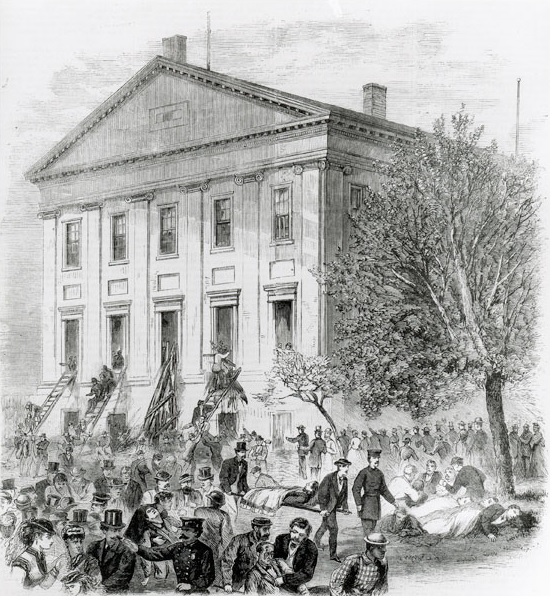
150 years ago today, April 27, 1970, the chamber of the Virginia Supreme Court collapsed into the House of Delegates one floor below. Postwar military rule had ended in January, and a dispute arose over the leadership of the City of Richmond. The case was to be heard by the Virginia Supreme Court, and several hundred, including the two mayoral hopefuls, crowded into the courtroom. A gallery full of spectators collapsed, which in turn caused the main courtroom floor to fall 40 feet to the floor below.
62 were killed, with 251 injured. The dead included a grandson of Patrick Henry. Despite initial calls to demolish the building, it was repaired. The building still stands, with two wings added in 1904.
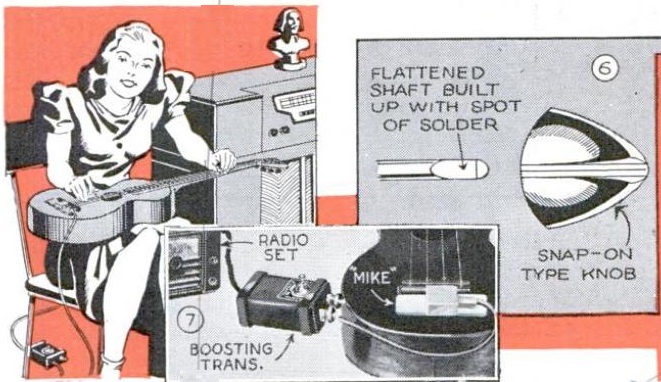
The musician shown here, under the watchful eye of J.S. Bach perched atop her radio, is an early adopter of the electronically amplified guitar. She has a small pickup microphone mounted on the guitar, which is fed into the boosting transformer shown. The output went to the radio’s phono jack, or if it didn’t have one, to the volume control.
The picture to the right, while unrelated, shows a hint that is worth noting. The radio knob had come loose from its shaft. The problem was solved by adding a bit of solder to the shaft to build it up and ensure a tight fit.
The illustration appeared in the April 1940 issue of Popular Mechanics.
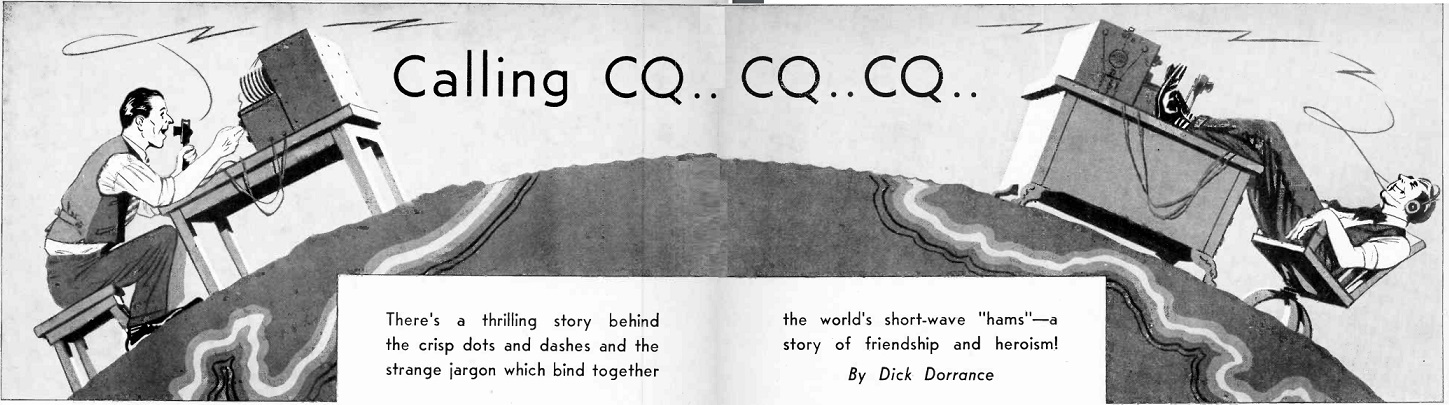
Broadcast listeners 80 years ago, while tuning the shortwave dial of their set, might occasionally have heard the sounds of “that fool kid down the block,” namely a ham radio operator, coming through the speaker of their console set. But this article, in the April 13, 1940, issue of Radio Guide reminds listeners that that fool kid was a member of an “old and honorable clan–a clan which, out of its own altruism and persistence, has helped give us the wonderful marvels of radio which today we take so much for granted.”
The article highlighted both the technical tinkering and “ragchewing” done by hams, who, according to the article, averaged 27 years of age.
The article starts with a story that is familiar, but I suspect at least partly apocryphal. A ham in Alaska was working a ham in New Zealand. The ham in Alaska gave a report of 549x. But suddenly, the “sharp dots and dashes faltered, once, twice, then pieced out falteringly. ‘I feel ill ….” Suddenly, the radio went silent.
The ham in New Zealand put out a distress call, and eventually raised a station on the West Coast of the U.S. He put out a call for Alaska, and soon raised another station in the Alaskan ham’s hometown. That ham raced to the house, dragged the unconscious ham outside from the home where he had been suffering from carbon monoxide poisoning.
No names were given, and the story is almost identical to the one given in the 1939 film Radio Hams, which appears at the bottom of this page. The story recounted in the film took place “some years ago,” and similarly contains few details. It does mention the name of the ham, Clyde De Vinna, and there seems to be some corroboration on his Wikipedia entry, although few details of the incident.
The article does identify another ham, Frank Carter, W2AZ, of East Rockaway, Long Island, who maintained daily contact with the Archbold Expedition in New Guinea. Other stations involved in that communication were K4FAY in Puerto Rico, W6LYY, W4DLH, and K6OQE in Hawaii. The magazine recounted a story of W2AZ getting an urgent call from a station in Colobmia looking for information on his children who were ill in a New York hospital.




 Hodgkinson’s memoir of his days during the war,