Eighty years ago, the war had been won, and a lot of people were happy about it. And that included these two on the cover of Radio Retailing, October 1945. The woman on the right was happy because she was able to buy a new radio, for the first time since 1942. And the gentleman on the left was even happier, because he was a radio dealer, and was able to once again make it a Radio Christmas.
Eighty-five years ago, this gentleman is pulling in a program with a receiver he built for only $4.06, following the plans in the October 1940 issue of Popular Science.
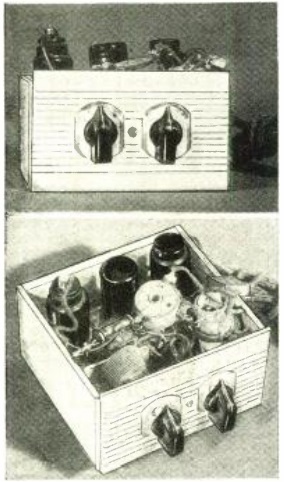
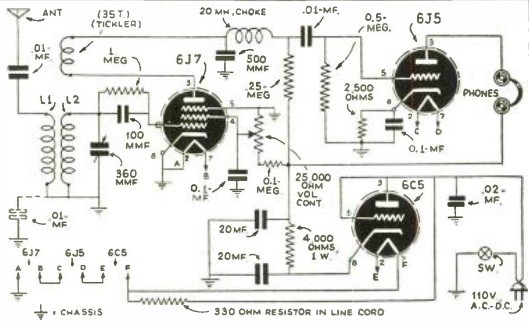
The three-tube circuit was simplicity itself. It was an AC-DC set that used a 25Z5 rectifier, 6C6 regenerative detector, and 43 AF amplifier. It could provide loudspeaker volume on the broadcast band.
The chassis was an aluminum cake pan, which had the added advantage of being easy to work with. If no drill or punch were available, it could be cut with an ordinary pair of scissors. It was housed in a metal cabinet found in the home scrap pile. The coils were honeycomb-style and were easy to wind. A 25 foot antenna was called for.
Shown here is an artist’s conception of a possible solution for communications with aircraft on transatlantic routes. Aircraft equipped with only VHF radio experienced significant gaps when they were incommunicado while crossing the ocean. There were some plans to extend their VHF range by use of directional antennas aboard the aircraft, but there were still gaps.
One proposed solution was two to four floating communications platforms mid-ocean. They would be linked by cable to shore. With these, aircraft could be continually in line-of-sight communication.
Of course, HF communication is also available on aircraft. But the article noted that this communication was not 100% reliable, due to occasional HF blackouts and the vagaries of HF propagation.
For those stationed on these platforms, it looks like a lonely assignment.
The illustration appeared in the October 1965 issue of Radio-Electronics.
Seventy years ago, the British radio hobbyist with 30 shillings in his or her pocket might want one of these receiver kits. The broadcast portable would allow private listening nearly anywhere, and the other set would inexpensively introduce him or her to the short waves.
Eighty-five years ago, this thoroughly modern housewife made sure she didn’t miss her favorite program. The timer on the electric stove was primarily designed to control three cooking circuits on the stove. But she was also able to plug in a radio to make sure it came on at just the right time. The picture appeared in the October 1940 issue of Popular Mechanics.
As shown in this announcement in the October 1965 issue of Boys’ Life magazine, the Electronics Merit Badge (along with Space Exploration) is sixty years old. Metallurgy was also new that year, but was renamed Metals Engineering in 1972 and then discontinued in 1995.
I recently had to replace the windshield washer nozzles on my 2014 Dodge Journey. My son helped me, but it was an extremely easy and inexpensive job.
Previously, the hose running to the nozzles broke at the point right where the hood hinges. I replaced that originally with a piece of tubing and two hose clamps. It leaked somewhat, but it worked well enough. But eventually, the connections to both nozzles broke, and it stopped working entirely. So, of course, I went to YouTube and found this video, which shows the entire repair process:
Interestingly, mine broke in exactly the same three places, and other people reported that theirs also broke in those three places. Armed with the knowledge of how simple the project was, I ordered the replacement parts on Amazon. I probably could have found the nozzles at an auto parts store, but for probably less money, the Amazon kit included all of the parts that I might potentially need to do the repair. As you can see from the
Leftover parts from kit.
unused parts at left, it included as much hose as might be needed to do a complete replacement, as well as enough fittings, just in case I needed to replace everything. According to the Amazon listing, the same parts are used on a number of Chrysler vehicles, including the following: 2008-2017 Grand Caravan, 2007-2012 Caliber, 2001-2010 Chrysler Pt Cruiser, 2005-2010 Chrysler 300, 2005-2010 Jeep Grand Cherokee, 2008-2015 Patriot, 2009-2010 Dodge Ram 1500 2500 3500 Pickup, 2006-2010 Dodge Charger, 2007-2016 Journey, 2011-2017 RAM 1500 2500 3500 4000, 2008-2011 Dodge Avenger, 2004-2009 Dodge Durango. The OEM part numbers are 5116079AA, 4805742AB, 5113049AA, 5303833AA, 55077460AA, 5160308AA.
Old broken nozzle.
The repair job is very simple. If you examine the new nozzle, or the old nozzle shown at right, you can see that you just need to push a tab, and the whole nozzle then slides out from the top of the hood. You can’t see where the tab is, but it’s an easy matter to find it by pushing a screwdriver into the hole, as shown at left.
You then place the included gasket on the new nozzle, and snap it back in to the hole. You then simply slide the old hose onto the nozzle. If the old hose is no good, you can replace it with the new hose that comes with the kit.
I could have lived with the leak near where the hood hinges, but we decided to fix that as well. Unlike the old tube I had found at the hardware store, the new one was just the right size and flexible enough to make a tight fit over the two pieces of original hose. The hose clamps probably weren’t necessary, but since I had them, I just put them back on.
The new nozzles aren’t quite as good as the original ones. I think they are designed for a sedan, and don’t spray quite high enough for the Journey. But they do the job, and they should be good for another 11 years of service.
Some links on this site are affiliate links, meaning that this site earns a small commission if you make a purchase after using the link.
Seventy years ago, the transistor was still the new kid on the block, and designers had to work around its limitations. It was hard to get it to work as a radio detector stage, so this design, from the September 1955 issue of Radio-Electronics dealt with the problem by using a hybrid circuit. A subminiature CK7088 pentode was used for the regenerative detector, and a transistor was used to amplify the audio. The circuit called for a Texas Instruments type 200, but the venerable CK722 could be used with some modifications to the circuit.
A hundred years ago this month, the September 1925 issue of Radio News showed this method of attracting fish. The accompanying article claims that the fish liked the music, came in flocks, and the fisherman could hardly keep up with pulling them in. But we suspect the article was facetious, and the cover photo is more likely what would happen.
My wife and daughter came home from Girl Scout camp with a bunch of leftover Ranch dressing, so I Googled to find recipes to use it. One site suggested biscuits, so that was all the inspiration I needed. I figured I could do it with just three ingredients, the ranch dressing, flour, and baking powder. And if I do say so myself, they turned out well.
The batch shown here used about a cup of flour, and about a tablespoon of baking powder. (You could also use self-rising flour or Bisquick, and not bother with the baking powder.) Then, start adding Ranch dressing. Start with too little, mix it together (with a spoon works just fine), and keep adding until it’s the right dough-like consistency.
Preheat the oven to 350 degrees Fahrenheit (175 Celsius). Put lumps of dough on a baking sheet as shown at left(it doesn’t need to be greased) and bake for about 15 minutes. The taste is actually somewhat reminiscent of the biscuits served at Red Lobster, so I hope I didn’t spill any trade secrets.
I don’t know what brand of Ranch dressing this is, but I’m sure other brands would work just fine. It might not be economical to buy Ranch dressing just to make biscuits (although, if you get a cheap enough brand, it just might be). But if you have a bunch of leftover Ranch, it’s a delicious way to use it up. And in the event of an emergency, and that’s what you have in your fridge, it would be a good option.
Bon apetit!
Some links on this site are affiliate links, meaning that this site earns a small commission if you make a purchase after using the link.