Category Archives: Radio history

MacMillan Arctic Expedition, 1923

We’ve previously written about the MacMillan Arctic expedition.  It was the first such expedition to be equipped with radio.  The radio operator was Don Mix, later W1TS, who went on to be a prolific writer of construction articles for QST.

A hundred years ago, if you wanted to stay up to date with the expedition, you would definitely want to take out a subscription to the Washington Star, as explained in this ad from the June 26, 1923, issue.  The paper would report dispatches received by radio, but for those who wanted to stay in close touch, all that was required was a ham license and station, or just a receiver to listen in.  The ad lists the times at which the expedition’s station (WNP, for Wireless North Pole) would be on the air.  And from 1:00 to 2:59 AM and again from 3:00 to 7:00 AM, it would be open for contacts with amateurs.  As we reported previously, Art Collins, W9CXX (later W0CXX) was able to do just that.


When Wires Are Down: 1948

1948JunQSTThere was a time when electronic communications meant wires running from city to city. In the United States, these were the telephone lines owned by The Phone Company, or telegraph lines owned by Western Union.  If those lines were knocked down due to some kind of natural disaster, then whole communities could be cut off from the rest of the world.

When that happened, Amateur Radio might serve as the only link.  And 75 years ago this month, the June 1948 issue of QST announced that Western Union had reinstated a cooperative program with the ARRL to ensure that hams were available as backup “when wires are down.”  It was a reinstatement because Amateur Radio had been off the air during the War, and the program originally dated to 1939, as announced in the June 1939 issue of QST.

The ARRL was able to “give W.U. a list of Emergency Coordinators (EC), so in any pinch, the W.U. local managers will know who to call upon for coordinated information on the active amateur stations, radio schedules, points in radio nets, local emergency-powered outlet, and so on, so
necessary emergency traffic might be filed.”  For their part, Amateurs were encouraged to fill out ARRL Form 7 and give it to their EC to sign up as members of the Amateur Emergency Corps.  In fact, the blank forms were available at Western Union offices, and could even be dropped off there, with Western Union routing the forms back to ARRL headquarters.

In reports of disasters, it wasn’t uncommon to read that hams had assisted Western Union when the lines were down.  For example, during the 1940 Armistice Day Blizzard, Sherm Boen  of Albert Lea handled traffic for the railroad, since a dispatcher in southern Minnesota needed permission from Minneapolis before sending a snowplow north.

These days, it’s unlikely (but not totally inconceivable) that the normal telecommunications networks will fail completely.  In addition to ground-based lines, there are multiple satellite options available for linking various communities.  So it’s unlikely that an internet service provider or phone company will call hams for assistance with restoring their networks.

However, it’s not unheard of for individuals and families in areas hit by disasters to be cut off from the outside world.  The ability to send a short message to family or friends in other states could be a major morale booster, and could be extremely helpful in reuniting families separated by disasters.  Hams spend an inordinate amount of time trying to find a “served agency” to whom they can offer their services.  But radio communications today isn’t exactly rocket science, and those agencies can probably have communications in place operated by their own personnel.

WFD1But hams still have a major strength, and that is the fact that they are widely dispersed around the country, mostly in residential areas.  In other words, if there is a local or regional disaster, they are already there, and they can begin communicating immediately.  As exercises such as Field Day and Winter Field Day prove, they can be on the air immediately, even if power is out, and even if part of their station is damaged.  A wire antenna can be put up almost anywhere, hooked up to an HF rig and car battery, and communications are immediately established.  Even the most modest of VHF rigs can provide local communications with other hams.

It seems to me that individual hams should figure out how they can serve their neighbors in time of emergency.  In my case, I will simply make it known, perhaps with a sign in the front yard, that I can send short messages to anyone, just about anywhere, via Amateur Radio.  I have multiple radios that can be pressed into service, and all I need is some wire to build an antenna.  For power, I have multiple options, such as a car battery, flashlight batteries, or a solar panel.  I can be on the air almost immediately, and stay on the air more or less indefinitely.  I don’t need any agency to serve.  My license is the only authorization I need to offer my services to my neighbors.


First National Presidential Radio Address: 1923

Screenshot 2023-06-06 12.26.41 PMToday marks the 100th anniversary of the first time an American president addressed the nation through a hookup of multiple radio stations.

President Warren Harding was on a tour of much of the continental United States, as well as the Territory of Alaska. While in Kansas City, he gave the speech over WDAF in that city. It was also picked up by WGY in Schenectady, NY, WEAF in New York City, and KDKA in Pittsburgh. The wire service story above appeared in the Casper (WY) Daily Tribune, June 22, 2023. It was estimated that about a million Americans heard the speech.


Summer Radio 1923

Screenshot 2023-06-06 12.52.14 PMThe summer of 1923 was to be a big one for radio, as predicted by the June 1923 issue of Wireless Age. The magazine editorialized that radio would be a major feature of summer camp experiences, and many farm families would be introduced to radio by their city visitors.

The cover featured this illustration by Charles S. Jaeger. But somehow, play-by-play broadcasts of rowing crew competitions never quite caught on.


1948 One Tube “Reflex” Receiver

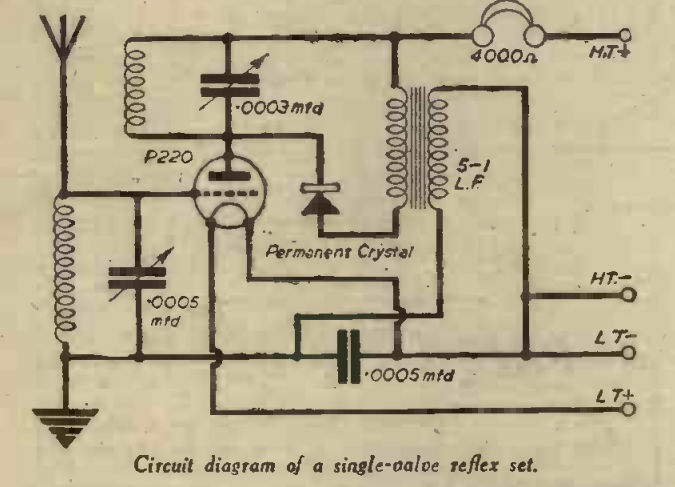
1948JuneRadioCraftThe June 1948 issue of Radio Craft showed this circuit for a one-tube “reflex” receiver, so named because the tube served double duty.  The input was connected to the antenna circuit, and the tube served as an RF amplifier, with the output going to a then relatively new 1N34 diode.  The audio then went through a transformer and volume control, where it was fed back to the tube, which then amplified the audio.  The audio then passed through an RF choke on its way to the speaker.

The circuit had been sent to the magazine by one Arthur S. Bean of Baltimore.  The magazine noted that his design provided good volume and moderate selectivity.


GE Model F-96, 1938

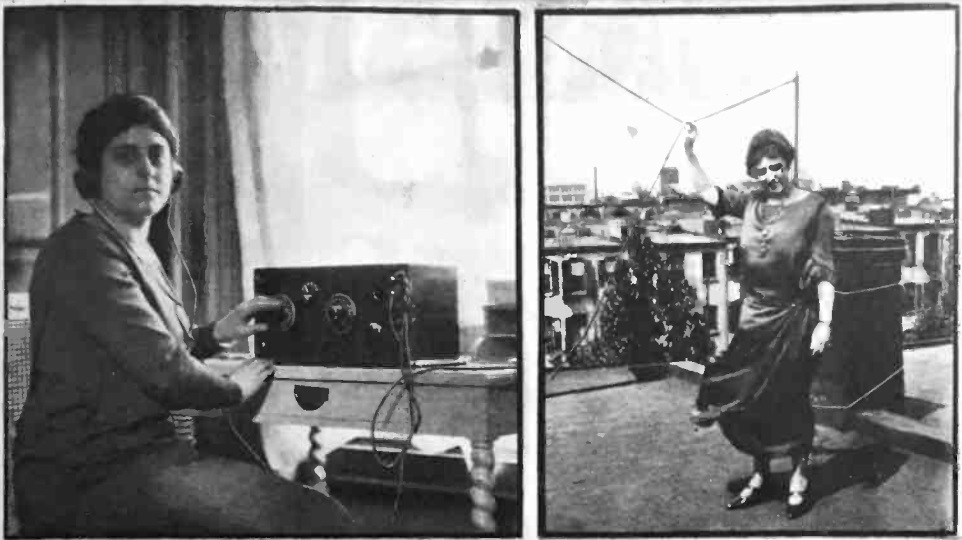
Screenshot 2023-05-30 11.53.16 AMThere was a time when people dressed up to listen to the radio, and 85 years ago was one of those times, as demonstrated by this young woman on the cover of the June-July 1938 issue of National Radio News.

You would dress up, too, if the receiver you were listening to was the General Electric model F-96 Electric Touch Button Tuning Radio.  The handsome nine tube set retailed for $110 (over $2300 in 2023 dollars).  It featured sixteen pushbuttons, and tuned both broadcast and short wave, as well as pulling in police calls.


1953 Coffee Can Transmitter

Screenshot 2023-05-25 12.59.20 PMScreenshot 2023-05-25 1.03.22 PMMany hams from the 1970s and later are familiar with variations on W1CER’s (later W1FB) Tuna Tin II, a transmitter which used a tuna can as its enclosure. But the 1950s had its own variation on the same theme, as shown here in the June 1953 issue of Radio News. A 117L7GT tube wouldn’t fit inside a tuna can, but it did fit into a coffee can, so that’s what was used.

This 80-meter transmitter was actually a club project by the Wantah Radio Club on Long Island, New York. It was designed to spur some activity as the club members built and used them. Once the rigs were built, they used them for local nets, and also used them for contests, such as for the most distant contact, and the highest number of states worked.

Half the tube was used as a Pierce oscillator, with the other half serving as rectifier. We’ve seen other transmitters using the same tube, and it’s a natural for a small one-tube QRP rig. This design put out about 3 watts, and the station on the other end was often surprised by the power used. The article warned that to save money, half of the line cord was attached to the chassis, making it potentially hot. Therefore, those making the set were cautioned to use care in plugging the cord in with the right polarity. They described a test circuit to see if it was plugged in the right way, but that circuit would trip a modern GFCI outlet.

The tuning circuit shown in the schematic below was “already mounted on a convenient subchassis from a BC-746 tuning unit available at surplus,” as if everyone knew what a BC-746 was. That appears to be an external antenna tuner, one portion of which was used here. If you can’t find a BC-746, the article gives alternatives for making your own.

The set was mounted on the coffee can lid, with the can itself then used as the enclosure. This was said to provide shielding to prevent TVI.

The author of the article was Jim Fahnestock, W2RQA. There can’t be that many Fahnestocks in the world, and since he was from New York, where the famed Fahnestock clip originated, we have to guess that he was related to the inventor of the clip and the namesake of the State Park.

Screenshot 2023-05-25 1.01.25 PM


TV Antenna Tutorial from 1948

Screenshot 2023-05-24 10.13.12 AMScreenshot 2023-05-24 10.14.27 AMOver the next few years, the TV antenna on top of houses would become a familiar sight, But 75 years ago, the concept was new, even for experienced radio technicians, who were just starting to realize that the way they would stay in business was by embracing television.

Therefore, the June-July 1948 issue of National Radio News, the publication sent to alumni of National Radio Institute, carried an extensive treatise on the subject of antennas for FM and TV. One concept that would soon become familiar, but was probably new to most readers, was “ghosts” caused by multipath interference. The cause is shown above, and the result is shown below.

Screenshot 2023-05-24 10.12.02 AM


1943 “Gibson Girl” Transmitter

Screenshot 2023-05-22 12.39.02 PMScreenshot 2023-05-22 12.39.39 PM

Eighty years ago this month, the June 1943 issue of Radio News showed the transmitter that was to become known as the “Gibson Girl.”  The two downed airmen had nothing but hope, and their potential rescuer was beyond the horizon, with no way of knowing they were there.

But that was soon to change, and the men would have with them a hand-cranked transmitter capable of summoning help over long distances, thanks to an automated message sent on 500 kHz.  Rescuers would be able to hear it for hundreds of miles, and zero in on their location through radio direction finding.

The antenna was to be made out of Belden wire, and they were justifiably proud of it.


1963 6 Meter Handheld Transceiver

1963JunQST2The June 1963 issue of QST carried the plans for this five-transistor transceiver for 6 meters. The author, David Light, K4IQU, reported a QSO of 15 miles between two of the units, in hilly terrain, presumably on two peaks within sight of each other. He also reported being heard 30 miles away (but not a two-way QSO) with a well equipped station with a beam at the other end.

As shown by the emblem on the set, the goal of the unit was for use in local emergencies.  But chances are, most of the use involved the secondary purpose, “having plenty of fun on 50 Mc.”

The superregenerative detector, the oscillator, and the RF amp were 2N1745 transistors.  Two stages of audio amplification were used for both transmitter and receiver, and used 2N43A transistors.  Power was supplied by a 9-volt battery.

For modern hams, the humble Baofeng handheld can be had for about $30, and almost certainly outperforms (on 2 meters and 70 cm) the humble little rig here.  So yes, if all you have is a Baofeng, there’s no reason why you can’t work another Baofeng 15 miles away, or a well equipped station 30 miles away.  There are much better radios, but if that’s what you got, there’s no reason why you can’t use it for having plenty of fun on 144 Mc.


1963JunQST