Category Archives: Radio history

Telemedicine, 1924

1924AprRadioNews2This artist’s conception of telehealth appeared a hundred years ago this month, on the cover of the April 1924 issue of Radio News.

According to the magazine, a prototype of the unit shown here had already been constructed, and a block diagram was included  in the accompanying article.  We note, however, that it was the April issue of the magazine.


1944 “Mystery” Crystal Set

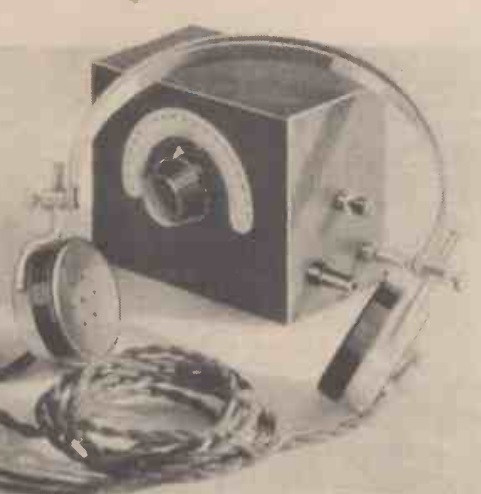
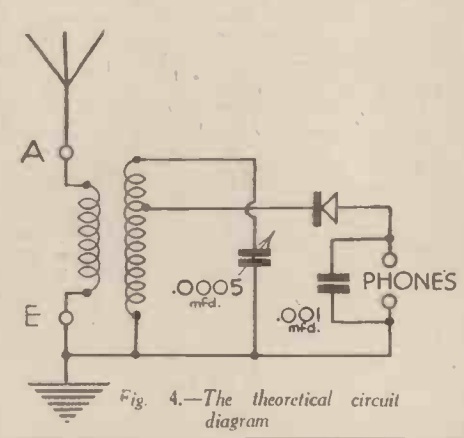
1944AprAustralasian1944AprAustralasian3The plans for this crystal set from Down Under appeared 80 years ago this month in the April 1944 issue of Australasian Wireless Review. It’s dubbed a “mystery” crystal set, and the entire circuit is built in to one side of an ordinary pair of headphones. The coil is as many turns as possible of wire wound spider-web style.

Before installing it into the headphone, it was a good idea to test it on a board, and ascertain the best spot to tap the coil. Then, it would be soldered into place and inserted. A small hole was drilled through which a shaft to the trimmer condenser was inserted for tuning.  Two wires, with spring clips at the end, were used to connect to a convenient antenna and ground.

The magazine recommended a fixed crystal of the “small round flat type,” although we’re guessing a 1N34 diode would work even better. It noted that the detector might be hard to obtain, with a war going on and all, “but all good Radiomen should be able to rig something up.”

1944AprAustralasian2


Some links on this site are affiliate links, meaning that this site earns a small commission if you make a purchase after using the link

1924 Transcontinental Broadcast

1924AprSciInvA hundred years ago this month, the April 1924 issue of Science and Invention reported on a transcontinental radio broadcast which took place on February 8. At the Congress Hotel in Chicago,  General John J. Carty, the Vice President of Bell Telephone Company delivered an address at a banquet. It was transmitted by land and submarine telephone wire to points as far east as New York, as far south as Havana, and as far west as San Francisco. The magazine noted that the submarine cable to Cuba was a mile below sea level, and the telephone lines in Denver were a mile above sea level.

The voices of telephone managers in each city were carried as well, each hearing the other, and with millions of radio listeners hearing as well from the seven stations carrying the broadcast.

A thousand telephone employees were standing by along the line, including scores of men at work near Winnemucca, Nevada, keeping the lines in repair while a severe blizzard was raging.


1974 8-Transistor Portable

Screenshot 2024-04-16 11.34.04 AMFifty years ago, the advanced British electronics hobbyist might have put together this portable 8-transistor receiver shown on the cover of the April 1974 issue of Practical Wireless.

The set was very versatile, tuning five bands:  160-350 and 580-1500 kHz for longwave and mediumwave broadcasts, 1.75-4 MHz for marine communications, as well as the 160 and 80 meter ham bands, and 5.9-11 and 13-27 MHz for shortwave broadcasts.

The finished superheterodyne set measured 5 x 7 x 1 inches, and was said to have wide general utility.  The set was constructed on three circuit boards.


Billings Polytechnic Institute, 1924

1924Apr24WolfPointHeraldA hundred years ago, a young man in Montana (it apparently never occurred to them that girls might be interested) who had completed the eighth grade, who would be interested in radio, could enroll in this course at the Billings Polytechnic Institute.

The course could stand alone, or be combined with a high school or college course.  The student would construct their own radio, and the course was to be unlike anything offered in the West.

The Billings Polytechnic Institute merged with another school and is now Rocky Mountain College.  This ad appeared a hundred years ago today in the Wolf Point (MT) Herald, April 24, 1924.


Sign of Spring

1939AprRadioRetailingIt’s a sure sign of spring when the birds start looking for parts from antennas that came down over the winter. This image is from the cover of Radio Retailing 85 years ago this month, April 1939.


A. Tomalino, Glendive, MT, 1944

1944AprNatlRadioNewsShown here, eighty years ago, is the well-appointed service bench of radio serviceman A. Tomalino of Glendive Montana. He was featured on the cover of the April 1944 issue of National Radio News, which noted that he unquestionably had one of the finest radio businesses in the west.

A 1956 issue of the same magazine shows the shop’s address as 303-1/2 N. Merrill, Glendive. According to his wife’s 2007 obituary, Tomalino died in 1993, almost a half century after this photo was taken.


1954 UHF Antenna and Converter

1954AprRadioNewsWe can’t think of anything that could possibly go wrong in this picture, which appeared on the cover of Radio News 70 years ago this month, April 1954.

It shows one Walter Schott assembling a Walsco Model 4450 UHF Corner Reflector in sunny California. On top of the set is the UHF converter made by the same company.


Radio at School, 1924

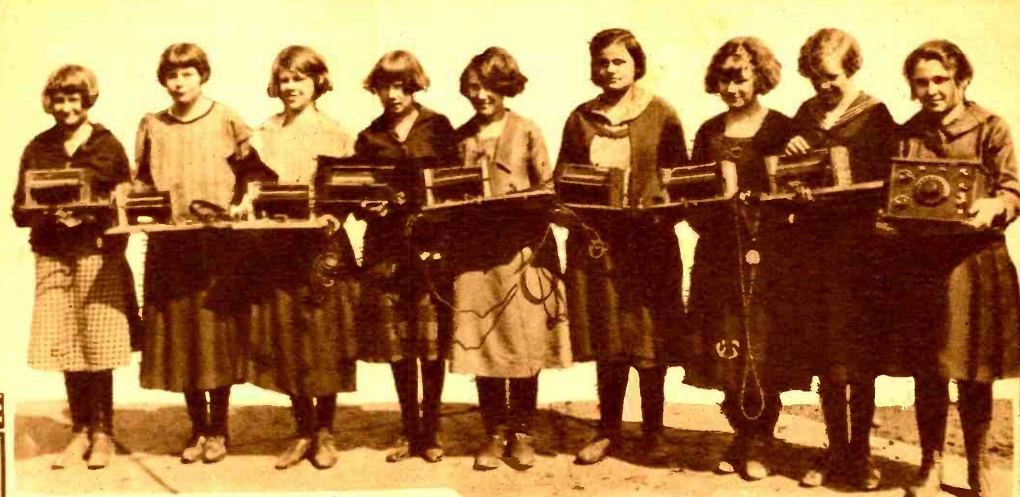
1924AprRadioNews1A hundred years ago, these students at Junior High School 61, Bronx, NY, were on the cutting edge of technology as they tuned into a program. The five-tube set was bought, installed, and operated by the students. The photo appeared in the April 1924 issue of Radio News.


1939 Lightning Arrestor

1939AprilPM11939AprilPM2Eighty-five years ago, both daughter and Fido were helping Dad install a lightning arrestor for the family radio antenna. Dad noticed that the spark plug from a Model T Ford could screw directly into a 3/4 inch water pipe fitting. So he added a tee to an outdoor tap, screwed the spark plug into the other end, and attached the antenna.

The magazine noted that the same thing could be done with a section of pipe driven into the ground.

This item appeared in the April 1939 issue of Popular Mechanics.