Category Archives: Radio history

1955 CONELRAD Markings

Screenshot 2025-02-28 12.04.55 PM

x

Seventy years ago this month, the March 1955 issue of Popular Mechanics showed off Chrysler’s “defense minded” radios.  The dials were “especially designed to enable motorists to tune in quickly for emergency Civil Defense instructions.”  As far as I can tell, that meant that the dials had the required CONELRAD markings on 640 and 1240.


1945 One Tube Radio

1945MarRadioCraftEighty years ago, the March 1945 issue of Radio Craft showed this circuit for a one-tube radio that actually had four stages. The tube is a 1D8GT, which appears to be at first glance a double tube.  But it’s actually a triple tube.  On the left is a pentode and on the right is a triode.  Down in the lower right side of the tube there is what appears to be a cathode, but it’s actually the plate of the third part of the tube, a diode.

The circuit first amplifies the RF signal with the pentode, and then sends it to the diode to be detected.  Then, the pentode is reflexed and serves as AF amplifier.  Finally, the triode is used as a second stage of AF amplification.  So the single tube actually takes the place of four tubes.

The circuit had been sent in to the magazine by one Sgt. L.R. Blattner, of Tinker Field, Ohio.


1925 Wireless

1925MarWirelessMagI’m not sure exactly what’s going on in this picture, but this British gentleman a century ago obviously took radio construction seriously. The illustration appeared on the cover of the March 1925 issue of The Wireless Magazine.


Admiral Model 35-G6, 1940

1940MarRadioRetailingEighty years ago this month, this broadcast listener is relaxing at the beach with her Admiral 35-G6 portable.  The model shown here is the 35-G6, a six-tube set that could run on either 110 volts AC or DC, or a 1-1/2 volt battery.  It was identical to the 37-G6, in a different cabinet without the cover.  Also shown are models 33-F5 and 34-F5, which were five-tube sets.

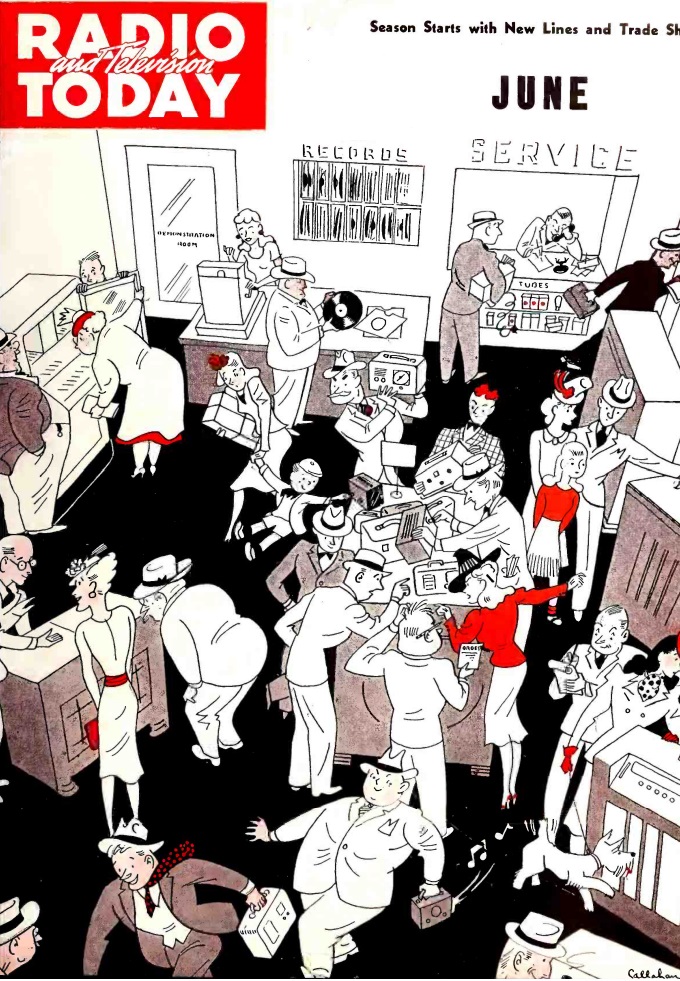
This ad appeared in the March 1940 issue of Radio Today.


1945MarRadioNewsThis cartoon appeared 80 years ago this month in the March 1945 issue of Radio News.

1965 Ham Station Budgets

Sixty years ago this month, the March 1965 issue of Electronics Illustrated offered some guidance on equipment for the new ham. The magazine noted that there was a lot of information on learning the code and getting your license, but it was sparse when it came to setting up a new station.

Therefore, they showed possible stations for four different price points: $100, $250, $500, and $1000.

The hundred dollar station consisted of an Ameco AC-1T transmitter kit, along with a Lafayette KT-320 general coverage receiver. The next step up would be a Heathkit DX-60 transmitter and HR-10 receiver. There was enough in the budget for a Lafayette 9902501 VFO.

For $500, the magazine recommended an E.F. Johnson Viking Ranger II, and Lafayette HA-350 receiver.

The well heeled ham could spend $1000 on a Hallicrafters HT-37 transmitter and Drake R-4 receiver.


TV in 1950: The Bomb!

1950MarRadioRetailingSeventy-five years ago this month, the cover of the March 1950 issue of Radio Retailing cheerfully predicted that television sales would be the atomic bomb of the year! TV sales were set to outpace refrigerators, washers, and even automobiles.


1950: Millionth Clock Radio

1950Mar13LifeSeventy-five years ago, the millionth clock radio was getting ready to roll off the General Electric assembly lines, and GE planned to celebrate. They were conducting a contest to give the radio to a lucky winner, who would also travel to New York to meet Fred Waring and the Pennsylvanians.

The set, a model 506, was billed as the world’s most useful radio.  It would lull you to sleep and then waken you to music or buzzer.  It could even control a light to waken the hard of hearing.  And in the kitchen, it could be used to control a coffee pot or other appliance.  And, of course, it could remind you of important appointments.

This ad appeared in Life Magazine, March 13, 1950.


1965 One IC Radio

1965MarEI1Sixty years ago this month, the March 1965 issue of Electronics Illustrated devoted much of the issue to a new kind of electronic component, the integrated circuit. In particular, it included some projects making use of the Motorola MC356G IC. The device, measuring only 5/16″ in diameter, packed in a full six transistors, along with five resistors. It could be had for only $3.55 plus postage.

The IC was designed for logic applications, so putting those transistors to use in a radio posed some challenges, since they were packed so close together physically. But with some trial and error, the magazine settled on the circuit shown below, which had good selectivity, sensitivity, and audio output.

The circuit used four of the six transistors. Components inside the IC are shown in black in the schematic, with added components in red.

1965MarEI2


1955 British Radio-Phono

Screenshot 2025-02-14 10.13.11 AMThe excitement is palpable in this image from the cover of the March 1955 issue of Practical Wireless. It looks like they’re simply listening to a record on their radiogram (what we would call a radio-phono on this side of the Pond). But one of them actually built the set according to plans in the magazine.

The set was said to be a selective and sensitive station getter, and had a tolerably high standard of reproduction for both the wireless and the gramophone. The March issue started the construction plans for the eight-tube set, to be continued in the April issue.