Category Archives: Radio history

1936 Tube Tester

1936TubeTester

Shown here is one of the tools of the trade of the radio serviceman 80 years ago, as shown in the March 1936 issue of Service magazine.

From the Precision Apparatus Corporation, this is the Electonometer Model 500 tube tester.

Click Here For Today’s Ripley’s Believe It Or Not Cartoon


1943 Wartime Intercom

1943RadioIntercom

This intercom from the March 1943 issue of Radio News shows the kind of ingenuity that was necessary in the face of wartime shortages on the home front.

The article notes that with defense priorities, many small business firms were in need of interoffice communications but unable to get them. The only immediate answer, according to the article, was to make a small radio do double duty.

The article describes a four-station intercom constructed with a six-tube table radio. The only additional parts, all of which were available at the “radio bargain counter” were nine switches, four speakers, and a roll of shielded cable. The hookup allowed for the station with the radio to serve as the master, able to call or receive calls from the other stations. As an added bonus, any of the four remotes could listen to the radio, but stil l make calls.

Click Here For Today’s Ripley’s Believe It Or Not Cartoon


1926 Popular Mechanics Crystal Set

1926MarPM

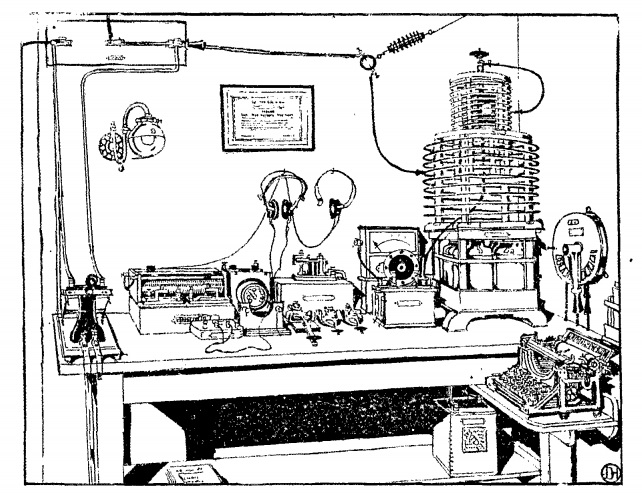
Ninety years ago, the March 1926 issue of Popular Mechanics carried the plans for this simple crystal set. The unique twist about this set was how it was tuned. Two metal plates (made from the lids of tin cans) were positioned such that the coil could be slid in and out. To tune the set, you simply slid it to the correct position.

The article noted that the set had selectivity sufficient to tune out a strong station a few miles away.  The total cost for the parts was fifty cents.

Click Here For Today’s Ripley’s Believe It Or Not Cartoon


RCA 56X5 “12,000 Miler” from 1946

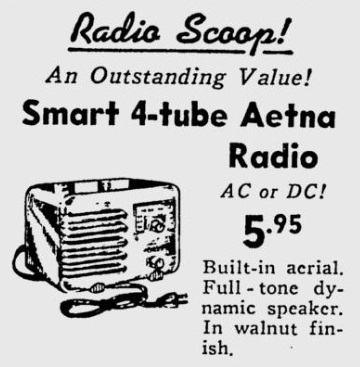
RCA56X5Seventy years ago, this day’s issue of Life Magazine, March 4, 1946, carried this ad for the RCA model 56X5. The “12,000 Miler” covered standard broadcast and short wave with six tubes, including the rectifier.

I’ve always considered this set to be quite handsome, and it’s also a good performer on both AM and shortwave.  A nice example can be found at the Radio Attic Archives.  And you can see the set in action pulling in some Chicago stations at YouTube.

Click Here For Today’s Ripley’s Believe It Or Not Cartoon


1941 Bamboo Beam

BambooBeam1

Seventy-five years ago, the March 1941 issue of Radio and Television carried the plans for this two-element 20 meter beam in use by R.M. Blanchard, W4FIC. The antenna was constructed of bamboo, with the driven element and director consisting of wires taped to the bamboo. The rotor consisted of a bicycle chain connected to ropes, adjusted on the ground as shown in the diagram below.

BambooBeam2

Mr. Blanchard reported that the antenna performed well, logging contacts with the Philipines, Guam, and Little America. In addition, the antenna was used for numerous schedules with the Hawaiian Islands.

Click Here For Today’s Ripley’s Believe It Or Not Cartoon


RCA Station Allocator, 1941

RCAallicator

Seventy-five years ago, it was a big month for radio servicemen.  The new North American Radio Broadcasting Agreement called for most North American broadcast stations to shift frequencies on March 29, 1941.  The trade press was abuzz with how this could be of benefit to servicemen, who would be called upon to reset the pushbuttons of millions of radios.

The undoubtedly caused a bit of trouble for some shops, since resetting the button really required the station to be on the air on the new channel to make sure the job was done right.  RCA came out with the piece of equipment shown here, in an ad in the March 1941 issue of Radio Today.  For $17.50, the shop could buy the RCA Station Allocator.  It consisted of a signal source with several buttons.  It would then put out a test signal on the given frequency, making short work of the adjustment of the customer’s set.

More information on this piece of test equipment can be found at RadioMuseum.org.  The set was portable, and could run either on AC power or internal batteries, making the house call for this adjustment quite simple.

Click Here For Today’s Ripley’s Believe It Or Not Cartoon


1941 Popular Science Radio-Phono Combo

1941MarPSSeventy-five years ago, the thrifty radio enthusiast could construct this radio-phono console for only $27.50, following the plans in the March 1941 issue of Popular Science.  Even though the set contained only two tubes, it reportedly boasted all of the features of an eight-tube set.

The receiver consisted of a 12B8GT regenerative detector.  The article noted that the regeneration control could be left at the same setting throughout the entire broadcast band, without the set breaking into an annoying squeal as the owner tuned from one end of the band to the other.

The amplifier for both radio and phono was a 32L7GT feeding a 6-inch speaker.  The dual tube also contained the rectifier, which allowed the transformerless set to run from household power.  The filaments were wired in series, along with a 220 ohm resistor.1941MarPS3

The $27.50 price tag quoted in the article included everything, including a pre-made cabinet, the phonograph motor, and pickup.


1941MarPS2

Click Here For Today’s Ripley’s Believe It Or Not Cartoon



Hallicrafters S-40, 1946

HallicraftersS40

Just six months after V-J day, Hallicrafters had the S-40 general coverage receiver on the market, as shown by this ad from the February 1946 issue of Radio Craft.


1975 QSL Card

IMG_2047

IMG_2048

I got a nice surprise in the form of an e-mail from Mark, AE6RT, formerly WN0OWP. He had googled his old call sign, and came across my Old QSL page, where I have listed the QSL cards I have from my first days as a ham in the 1970’s.

He included the photos of my card, which I sent to him in 1975 after a 40 meter CW QSO.  Of course, I still had his card and sent him a scan of it as well.

Click Here For Today’s Ripley’s Believe It Or Not Cartoon


Boy Scout Broadcasts, 1941

1941FebScoutingMag

Shown here are the Scouts and Scoutmaster of Troop 3, Bloomington, Illinois, presenting a radio broadcast over station WJBC, Bloomington-Normal Illinois. The photo appeared in the February 1941 issue of Scouting magazine, along with pointers for troops and local councils to put on Scout broadcasts. The article stressed that putting on a broadcast was not a small undertaking, and would require a great deal of effort by the Scouts and Scouters involved. It did note, however, that stations could be receptive to the idea: “Local stations in all parts of the country make a practice of devoting a certain amount of their time on the air to educational sustaining programs. It is generally very easy therefore, for Boy Scouts to secure free time on the air.”

The National Council of the BSA made available scripts for use by local units, and the U.S. Office of Education made available additional scripts that might be appropriate for Scout programs.

Because of the scope of such a project, the article recommended that such efforts were probably best accomplished by local councils, rather than individual troops. In any event, the article stressed that approval from the council must be obtained prior to approaching any radio station asking for air time.

Click Here For Today’s Ripley’s Believe It Or Not Cartoon