Author Archives: clem.law@usa.net

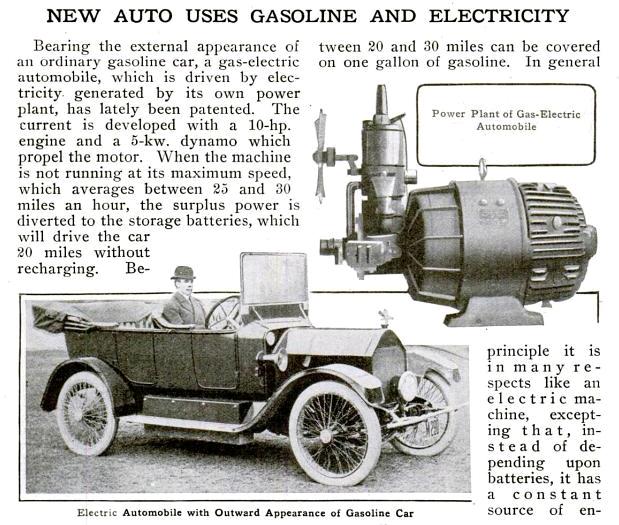
1914 Gas-Electric Hybrid Automobile

1914Hybrid

I’m always amused by those who apparently believe that the gasoline-electric hybrid automobile is a revolutionary technology. It is true that vehicles such as the Toyota Prius are well designed efficient vehicles. But there’s nothing inherently revolutionary about a vehicle powered by both a gasoline engine and an electric motor, with the gasoline engine used to charge the battery.

Indeed, the idea has been around for at least a hundred years, as shown by this example in the August 1914 issue of Popular Mechanics. This model appears to have an electric drive. The 10 horsepower gasoline engine powered a 5 kilowatt generator which in turn powered the motor. The battery could power the vehicle for about 20 miles without charging. Overall fuel economy was about 20-30 miles per gallon.


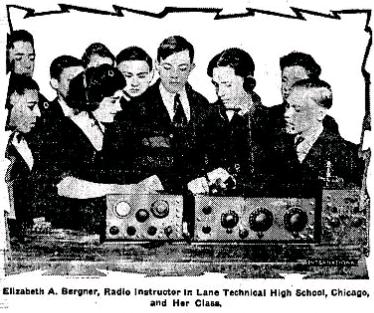
A 1922 Radio Class

This 1922 press service photo shows Elizabeth A. Bergner, the radio instructor at Lane Technical High School, Chicago, with some of her students. More details can be found in the January 1922 issue of Industrial Arts Magazine, wherein it is revealed that Miss Bergner was the Morse instructor. She reported success in grouping the boys in her class according to the speed they showed. Miss Bergner was the only woman in Chicago to have her wireless operator license. According to the 1922 call book, she was licensed as 9DET.


August 10, 1914: Wireless Sets Sealed

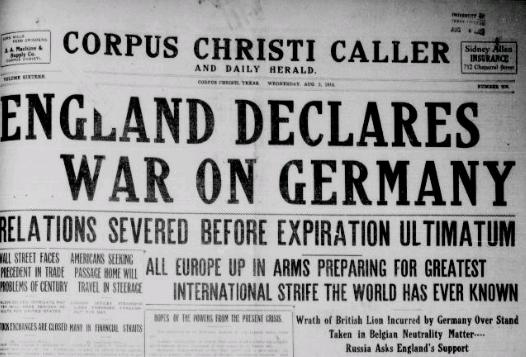
America was neutral, and was enforcing neutrality. The Harrisburg Telegraph and other papers report that U.S. Customs officers have begun sealing the wireless apparatus of all vessels flying the flags of the warring nations.

1914 USDA Yearbook

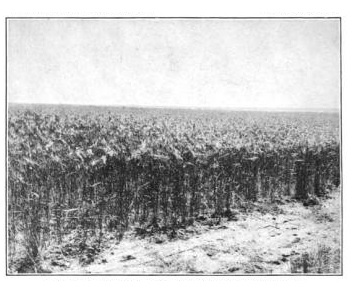
Wyoming Wheat, 1914 USDA Yearbook

In other war news, the U.S. price of wheat was rising, in part due to Canada’s offer to the British government of a million bags of flour.


Hiram Percy Maxim Catches a Breach of Neutrality

The New York Sun had a flurry of dispatches in its August 7, 1914, issue regarding wireless and U.S. neutrality. In the first, the French steamer Rochambeau, docked in New York, was reportedly sending wireless messages to the French cruisers Conde and Descartes. U.S. radio inspectors were investigating.

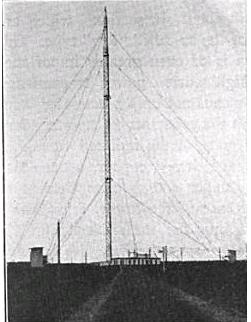
The Telefunken station at Sayville, Long Island

The Telefunken station at Sayville, Long Island (Google Books)

The report even mentioned that there were hundreds of licensed amateurs in the New York area, along with many more unlicensed operators of receivers. It pointed out that neither was allowed to divulge the contents of any message heard, but that “eager boys in Hoboken and this city who have been listening to war messages and then posting their friends are running the risk of $250 fine and three months in jail or both.”


Hiram Percy Maxim


One of the reports originated with none other than Hiram Percy Maxim:

NEW HAVEN, Conn., Aug 6–Hiram Percy Maxim, inventor of the Maxim Silencer, who is also an amateur wireless operator of note, said to-day that he had picked up messages flashed by the Telefunken tower at Sayville, L.I., to German merchantmen and warships. He has several messages in code and has advised Washington, accusing the Telefunken company of breach of neutrality.


More Mobile Wireless, 1914

SignalCorpsMules

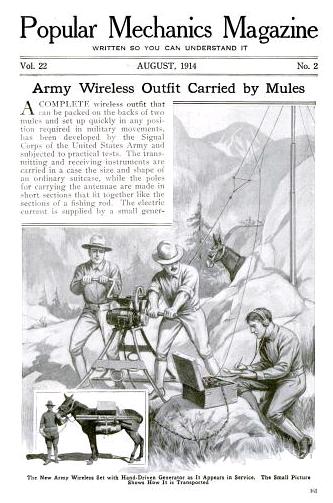
In the early days of radio, the U.S. Army Signal Corps was always looking for ways to get the wireless equipment in the field, and one method is shown in this August 1914 article in Popular Mechanics.

This set could be transported with two mules and quickly set up wherever needed. The electronics were contained “in a case the size and shape of an ordinary suitcase,” and the mast for the antenna were made in “short sections that fit together like the sections of a fishing rod.”

Electric current was supplied by a generator run by hand. The operators must have had very strong arms, since the generator was reported to supply 500 watts. The setup was capable of transmitting 40 miles.


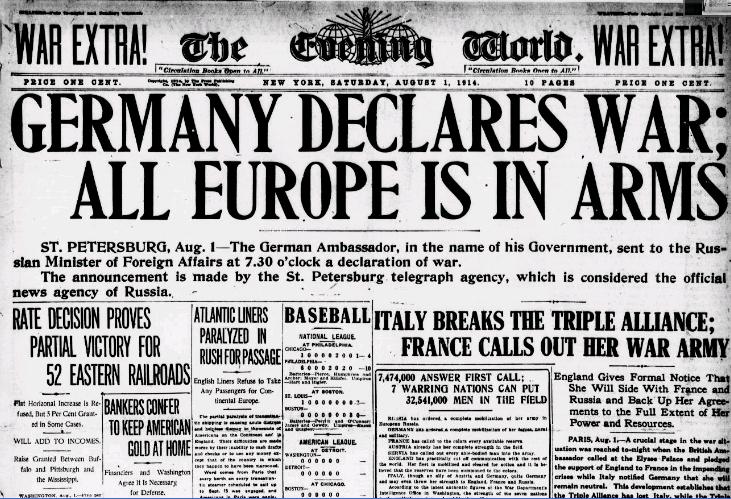
August 3, 1914: Germany Takes Control of Wireless

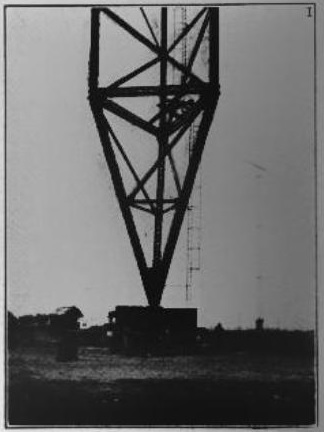
Base of one of the towers at the Telefunken Nauen station.  Google Books.

Base of one of the towers at the Telefunken Nauen station. Google Books.

The New York Sun, August 3, 1914, reports that the Kaiser has taken control of the two great wireless stations in the German Empire, and that commercial traffic to North America from those stations has now ceased. The station at Nauen, near Potsdam, was the flagship station of the Telefunken system, and had previously been in communication with the Telefunken station at Sayville, Long Island. The station near Hanover was the biggest station of the Goldschmidt System and had communicated with the station at Tuckerton, N.J.

The newspaper noted that if Britain entered the war, which was expected, that the last link with Europe would be cut. Howevver, the Marconi company was rushing to completion work on the station at Stavengar, Norway, which would keep North America linked to Europe.


The First Casualties of World War 1

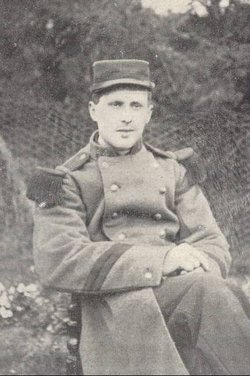
A_photo_of_Jules_Andre_Peugeot

Jules Andre Peugeot by French Army – Original publication: 1914, France. Immediate source: David O’Mara. Via Wikipedia

Jules Andre Peugeot was born at Etupes, France, on June 11, 1893. He was the son of Jules Albert Peugot and Francien Marie Frederique Pechin. He was a teacher, appointed to the school at Pissoux. He was regarded as a kindly man and well liked by his students. In 1913, he was conscripted into the French army.

Albert Otto Walter Mayer was born on April 24, 1892, in Magdeburg, Germany. Shortly thereafter, his family moved to the Alsace region. He became a Lieutenant in the German army.

On August 2, 1914, the day before Germany officially declared war on France, Lt. Mayer was assigned to a reconnaissance squadron to sueveil French positions. At 10:00 AM, he approached the village of Joncherey.

Corporal Peugot had been having breakfast at the house of one Monsieur Doucourt, where he had been billeted. M. Doucourt’s daughter, Nicolet, came in and alerted the soldiers that a German patrol had entered the town. The soldiers ran out, and Peugot yelled at Mayer to stop. Mayer pulled out his pistol and shot Peugot. Peugot returned the shot but missed. The other French soldiers returned fire, however, killing Mayer. Peugot died a few minutes later on the steps of the house.  The two bodies were placed side by side in the straw in a barn.

Mayer and Peugot were the first German and French casualties of the Great War.
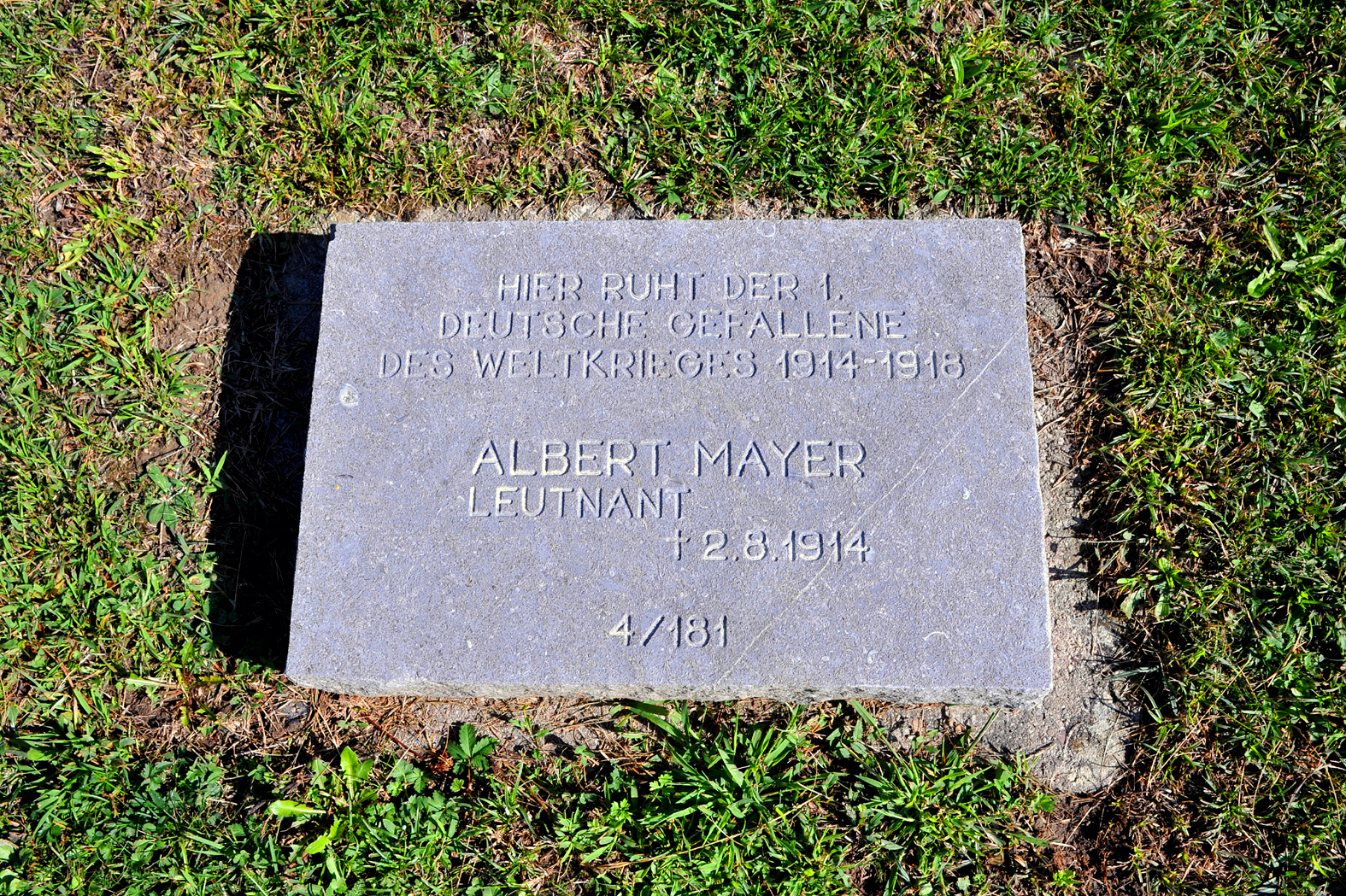
Leutnant Albert Mayer Grabstein 01 09  par Хрюша — Travail personnel. Sous licence Creative Commons Attribution-Share Alike 3.0 via Wikimedia Commons

Leutnant Albert Mayer Grabstein 01 09  par Хрюша — Travail personnel. Sous licence Creative Commons Attribution-Share Alike 3.0 via Wikimedia Commons

In 2008, on the occasion of the death of the last French veteran of the war, French President Sarkozy remembered the two men:

The Frenchman was 21 years old. He was a teacher. His name was Jules-André Peugeot. The German is Alsatian, a native of the region of Mulhouse. He was just 20 years old. His name was (Albert) Camille Mayer.

They loved life as we love it in 20 years. They had no vengeance, they had no hate to satisfy.

They were 20 years old, the same dreams of love, the same ardor, the same courage.

They were 20 years old and felt that the world was theirs.

They were 20 years old; they believed in happiness.

They had barely left childhood and did not want to die. They both died on a beautiful summer morning, one with a bullet in the shoulder, the other shot in the stomach. They were the first unconscious actors in the same tragedy whose blind fate and folly had long secretly woven a sinister plot that would take its son in a sacrifice of heroic youth.

Both died at 20 years and did not see the terrible result of what they began: These millions of deaths, mowed down by machine guns embedded in the mud of the trenches, torn by shells. Nor did they see the huge crowd of millions of wounded, crippled, disfigured, gassed, who lived with the nightmare of war etched into their flesh.

They did not see their parents crying, widows mourning their husbands, children crying for their fathers. They did not experience the suffering of a soldier who smokes a cigarette to overcome the smell of dead abandoned by those who did not even had time to throw them a few clods of earth, so that do not see them rot. ”

These two young men of twenty years did not experience nights of rain, the winter in the trenches, “silent and shivering waiting long minutes like hours.” They did not cross columns returning fire “with their wounds, their blood, their mask of suffering” and their eyes seemed to say to those over, “Do not go there!” They did not fight tirelessly against mud, against rats, against lice, against the night, against the cold, against fear.

They did not have to live for years with the memory of so much pain, with the thought of so many lives Blasted next to them and the need to step over the body to mount an assault.

References

Rene Puaux, The Lie of the 3rd of August, 1914 (1917)

Jules-André Peugeot at Wikipedia

Jules-André Peugeot at French Wikipedia

Albert Mayer at French Wikipedia

The First to Fall: Peugot and Mayer

Skirmish at Joncherey at Wikipedia

Declaration of President Sarkozy (French)