
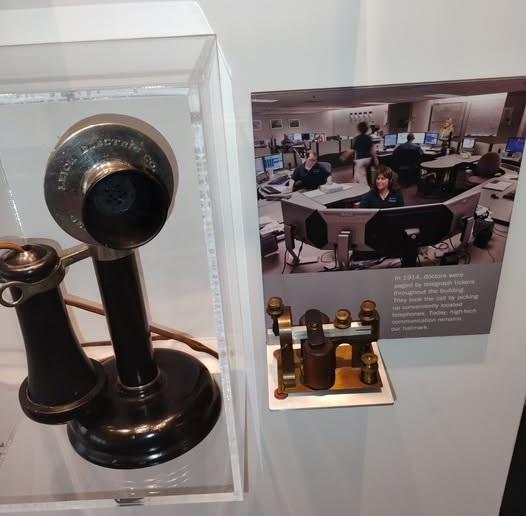
 We recently had occasion to visit the Mayo Clinic in Rochester, Minnesota. They have a small historical display in the lobby commemorating the institution’s venerable history. One particular exhibit caught our eye, with a caption reading: “In 1914, doctors were paged by telegraph tickers throughout the building. They took the call by picking up conveniently located telephones.”
The telephone was safely tucked behind plexiglass, but the telegraph sounder (the plaque’s “ticker”) sat right out in the open—practically begging to be manually clicked. Which, of course, we did. Nobody answered our CQ, but perhaps that’s because we were using International Morse and not American Morse.
Mayo was an early adopter of communication technology, integrating pneumatic tubes, central switchboards, and telegraph paging when they opened their state-of-the-art 1914 building. Eight years later, the June 1922 issue of The Modern Hospital described the system as an established method of hospital paging:
One method is to install sounders, similar to telegraph sounders, at various points throughout the hospital. These are actuated from a telegraph key or code calling device located at the telephone operator’s desk. When a telephone call is received for a doctor the operator sounds the call on the system and the doctor calls the telephone operator from the nearest telephone. This system embodies one feature sometimes considered objectionable. The signal is given by ticks or dots, as in the Morse code, and its success depends entirely upon the doctor’s being able to distinguish his particular call.
Of course, we don’t see this as a shortcoming. If a physician cannot distinguish their own Morse code call sign, we’re not entirely sure we’d want them treating us in the first place.