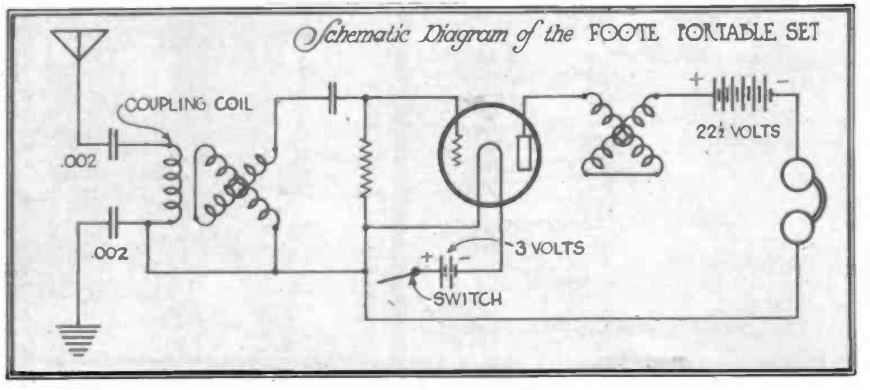
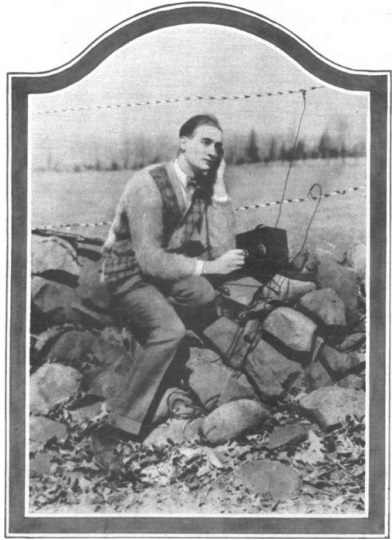
 Shown here, one hundred years ago, is Brainard Foote, showing off the one-tube portable receiver, the details of which are contained in the construction article he authored in the May 1926 issue of Radio In The Home. He calls the set a Magic Music Box, and notes that it’s useful for picnics and outings. But it’s also useful for the traveling man, for information and entertainment in some distant city.
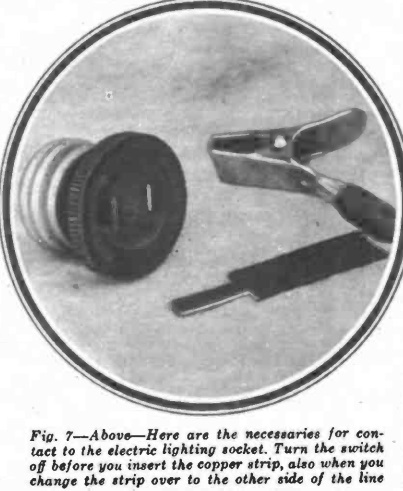 The set is small enough to be tucked away in a handbag, convenient to use, and ready for work at a second’s notice. In particular, he points out numerous available antennas. In the photo, he is using the wires of a fence as antenna and counterpoise, “even though the farmer didn’t dream of such a thing when he put them there.” For the hotel, he suggests the electric wires, the telephone, or even the button for calling the bellboy. He notes that the two capacitors on the antenna and ground leads mean that it won’t affect the phone. And (unless something goes wrong), they also make it possible to hook directly to the power wiring. (When inserting the copper strips in the outlet, he notes that the light should be turned off.)
He warns to be careful with the regeneration, and not let the set oscillate any longer than necessary. Not only will it distort the signal, but it will also disturb other nearby listeners.