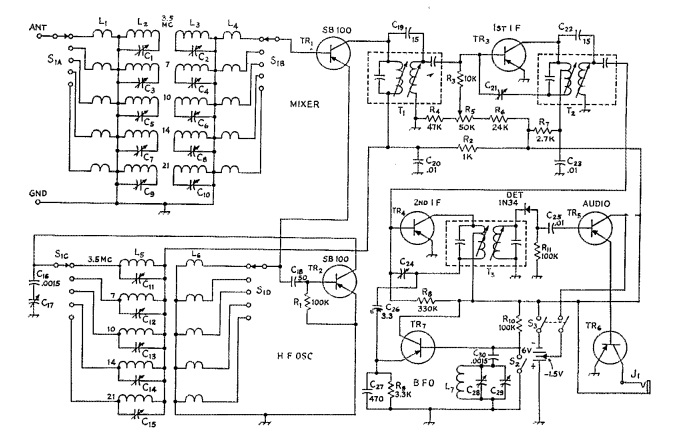
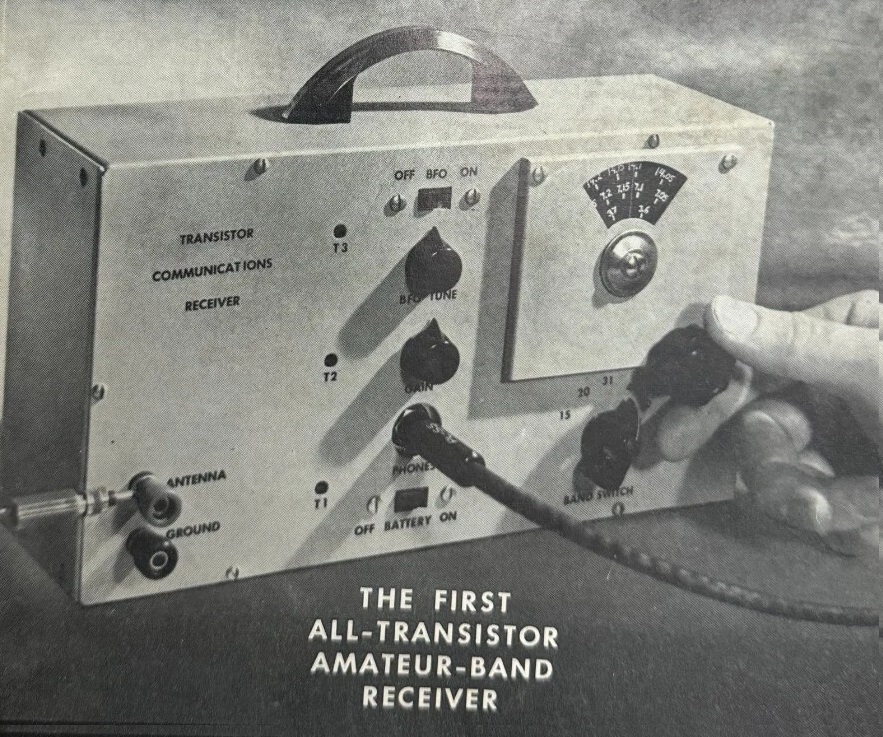
 Seventy years ago this month, the May 1956 issue of QST featured what it dubbed the first all-transistor amateur-band receiver, handsomely housed in this 10 x 5-1/2 x 3 inch cabinet. Designed by Carl Heinen, W0MCN, the 7-transistor set covered the 15 through 80 meter ham bands. The editors of the magazine noted that it was not a toy, but instead a set that compared favorably to the lower-priced communications receivers on the market.
It was powered by four flashlight cells, which would keep it running “indefinitely.” The author scored some transistors from his employer (Honeywell, we learn in the above-linked obituary) and set to work. He initially tried to get it to work on 10 meters, but found that mixer performance fell off sharply between 24 and 27 MHz.
Since the bandswitch had an extra contact available, he decided to include the 31-meter broadcast band, to provide a source of Latin American music for which he always had a weakness. The set had an I.F. of 455 kHz and, of course, included a BFO. The author noted that the BFO should be shielded, as it put out harmonics as high as 7 MHz.
Audio output was sufficient for loud volume through headphones, but not quite enough for a speaker.