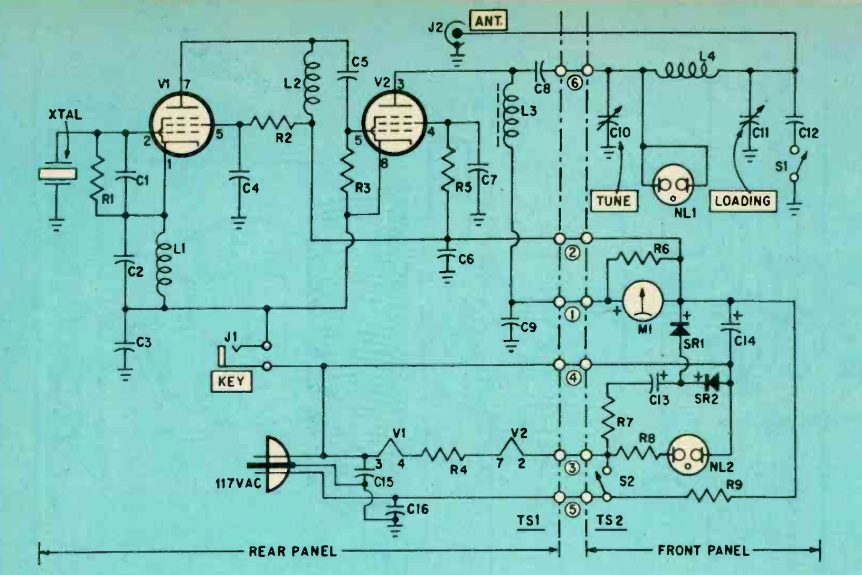
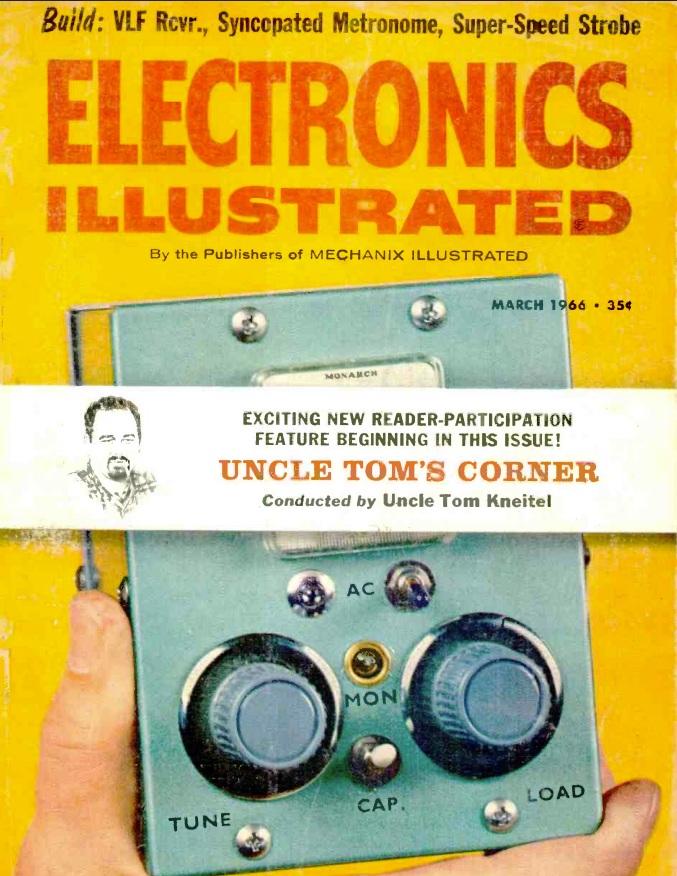
 Sixty years ago this month, the cover of the March 1966 issue of Electronics Illustrated featured the “Mini-Mitter,” a compact and lightweight (28.5 oz.) 15 watt transmitter for 40 meters. The construction article, is written by Russ Alexander, W6IEL, whose work we have seen previously. He notes that the radio weighs less than the missing power transformer. No transformer was necessary for two reasons. First, the 50-volt tubes were wired in series (along with a 130 ohm 5 watt resistor) directly to the AC power. And the B+ was courtesy of two solid-state diodes wired as a voltage doubler to produce about 310 volts.
The first day on the air, the author, in California, worked both the East Coast of the U.S., but also a 579 report from Sakhalin Island, Russia.
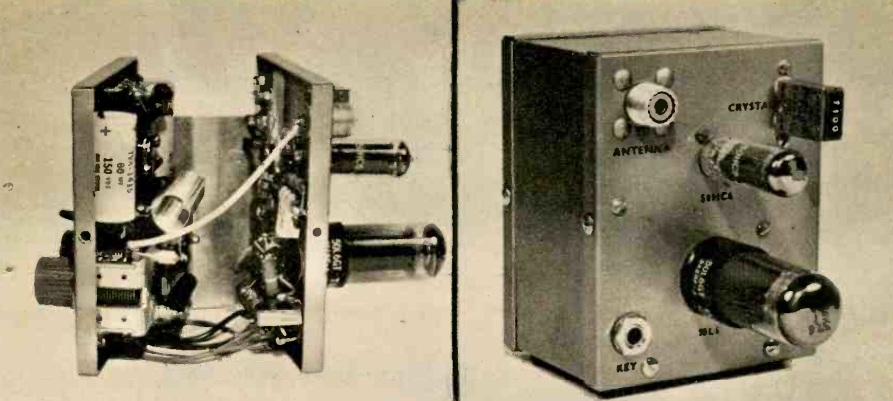
As shown here, the transmitter was constructed with two chasses. The front contained the controls, meter, and tuning indicator. The rear panel was for mounting the tubes and crystal, and for the key and antenna connections.
The other piece of news heralded by the magazine cover was the appearance of a new column in the magazine, questions and answers by “Uncle” Tom Kneitel, then K2AES, whom we have previously featured.