 Sixty years ago, the February 1966 issue of the British Radio Constructor showed a refinement in light beam communication. As we’ve shown previously, it can be done with a normal incandescent bulb. But there were two disadvantages. First, the bandwidth was quite low. And because the light source was spread out along the filament, it wasn’t possible to concentrate the light into an extremely narrow beam.
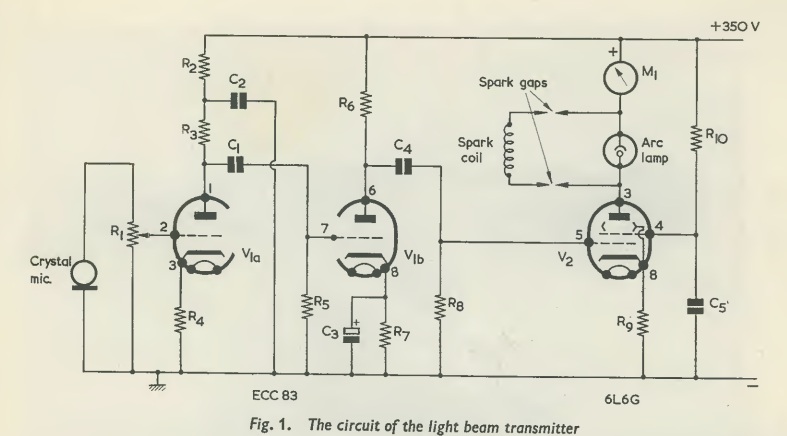
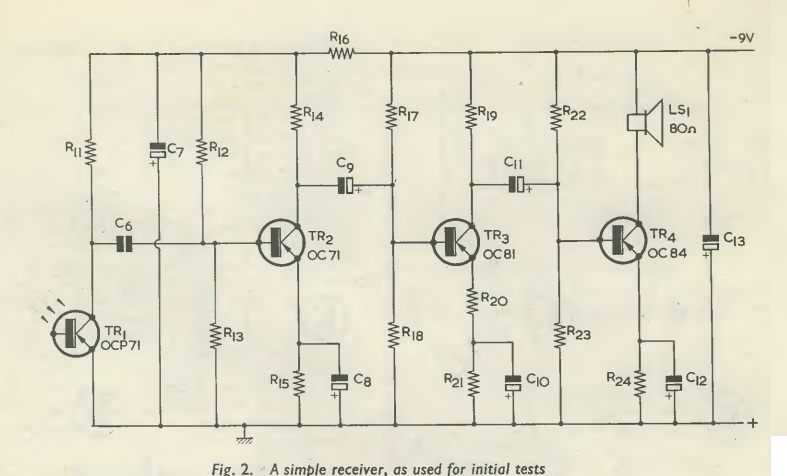
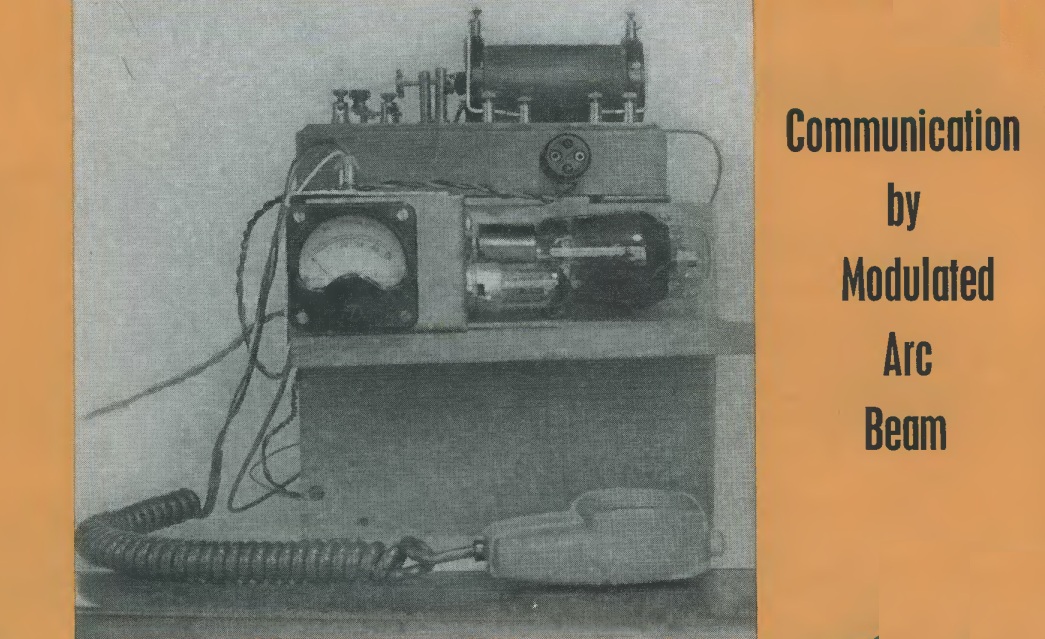
These problems were solved by the use of an arc lamp, specifically, a Sylvania Concentrated-Arc Lamp type A2, was used. The bulb necessitated a pulse of about 1000 volts, so some additional circuitry is required. The transmitter is shown here. The transistorized receiver is typical of other receivers, and is transistorized.
During daylight, the set was said to have a range of at least a quarter mile, and the bandwidth was 1000 Hz.