Watch for Severe Weather While You Sleep.
The recent flooding in Texas should serve as a reminder that everyone should have a weather radio! In most cases, your cell phone provides accurate up-to-date weather information. But it has limitations, particularly in an emergency.
It appears that many of the Texas victims were caught unaware of rising flood waters. The flood happened at night, and even though the information was available on the phone, the victims were asleep and not looking at their phones. In addition (especially at low-lying areas in a river valley), the phone might not have had service.
But a NOAA weather radio would have awakened sleeping victims, and given enough advance warning so that they could go to higher ground.
According to news accounts, the flood waters hit Camp Mystic at about 4:00 AM on July 4. And according to news accounts, the first NOAA Weather broadcast would have been at 1:18 PM Thursday, when a flood watch was issued by the National Weather Service in San Antonio. Since this was a watch, I don’t believe that it would have triggered an alarm from a weather radio. But it would have been broadcast repeatedly during the day on NOAA Weather Radio, so someone tuning in to check the weather would have heard it.
At 11:41 PM, a Flash Flood Warning was issued for Bandera County, and would have set off the loud siren on any weather radio in the area. That loud siren would have gone off again at 1:14 AM Friday, with a warning for Bandera and Kerr Counties. This time, the message would have included that there would be “considerable” flooding. More warnings continued through the morning hours.
If people had a NOAA Weather Radio, they would have been awakened by the loud siren. (As we’ve reported earlier, add-ons are available to allow deaf people to be awakened by a weather emergency.)
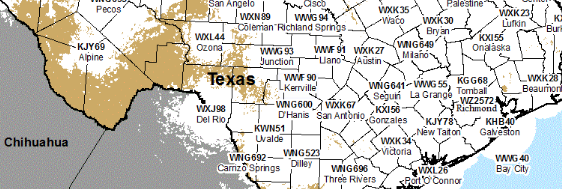 Unlike cell phone coverage, which can sometimes be spotty, the NOAA Weather Radio transmitters blanket most of the nation. In the map above, white areas have coverage, and only the beige areas lack coverage. In this case, transmitters in both San Antonio and Kerrville would have provided warnings. You can find out if you have coverage at this interactive map.
There are three types of weather radios you can buy. The cheapest option is a radio like this that allows you to listen to the 24 hour weather broadcast. That can be very handy, but it doesn’t have an alarm, and it won’t wake you up if there’s a warning.
The best option is a weather radio similar to the one shown here, the Midland WR-120B. If you ever want to hear the weather, you can push the button and you will hear it. But more importantly, it sits silently until there is a warning. At that time, it sets off a loud siren that will wake you. This model has “SAME” encoding, meaning that you can program it in advance to hear warnings only in certain counties. This is a useful feature, because it prevents false alarms for warnings from neighboring counties. But this feature is not essential. For example, the radio I have does not have SAME encoding. I find it useful to know what’s going on in neighboring counties.
This radio also runs off household current, meaning that you can just plug it in and forget it. It does have battery backup in case the power goes out.
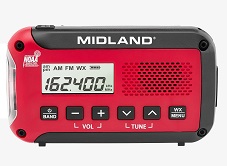 Another radio I own is the one shown at the left, the Midland ER-10VP. It has a weather radio with the alert feature, so it will wake you up in the middle of the night. It does not have SAME encoding, so you will hear warnings for neighboring counties. It has a rechargeable battery, which can be charged from a USB charger just like your cell phone, or from solar or hand crank. The battery power is both an advantage and disadvantage. It will work even if the power goes out, but you do have to be mindful and keeping the battery charged. If you are going to use it at home, I would recommend getting a USB charger and keeping it plugged in all the time.
The hand crank and solar charger could be handy in an emergency, since you can listen to the radio more or less indefinitely without external power. But charging the battery with an external charger is much more convenient for daily use, especially if you use it for the alert feature and want to just plug it in and forget it.
The cost of these radios is so low that everyone should have one. But this is particularly true if you are responsible for the safety of other people. So if you are in charge of a school, a summer camp, or any other place where people gather, you really ought to have one of these.
Some links on this site are affiliate links, meaning that this site earns a small commission if you make a purchase after using the link.

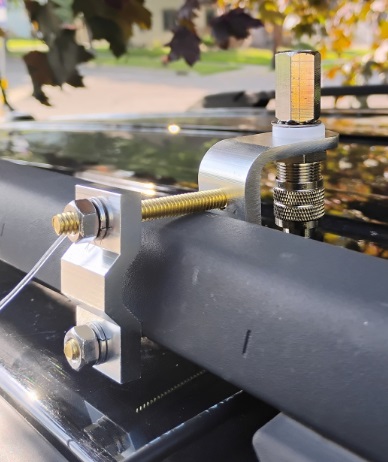 Now that I have my little zBitX transceiver, I’ve been trying it out during POTA activations. For Field Day, I set up a temporary dipole, but it’s always nice to be able to operate right from the car. In the past, I’ve used a trunk mount and a magnetic mount antenna. The trunk mount doesn’t fit very well on my car (a 2014 Dodge Journey), and the magnetic mount is old and in pretty bad shape.



 In the United States, today is Independence Day, also known as the Fourth of July. It marks the anniversary of U.S. Independence on July 4, 1776, meaning that the country is 249 years old today. The mathematically inclined will note that next year, it will be 250 years, which is a nice round number.