Monthly Archives: July 2025

1950 Code Oscillator

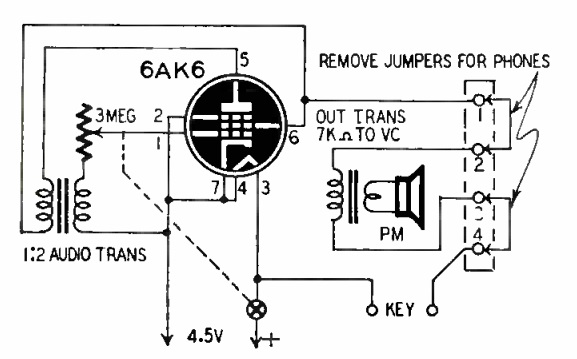
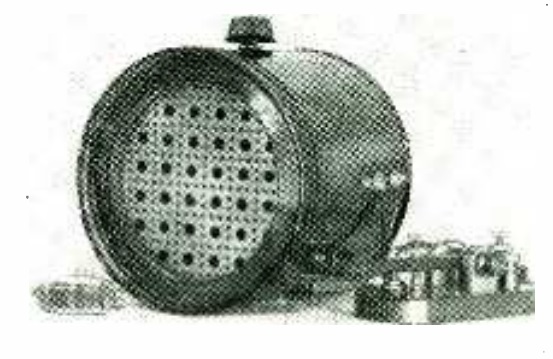
Seventy-five years ago, many would-be hams were applying themselves to learning the code, and the July 1950 issue of Radio-Electronics obliged them by providing the plans for this simple code practice oscillator. The circuit is simplicity itself, and is built in to a jam tin, complete with speaker. The 6-volt tube ran fine on 4.5 volts from three flashlight cells, and the circuit required no additional B+ voltage.

It featured adjustable pitch, and put out a clear tone through either loudspeaker or headphones.


1940: American Opinion About the War

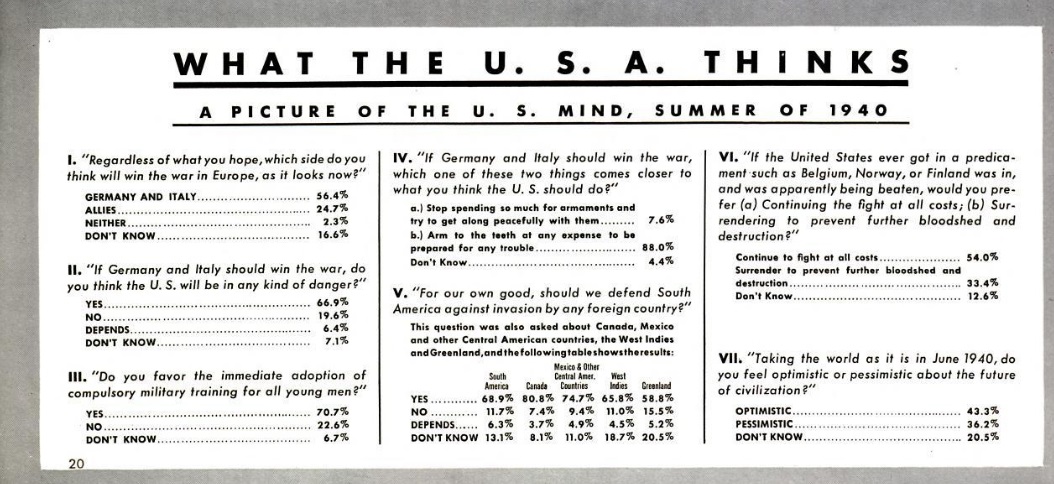
Here’s a snapshot of U.S. public opinion after Europe had been at war for almost a year, from the July 29, 1940, issue of Life Magazine. (You can view a larger image by clicking the image above.)

56% of the American population thought that German and Italy were going to win the war, and two thirds believed that the United States would be in danger if that happened. Over 70% believed that the U.S. should immediately begin compulsory military training for all young men.

If Germany and Italy were to win the war, then an overwhelming 88% of the public believed that the U.S. should arm to the teeth at any expense.

American supported the Monroe Doctrine, and was asked whether the U.S. should defend the hemisphere against foreign invasion. 80% believed that Canada should be defended, and almost 75% believed that Mexico and Central America should be defended. Two-thirds believed that South America and the West Indies should be defended, and 58% believed the same with respect to Greenland.

If America were ever to get into a predicament such as Belgium, Norway, or Finland and was apparently being beaten, a majority believed that America should continue to fight at all costs, with only a third advocating surrender to prevent further bloodshed and destruction.

Overall, 43% of Americans were optimistic as to the future of civilization, with 35% pessimistic, and 20% not knowing.


A Rare Species: 1925

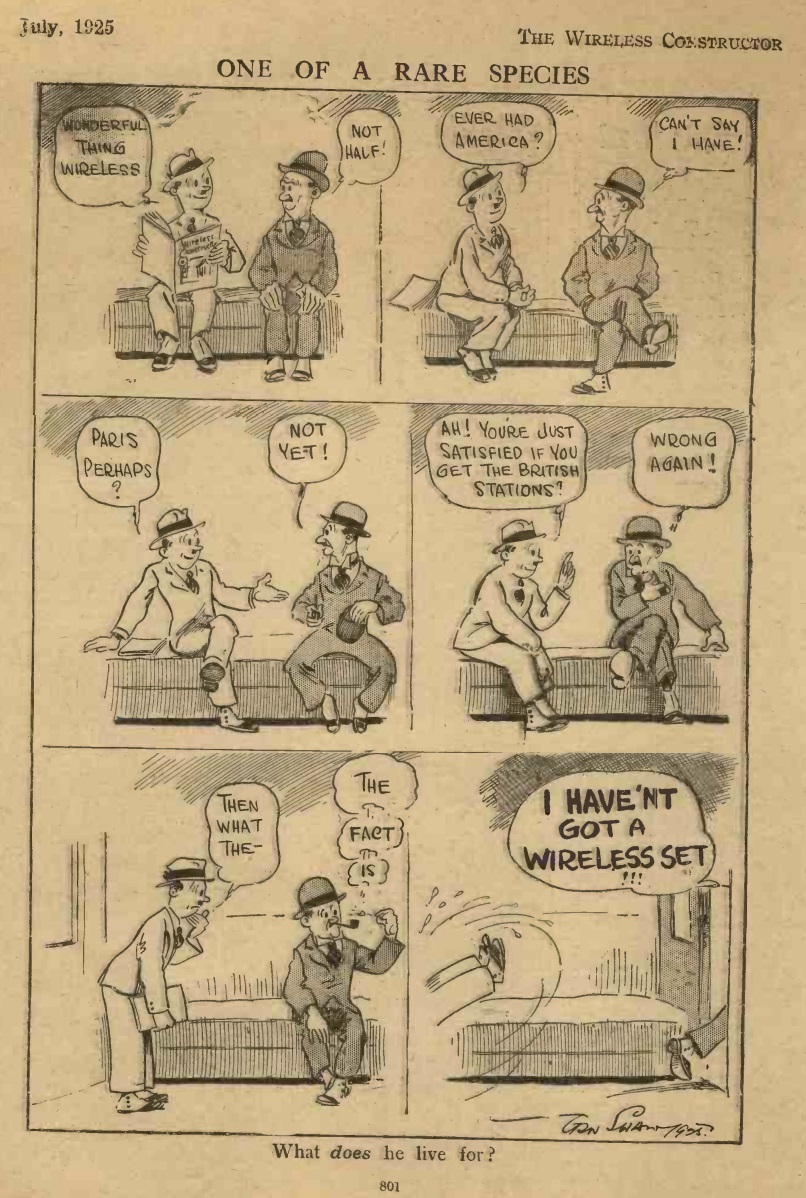
One hundred years ago, it was the rare breed who did not have a radio set. And that was true on both sides of the Atlantic, as demonstrated by this cartoon in the July 1925 issue of Wireless Constructor.

Under pressure, this man had to admit that he didn’t own a wireless set. As the caption notes, we also wonder what he lived for.


1950 TV Network Hookups

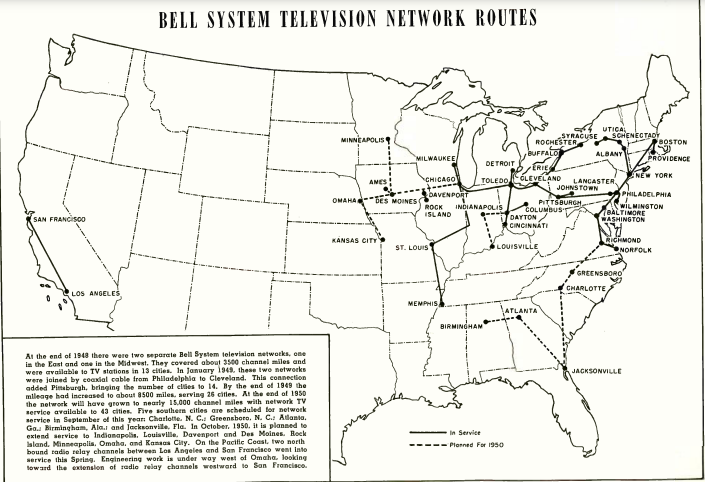
Shown here is the status of U.S. network television 50 years ago. The map shows the coaxial connections of the Bell System, which brought live network television to the nation. The solid lines show existing connections, and the dotted lines show those planned for 1950. New connections would extend to the southeast, and from Chicago to Des Moines and Minneapolis.

The caption at the bottom notes that as of 1948, there were two networks, in the east and the midwest. They were joined with a link from Philadelphia to Cleveland, which also added Pittsburgh.

The map appeared in the July 1950 issue of Radio News.


Happy Birthday U.S. Post Office

Mr. Zip.

Today marks the 250th anniversary of the United States Postal Service. On July 26, 1775, the United States Post Office was formed by the Second Continental Congress, and Benjamin Franklin was named Postmaster General. Franklin’s postal career actually dated to 1737, when he was named Postmaster of Philadelphia under the British.


1945 Radio Listings

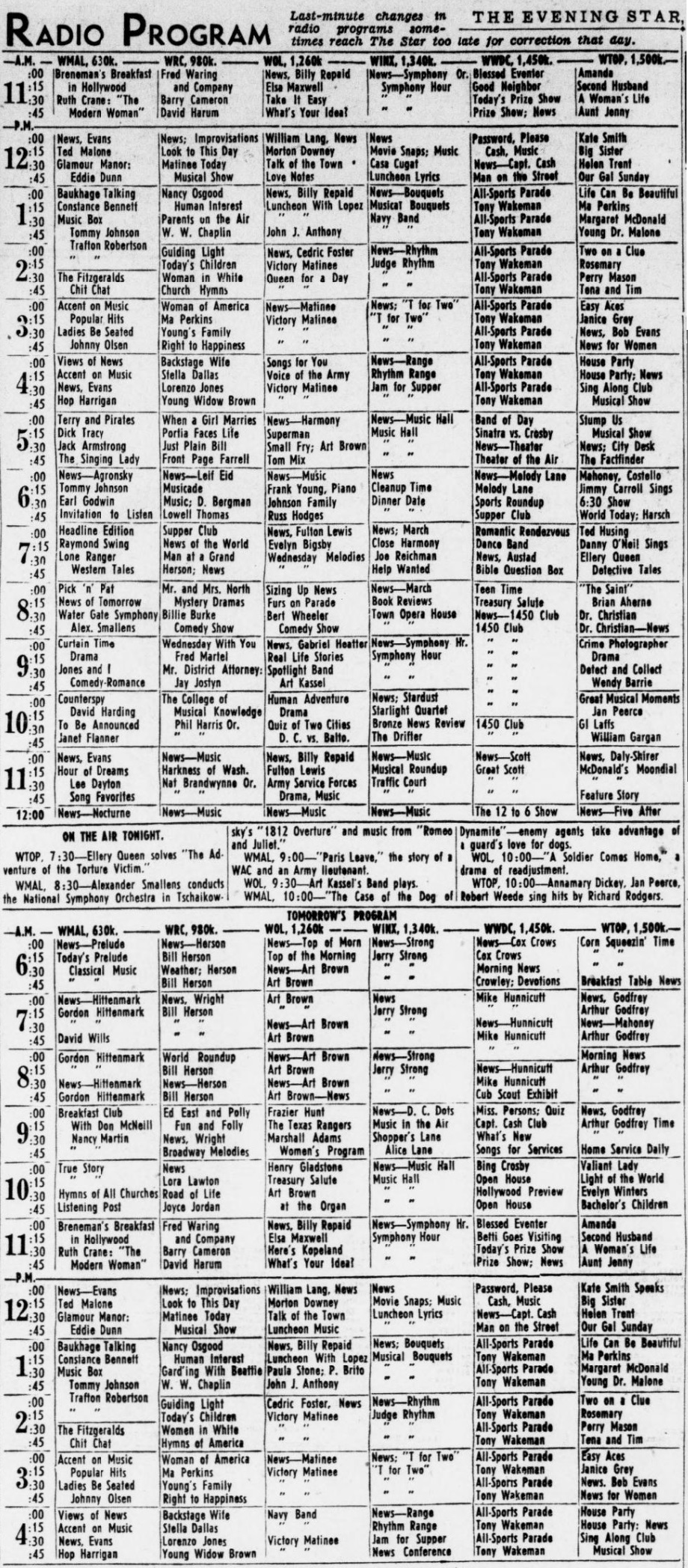
Here’s what was on the radio 80 years ago, from the radio listing in the July 25, 1945, issue of the Washington Evening Times. You can click on the image above for a larger version.


1945 Scouting

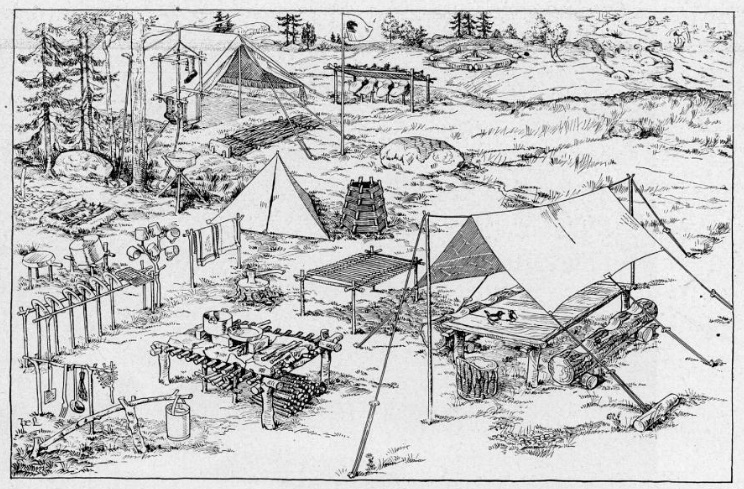
In his column in the July 1945 issue of Boys’ Life, William “Green Bar Bill” Hillcourt offers this illustration of some rustic features and camp gadgets that a scout could use to make himself comfortable in camp. The illustration originally appeared in the Swedish Scout magazine Scouten.


Kimbark Electric, Chicago, 1945

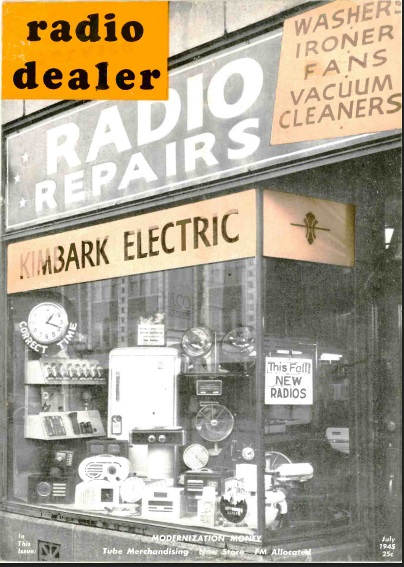
Eighty years ago, there was still a war going on, but people were itching for things to get back to normal. For example, civilian radios were still out of production, but this dealer guessed (correctly, it turns out) that there would be new ones rolling off the assembly line come fall. The picture appears on the cover of the July 1945 issue of Radio Service Dealer, and that issue gives no clues as to exactly where the sign is located.

But with a little bit of detective work, we found the location, and we also determined that the picture shown above was Photoshopped! The sign above reads “This Fall! New Radios.” The magazine doesn’t say where the sign is located. The magazine states only “dealer looks forward.”

But the identical photo appeared in the December 1943 issue of the magazine.  Well, we should say that it was almost identical.  Because the sign really said, “Wanted-Used Radios.”  I bet they still wanted them in 1945, but a graphic artist (if not the dealer) guessed that the end of the shortage was in sight.

The 1943 issue reveals that the shop was Kimbark Electric Appliance Co., 1309 E. 53rd St., Chicago.  The owner was Harold E. Wollenhaupt, who died in 1989.


1925 Portable Radios

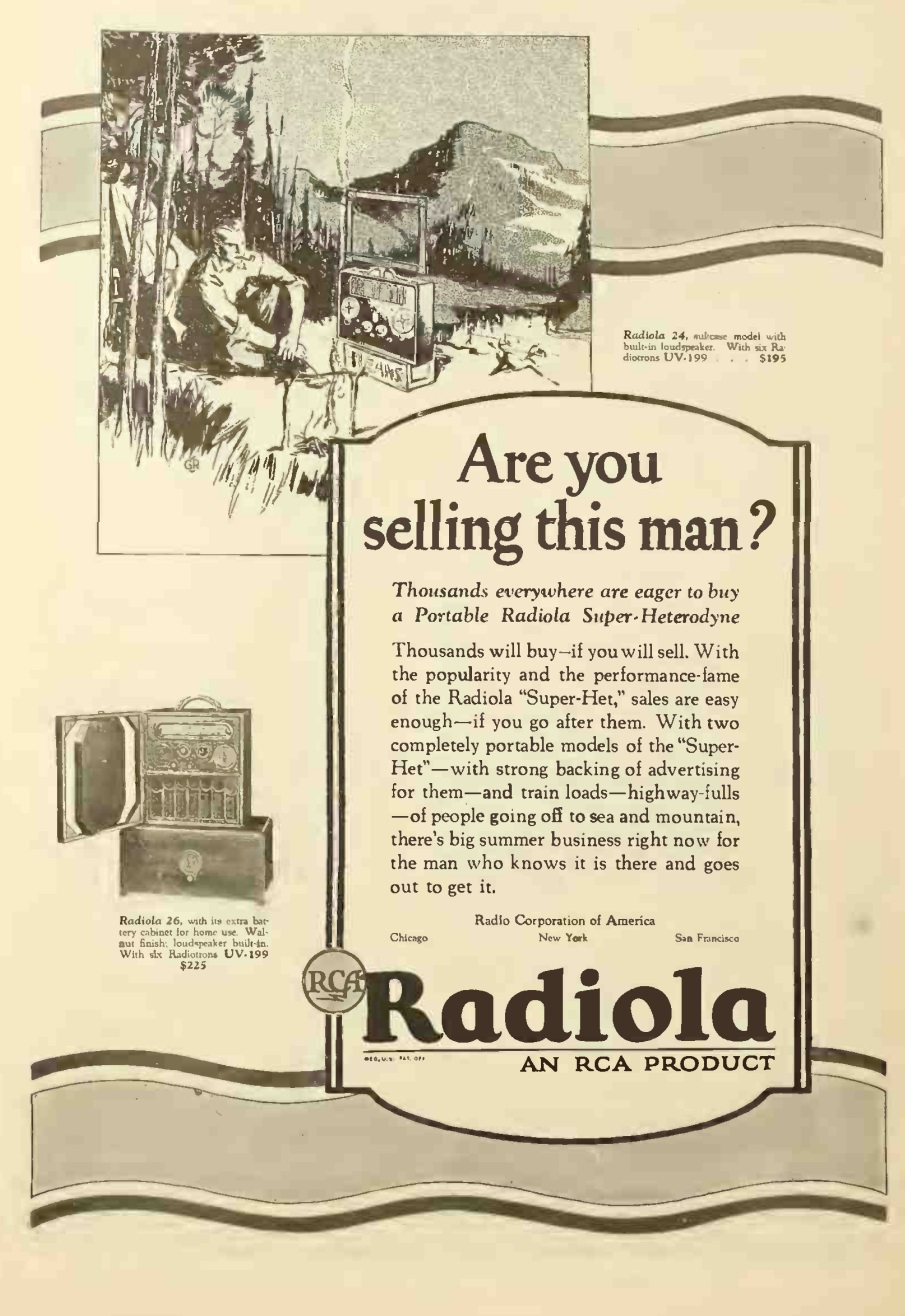
A hundred years ago, the July 1925 issue of Talking Machine World carried this ad from RCA showing Radiola models 24 and 26.  These models had performance on par with modern receivers, as they were superheterodynes containing six UV-199 tubes.

Millions of Americans were heading for sea and mountains, and this ad reminded dealers that they were all prospects for a set such as this, if only the dealer took time to sell them on the idea.

They weren’t cheap, however.   They started at $195, which works out to over $3600 in 2025 dollars.  Today, for a tiny fraction of that price, you can get an inexpensive portable which will pull in AM, FM, and weather broadcasts.  (And, of course, don’t forget to buy some extra batteries, which we guarantee will weigh a lot less than the ones this gentleman is using.)


Some links on this site are affiliate links, meaning that this site earns a small commission if you make a purchase after using the link.

1965 Sprage Quig Connectors

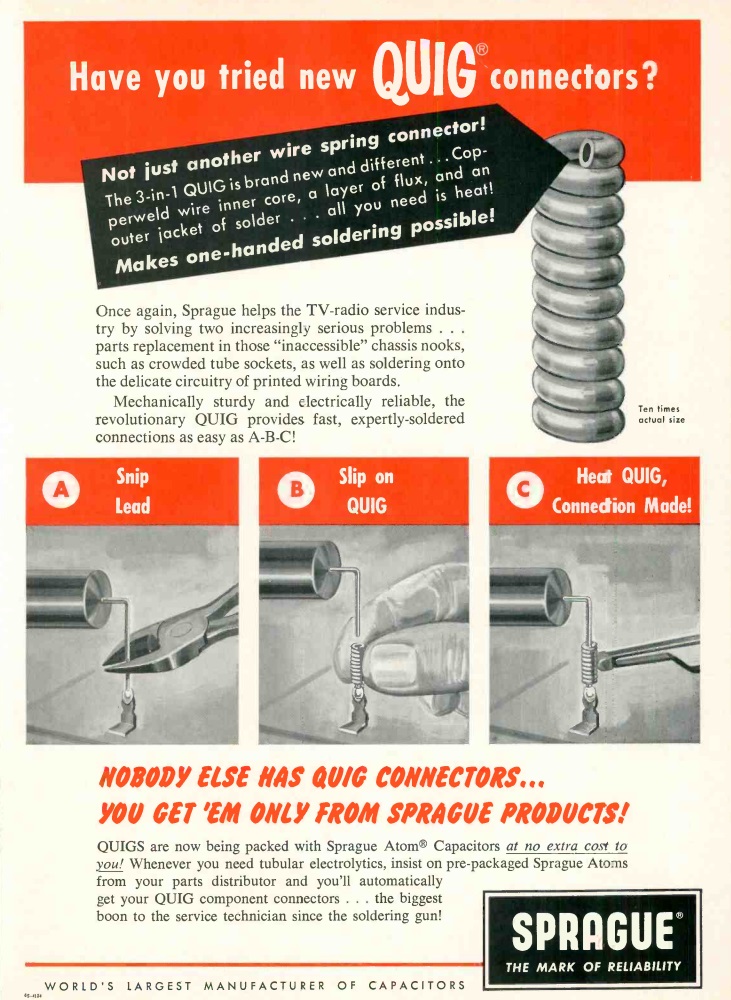
Sixty years ago this month, the July 1965 issue of Electronics Technician carried this ad for a useful product from Sprague Capacitors, the “Quig”. It was for making connections for replacement components in tight spaces. It was essentially a solder-covered spring. When removing the old component, you would leave part of the lead in place, slip the Quig over it, and then slip the new component into the Quig. With one hand, you could hit it with the soldering iron, and be done with the job.

As far as I know, the Quig no longer exists. But for replacing components in old radios, a similar method is employed. You leave a portion of the old lead, and then wind a little spring on the new component. You slip that over the old lead and solder it in place (with two hands).