Monthly Archives: June 2025

1925 Hand Drill

Screenshot 2025-06-05 11.06.16 AMSometimes it’s easier to do things the hard way.

Some useful products seem to have been forgotten after an “improved” version comes along, and one of those is the hand drill, shown here in an ad in Science and Invention 100 years ago this month, June 1925. These tools were ubiquitous back in the day. But at some point, an improved version, namely the cordless electric drill, came along. And the humble hand drill was forgotten. I’ve gone to big-box home improvement stores, and the salesman earnestly asserts that there is no such thing. (The other case where this happened was for the basic car-top carrier.)

The cordless electric drill certainly is better, especially if you need to drill hundreds of holes. But if you have only one hole to drill, then the hand drill can’t be beat. Invariably, when you need to drill a single hole, after you find the cordless drill, the battery is invariably dead. So before you can drill the hole, you need to charge the thing. It would be much simpler just to grab the hand drill and do the job. You’ll burn a tiny amount of calories turning the crank with your muscle power. But the convenience far outweighs the added labor if only a few holes are involved.

Fortunately, like everything else, hand drills are still available on Amazon. And just like a hundred years ago, it’s a valuable tool to keep around the house.


Some links on this site are affiliate links, meaning that this site earns a small commission if you make a purchase after using the link.
WWV Shutting Down? 1925

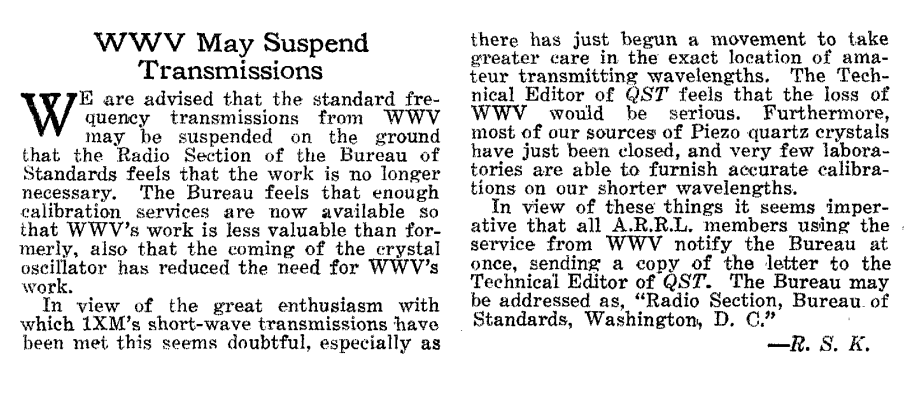
Screenshot 2025-06-04 1.46.31 PMOne hundred years ago this month, this item appeared in the June 1925 issue of QST. There were apparently rumblings that the Government was going to pull the plug on WWV, and the magazine encouraged readers to contact the Bureau of Standards  and let them know how vital the service was.

The plea was apparently successful, as WWV remains on the air a century later.  We previously talked about their move to Colorado  in 1966 and their status in 1953.


1940 British Crystal Set

Screenshot 2025-06-03 2.03.07 PMEighty-five years ago this month, the June 1940 issue of Practical Wireless showed how to put together this basic crystal set for the beginning radio experimenter. Just because there was a war going on didn’t mean that one couldn’t get a start in radio with this simple receiver.

The magazine noted that in most areas of Britain, the set would be able to pick up the Home Service broadcasts on 449 meters (668 kHz). But because transmitter power varied, there was no set number of miles that the set would pull in. Therefore, it advised checking with experienced amateurs in the area before beginning construction.

Screenshot 2025-06-03 2.04.12 PMIt noted that buying commercial coils would be an easy way to make a compact set. But it encouraged winding your own, as that way, the beginner would be able to see the works.


AMECO AC-1 Transmitter Replica

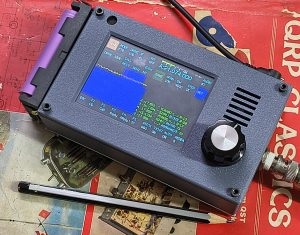
I recently acquired the radio shown here, the zBitX from HFSignals.com in India.  It is a transceiver that covers 80 through 10 meters, CW, SSB, and digital modes.  It’s a software defined radio (SDR) built around a Raspberry Pi computer, and it includes the software to operate FT8, with no additional hardware required.  I’ll be writing a complete review in the coming weeks, but this radio is absolutely amazing.  It is sold for under $200, including shipping from India.

Most of my QSOs so far have been FT8, and I have about 22 states confirmed after about a week of playing with it.  But my very first CW QSO was with Kosta, KY6AA.  I mentioned that I was running a new QRP rig, and he suggested that I check out his QRZ page to see another QRP rig.

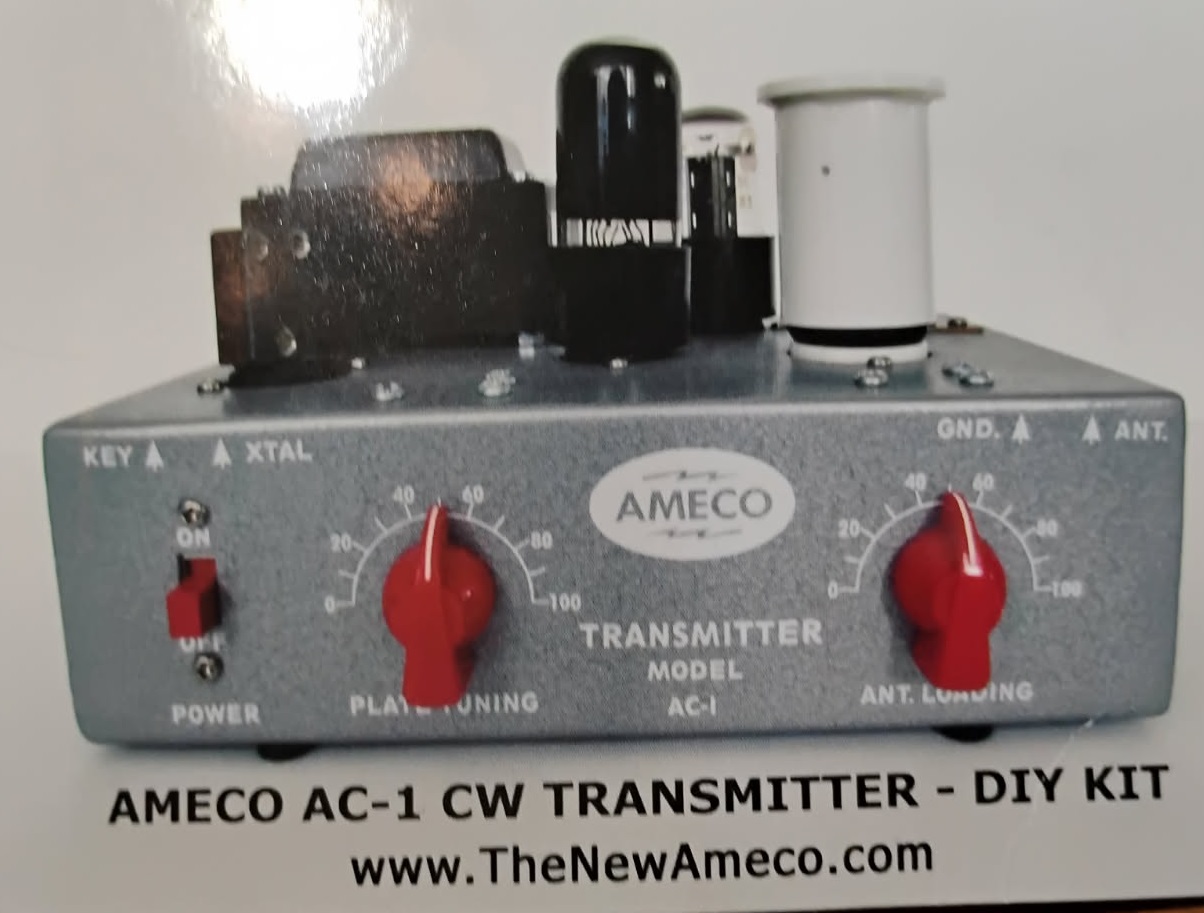
And what a QRP rig it was:  Kosta has kitted and is selling a reproduction of the the AMECO AC-1 novice transmitter.  I just received his QSL card, and it’s prominently featured on the back of the card here.   If you’re not familiar with that rig, it was mentioned here a few weeks ago in connection with a 1965 buyer’s guide for ham equipment.  It was a very basic transmitter for the novice, with about 15 watts input power.  While there might be some minor changes, the new kit is essentially the same as the original, with new parts, many of which (notably, the tubes and power transformer) are sourced from the former Soviet Union.

The replica kits (also available fully assembled) are for sale at TheNewAmeco.com for $230.32.  At first glance, that seems expensive for such a bare-bones transmitter.  But as we saw previously, the original sold for $19.95 in 1965.  According to this online inflation calculator, that works out to $203.17 in 2025 dollars, so the current version is pretty comparably priced.  So yes, it’s expensive today for such a basic transmitter.  But it was just as expensive back in the day.  The only difference is that back then, it was the least expensive option!  And you would still need a receiver (which would probably cost more).

The New Ameco has another product in the planning stage, a basic receiver of the same era.  If you look at that page, it might look familiar.  That’s because we previously featured the same design, by V.A. Egorov, UA3AB!

It would be fun to assemble the AC-1, and maybe I’ll get one some day.  But for the same money, I have the zBitX.  Not only does it transmit, but it receives.  It covers all HF bands, and all modes.  If I had bought an AC-1 back in the day, I doubt if I would have worked 22 states in the first week.  So don’t let anyone tell you that amateur radio is an expensive hobby!


Amazon links on this site are affiliate links, meaning that this site earns a small commission if you make a purchase after using the link.

1965 Wheel Radio

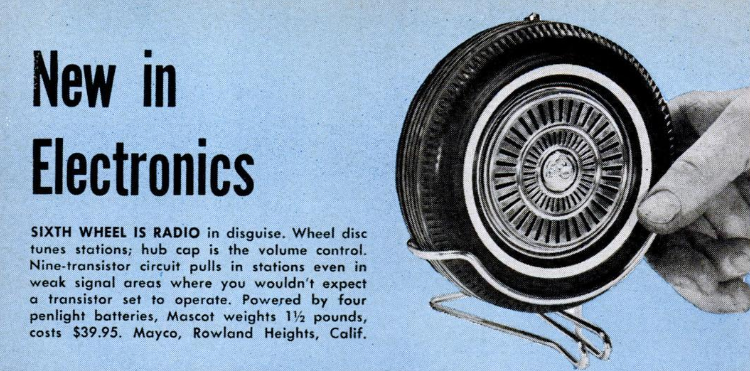
Screenshot 2025-06-03 12.03.30 PMIf you were looking for a novelty radio sixty years ago, you couldn’t go wrong with this nine-transistor set that looked like a wheel. Spinning the tire tuned in stations, and the volume control was at the center.

It was named the Mascot, and was marketed by Mayco of Rowland Heights, California.  It retailed for a mere $39.95, which works out to $406.85 in 2025 dollars.

It appeared in the June 1965 issue of Popular Mechanics.


Radio: The Perfect Wedding Gift

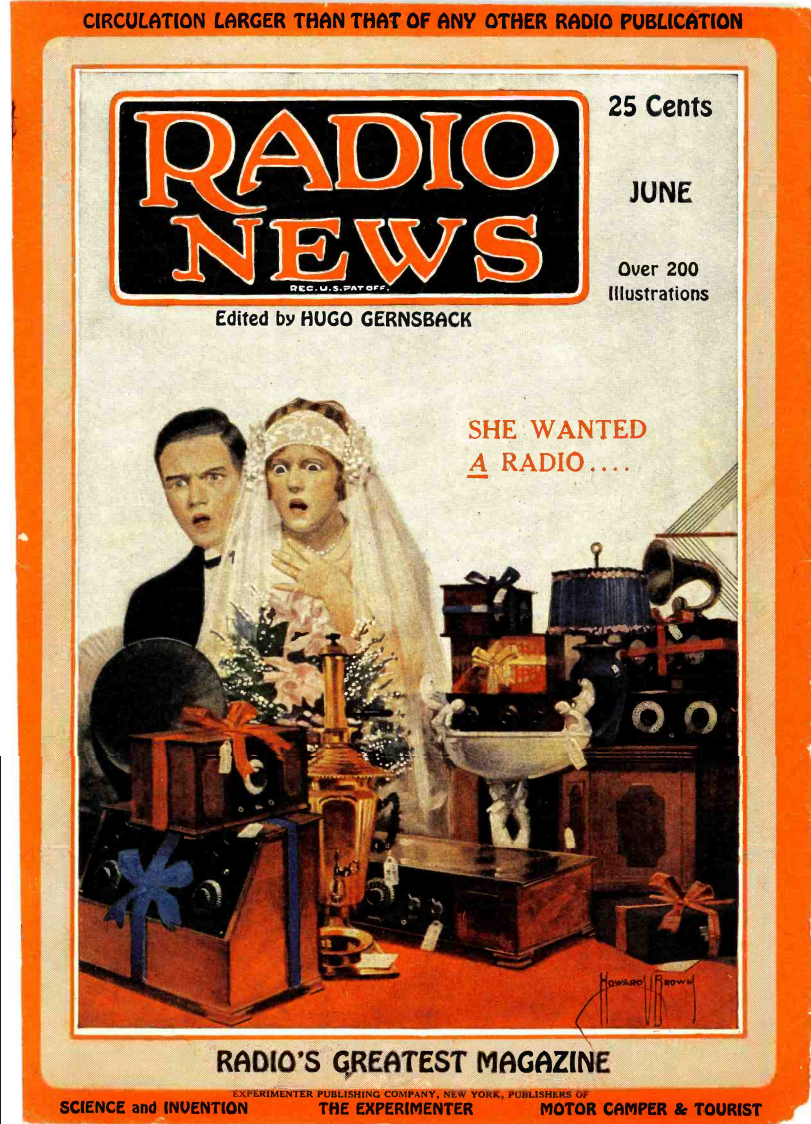
1925JunRadioNewsA hundred years ago, a radio would have made the perfect wedding present, and this June bride put out the word that she wanted one. Word spread, and it turned out that everyone got her a radio. Here, she’s reacting with surprise. But she’ll soon learn that you can never have too many radios, and she will have one in every room.

The artwork appeared on the cover of Radio News, June 1925.  The artist is Howard V. Brown, whom we’ve seen previously.


1945 One-Tube Broadcast Receiver

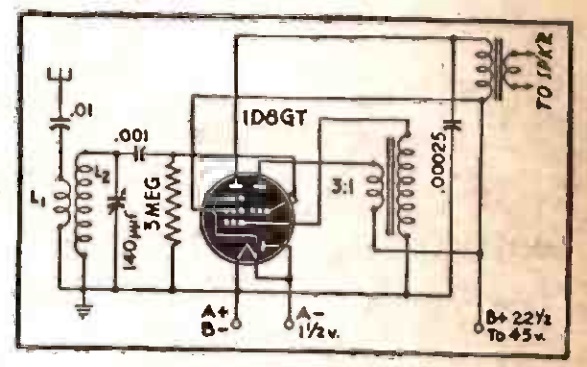
1945JunRadioCraftEighty years ago this month, this circuit for a one-tube broadcast radio appeared in the June 1945 issue of Radio Craft. It was sent in to the magazine by a soldier stationed in Florida, who assembled it in his barracks with various parts gathered around camp.

He reported that with a 45 volt battery, the set provided good loudspeaker volume. A 1D8GT tube served as both amplifier and detector, and all stations came in loud and clear.

Unfortunately, we don’t know the identity of the soldier, due to a typographical error by the magazine. He was stationed at Camp Gordon Johnston, Florida. Unfortunately, the author’s name was listed as “Camp Gordon” with a town of Johnston, Florida.


1955 Sleep Learning

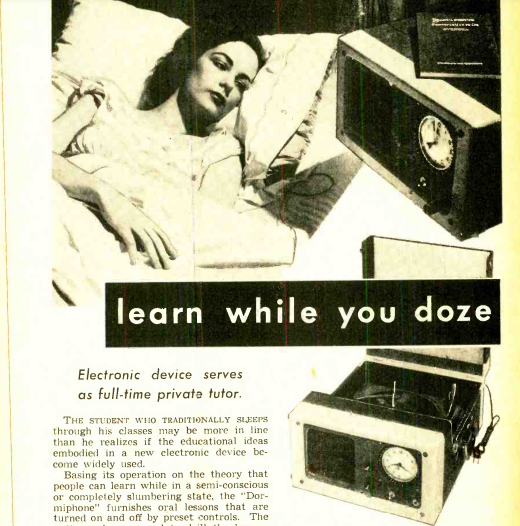
Screenshot 2025-05-23 12.19.34 PMShown here, in the June 1955 issue of Popular Electronics, is French actress Jeanne Demery hard at work learning Swedish for an upcoming play, all while she sleeps. We’ve reported previously (here, here, and here) about the concept of sleep learning. According to Wikipedia, it doesn’t work, but as a kid, it sounded reasonable to me, and sounded like a good way of bypassing the drudgery of studying.  I had to sleep anyway, so it seemed reasonable to take advantage of that time to learn.

The problem I ran into was the lack of suitable equipment.  The tape had to play while I was deep asleep, and ideally keep repeating.  I had a tape recorder, but once the tape ran out after a few minutes, I would be left without anything to learn.

With one of the devices shown in this article, I would have been all set up.  It looked like a phonograph with a timer, but it could also be used as a magnetic recorder.  The normal cartridge was replaced with a magnetic head, and speech could be recorded onto a magnetic disc.  The device was the Dormiphone, and was manufactured by Modernophone, Inc., 30 Rockefeller Plaza, New York.  It retailed for $229.50, which works out to $2747 in 2025 dollars.  That would have been out of my price range as a kid, so I guess that was another reason why I had to do my learning the traditional way.

(We searched in vain for more information about actress Jeanne Demery, but about the only thing we were able to find was this newspaper article also detailing her sleep learning achievements.)


1945 Automatic Relaying System

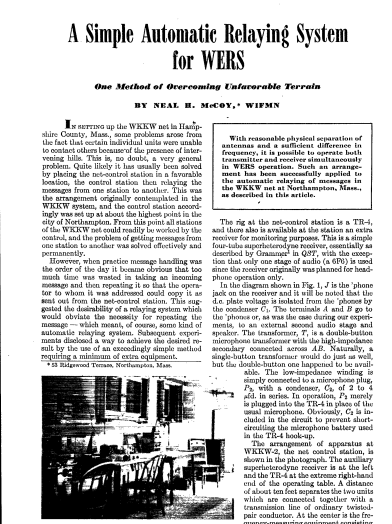
Screenshot 2025-05-22 12.57.36 PMThe first automatic amateur radio repeater station was put on the air in 1956 by Art Gentry, W6MEP, and it’s been on the air ever since. But you can see that the idea had been around for a while, as shown in this article 80 years ago, in the June 1945 issue of QST.

At the time, Amateur Radio was still off the air for the duration of the war, but some hams involved in civilian defense activities did have authorization to operate as part of the War Emergency Radio Service (WERS), usually on the 2-1/2 meter band. One such WERS station was WKKW in Hanipshire County, Mass.  The network was headed up by a net control station (NCS) at one of the highest points in the county, which ensured good coverage.  The problem was, however, that not all stations could hear each other.  So if a message needed to be relayed, it meant an added step of the NCS relaying it.

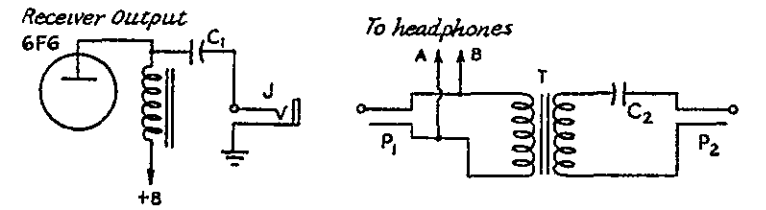
Screenshot 2025-05-22 1.13.42 PMThe solution was an automatic relaying system at the NCS station.  While the article called it “automatic,” it did not automatically hit the air as with a more modern repeater.  Instead, the NCS merely patched the audio from a second receiver into the transmitter, with the patch cord shown here.  He monitored through headphones, and switched back when the message was over.  Of course, the transmitter and receiver had to be on different frequencies, so when a message had to be retransmitted, the originating station was told to QSY to 112.7 MHz, and the repeated signal was on the net frequency of 114.6 MHz.

The equipment had to be reasonably well shielded, and the antennas had to be separated.  (The article noted that the feed line was a twisted pair.)  The article concluded by noting, “it is to be hoped that others will experiment with this and other simple means of relaying, since it is an interesting field of experimentation and one which offers a good return in the way of improved WERS operation. It suggests, also, interesting possibilities for postwar amateur activities at the high frequencies.”